Research Article

Horticultural Science and Technology. 2026.
https://doi.org/10.7235/HORT.20260034

ABSTRACT


MAIN

  • 서 언

  • 재료 및 방법

  •   공개 유전체 및 전사체 데이터 확보

  •   유전자 재동정 및 도메인 구성 분석

  •   Gene Ontology 분석

  •   MYB 도메인의 아미노산 서열 및 이차구조 분석

  •   모티프 분석

  •   MYB 유전자의 계통학적 분석

  •   MYB 유전자 서브그룹의 확장 분석

  •   흰가루병 감염에 따른 V. piasezkii의 MYB 유전자 발현 분석

  • 결과 및 고찰

  •   MYB 유전자의 재동정 및 반복 유형별 분포

  •   MYB 도메인의 서열 보존성 및 모티프 구성

  •   MYB 유전자의 계통학적 분류 및 계통 특이적 확장

  •   흰가루병 감염에 따른 MYB 유전자의 발현 및 공동 발현

서 언

MYB 전사인자는 식물계 전반에 널리 존재하는 주요 전사인자군으로 세포 분화, 기관 형성, 2차 대사 조절 및 환경 스트레스 반응 등 다양한 생리적 과정에 관여한다(Ambawat et al. 2013; Chen et al. 2019; Feng et al. 2023). MYB 도메인은 약 50개의 아미노산으로 구성된 반복 단위로 이루어지며, 각 반복은 세 개의 α-helix를 형성한다. 이 중 두 번째와 세 번째 α-helix는 DNA 결합에 관여하는 helix-turn-helix-related 구조를 형성하고, 보존된 트립토판 잔기들은 소수성 코어를 형성하여 도메인의 구조적 안정성에 기여한다(Ogata et al. 1992; Wang et al. 2019). MYB 전사인자는 이러한 반복 도메인의 수에 따라 1R-MYB, 2R-MYB(R2R3-MYB), 3R-MYB(R1R2R3-MYB) 및 4R-MYB로 구분된다(Wu et al. 2024; Zhang et al. 2025). 이 중 2R-MYB는 식물에서 가장 활발하게 연구되어 온 유형으로, 모용 형성, 안토시아닌 생합성 및 스트레스 반응 등 다양한 과정에서 주요 조절 기능을 수행하는 것으로 알려져 있다(Sun et al. 2017; Chen et al. 2021; Zhu et al. 2022). 또한 1R-MYB에 속하는 유전자들도 엽록소 생합성과 스트레스 반응 등 다양한 생리적 과정에 관여하는 것으로 보고되었다(Fang et al. 2025; Ma et al. 2025). 이처럼 MYB 반복 도메인 수에 따른 구성의 차이와 각 유형의 다양한 기능은 식물 MYB 전사인자군의 높은 기능적 다양성을 보여준다.

포도과(Vitaceae)는 열대 및 온대 지역에 널리 분포하며 16개 속 약 950종으로 구성되어 있다(Wen et al. 2018). 포도(V. vinifera)는 대표적인 재배 작물로 생과 및 와인 생산에 널리 이용되며 높은 경제적 가치를 가진다(KREI 2024). 포도에서 MYB 전사인자는 안토시아닌과 플라보노이드 등 과실의 색과 품질에 관여하는 2차 대사산물의 생합성을 조절하는 주요 인자로 알려져 있다(Deluc et al. 2008). 이에 따라 기존 연구는 주로 V. vinifera의 안토시아닌 생합성과 관련된 R2R3-MYB 유전자에 집중되어 왔으며 다른 포도과 종에서 MYB 유전자군의 유전체적 다양성과 진화 양상을 비교한 연구는 상대적으로 제한적이다(Matus et al. 2008). 또한 MYB 전사인자는 생물적 스트레스 반응에도 관여하는 것으로 알려져 있으나 포도에서 병원균 반응과 관련된 MYB 유전자군의 발현 특성에 대한 연구는 충분히 이루어지지 않았다. 따라서 다양한 포도과 종을 대상으로 MYB 유전자군의 구성과 진화적 특성을 비교하고 포도에서 병원균 감염에 따른 발현 양상을 함께 분석하는 것은 포도과 MYB 전사인자의 다양성과 기능을 폭넓게 이해하는 데 중요하다.

본 연구에서는 포도과 5종(Cissus quadrangularis, V. amurensis, V. rotundifolia, V. vinifera, V. piasezkii)과 애기장대(Arabidopsis thaliana)를 대상으로 MYB 유전자를 재동정하고 비교 분석하였다. 재동정된 MYB 유전자의 반복 도메인 구성, 서열 보존성, 예측 이차구조 및 모티프를 분석하여 MYB 도메인의 특성을 확인하였으며 계통 분석과 유전자군 확장 분석을 통해 MYB 유전자의 진화적 특성을 조사하였다. 또한 V. piasezkii의 흰가루병 감염에 따른 RNA-seq 데이터를 이용하여 MYB 유전자의 발현 양상을 분석하고 공동 발현 네트워크 분석을 통해 흰가루병 반응과 관련될 가능성이 있는 후보 유전자를 선별하였다. 본 연구는 포도과 MYB 전사인자군의 유전체 구성과 진화적 특성에 대한 이해를 확장하고 흰가루병 반응 관련 MYB 후보 유전자를 제시함으로써 향후 기능 분석 및 포도 분자육종 연구를 위한 기초 자료를 제공한다.

재료 및 방법

공개 유전체 및 전사체 데이터 확보

본 연구에서는 포도과 MYB 유전자군의 비교 분석을 위해 다음과 같이 공개된 유전체 데이터를 활용하였다. 분석에는 V. amurensis ‘Zuoshan 1’(Wang et al. 2024), V. rotundifolia ‘Carlos’(Huff et al. 2023), V. vinifera ‘PN40024’(Shi et al. 2023) 및 V. piasezkii ‘DVIT2027’(Massonnet et al. 2025)의 유전체를 사용하였다. 또한 포도과 내 비교를 위하여 Cissus quadrangularis의 유전체(Li et al. 2024)를 포함하였으며, 포도과 외 비교종으로 Arabidopsis thaliana의 TAIR 10 유전체 정보(Lamesch et al. 2012)를 이용하였다.

MYB 유전자 발현 양상 분석을 위하여, Zhao et al.(2025)이 보고한 V. piasezkii의 ‘Baishui-40’(BS-40)으로부터 확보된 공개 RNA-seq 데이터를 이용하였다. 포도 흰가루병균 접종 후 0, 12, 24, 48 및 72시간의 BS-40 잎으로부터 생산된 전사체 데이터를 이용하였으며 NCBI BioProject PRJNA1105926에 등록된 RNA-seq 데이터를 분석에 활용하였다.

유전자 재동정 및 도메인 구성 분석

기존 유전체 주석에서 누락되었을 가능성이 있는 MYB 유전자를 탐색하기 위해 TGFam-Finder(Kim et al. 2020)를 이용하여 재동정을 수행하였다. 표적 도메인은 Pfam 데이터베이스의 MYB DNA-binding domain에 해당하는 PF00249로 설정하였으며 InterProScan 5(-f tsv -appl Pfam) (Jones et al. 2014)로 생성한 TSV 파일을 도메인 식별 파일로 사용하였다. TGFam-Finder 분석에는 ‘EXTENSION_LENGTH = 100,000’, ‘MAX_INTRON_LENGTH = 100,000’, 및 ‘HMM_CUTOFF = 1e-3’의 매개변수를 적용하였다. 재동정을 통해 예측된 유전자 중 PF00249 도메인의 E-value가 1e-4 이하인 유전자를 대상으로 후속 분석을 수행하였다. TGFam-Finder 분석 결과로 생성된 TSV 파일을 이용하여 MYB 유전자의 도메인 구성과 배열을 확인하였으며 MYB 도메인(PF00249)의 개수 및 반복 양상을 기준으로 MYB 유전자를 분류하였다. PF00249 도메인을 1개 포함하는 유전자는 1R-MYB, 2개는 2R-MYB, 3개는 3R-MYB, 4개를 포함하는 유전자는 4R-MYB로 분류하였다.

Gene Ontology 분석

MYB 유전자의 기능을 추정하기 위하여 OmicsBox v3.4.6(https://www.biobam.com/omicsbox/)를 사용하여 Gene Ontology(GO) 분석을 수행하였다(Al-Shahrour et al. 2004). MYB 단백질의 아미노산 서열을 이용하여 BLASTP를 통해 non-redundant protein sequence database(nr v5)를 검색하였다. 이때 E-value는 1e-3 미만으로 설정하였으며 BLASTP 매개변수는 기본값을 사용하였다. 이후 InterProScan 5(-f xml -appl Pfam) (Jones et al. 2014)를 통해 생성한 XML 파일을 BLASTP 결과와 병합하여 GO mapping 및 annotation을 수행하였으며 이 과정에서 기본 매개변수를 사용하였다. MYB 단백질에 대한 GO term은 세 범주(biological process, molecular function, cellular component)로 구분하고 각 범주에서 상위 5개의 GO term을 선별하였다. 최종적으로 도출된 GO term은 MYB 반복 유형별 기능적 특성을 비교하는 데 활용하였다.

MYB 도메인의 아미노산 서열 및 이차구조 분석

MYB 도메인의 아미노산 서열 특성을 분석하기 위해 도메인 영역에 해당하는 아미노산 서열을 MAFFT v7.525(Katoh and Standley 2013)를 이용하여 다중서열 정렬하였다. 도메인 영역의 아미노산 서열을 대상으로 –reorder 및 –maxiterate 1000 옵션을 적용하여 반복적 정렬 보정을 수행하였다. 정렬 결과에서 신뢰도가 낮은 영역을 제거하기 위해 trimAl v1.4(Capella-Gutierrez et al. 2009)를 이용하여 gap threshold(-gt) 0.1 옵션을 적용하였다. 정렬된 아미노산 서열의 보존도를 시각화하기 위해 WebLogo 3(Crooks et al. 2004)를 사용하였다. 아미노산 서열 기반 이차구조 예측은 JPred(Drozdetskiy et al. 2015)를 이용하였다. 반복 유형별 consensus sequence는 EMBOSS Cons(Madeira et al. 2022)를 이용해서 생성하였다. 다중서열 정렬 결과는 Jalview v2.11.4(Procter et al. 2021)를 이용하여 시각적으로 확인하였다.

모티프 분석

MYB 단백질에서 보존된 아미노산 서열 패턴을 확인하기 위해 6종에서 동정된 MYB 단백질의 전체 아미노산 서열을 대상으로 모티프 분석을 수행하였다. 이를 위해 MEME Suite v5.0.5(Bailey et al. 2015)를 이용하여 -oc meme -V -time 18000 -mod zoops -nmotifs 20 -minw 10 -maxw 50 -objfun se -markov_order 0 조건을 적용하였다. 검출된 모티프의 서열 내 분포와 위치를 확인하기 위해 MAST v5.0.5(Bailey and Gribskov 1998)를 이용해서 각 모티프를 MYB 단백질 서열에 매핑하였다.

MYB 유전자의 계통학적 분석

MYB 유전자의 계통학적 관계를 분석하기 위해 Jang et al.(2024)의 방법을 참고하여 계통수 분석을 수행하였다. 재동정된 MYB 단백질의 전체 아미노산 서열을 MAFFT v7.525를 사용하여 정렬하였다(Katoh and Standley 2013). 그 후 trimAl v1.4(-gt 0.1)를 이용하여 정렬에서 신뢰도가 낮은 영역을 제거하였다(Capella-Gutierrez et al. 2009). MYB 유전자 간의 진화적 관계를 분석하기 위해 IQ-TREE v2.0.6(-alrt 1000 -B 1000 -safe)를 사용하여 유전자 간의 진화적 관계를 조사하고, iTOL v6를 이용하여 이를 시각화하였다(Minh et al. 2020; Letunic and Bork 2024). 또한 MYB 반복 유형과 계통수 분석 결과를 바탕으로 MYB 유전자를 총 10개의 서브그룹(G1-G10)으로 분류하였다.

MYB 유전자 서브그룹의 확장 분석

서브그룹별 MYB 유전자의 계통 특이적 확장 양상을 분석하기 위해 CAFE v5(Mendes et al. 2020)를 활용하였다. 이를 위하여 분석 대상 6종의 분기시간이 반영된 종 계통수를 TimeTree(http://www.timetree.org/)에서 확보하고 각 서브그룹에 속하는 MYB 유전자 수를 산출한 뒤 기본 매개변수를 적용하여 CAFE 분석을 수행하였다(Kumar et al. 2022). 분석 결과 중 ‘Base_change.tab’ 파일을 이용하여 양의 변화값을 보인 분지를 종 계통수에 시각화하였다.

흰가루병 감염에 따른 V. piasezkii의 MYB 유전자 발현 분석

흰가루병 감염에 따른 V. piasezkii의 MYB 유전자 발현 특성을 분석하기 위해 포도 흰가루병을 V. piasezkii ‘Baishui-40’에 접종한 후 0, 12, 24, 48 및 72시간 시점에서 조사된 공개 RNA-seq 데이터를 수집하여 분석에 활용하였다(Zhao et al. 2025). CLC Assembly Cell(CLC Bio, Aarhus, Denmark)을 이용하여 FASTQ 파일을 트리밍한 뒤 HISAT2(-dta -x) (Kim et al. 2019)를 통해 V. piasezkii 참조 유전체에 RNA-seq 데이터를 매핑하였다. 이후 StringTie(-e -B -G) (Pertea et al. 2015)를 이용하여 유전자 발현량을 정량화하고 FPKM 값을 산출하였으며 Python 스크립트 prepDE.py3를 이용하여 DESeq2 분석을 위한 gene-level read count matrix를 생성하였다. 차등 발현 유전자(differentially expressed genes, DEGs)는 DESeq2(Love et al. 2014)를 이용해 |log2 fold change| > 1 및 adjusted p-value < 0.05를 기준으로 선별하였다. 전체 MYB 유전자 및 DEGs를 대상으로 하여 R 패키지 Mfuzz(Kumar and Futschik 2007)를 활용하여 발현 양상 클러스터링을 수행하였다. GO term enrichment 분석은 OmicsBox v3.4.6(Al-Shahrour et al. 2004)를 사용하였으며 BLASTP(nr v5, E-value < 1e-3) 및 InterProScan 결과를 통합하여 기능 주석을 부여하였다. GO term enrichment 분석에서는 adjusted p-value < 0.01을 기준으로 유의한 GO term을 선별하였으며 분석 결과는 R을 사용하여 시각화하였다. 또한 공동 발현 네트워크는 R 패키지 WGCNA(Langfelder and Horvath 2008)를 이용하여 구축하였다. Soft-thresholding power(β)는 scale-free topology fit index(SFT.R.sq) > 0.8을 기준으로 선정하였으며 minModuleSize = 30을 적용하여 모듈을 구축하였다. 네트워크 시각화를 위한 edge는 topological overlap measure(TOM)을 기준으로 선별하였으며 VPIA_67은 TOM ≥ 0.3, VPIA_312는 TOM ≥ 0.5를 적용하였다. 선별된 공동 발현 네트워크는 Cytoscape v3.10.3(Shannon et al. 2003)를 통해 시각화하였다.

결과 및 고찰

MYB 유전자의 재동정 및 반복 유형별 분포

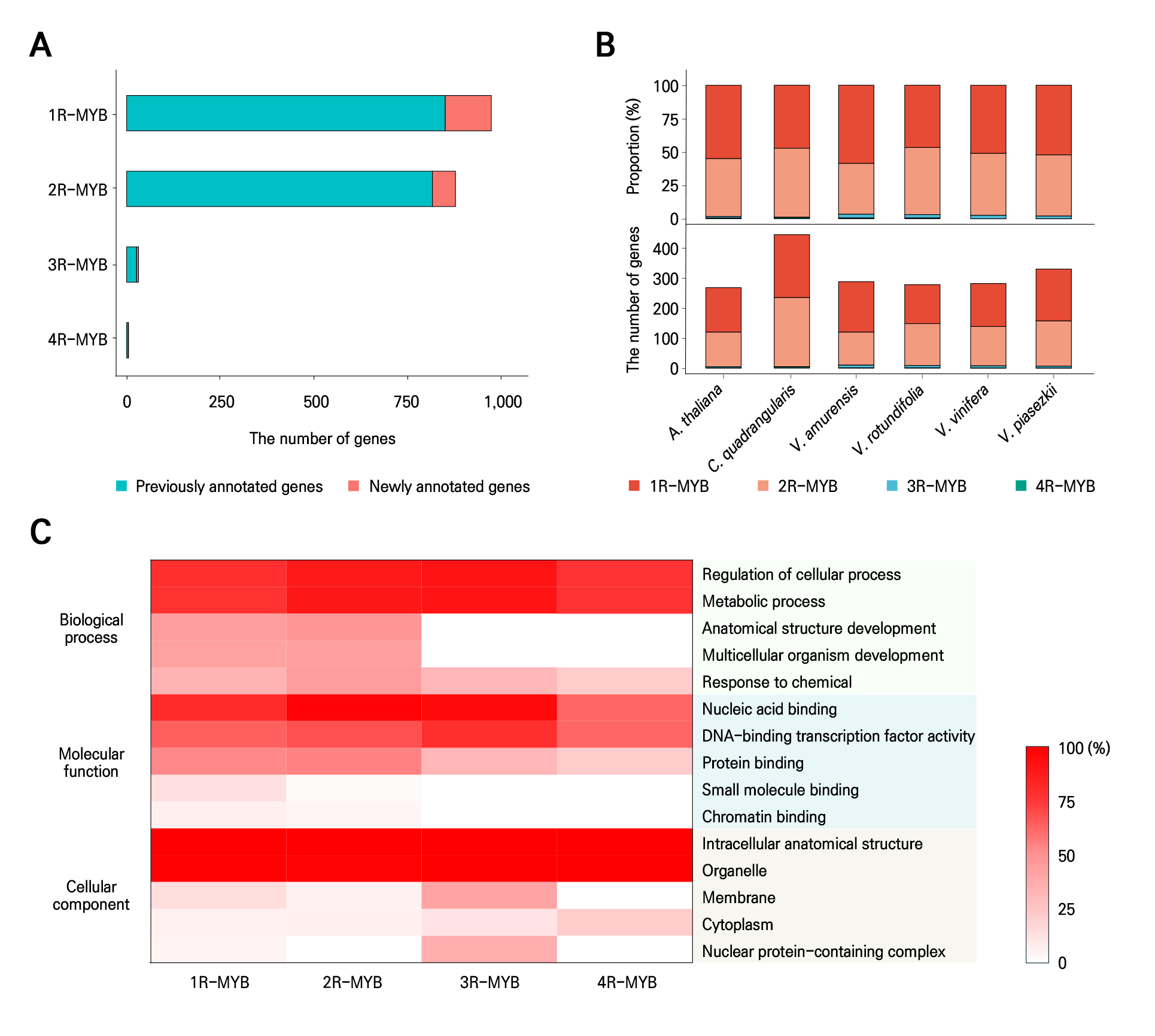
포도과 MYB 유전자 정보를 보완하고 종간 특성을 비교하기 위해 포도과 5종과 애기장대를 대상으로 MYB 유전자를 재동정하였다. 그 결과 총 1,891개의 MYB 유전자가 확인되었으며 이 중 191개(10.1%)는 새롭게 동정된 유전자였다(Table 1 and Supplementary Table S1). 포도과 5종에서 새롭게 동정된 유전자의 비율은 3.9-19.1%로 모델 식물인 애기장대(1.5%)보다 높았으며 이는 포도과 MYB 유전자 정보를 보완하기 위한 재동정의 필요성을 시사한다. MYB 도메인의 반복 수에 따라 분류한 결과 1R-MYB 974개(51.5%), 2R-MYB 878개(46.4%), 3R-MYB 33개(1.8%) 및 4R-MYB 6개(0.3%)로 확인되었으며 1R-MYB와 2R-MYB가 유사한 비율로 전체의 97.9%를 차지하는 주요 반복 유형으로 나타났다(Fig. 1A). 종별 분포에서도 1R-MYB와 2R-MYB가 대부분을 차지하는 유사한 경향이 나타났으며 이는 두 반복 유형이 분석 대상 종 전반에서 MYB 유전자군의 주요 구성 요소임을 보여준다(Fig. 1B). 동정된 MYB 유전자군의 기능적 특성을 조사하기 위해 Gene Ontology(GO) 분석을 수행한 결과 biological process에서는 ‘regulation of cellular process’와 ‘metabolic process’, molecular function에서는 ‘nucleic acid binding’과 ‘DNA-binding transcription factor activity’, cellular component에서는 ‘intracellular anatomical structure’와 ‘organelle’이 높은 비율로 나타났다(Fig. 1C). 이러한 결과는 본 연구에서 동정된 MYB 유전자군이 기존에 알려진 MYB 전사인자와 유사한 기능적 특성을 보이며(Dubos et al. 2010; Katiyar et al. 2012; Wu et al. 2024; Bao et al. 2025) 전사 조절과 대사를 포함한 다양한 세포 과정에 관여할 가능성을 보여준다.

Table 1.

Number of re-annotated MYB genes in six plant species
Species Previously annotated genes Newly annotated genes Total
Arabidopsis thaliana 264 4 268
Cissus quadrangularis 409 36 445
Vitis amurensis 234 54 288
Vitis rotundifolia 225 53 278
Vitis vinifera 271 11 282
Vitis piasezkii 297 33 330
Total 1,700 191 1,891

https://cdn.apub.kr/journalsite/sites/kshs/2026-044-00/N020260034/images/HST_20260034_F1.jpg
Fig. 1.

Characteristics of MYB genes across five Vitaceae species and Arabidopsis thaliana: (A) Number of MYB genes in each MYB repeat type (1R-MYB to 4R-MYB). Blue and red bars represent previously and newly annotated genes, respectively. (B) Distribution of MYB repeat types across five Vitaceae species (Cissus quadrangularis, Vitis amurensis, V. rotundifolia, V. vinifera, and V. piasezkii) and A. thaliana. The upper and lower bar plots represent the proportions and numbers of genes, respectively. Colors represent the four MYB repeat types. (C) Top five Gene Ontology (GO) terms in each category for the four MYB repeat types. The color intensity represents the percentage of genes assigned to each GO term across the three categories, i.e., biological process, molecular function, and cellular component.

MYB 도메인의 서열 보존성 및 모티프 구성

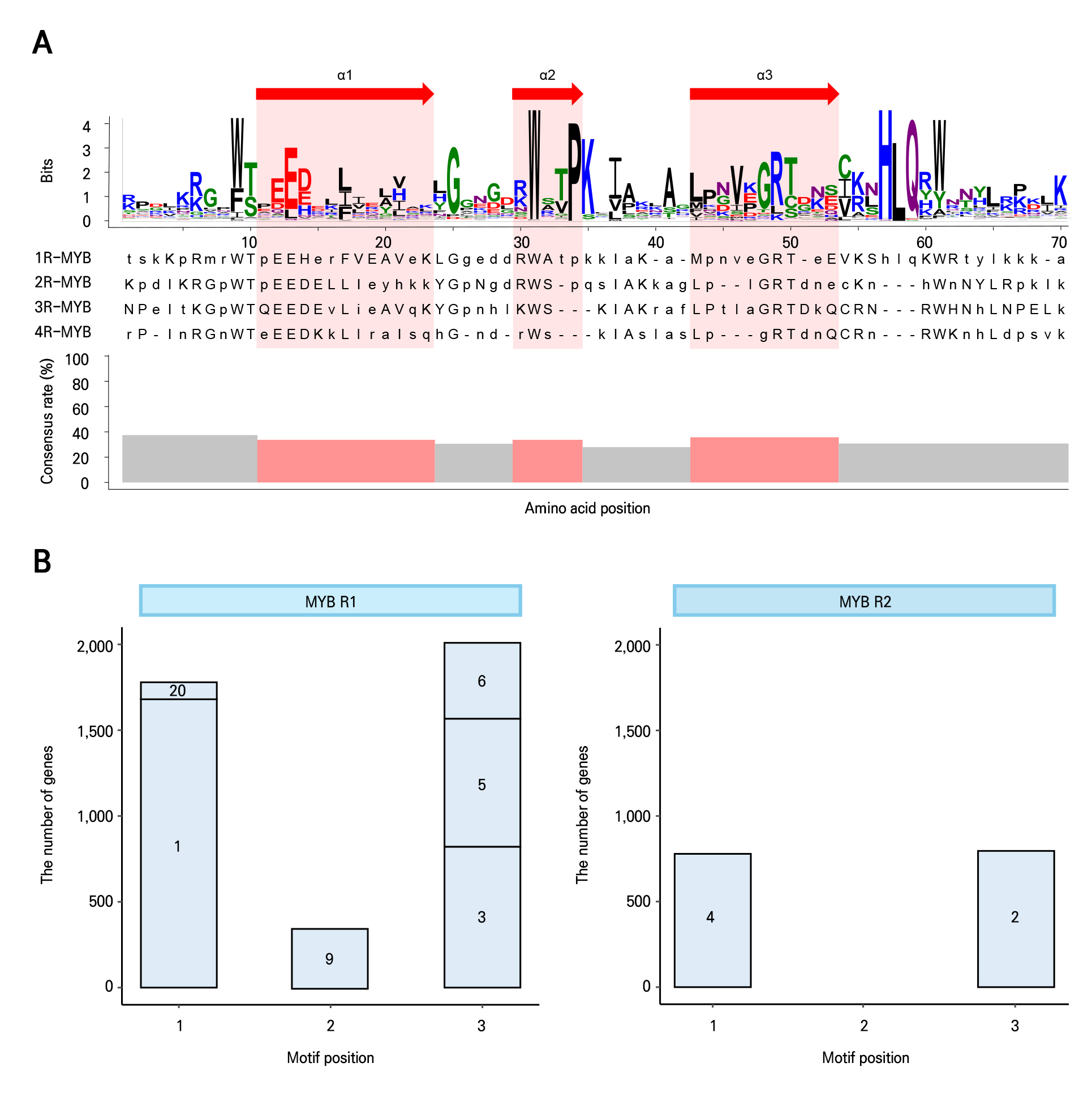
MYB 도메인의 서열 및 이차구조적 특성을 분석한 결과 세 개의 예측된 α-helix와 일정한 간격으로 위치하는 세 개의 트립토판 잔기가 확인되었다(Fig. 2A). 세 개의 α-helix 중 두 번째와 세 번째 α-helix는 helix-turn-helix-related 구조를 형성하여 DNA 인식과 결합에 관여하며 트립토판 잔기는 소수성 코어를 형성하여 MYB 도메인의 구조적 안정성에 기여하는 것으로 알려져 있다(Ogata et al. 1992). 이러한 특징을 고려할 때 1R-MYB, 2R-MYB, 3R-MYB 및 4R-MYB에서 세 개의 α-helix와 트립토판 잔기가 공통적으로 나타난 것은 반복 유형과 관계없이 MYB 도메인의 핵심적인 서열 및 이차구조적 특징이 보존되어 있음을 보여준다. 반면 이러한 핵심 특징을 제외한 영역에서는 상대적으로 높은 서열 다양성이 관찰되었다. 앞서 1R-MYB와 2R-MYB가 MYB 유전자군의 주요 반복 유형으로 확인됨에 따라 이들을 중심으로 MYB 반복 단위의 모티프 구성을 비교하였다. 그 결과 첫 번째 반복(R1)에서는 motif 1, 3, 5, 6, 9 및 20이 확인된 반면 두 번째 반복(R2)에서는 motif 2와 4가 확인되어 두 반복 사이에 뚜렷한 모티프 구성의 차이가 나타났다(Fig. 2B). 이러한 결과는 MYB 도메인이 DNA 결합과 구조적 안정성에 필요한 핵심 특징을 보존하는 한편 세부 서열과 모티프 구성에서는 다양성을 가지며 이러한 차이가 MYB 유전자군의 기능적 분화와 연관될 가능성을 시사한다.
https://cdn.apub.kr/journalsite/sites/kshs/2026-044-00/N020260034/images/HST_20260034_F2.jpg
Fig. 2.

Sequence conservation and motif composition of MYB domains: (A) Amino acid conservation and predicted secondary structure of the MYB domain. The sequence logo shows the conservation of amino acid residues, and the red arrows indicate the three predicted α-helices (α1-α3). Consensus sequences of 1R-MYB, 2R-MYB, 3R-MYB, and 4R-MYB are shown below the sequence logo, and the amino acid consensus rate is shown at the bottom. (B) Motif compositions of the first (R1) and second (R2) MYB repeats. Bars indicate the number of genes containing each motif at the indicated positions, and the numbers within the bars represent the motif IDs.

MYB 유전자의 계통학적 분류 및 계통 특이적 확장

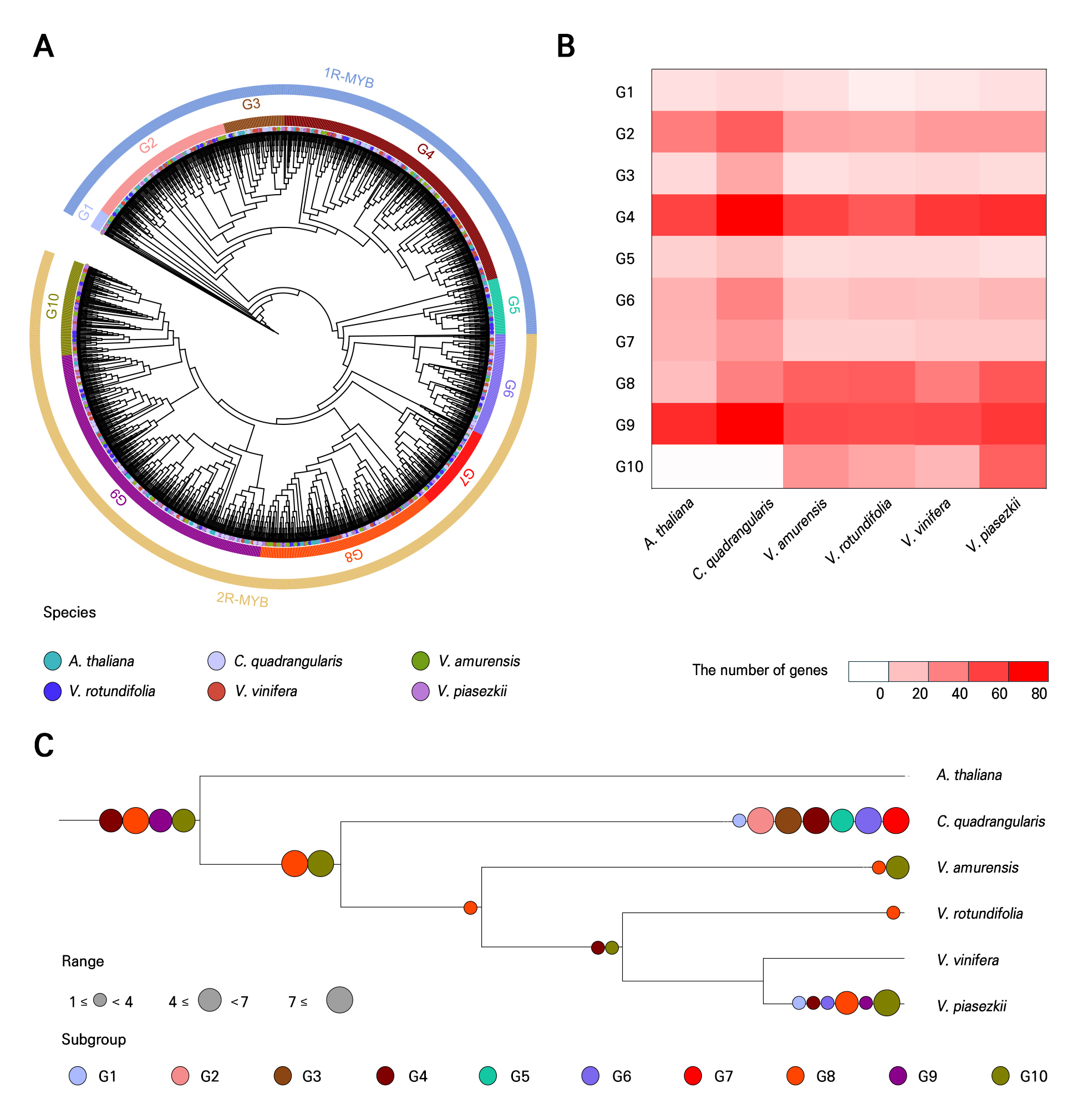
MYB 유전자의 진화적 관계를 분석하기 위해 포도과 5종과 애기장대에서 확인된 총 1,891개의 MYB 유전자에 대해 계통수 분석을 수행하였다(Fig. 3A). 계통수에서 주요 반복 유형인 1R-MYB와 2R-MYB는 전반적으로 서로 구분되는 계통적 분포를 보였으며 계통적 유연관계를 바탕으로 총 10개의 서브그룹(G1-G10)으로 분류되었다. 서브그룹별 유전자 분포를 비교한 결과 G4와 G9은 분석한 모든 종에서 높은 유전자 수를 보여 공통적으로 풍부한 서브그룹으로 나타났다(Fig. 3B). 반면 일부 서브그룹에서는 계통에 따른 차이가 확인되었다. C. quadrangularis에서는 G2와 G6가 다른 종보다 상대적으로 많았으며 Vitis속 4종에서는 G8가 전반적으로 높은 유전자 수를 보였다. 특히 G10은 Vitis속 4종에서만 확인되어 Vitis 계통에 제한적인 분포를 보였다. 이러한 결과는 MYB 서브그룹의 구성이 계통에 따라 서로 다른 양상을 보여준다. 서브그룹별 MYB 유전자의 계통 특이적 확장을 분석하기 위해 CAFE 분석을 수행하였다(Fig. 3C). 애기장대 계통과 포도과 계통이 분기된 이후 포도과 공통조상에서 G8과 G10의 확장이 나타났으며 이후 Vitis 공통조상에서도 G8의 추가적인 확장이 확인되었다. 종 분화 이후에도 이러한 확장은 반복적으로 나타나 G8은 V. amurensis, V. rotundifoliaV. piasezkii에서, G10은 V. amurensisV. piasezkii에서 추가적으로 확장되었다. 한편 C. quadrangularis에서는 G1-G7의 여러 서브그룹에서 확장이 나타난 반면 V. piasezkii에서는 G1, G4, G6, G8, G9 및 G10에서 확장이 확인되어 서로 다른 계통 특이적 확장 양상을 보였다. 이러한 결과는 포도과 MYB 유전자군의 다양화가 단순한 유전자 수 증가보다는 계통에 따라 서로 다른 서브그룹의 선택적인 확장을 통해 이루어졌으며 이러한 차이가 계통 특이적인 기능 분화와 연관될 가능성을 시사한다.
https://cdn.apub.kr/journalsite/sites/kshs/2026-044-00/N020260034/images/HST_20260034_F3.jpg
Fig. 3.

Phylogenetic relationships and expansion of MYB genes across six species: (A) Phylogenetic tree of MYB genes. The node colors represent species. The outer ring highlights the two predominant repeat types, 1R-MYB and 2R-MYB, and the inner ring indicates the ten MYB subgroups (G1-G10). (B) Number of MYB genes in each subgroup across species. The color intensity indicates the number of genes. (C) Copy number expansion of MYB gene subgroups. The circle colors correspond to the subgroup colors in the phylogenetic tree, and the circle sizes reflect the degree of gene copy number expansion.

흰가루병 감염에 따른 MYB 유전자의 발현 및 공동 발현

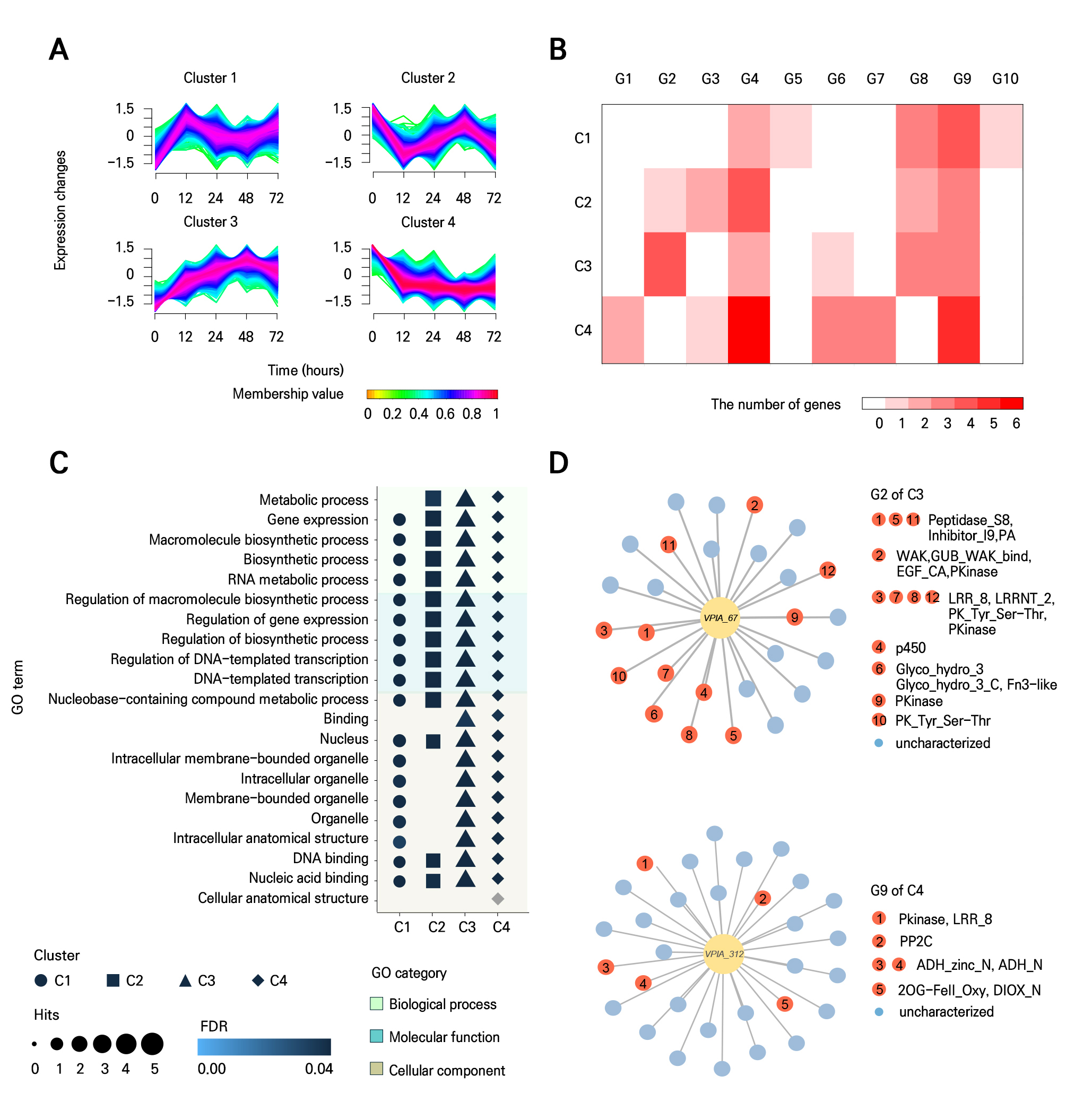
MYB 유전자는 식물의 생물적 스트레스 반응과 관련된 주요 전사인자군으로 병원균 감염에 대한 방어 반응에도 관여하는 것으로 알려져 있다. 이를 조사하기 위해 V. piasezkii를 대상으로 흰가루병 접종 후 0, 12, 24, 48 및 72시간의 RNA-seq 데이터를 분석하였다. MYB 유전자와 차등 발현 유전자(differentially expressed genes, DEGs)의 발현 패턴을 비교하여 클러스터링을 수행한 결과 유사한 발현 양상을 보이는 총 4개의 클러스터(C1–C4)가 확인되었다(Fig. 4A). 각 클러스터에는 C1 906개, C2 612개, C3 750개, C4 1,810개의 유전자가 포함되었다. MYB 유전자의 서브그룹별 분포를 분석한 결과 C3에서는 G2가 4개로 가장 많이 분포하였으며 C4에서는 G4와 G9이 각각 6개와 5개로 상대적으로 높은 유전자 수를 보였다(Fig. 4B). 이러한 결과는 MYB 서브그룹에 따라 흰가루병 감염에 대한 발현 반응이 서로 다르게 나타남을 보여준다. 각 발현 클러스터의 기능적 특성을 확인하기 위해 GO enrichment 분석을 수행하였다(Fig. 4C). 대사 관련 기능에서는 ‘metabolic process’가 C2, C3 및 C4에서 공통적으로 나타났으며 ‘macromolecule biosynthetic process’, ‘biosynthetic process’ 및 ‘RNA metabolic process’도 여러 클러스터에서 확인되었다. 또한 전사 조절과 관련된 ‘gene expression’, ‘regulation of gene expression’, ‘regulation of DNA-templated transcription’, ‘DNA-templated transcription’, ‘DNA binding’ 및 ‘nucleic acid binding’이 다양한 클러스터에서 나타났다. 이러한 결과는 흰가루병 감염에 따른 유전자 발현 변화가 전사 조절 및 다양한 대사 과정의 변화와 함께 나타남을 보여준다.
https://cdn.apub.kr/journalsite/sites/kshs/2026-044-00/N020260034/images/HST_20260034_F4.jpg
Fig. 4.

Expression clustering and co-expression networks of MYB genes in V. piasezkii following powdery mildew infection: (A) Expression patterns of differentially expressed genes (DEGs) and MYB genes following powdery mildew infection. (B) Number of MYB genes in each subgroup across expression clusters. The color intensity indicates the number of genes. (C) GO enrichment analysis of each expression cluster. The background colors represent the three GO categories. Symbol shapes represent expression clusters, symbol sizes indicate the number of genes associated with each GO term, and symbol colors indicate the false discovery rate (FDR). (D) Co-expression networks of VPIA_67 and VPIA_312. The central yellow nodes represent MYB genes, red nodes represent genes with annotated domains, and blue nodes indicate uncharacterized genes.

흰가루병 반응과 관련된 MYB 후보 유전자를 조사하기 위해 공동 발현 분석을 수행한 결과 C3의 G2에 속하는 VPIA_67과 C4의 G9에 속하는 VPIA_312를 중심으로 공동 발현 네트워크가 확인되었다(Fig. 4D). VPIA_67과 공동 발현된 유전자들은 Peptidase_S8, WAK, LRR, P450, glycoside hydrolase 및 protein kinase 관련 도메인을 포함하였다. 이들 도메인과 관련하여 밀의 TaWAK6Puccinia triticina에 대한 저항성에 관여하는 것으로 보고되었으며(Dmochowska-Boguta et al. 2020), 애기장대의 SBT3.3Pseudomonas syringaeHyaloperonospora arabidopsidis에 대한 면역 반응에 관여하는 것으로 보고되었다(Ramirez et al. 2013). 또한 콩 유래 GmCYP82A3Nicotiana benthamiana에서 과발현한 경우 Botrytis cinereaPhytophthora parasitica에 대한 저항성이 증가하였다(Yan et al. 2016). VPIA_312와 공동 발현된 유전자들은 Pkinase, LRR_8, PP2C, ADH 및 2OG-FeII_Oxy 관련 도메인을 포함하였다. 이들 도메인과 관련하여 토마토의 SlLRR-RLK94Phytophthora infestans에 대한 저항성에 관여하는 것으로 보고되었으며(Dmochowska-Boguta et al. 2020), 애기장대의 PP2C38는 flg22와 elf18에 의해 유도되는 PAMP-triggered immunity에서 면역 관련 kinase인 BIK1을 조절하는 것으로 보고되었다(Couto et al. 2016). 또한 콩의 GmCAD3 과발현은 Fusarium oxysporum에 대한 저항성을 증가시키는 것으로 보고되었다(Zhou et al. 2025). 따라서 VPIA_67VPIA_312의 공동 발현 유전자들이 포함하는 도메인과 관련된 유전자들이 다양한 식물에서 병원균 방어 및 면역 반응에 관여한다는 점은 두 MYB 유전자가 흰가루병 반응에 관여할 가능성이 있는 후보 유전자임을 뒷받침한다.

종합적으로 본 연구는 포도과 MYB 유전자 정보를 재정립하고 MYB 도메인의 보존된 핵심 특징, 서열적 다양성 및 계통에 따른 유전자 확장 양상을 제시하였다. 또한 V. piasezkii의 흰가루병 감염에 따른 발현 및 공동 발현 분석을 통해 VPIA_67VPIA_312를 병원균 반응과 관련된 후보 MYB 유전자로 제안하였다. 이러한 결과는 포도과 MYB 유전자군의 진화와 기능적 다양성에 대한 이해를 넓히며 향후 흰가루병 반응 관련 MYB 유전자의 기능 연구 및 포도 육종을 위한 기초 자료로 활용될 수 있을 것이다.

Supplementary Material

Supplementary materials are available at Horticultural Science and Technology website (https://www.hst-j.org).

Acknowledgements

이 논문은 2026년도 서울시립대학교 교내학술연구비에 의하여 지원되었음.

References

1

Al-Shahrour F, Diaz-Uriarte R, Dopazo J (2004) FatiGO: a web tool for finding significant associations of Gene Ontology terms with groups of genes. Bioinformatics 20:578-580. https://doi.org/10.1093/bioinformatics/btg455

10.1093/bioinformatics/btg455
2

Ambawat S, Sharma P, Yadav NR, Yadav RC (2013) MYB transcription factor genes as regulators for plant responses: an overview. Physiol Mol Biol Plants 19:307-321. https://doi.org/10.1007/s12298-013-0179-1

10.1007/s12298-013-0179-124431500PMC3715649
3

Bailey TL, Gribskov M (1998) Combining evidence using p-values: application to sequence homology searches. Bioinformatics 14:48-54. https://doi.org/10.1093/bioinformatics/14.1.48

10.1093/bioinformatics/14.1.48
4

Bailey TL, Johnson J, Grant CE, Noble WS (2015) The MEME Suite. Nucleic Acids Res 43:W39-W49. https://doi.org/10.1093/nar/gkv416

10.1093/nar/gkv41625953851PMC4489269
5

Bao G, Xu X, Yang J, Liu J, Shi T, Zhao X, Li X, Bian S (2025) Identification and functional characterization of the MYB transcription factor GmMYBLJ in soybean leaf senescence. Front Plant Sci 16:1533592. https://doi.org/10.3389/fpls.2025.1533592

10.3389/fpls.2025.153359239926644PMC11802812
6

Capella-Gutierrez S, Silla-Martinez JM, Gabaldon T (2009) trimAl: a tool for automated alignment trimming in large-scale phylogenetic analyses. Bioinformatics 25:1972-1973. https://doi.org/10.1093/bioinformatics/btp348

10.1093/bioinformatics/btp34819505945PMC2712344
7

Chen L, Hu B, Qin Y, Hu G, Zhao J (2019) Advance of the negative regulation of anthocyanin biosynthesis by MYB transcription factors. Plant Physiol Biochem 136:178-187. https://doi.org/10.1016/j.plaphy.2019.01.024

10.1016/j.plaphy.2019.01.024
8

Chen Q, Wang J, Danzeng P, Danzeng C, Song S, Wang L, Zhao L, Xu W, Zhang C, et al. (2021) VvMYB114 mediated by miR828 negatively regulates trichome development of Arabidopsis. Plant Sci 309:110936. https://doi.org/10.1016/j.plantsci.2021.110936

10.1016/j.plantsci.2021.110936
9

Couto D, Niebergall R, Liang X, Bucherl CA, Sklenar J, Macho AP, Ntoukakis V, Derbyshire P, Altenbach D, et al. (2016) The Arabidopsis protein phosphatase PP2C38 negatively regulates the central immune kinase BIK1. PLoS Pathog 12:e1005811. https://doi.org/10.1371/journal.ppat.1005811

10.1371/journal.ppat.100581127494702PMC4975489
10

Crooks GE, Hon G, Chandonia JM, Brenner SE (2004) WebLogo: a sequence logo generator. Genome Res 14:1188-1190. https://doi.org/10.1101/gr.849004

10.1101/gr.84900415173120PMC419797
11

Deluc L, Bogs J, Walker AR, Ferrier T, Decendit A, Merillon JM, Robinson SP, Barrieu F (2008) The transcription factor VvMYB5b contributes to the regulation of anthocyanin and proanthocyanidin biosynthesis in developing grape berries. Plant Physiol 147:2041-2053. https://doi.org/10.1104/pp.108.118919

10.1104/pp.108.11891918539781PMC2492604
12

Dmochowska-Boguta M, Kloc Y, Zielezinski A, Werecki P, Nadolska-Orczyk A, Karlowski WM, Orczyk W (2020) TaWAK6 encoding wall-associated kinase is involved in wheat resistance to leaf rust similar to adult plant resistance. PLoS One 15:e0227713. https://doi.org/10.1371/journal.pone.0227713

10.1371/journal.pone.022771331929605PMC6957155
13

Drozdetskiy A, Cole C, Procter J, Barton GJ (2015) JPred4: a protein secondary structure prediction server. Nucleic Acids Res 43:W389-W394. https://doi.org/10.1093/nar/gkv332

10.1093/nar/gkv33225883141PMC4489285
14

Dubos C, Stracke R, Grotewold E, Weisshaar B, Martin C, Lepiniec L (2010) MYB transcription factors in Arabidopsis. Trends Plant Sci 15:573-581. https://doi.org/10.1016/j.tplants.2010.06.005

10.1016/j.tplants.2010.06.005
15

Fang J, Liu S, Chen S, Deng H, Zhao L, Liang X, Chen Z, Zhang X, Xu S, et al. (2025) A R1-type MYB CmREVEILLE2 regulates light-mediated chlorophyll biosynthesis and green color formation in chrysanthemum flowers. Hortic Adv 3:17. https://doi.org/10.1007/s44281-025-00069-4

10.1007/s44281-025-00069-4
16

Feng J, Wu XY, Xiu Y, Zheng CX (2023) Comparative transcriptomic screen identifies expression of key genes involved in pattern-triggered immunity induced by salicylic acid in strawberry. Hortic Environ Biotechnol 64:835-848. https://doi.org/10.1007/s13580-023-00548-5.

10.1007/s13580-023-00548-5
17

Huff M, Hulse-Kemp AM, Scheffler BE, Youngblood RC, Simpson SA, Babiker E, Staton M (2023) Long-read, chromosome-scale assembly of Vitis rotundifolia cv. Carlos and its unique resistance to Xylella fastidiosa subsp. fastidiosa. BMC Genomics 24:409. https://doi.org/10.1186/s12864-023-09514-y

10.1186/s12864-023-09514-y37474911PMC10357881
18

Jang MJ, Cho HJ, Park YS, Lee HY, Bae EK, Jung S, Jin H, Woo J, Park E, et al. (2024) Haplotype-resolved genome assembly and resequencing analysis provide insights into genome evolution and allelic imbalance in Pinus densiflora. Nat Genet 56:2551-2561. https://doi.org/10.1038/s41588-024-01944-y

10.1038/s41588-024-01944-y
19

Jones P, Binns D, Chang HY, Fraser M, Li W, McAnulla C, McWilliam H, Maslen J, Mitchell A, et al. (2014) InterProScan 5: genome-scale protein function classification. Bioinformatics 30:1236-1240. https://doi.org/10.1093/bioinformatics/btu031

10.1093/bioinformatics/btu03124451626PMC3998142
20

Katiyar A, Smita S, Lenka SK, Rajwanshi R, Chinnusamy V, Bansal KC (2012) Genome-wide classification and expression analysis of MYB transcription factor families in rice and Arabidopsis. BMC Genomics 13:544. https://doi.org/10.1186/1471-2164-13-544

10.1186/1471-2164-13-54423050870PMC3542171
21

Katoh K, Standley DM (2013) MAFFT multiple sequence alignment software version 7: improvements in performance and usability. Mol Biol Evol 30:772-780. https://doi.org/10.1093/molbev/mst010

10.1093/molbev/mst01023329690PMC3603318
22

Kim D, Paggi JM, Park C, Bennett C, Salzberg SL (2019) Graph-based genome alignment and genotyping with HISAT2 and HISAT-genotype. Nat Biotechnol 37:907-915. https://doi.org/10.1038/s41587-019-0201-4

10.1038/s41587-019-0201-431375807PMC7605509
23

Kim S, Cheong K, Park J, Kim MS, Kim J, Seo MK, Chae GY, Jang MJ, Mang H, et al. (2020) TGFam-Finder: a novel solution for target-gene family annotation in plants. New Phytol 227:1568-1581. https://doi.org/10.1111/nph.16645

10.1111/nph.1664532392385PMC7496378
24

KREI (Korea Rural Economic Institute) (2024) Agriculture outlook Korea 2024 Part 3: Industry issues and outlooks. Chapter 14: Trends and outlooks in fruit supply and demand. Korea Rural Economic Institute. https://www.krei.re.kr

25

Kumar LE, Futschik M (2007) Mfuzz: a software package for soft clustering of microarray data. Bioinformation 2:5-7. https://doi.org/10.6026/97320630002005

10.6026/9732063000200518084642PMC2139991
26

Kumar S, Suleski M, Craig JM, Kasprowicz AE, Sanderford M, Li M, Stecher G, Hedges SB (2022) TimeTree 5: an expanded resource for species divergence times. Mol Biol Evol 39:msac174. https://doi.org/10.1093/molbev/msac174

10.1093/molbev/msac17435932227PMC9400175
27

Lamesch P, Berardini TZ, Li D, Swarbreck D, Wilks C, Sasidharan R, Muller R, Dreher K, Alexander DL, et al. (2012) The Arabidopsis Information Resource (TAIR): improved gene annotation and new tools. Nucleic Acids Res 40:D1202-D1210. https://doi.org/10.1093/nar/gkr1090

10.1093/nar/gkr109022140109PMC3245047
28

Langfelder P, Horvath S (2008) WGCNA: an R package for weighted correlation network analysis. BMC Bioinformatics 9:559. https://doi.org/10.1186/1471-2105-9-559

10.1186/1471-2105-9-55919114008PMC2631488
29

Letunic I, Bork P (2024) Interactive Tree of Life (iTOL) v6: recent updates to the phylogenetic tree display and annotation tool. Nucleic Acids Res 52:W78-W82. https://doi.org/10.1093/nar/gkae268

10.1093/nar/gkae26838613393PMC11223838
30

Li Q, Wang Y, Zhou H, Liu Y, Gichuki DK, Hou Y, Zhang J, Aryal R, Hu G, et al. (2024) The Cissus quadrangularis genome reveals its adaptive features in an arid habitat. Hortic Res 11:uhae038. https://doi.org/10.1093/hr/uhae038

10.1093/hr/uhae03838595910PMC11001597
31

Love MI, Huber W, Anders S (2014) Moderated estimation of fold change and dispersion for RNA-seq data with DESeq2. Genome Biol 15:550. https://doi.org/10.1186/s13059-014-0550-8

10.1186/s13059-014-0550-825516281PMC4302049
32

Ma Z, Hu L, Zhong Y (2025) Structure, evolution, and roles of MYB transcription factors proteins in secondary metabolite biosynthetic pathways and abiotic stresses responses in plants: a comprehensive review. Front Plant Sci 16:1626844. https://doi.org/10.3389/fpls.2025.1626844

10.3389/fpls.2025.162684440822724PMC12350382
33

Madeira F, Pearce M, Tivey ARN, Basutkar P, Lee J, Edbali O, Madhusoodanan N, Kolesnikov A, Lopez R (2022) Search and sequence analysis tools services from EMBL-EBI in 2022. Nucleic Acids Res 50:W276-W279. https://doi.org/10.1093/nar/gkac240

10.1093/nar/gkac24035412617PMC9252731
34

Massonnet M, Figueroa-Balderas R, Cochetel N, Riaz S, Pap D, Pap D, Walker MA, Cantu D (2025) Dissection of the Ren6 and Ren7 powdery mildew resistance loci in Vitis piasezkii DVIT2027 using phased parental-progeny genomes and intraspecific locus graph reconstruction. G3 Genes Genomes Genet 15:jkaf250. https://doi.org/10.1093/g3journal/jkaf250

10.1093/g3journal/jkaf25041121521PMC12693563
35

Matus JT, Aquea F, Arce-Johnson P (2008) Analysis of the grape MYB R2R3 subfamily reveals expanded wine quality-related clades and conserved gene structure organization across Vitis and Arabidopsis genomes. BMC Plant Biol 8:83. https://doi.org/10.1186/1471-2229-8-83

10.1186/1471-2229-8-8318647406PMC2507771
36

Mendes FK, Vanderpool D, Fulton B, Hahn MW (2020) CAFE 5 models variation in evolutionary rates among gene families. Bioinformatics 36:5516-5518. https://doi.org/10.1093/bioinformatics/btaa1022

10.1093/bioinformatics/btaa1022
37

Minh BQ, Schmidt HA, Chernomor O, Schrempf D, Woodhams MD, Haeseler A, Lanfear R (2020) IQ-TREE 2: new models and efficient methods for phylogenetic inference in the genomic era. Mol Biol Evol 37:1530-1534. https://doi.org/10.1093/molbev/msaa015

10.1093/molbev/msaa01532011700PMC7182206
38

Ogata K, Hojo H, Aimoto S, Nakai T, Nakamura H, Sarai A, Ishii S, Nishimura Y (1992) Solution structure of a DNA-binding unit of Myb: a helix-turn-helix-related motif with conserved tryptophans forming a hydrophobic core. Proc Natl Acad Sci USA 89:6428-6432. https://doi.org/10.1073/pnas.89.14.6428

10.1073/pnas.89.14.64281631139PMC49514
39

Pertea M, Pertea GM, Antonescu CM, Chang TC, Mendell JT, Salzberg SL (2015) StringTie enables improved reconstruction of a transcriptome from RNA-seq reads. Nat Biotechnol 33:290-295. https://doi.org/10.1038/nbt.3122

10.1038/nbt.312225690850PMC4643835
40

Procter JB, Carstairs GM, Soares B, Mourao K, Ofoegbu TC, Barton D, Lui L, Menard A, Sherstnev N, et al. (2021) Alignment of biological sequences with Jalview. Methods Mol Biol 2231:203-224. https://doi.org/10.1007/978-1-0716-1036-7_13

10.1007/978-1-0716-1036-7_1333289895PMC7116599
41

Ramirez V, Lopez A, Mauch-Mani B, Gil MJ, Vera P (2013) An extracellular subtilase switch for immune priming in Arabidopsis. PLoS Pathog 9:e1003445. https://doi.org/10.1371/journal.ppat.1003445

10.1371/journal.ppat.100344523818851PMC3688555
42

Shannon P, Markiel A, Ozier O, Baliga NS, Wang JT, Ramage D, Amin N, Schwikowski B, Ideker T (2003) Cytoscape: a software environment for integrated models of biomolecular interaction networks. Genome Res 13:2498-2504. https://doi.org/10.1101/gr.1239303

10.1101/gr.123930314597658PMC403769
43

Shi X, Cao S, Wang X, Huang S, Wang Y, Liu Z, Liu W, Leng X, Peng Y, et al. (2023) The complete reference genome for grapevine (Vitis vinifera L.) genetics and breeding. Hortic Res 10:uhad061. https://doi.org/10.1093/hr/uhad061

10.1093/hr/uhad06137213686PMC10199708
44

Sun T, Xu L, Sun H, Yue Q, Zhai H, Yao Y (2017) VvVHP1;2 is transcriptionally activated by VvMYBA1 and promotes anthocyanin accumulation of grape berry skins via glucose signal. Front Plant Sci 8:1811. https://doi.org/10.3389/fpls.2017.01811

10.3389/fpls.2017.0181129104582PMC5655013
45

Wang B, Luo Q, Li Y, Yin L, Zhou N, Li X, Gan J, Dong A (2019) Structural insights into target DNA recognition by R2R3-MYB transcription factors. Nucleic Acids Res 47:10387-10399. https://doi.org/10.1093/nar/gkz1081

10.1093/nar/gkz108131733060PMC7145699
46

Wang P, Meng F, Yang Y, Ding T, Liu H, Wang F, Li A, Zhang Q, Li K, et al. (2024) De novo assembling a high-quality genome sequence of Amur grape (Vitis amurensis Rupr.) gives insight into Vitis divergence and sex determination. Hortic Res 11:uhae117. https://doi.org/10.1093/hr/uhae117

10.1093/hr/uhae11738919553PMC11197301
47

Wen J, Lu L, Nie Z, Liu X, Zhang N, Ickert-Bond S, Gerrath J, Manchester SR, Boggan J, et al. (2018) A new phylogenetic tribal classification of the grape family (Vitaceae). J Syst Evol 56:262-271. https://doi.org/10.1111/jse.12427

10.1111/jse.12427
48

Wu X, Xia M, Su P, Zhang Y, Tu L, Zhao H, Gao W, Huang L, Hu Y (2024) MYB transcription factors in plants: a comprehensive review of their discovery, structure, classification, functional diversity and regulatory mechanism. Int J Biol Macromol 282:136652. https://doi.org/10.1016/j.ijbiomac.2024.136652

10.1016/j.ijbiomac.2024.136652
49

Yan Q, Cui X, Lin S, Gan S, Xing H, Dou D (2016) GmCYP82A3, a soybean cytochrome P450 family gene involved in the jasmonic acid and ethylene signaling pathway, enhances plant resistance to biotic and abiotic stresses. PLoS One 11:e0162253. https://doi.org/10.1371/journal.pone.0162253

10.1371/journal.pone.016225327588421PMC5010195
50

Zhang D, Zhou H, Zhang Y, Zhao Y, Zhang Y, Feng X, Lin H (2025) Diverse roles of MYB transcription factors in plants. J Integr Plant Biol 67:539-562. https://doi.org/10.1111/jipb.13869

10.1111/jipb.13869
51

Zhao L, Hu Y, Ji QY, Gong LX, Lu MJ, Yu XN, Jin ZS, Zhou M, Dai XL, et al. (2025) Chromosome-level reference genome of Vitis piasezkii var. pagnucii provides insights into a new locus of resistance to grapevine powdery mildew. Hortic Res 12:uhaf146. https://doi.org/10.1093/hr/uhaf146

10.1093/hr/uhaf14640756639PMC12313342
52

Zhou R, You J, Li J, Li H, Lamlom SF, Ren H, Wang J (2025) Genome-wide analysis of soybean cinnamyl alcohol dehydrogenase genes identifies GmCAD3 as a positive regulator of Fusarium oxysporum resistance. Front Plant Sci 16:1731612. https://doi.org/10.3389/fpls.2025.1731612

10.3389/fpls.2025.173161241459444PMC12738375
53

Zhu J, Li Y, Yang R, Xue Z, Lv R, Wei H, Wang Z, Wang R, Luan Y (2025) The receptor-like kinase SlLRR-RLK94 as a positive regulator of tomato resistance to Phytophthora infestans. Plant Cell Rep 44:257. https://doi.org/10.1007/s00299-025-03648-x

10.1007/s00299-025-03648-x
54

Zhu Z, Quan R, Chen G, Yu G, Li X, Han Z, Xu W, Li G, Shi J, et al. (2022) An R2R3-MYB transcription factor VyMYB24, isolated from wild grape Vitis yanshanesis J. X. Chen., regulates the plant development and confers the tolerance to drought. Front Plant Sci 13:966641. https://doi.org/10.3389/fpls.2022.966641

10.3389/fpls.2022.96664136160974PMC9495713
페이지 상단으로 이동하기