

Introduction
Materials and Methods
Plant Materials
Seed Germination and Planting
Irrigation
Measurement of Growth and Yield Characteristics
Data Analysis
Results
Early Growth Characteristics
Final Growth Characteristics
Fruit Characteristics
Yield Characteristics
Principal Component Analysis and Partial Correlation Analysis
Discussion
Introduction
Sweet pepper (Capsicum annuum L.) is a fresh vegetable that comes in assorted colors and contains high levels of vitamin A and C. In South Korea, the sweet pepper cultivation area increased dramatically from 1.1 hectares (ha) in 1995 to 733 ha in 2020, and sweet pepper production reached 81,841 tons in 2020 (MAFRA, 2021). Gangwon and Gyeongsangnam-do provinces in South Korea are two major sweet pepper production regions, accounting for 258 ha and 260 ha in 2021, respectively (KOSIS, 2023).
Until the early 2000s, most sweet peppers were produced in South Korea for export to Japan and other countries; however, domestic consumption has been rising rapidly. Along with the increase in domestic consumption, consumer preferences are diversifying (Yun et al., 2021). Thus, there is an urgent need to develop and introduce new varieties to respond to consumer preferences and to provide sweet pepper seeds to farmers at lower prices compared to expensive imported seeds. The seeds of most sweet pepper cultivars cultivated in Korea are imported from multinational foreign seed companies, including Enza Zaden, Rijk Zwaan, Monsanto, and Syngenta (Lhee et al., 2012). Expenditure for the imported seeds is currently high at approximately 15 to 20 million won (KR) for one hectare. To date, only a limited number of domestic cultivars have been developed in South Korea. To mitigate this issue, 13 sweet pepper cultivars were developed recently through the Korean government-assisted Golden Seed Project (GSP); seeds from some of these new domestic cultivars are approximately 20–40% less expensive than imported sweet pepper seeds (Yun et al., 2021).
In South Korea, there are two major seasonal practices related to sweet pepper cultivation: summer cropping in the cold northern regions of Gangwon province and winter cropping in the warm southern regions in Gyeongsangnam-do and Jeollanam-do provinces (Jeong et al., 2008). However, most sweet pepper cultivars cultivated in South Korea are from winter cropping, with summer cropping practices rarely used (Lhee, 2012). Therefore, it is necessary to select cultivars suitable for summer cropping that would yield better performance outcomes in Gangwon province. Early studies that attempted to select suitable cultivars for summer cropping focused on the effects of grafting methods (Lee et al., 2004) and stem training (Lee et al., 2008) as well as improving hydroponic cultivation systems (Won et al., 2009; Rhee et al., 2011, 2012; Jang et al., 2017) and evaluating postharvest characteristics (Kang et al., 2008). Recent studies have investigated how seedling age before planting (Jang et al., 2018) and methods by which to regulate the sink and source balance (Jang et al., 2021) effect on sweet pepper growth. Also, it was recently reported that additional far-red light can increase sweet pepper yield in insufficient light conditions (Kim et al., 2023), which could be applied to summer cropping practice to increase yield at early winter when sunlight is waning down.
A previous study examined the suitability of twelve sweet pepper cultivars for a hydroponic cultivation system for summer cropping in the highland area of Jinbu, Gangwon, South Korea. In this study, seven cultivars consisting of two red (‘Special’ and ‘Cupra’), three orange (‘Boogie’, ‘Fellini’, and ‘President’), and two yellow (‘Fiesta’ and ‘Derby’) cultivars were found to outperform other cultivars in terms of fruit setting, showing marketable yields (Won et al., 2009). In a more recent study, ten cultivars were investigated for suitability as summer cropping cultivars in Gangwon province; five cultivars (‘Maranello’, ‘Nagano’, ‘Sven’, ‘Thialf’, and ‘Volante’) were considered suitable for cultivation in a high-ceiling plastic greenhouse (Jang et al., 2016). On the other hand, four cultivars, ‘Maranello’, ‘Special’, ‘Volante’, and ‘Zagato’, were considered suitable for a low-ceiling plastic greenhouse (Jang et al., 2016). Other than these studies, very few researchers have studied suitable sweet pepper cultivars for summer cropping in Gangwon province, Korea.
This study sought to evaluate and select cultivars suitable for summer cropping among six new sweet pepper cultivars in a combined effort between the Agricultural corporation KOPA Inc. (KOPA) and Gangwon Province Agricultural Research and Extension Services (https://www.ares.gangwon.kr). This study is the first trial to examine these new domestic cultivars for summer cropping in the northern region of South Korea.
Materials and Methods
Plant Materials
New cultivar testing was carried out using ten sweet pepper cultivars (Capsicum annuum L.). Among them, six new cultivars were included, three red (‘632’, ‘ARO-2’, and ‘HeraRed’), two yellow (‘719’, and ‘ARO-4’), and one orange (‘ARO-5’), that were developed by the Golden Seed Project (GSP) of South Korea. The red ‘Nagano’, yellow ‘Allrounder’ and ‘WLS1380’, and orange ‘DSP7054’ cultivars were used as control varieties (Table 1). Trial tests were carried out in triplicate of 15 individual plants in 0.1 hectares of a wide-span greenhouse with a side elevation of five meters located in Inje, Gangwon, Republic of Korea (GPS: 37° 59' 54"N 128° 14' 59"E).
Table 1.
List of the ten cultivars used in this study
Seed Germination and Planting
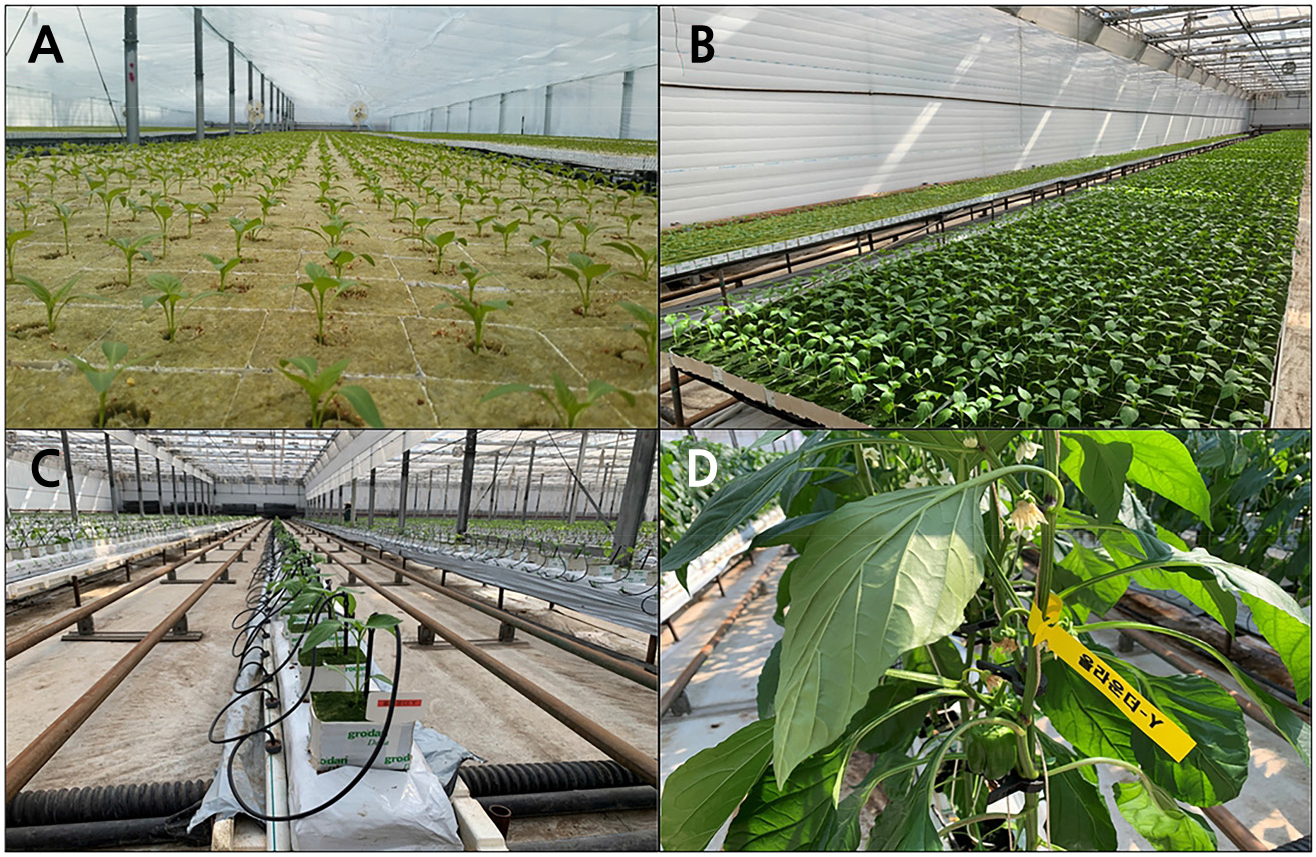
Seeds were sown for germination individually in each cell of rockwool 240-cell plug trays (Grodan, Roermond, Netherlands) and covered with vermiculite. Trays with sown seeds were placed in a germination room set at 25°C and 85% humidity, and LED lights (3:1 ratio of red:blue light) were illuminated after germination to prevent seedling overgrowth for 1.5 days. The nutrient solution for germination was adjusted to an electrical conductivity (EC) of 1.0 dS·m-1 with pH 5.8. After germination, trays with seedlings were transferred to a nursery room set at 25°C and 22°C during the day and night, respectively. When two to three true leaves expanded, the seedlings were transferred to 10 × 10 × 7.5 cm rockwool cubes (Grodan, Roermond, Netherlands) using a 180° bending method on February 24, 2020 (Fig. 1). The greenhouse was set to 25°C and 20°C during the day and night, respectively. When five to six true leaves were expanded, the seedlings were planted permanently in one-year-old coir grow bags (100 × 15 × 7.5 cm) that were irrigated before planting with a nutrient solution adjusted to EC 3.0 and pH 5.8. Five plants were planted in each bag with s separation distance of 20 cm, resulting in a density of 6.75 plants per square meter. Priva Maximizer software (Priva Maximizer 9.3.0 Build 7269, Priva, Netherlands) was used to control the water supply and greenhouse environmental conditions. The greenhouse was set to 25°C and 18°C during the day and night, respectively, to maintain a 21.5°C mean daily temperature. Sweet peppers were trained to a “V” shape with two stems, leaving one leaf per node. Fruiting was induced from the first node and was thereafter not controlled. Fruits were harvested from May 22 to October 28, 2020.
Irrigation
Irrigation occurred 2.5 hours after sunrise until three hours before sunset. The fertilizer solution (Priva Maximizer) was automatically irrigated through drip watering for every 130–140 watts generated from sunlight. One drip watering session consisted of approximately 100 mL, of which 30% was drained. EC was set to 2.3 in the early seedling stage and 2.4 for the remainder of the growing period.
Measurement of Growth and Yield Characteristics
An initial growth survey was conducted on the planting day by measuring the plant height, leaf number, main stem diameter, number of leaves, the largest leaf size, and the chlorophyll content on February 24, 2020. The chlorophyll content was measured using a Minolta SPAD-502 chlorophyll meter (Minolta, Tokyo, Japan). An interim growth survey was conducted 50 days after planting on April 14, 2020 by measuring the plant height, main stem length and diameter, fruit size, the number of branches and fruit sets, and the largest leaf size. The final growth characteristics were examined by measuring the plant height, main stem length, and the number of branches on November 3, 2020. To examine the yield characteristics of each cultivar, the fruit yield was evaluated every two weeks by determining the marketable and nonmarketable yields based on the criteria of the standards for export from May 22 to October 28, 2020.
Regarding the leaf characteristics, the single most fully expanded leaf for each stem was measured for the length and width. The leaf area was estimated based on the following formula:
La = L × D × 0.6, where La is leaf area (cm2), L is leaf length, and D is leaf width.
The fruit volume (size) was estimated using the following formula:
VF = 1.1πLD2/6, where VF is the fruit volume (cm3), L is the fruit length, and D is the fruit width (Ngouajio et al., 2003).
Fruit characteristics were measured by examining the fruit weight, fruit height and width, fruit shape index (fruit height/fruit width), locule number, fruit size, fruit stalk length and diameter, flesh thickness, firmness, soluble sucrose content, and fruit color between August 10 and September 7, 2020. The flesh color of the sweet peppers was measured using a Minolta CR-300 chroma meter (Konica Minolta, Tokyo, Japan). Organic acid and sugar contents were measured using a G-won SAM-706AC fruit sugar-acid meter (G-won Hitech, Seoul, South Korea).
To examine the greenhouse environment during the growing period, the temperature, humidity, light intensity, and CO2 concentrations were recorded every five minutes (Suppl. Fig. 1s).
Data Analysis
Statistical analyses were conducted with a one-way ANOVA embedded in Jamovi or with IBM SPSS Statistics 26. Principal component analysis (PCA) and partial correlation analyses were conducted using the Snowcluster and the Seolmatrix software, respectively, embedded in the Jamovi standalone statistical software (The jamovi project, 2022). For the PCA and partial correlation analyses, two datasets, the growth characteristics 50 days after planting and the fruit characteristics from August 10-September 7, 2020, were used.
Results
In this study, ten sweet pepper cultivars were examined for their vegetative growth and fruit yield characteristics during summer cropping in the northern regions of Gangwon province. Six new cultivars (three red, two yellow, and one orange) were used in cultivation trials to evaluate the performance of these plants as potential cultivars; four cultivars (one red, two yellow, and one orange) were used as controls cultivars for comparison (Table 1).
Early Growth Characteristics
To examine vegetative growth at an early developmental stage, the growth parameters were measured at the initial seedling stage on the day of planting and 50 days after planting. These outcomes are presented in Table 2. At the initial seedling stage, the tallest cultivar was yellow ‘DSP7054’ at 12.2 cm, whereas yellow ‘ARO-4’ was the shortest at 8.9 cm. Yellow ‘WLS1380’ exhibited the thickest stem diameter at 2.4 mm, while two red cultivars, ‘HeraRed’ and ‘ARO-4’, had the thinnest stem diameter at 1.8 mm. The leaf area varied and was between 10.6 cm2 (red ‘Nagano’) and 15.4 cm2 (orange ‘DSP7054’). Regarding the number of leaves, two yellow cultivars, ‘719’ and ‘ARO-5’, exhibited the most leaves at 5.9, whereas two red cultivars, ‘HeraRed’ and ‘ARO-4’, had the fewest leaves at 5.1. The chlorophyll content (SPAD values) ranged from 28.6 for yellow ‘Allrounder’ to 34.6 for red ‘HeraRed’.
Table 2.
Seedling characteristics of ten cultivars on the day of planting (February 24, 2020) in rock wool bag (n = 10)
| Color | Cultivar | Plant height (cm) | Leaf number | Leaf areaz (cm2) | Stem diameter (mm) | SPAD value |
| Red | 632 | 9.4 cdey | 5.6 ab | 12.6 bcd | 2.3 ab | 33.7 ab |
| ARO-2 | 9.5 cde | 5.5 ab | 10.7 d | 2.1 bc | 34.6 a | |
| HeraRed | 10.0 bcd | 5.1 b | 11.5 cd | 1.8 d | 34.2 a | |
| Nagano | 9.1 e | 5.3 ab | 10.6 d | 2.1 bc | 31.2 bcd | |
| Yellow | 719 | 9.2 de | 5.9 a | 12.3 bcd | 2.0 c | 32.6 abc |
| ARO-4 | 8.9 e | 5.1 b | 11.3 d | 1.8 d | 30.6 cd | |
| WLS1380 | 10.6 b | 5.7 a | 13.6 b | 2.4 a | 30.9 cd | |
| Allrounder | 9.5 cde | 5.4 ab | 13.3 bc | 2.1 bc | 28.6 d | |
| Orange | ARO-5 | 10.2 bc | 5.9 a | 11.5 cd | 1.9 cd | 29.2 d |
| DSP7054 | 12.2 a | 5.8 a | 15.4 a | 2.3 ab | 30.3 cd | |
| Significancex | ||||||
| Color | *** | ** | *** | NS | *** | |
| Cultivar | *** | ** | *** | *** | *** |
Plant characteristics were measured 50 days after planting and are presented in Table 3. Plant heights ranged from 78.8 to 98.2 cm. Red ‘ARO-2’ was the significantly tallest cultivar at 98.2 cm (p < 0.01), followed by orange ‘ARO-5’ at 92.6 cm, and yellow ‘ARO-4’ at 88.9 cm (Table 3). The shortest cultivar was red ‘632’ at only 78.8 cm. Leaf area varied and was between 159.3 cm2 (red ‘HeraRed’) and 274.9 cm2 (red ‘632’). The number of fruit sets ranged from 3.3 (yellow ‘ARO-4’) to 7.1 (yellow ‘WLS1380’). Among the red cultivars, ‘HeraRed’ and ‘ARO-2’ exhibited the most fruit sets. Among the orange cultivars, ‘ARO-5’ had significantly more fruit sets than ‘DSP7054’ (p < 0.001). Fruit size differed significantly among the ten cultivars, ranging from 5.7 cm3 (yellow ARO-4’) to 72.6 cm3 (yellow ‘WLS1380’).
Table 3.
Characteristics of plant growth 50 days after planting on April 14, 2020 (n = 15)
| Color | Cultivar |
Plant height (cm) |
No. of branches |
Leaf area (cm2) | Main stem |
No. of fruit sets per stem |
Fruit size (cm3)z | |
| length (cm) | diameter (mm) | |||||||
| Red | 632 | 78.8 gy | 4.0 f | 247.9 a | 36.1 de | 11.6 c | 3.6 d | 6.7 e |
| ARO-2 | 98.2 a | 5.0 abc | 199.9 bc | 39.5 ab | 11.6 c | 5.4 b | 24.4 bc | |
| HeraRed | 81.3 fg | 5.3 a | 159.3 e | 32.8 f | 11.0 d | 5.0 b | 27.3 b | |
| Nagano | 83.0 ef | 4.6 de | 211.8 b | 35.0 e | 11.7 bc | 5.4 b | 28.8 b | |
| Yellow | 719 | 88.2 cd | 4.8 bcde | 192.3 c | 36.9 cd | 12.1 abc | 4.9 bc | 9.3 de |
| ARO-4 | 88.9 c | 4.5 e | 203.2 bc | 38.2 bc | 11.6 bc | 3.3 d | 5.7 e | |
| WLS1380 | 87.8 cd | 4.9 bcd | 174.8 d | 32.9 f | 11.6 | 7.1 a | 72.6 a | |
| Allrounder | 88.3 cd | 4.8 bcd | 192.9 c | 34.4 ef | 11.8 bc | 4.7 bc | 28.2 b | |
| Orange | ARO-5 | 92.6 b | 5.1 ab | 200.8 bc | 40.5 a | 12.2 ab | 5.5 b | 17.3 cd |
| DSP7054 | 85.5 de | 4.7 cde | 195.2 c | 37.5 cd | 12.4 a | 4.1 cd | 15.0 d | |
| Significancex | ||||||||
| Color | * | NS | * | *** | *** | NS | * | |
| Cultivar | *** | *** | *** | *** | *** | *** | *** | |
zFruit size was estimated based on the formula 1.1πLD2/6 (Ngouajio et al., 2003).
Final Growth Characteristics
The final growth parameters were measured 252 days after planting and are presented in Table 4. Plant heights ranged from 276 cm (yellow ‘WLS1380’) to 338 cm (orange ‘DSP7054’). With regard to the main stem length, ‘ARO-5’ had the longest main stem at 40.9 cm and the stem of yellow ‘WLS1380’ was the shortest at 32.4 cm, which was significantly shorter (p < 0.05) than those of the other cultivars, except for red ‘HeraRed’. The mean number of branches (internodes) ranged from 35.2 (‘HeraRed’) to 39.1 (‘Allrounder’). The tallest red and yellow cultivars were ‘ARO-2’ and ‘719’, respectively. Two orange cultivars (‘ARO-5’ and ‘DSP7054’) exhibited nearly the same plant height. The main stem length ranged from 32.4 to 40.9 cm. The cultivars with the longest main stem length in each color were ‘ARO-5’ in orange, ‘ARO-4’ in yellow, and ‘ARO-2’ in red.
Table 4.
Summary of the final growth characteristics on November 3, 2020 (n = 15)
| Color | Cultivar | Plant height (cm) | Main stem length (cm) | No. of branches | Internode length (cm)z |
| Red | 632 | 302 cy | 37.2 de | 35.4 d | 7.49 cd |
| ARO-2 | 320 b | 40.4 ab | 35.4 d | 7.90 ab | |
| HeraRed | 287 d | 35.8 e | 35.2 d | 7.12 e | |
| Nagano | 290 cd | 36.3 de | 35.8 cd | 7.10 e | |
| Yellow | 719 | 332 a | 37.8 cd | 36.9 bc | 7.96 ab |
| ARO-4 | 329 ab | 39.4 abc | 37.5 b | 7.72 bc | |
| WLS1380 | 276 d | 32.4 f | 35.7 cd | 6.81 f | |
| Allrounder | 327 ab | 36.4 de | 39.1 a | 7.42 d | |
| Orange | ARO-5 | 337 a | 40.9 a | 37.0 bc | 8.00 a |
| DSP7054 | 338 a | 39.0 bc | 38.1 ab | 7.85 ab | |
| Significancex | |||||
| Color | *** | *** | *** | *** | |
| Cultivar | *** | *** | *** | *** |
Fruit Characteristics
To examine the fruit characteristics, eleven fruit traits were examined from August 10 to September 7, 2020 (Table 5). The average fruit weight ranged from 152.8 g (orange ‘ARO-5’) to 201.5 g (yellow ‘719’). The number of locules ranged from 2.73 for yellow ‘Allrounder’ to 3.40 for yellow ‘719’. The fruit shape index ranged from 0.99 for yellow ‘Allrounder’ to 1.18 for red ‘Nagano’. The thickest pericarp was 7.07 mm for yellow ‘WLS1380’, whereas ‘Nagano’ exhibited the thinnest pericarp of 6.03 mm. Fruit firmness ranged from 1.33 kg/mm2 in ‘WLS1380’ to 1.66 kg/mm2 in ‘719’. The sugar contents of the ten cultivars ranged from 4.97 °Brix (yellow ‘ARO-4’) to 6.31 (red ‘ARO-2’). Red ‘ARO-2’, yellow ‘Allrounder’, and orange ‘DSP7054’ were the cultivars with the highest sugar contents in each color group.
Table 5.
Fruit characteristics of ten sweet pepper cultivars during August 10 ‒ September 7, 2020 (n ≥ 31)
| Color | Cultivar |
Fruit weight (g) |
Fruit sizez (cm3) |
No. of locules |
Fruit shape indexy |
Pericarp thickness (mm) |
Firmness (kg/mm2) |
Sugar content (°Brix) | Chroma |
| Red | 632 | 177.4 bcx | 416.5 a | 3.39 a | 1.14 abc | 6.37 cde | 1.59 abc | 5.07 e | 29.3 e |
| ARO-2 | 168.4 cd | 342.3 cd | 3.08 ab | 1.18 ab | 6.62 bc | 1.61 ab | 6.31 a | 37.4 d | |
| HeraRed | 166.6 cd | 338.7 cd | 3.00 bc | 1.09 abc | 6.07 ef | 1.49 bcde | 5.67 bc | 36.2 d | |
| Nagano | 162.1 cd | 339.2 cd | 3.14 ab | 1.18 a | 6.03 f | 1.51 bcd | 5.42 cd | 31.9 e | |
| Yellow | 719 | 201.5 a | 399.9 ab | 3.40 a | 1.08 bc | 6.33 cdef | 1.66 a | 5.55 bc | 53.1 b |
| ARO-4 | 172.4 cd | 347.3 cd | 3.00 bc | 1.05 cd | 6.76 b | 1.60 abc | 4.97 e | 51.7 bc | |
| WLS1380 | 192.8 ab | 404.9 ab | 3.39 a | 1.15 ab | 7.07 a | 1.33 e | 5.19 de | 58.5 a | |
| Allrounder | 168.5 cd | 369.4 bc | 2.73 c | 0.99 d | 6.57 bcd | 1.39 de | 5.71 bc | 59.1 a | |
| Orange | ARO-5 | 152.8 d | 312.0 d | 2.92 bc | 1.17 ab | 6.69 b | 1.46 cde | 5.50 cd | 57.3 a |
| DSP7054 | 163.8 cd | 323.5 cd | 3.03 bc | 1.14 ab | 6.26 def | 1.60 abc | 5.91 b | 49.6 c | |
| Significancew | |||||||||
| Color | *** | *** | * | ** | *** | NS | *** | *** | |
| Cultivar | *** | *** | *** | *** | *** | *** | *** | *** | |
zFruit size was estimated based on a formula: 1.1πLD2/6 (Ngouajio et al., 2003).
Among the red cultivars, three new cultivars (‘HeraRed’, ‘ARO-2’, and ‘632’) produced fruits with average weights of 167-177 g; this range was heavier than the mean for the control ‘Nagano’ at 162 g. Among the yellow cultivars, ‘719’ produced the heaviest fruits with an average weight of 201.5 g, while ‘Allrounder’ exhibited the lightest fruits at 168.5 g. The two orange cultivars did not show any differences in the average fruit weight. Regarding the pericarp thickness and fruit firmness, the two red cultivars ‘ARO-2’ and ‘632’ showed significantly thicker pericarps (p < 0.05) at 6.62 and 6.37 mm than ‘Nagano’ at 6.03 mm. Among the yellow cultivars, ‘WLS1380’ and ‘719’ exhibited the thickest and thinnest pericarps at 7.07 and 6.33 mm, respectively. The firmest fruits were produced by ‘ARO-2’ in red, ‘ARO-4’ and ‘719’ in yellow, and ‘DSP7054’ in orange compared to their color counterparts.
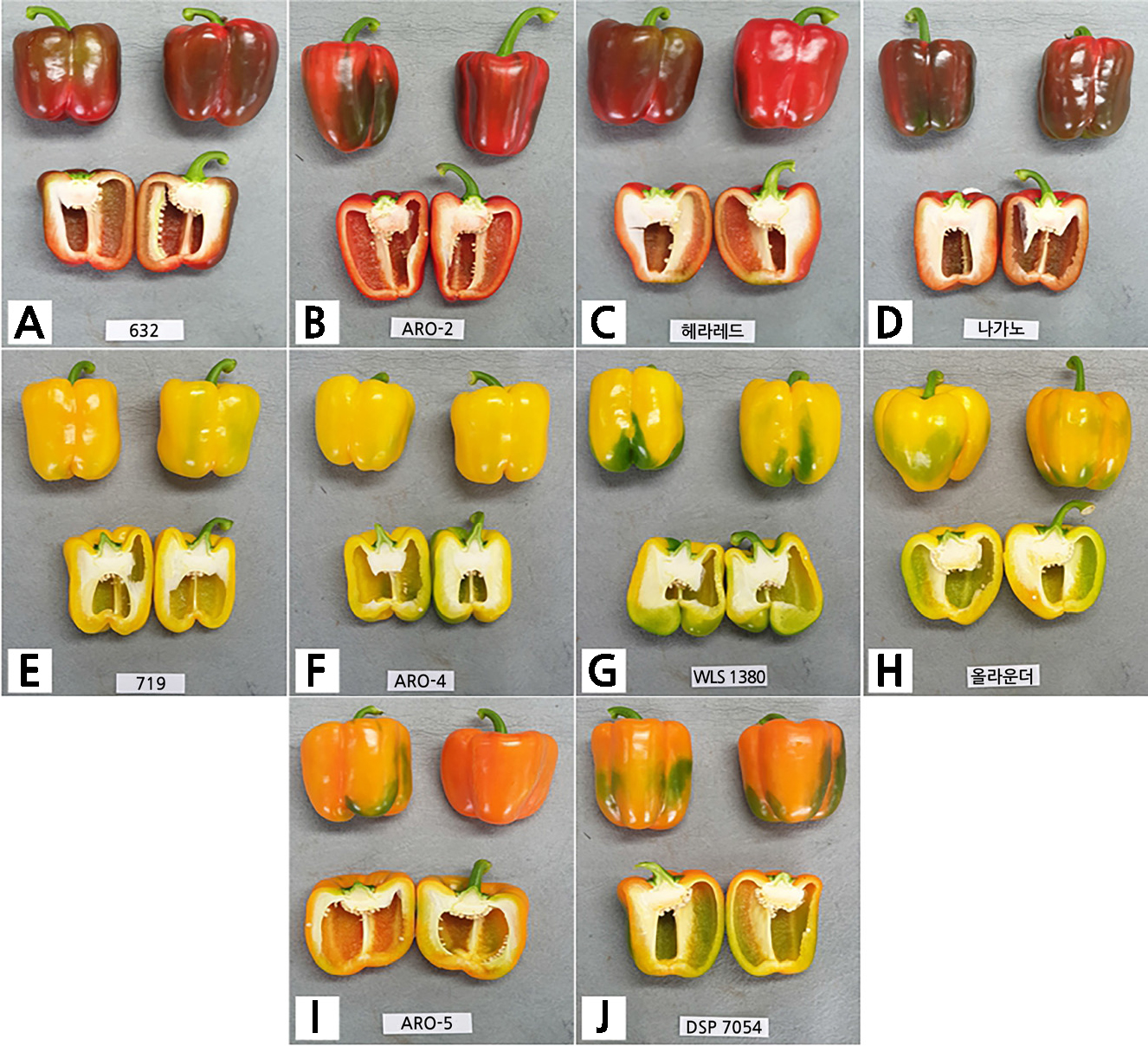
To examine the fruit colors in details, color traits of the fruits were measured from each cultivar (Fig. 2). ‘ARO-2’ and ‘HeraRed’ showed significantly higher color a* (p < 0.05) than ‘632’ and ‘Nagano’, the other red cultivars. The yellow ‘WLS1380’ and ‘Allrounder’ showed significantly higher chroma values (p < 0.01) and color b* (p < 0.05) than the other yellow cultivars ‘719’ and ‘ARO-4’. The orange ‘ARO-2’ cultivar exhibited significantly higher L*/a*/b* values (p < 0.05) than the orange ‘DSP7054’ cultivar (L*/a*/b*; data not shown).
Yield Characteristics
To examine the yield characteristics of the sweet peppers tested here, the total and marketable yields were examined for each cultivar (Table 6). The top four cultivars with the highest total yields were yellow ‘Allrounder’ at 5.9 kg/plant, yellow ‘719’ at 5.4 kg/plant, and both red ‘Nagano’ and orange ‘ARO-5’ at 5.3 kg/plant. On the other hand, the three cultivars with the lowest total yield were red ‘ARO-2’ at 4.3 kg/plant, orange ‘DSP7054’ at 4.9 kg/plant, and yellow ‘ARO-4’ at 4.9 kg/plant. In addition to the highest total yield, ‘Allrounder’ produced the highest number of total fruits with 33.0 fruits per plant, followed by orange ‘ARO-5’ with 32.3 fruits per plant, whereas yellow ‘WLS1380’ had the lowest number of total fruits with 24.7 fruits per plant.
Table 6.
Fruit yield characteristics of ten sweet pepper cultivars harvested from May 22 to October 28, 2020 in a plastic greenhouse located in Inje, Gangwon province, South Korea (n = 50)
| Color | Cultivar | Total yield per plant | Marketable yield per plant |
Ratio of marketable yield (%) | ||||
| No. of fruits | Weight (kg) | Avg. fruit weight (g) | No. of fruits | Weight (kg) | ||||
| Red | 632 | 26.3 bz | 5.0 bc | 189.3 bc | 22.9 ab | 4.5 abc | 90.2 a | |
| ARO-2 | 24.9 b | 4.3 c | 171.3 def | 17.2 c | 3.3 d | 77.8 d | ||
| HeraRed | 28.1 ab | 5.2 ab | 185.4 cd | 24.1 ab | 4.6 ab | 89.2 ab | ||
| Nagano | 29.3 ab | 5.3 ab | 182.2 cde | 25.0 ab | 4.7 ab | 88.2 abc | ||
| Yellow | 719 | 26.4 b | 5.4 ab | 203.7 ab | 20.8 bc | 4.4 abc | 81.6 cd | |
| ARO-4 | 29.3 ab | 4.9 bc | 168.2 ef | 23.1 ab | 4.1 bcd | 82.7 bcd | ||
| WLS1380 | 24.7 b | 5.2 ab | 211.4 a | 21.6 ab | 4.7 ab | 90.5 a | ||
| Allrounder | 33.0 a | 5.9 a | 178.0 cdef | 26.1 a | 5.0 a | 84.7 abc | ||
| Orange | ARO-5 | 32.3 a | 5.3 ab | 163.0 f | 21.8 ab | 3.8 cd | 71.5 e | |
| DSP7054 | 28.2 ab | 4.9 bc | 174.1 cdef | 23.6 ab | 4.2 abc | 86.0 abc | ||
As for the marketable yields, ‘Allrounder’ produced the highest marketable yield at 5.0 kg/plant, followed by both ‘WLS1380’ and red ‘Nagano’ at 4.7 kg/plant and ‘HeraRed’ at 4.6 kg/plant. The ‘ARO-5’ and ‘ARO-2’ cultivars had the lowest marketable yields at 3.8 and 3.3 kg/plant, respectively. ‘Allrounder’ produced the highest number of marketable fruits at 26.1 fruits per plant, followed by ‘Nagano’ at 25.0 fruits per plant, ‘HeraRed’ at 24.1 fruits per plant, and ‘DSP7054’ at 23.6 fruits per plant. The ‘ARO-2’ and ‘710’ cultivars produced the lowest number of marketable fruits per plant at 17.2 and 20.8 fruits per plant, respectively. Among the red cultivars, three cultivars, ‘Nagano’, ‘HeraRed’, and ‘632’, had similar marketable yields and marketable fruits per plant; the ‘ARO-2’ cultivar was significantly less productive than the other three cultivars (p < 0.05). Among the four yellow cultivars, the two control cultivars ‘Allrounder’ and ‘WLS1380’ produced higher marketable yields than the two new cultivars ‘ARO-4’ and ‘719’. ‘ARO-4’ produced the second-highest number of marketable fruits, but its marketable yield was lowest, even lower than those of ‘WLS1380’ and ‘719’ which produced fewer fruits. Thus, the fruit weight is lower in ‘ARO-4’ compared to the other yellow cultivars. In the two orange cultivars, ‘DSP7054’ had slightly more marketable fruits and a higher yield than ‘ARO-5’, but these differences were not significant.
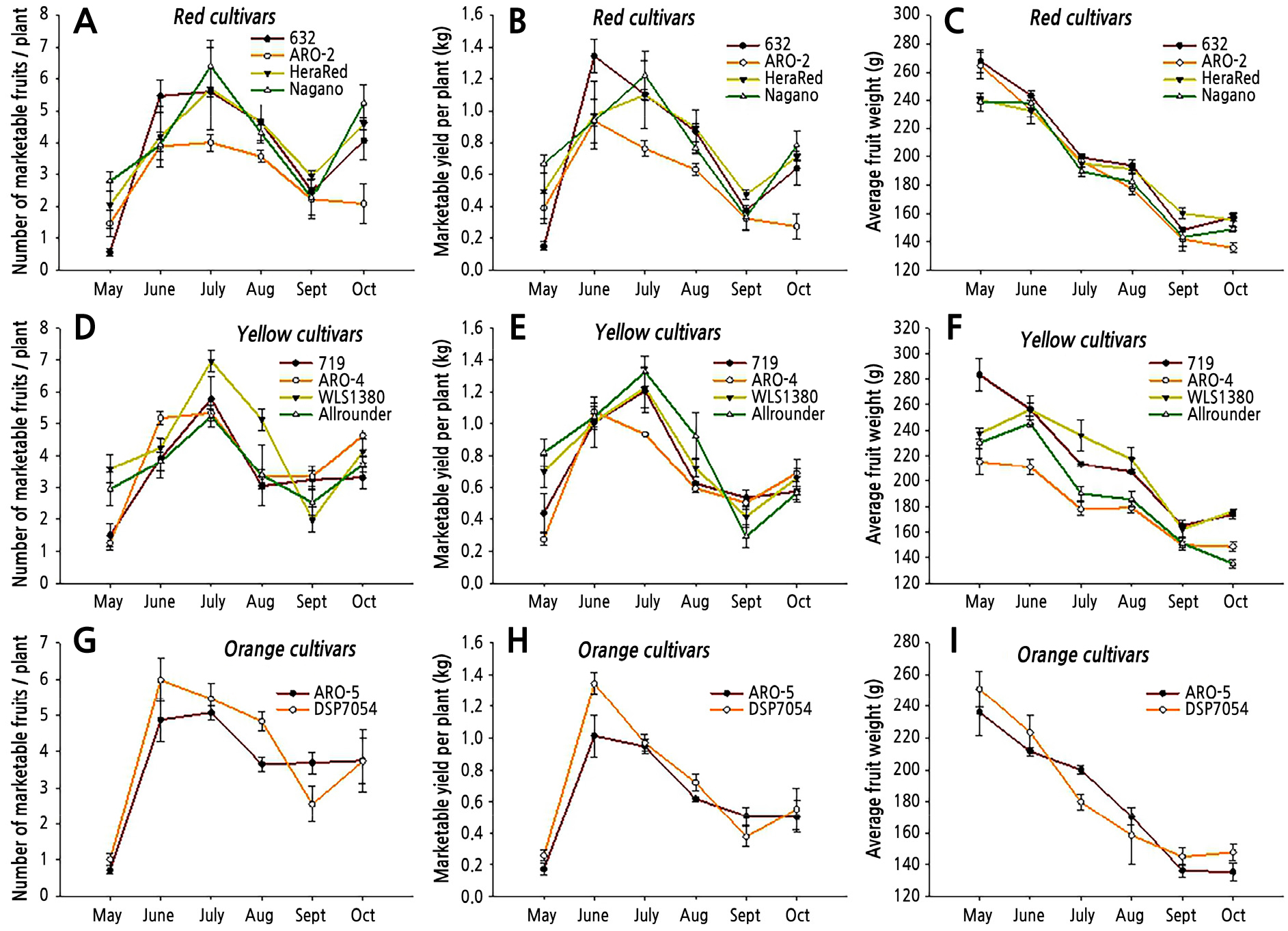
Given that sweet pepper production is associated with large fluctuations in the fruit yield throughout the harvest season (Suppl. Fig. 2s), it is important to examine changes in monthly yields. The number of marketable fruits peaked in June and July, gradually decreased, and then increased slightly in October (Fig. 3A-3C). Similarly, the marketable yields peaked in June and July and then decreased gradually in all cultivars (Fig. 3D-3F). Among the red cultivars, ‘HeraRed’ showed a yield pattern similar to that of the control ‘Nagano’ (Fig. 3D). Within the yellow cultivars, the ‘719’ cultivar showed similar monthly marketable yields to ‘WLS1380’, but not to the other control ‘Allrounder’ (Fig. 3E). The monthly mean fruit weight decreased sharply in all cultivars after June (Fig. 3G-3I). Among the yellow cultivars, ‘719’ and ‘WLS1380’ showed higher monthly mean fruit weights than ‘Allrounder’ and ‘ARO-4’ (Fig. 3H).
Principal Component Analysis and Partial Correlation Analysis
PCA and partial correlation analyses were conducted to investigate whether there were any correlations among the plant traits. PCA was conducted using seven growth traits from 50-day-old plants that resulted in two groups, one with three traits (fruit size, number of fruit sets, and number of branches) and the other with four traits (main stem length and diameter, plant height, and leaf area), indicating that the traits grouped together are likely positively related (Fig. 4A). The partial correlation analysis indicated a negative correlation between fruit size (Frs) and main stem length (Msl). On the other hand, Frs showed a positive correlation with the number of fruit sets (Nofs) and the number of branches (Brn). However, leaf area (Lfa) did not strongly correlate with the other traits (Fig. 4B).
Nine traits were used for PCA and partial correlation analyses to examine the correlations among the fruit traits. The PCA results showed that the nine traits could be divided into two groups, one with four traits (fruit size, locule number, weight, and pericarp thickness) and the other with five traits (stalk length and width, fruit hardness and shape index, and sugar content). These results indicate that fruit weight is strongly correlated with the number of locules and the pericarp thickness (Fig. 4C). The partial correlation confirmed the PCA results in that the fruit weight (Wgh) and locule number (lcl) showed a strong positive correlation (Fig. 4D). The partial correlation also revealed that the fruit weight (Wgh) is negatively correlated with the fruit shape index (Fri) and stalk length (Stl). The pericarp thickness (Prt) has a strong negative correlation with the sugar content (Sgc) (Fig. 4D).
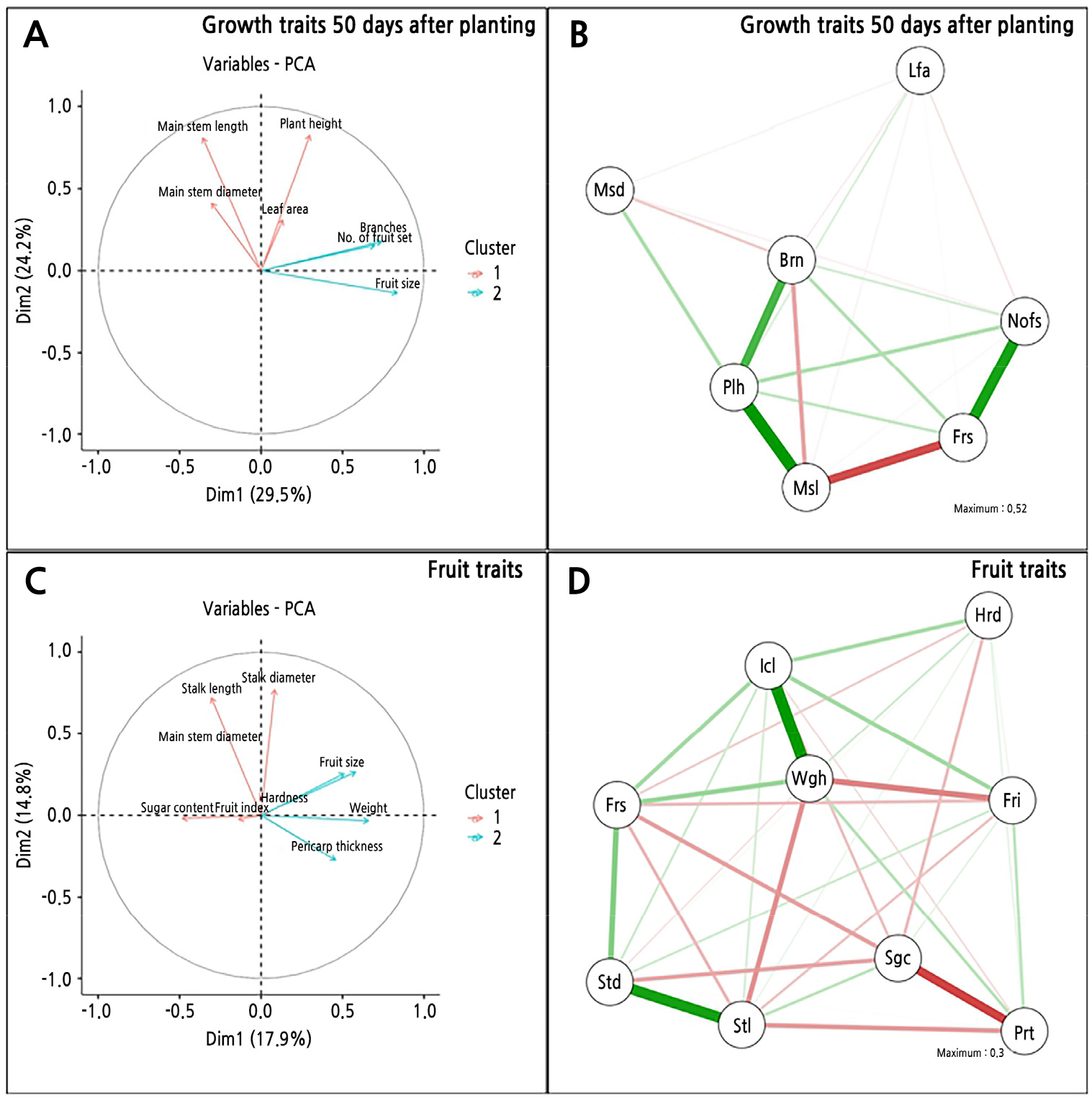
Fig. 4.
Principal component analysis (PCA) plots and partial correlation analysis results based on growth and fruit traits using the Jamovi statistic tool. A-B. PCA cluster plot and partial correlation result based on the variables (traits) of 50-day-old plants after planting. Abbreviation of variables (traits): Lfa, leaf area; Msd, main stem diameter; Brn, number of branches; Plh, plant height; Msl, main stem length; Frs, fruit size; Nofs, number of fruit sets. C-D. PCA cluster plot and partial correlation result based on variables from fruits harvested during Aug. 10 ‒ Sept. 7, 2020. Correlations among traits in the partial correlation analysis are indicated by the red line for negative and by the green line for positive correlations. Abbreviation of variables (traits): Lcl, locule number; Hrd, fruit hardness; Frs, fruit size; Wgh, fruit weight; Fri, fruit shape index; Std, stalk diameter; Stl, stalk length; Sgc, sugar content; Prt, pericarp thickness.
Discussion
Productive sweet pepper cultivation is dependent on maintaining an adequate mean daily temperature. A previous study indicated that the highest yield for the ‘Delphin’ cultivar is achieved with a mean daily temperature of 21–21.5°C (Bakker and van Uffelen, 1988). Furthermore, the nighttime temperature is important for obtaining optimum yields, as normal flowering and fruit setting are difficult to achieve when nighttime temperatures are lower than 16–18°C (Pressman et al., 1998; Myung et al., 2012). However, it is too costly to maintain such high daily and nighttime temperatures in areas such as those in the northern region of South Korea during a cold winter. Therefore, cultivation practices vary between the northern and southern regions of South Korea; in the southern regions, harvesting begins in November after seeds are sown from July to September, whereas harvesting occurs in the northern regions in June through December after seeds are sown in January through March (Jeong et al., 2008). Despite such differences in the growing periods and cultivation environments between the two regions, only a few studies have examined suitable cultivars for the northern region of South Korea (Won et al., 2009; Jang et al., 2016). Therefore, it is important to identify or develop new varieties that perform well in the northern region. This study was conducted to examine the suitability of the new domestically developed varieties of sweet pepper for summer cropping in the northern region of South Korea.
A previous study indicated that seedling quality is important for vegetative growth and yield (Markovic et al., 2000). Here, based on various seedling growth parameters, two control cultivars, ‘DSP7054’ and ‘WLS1380’, exhibited good seedling quality in terms of the plant height, leaf area and number, and stem diameter (Table 2). After 50 days of cultivation, ‘WLS1380’ exhibited decent yield-related characteristics with a relatively high number of fruit sets and a large fruit size, but such characteristics were not found in ‘DSP7054’ (Table 3). These data suggest that good vegetative growth during the early developmental stage is not necessarily positively correlated with good traits related to early yields. Furthermore, we observed that the plant height during the early developmental stage did not correlate with the final plant height (Suppl. Fig. 3s).
In addition, a partial correlation analysis was conducted identify any possible correlations within the fruit traits. One of the partial correlations revealed that there was a strong negative correlation between the soluble sugar content and the pericarp thickness (Fig. 4D). This correlation can be similarly inferred from previous studies (Ha et al., 2012; Yeo et al., 2021). Thus, the correlation between the sugar content and pericarp thickness can be utilized when characterizing fruit traits. However, the other correlations found in this study require further verification through future studies or more with a thorough literature search.
One of the most important factors when introducing new sweet pepper cultivars is the yield, as new cultivars must yield steady production of high-quality fruits during the growing period. Among the ten cultivars tested here, a yellow control cultivar (‘Allrounder’) showed the highest total yield with 5.9 kg per plant, of which 5.0 kg per plant was marketable. The next five cultivars with the highest total yields were the red ‘Nagano’ and ‘HeraRed’, orange ‘ARO-5’, and yellow ‘WLS1380’ and ‘719’, of which the total yields ranged from 5.2 to 5.4 kg per plant (Table 6). However, only ‘WLS1380’, ‘Nagano’, and ‘HeraRed’ showed high marketable yields at 4.6–4.7 kg per plant (Table 6).
The monthly marketable yield was lower in May overall, but the yields peaked in June-July (Fig. 3D-3F). Yields gradually decreased in all cultivars thereafter but showed a slight increase overall in October. This gradual decrease in the sweet pepper yield may be common in summer cropping practices in Korea, as similar trends were also reported previously (Won et al., 2009; Yeo et al., 2021). This decrease is likely caused by elevated daytime and nighttime greenhouse temperatures due to extremely high outside temperatures. Thus, plant respiration rates increase during the night, which could be exacerbated by shading to prevent temperature rises in the greenhouse during the day, thus reduced assimilate accumulation by photosynthesis.
Based on the total marketable yield characteristics, ‘Allrounder’ was the best cultivar among the yellow cultivars, and its marketable yield could be improved with better management because it produced a relatively high nonmarketable yield. The two new yellow cultivars ‘719’ and ‘ARO-4’ did not perform well in terms of their marketable yields compared to the two control cultivars ‘WLS1380’ and ‘Allrounder’. Therefore, these new cultivars may not be good candidates for replacing the yellow control cultivars. However, ‘719’ produced slightly more fruits and a higher total yield than ‘WLS1380’, meaning that it can be considered a candidate if the ratio of the marketable yield is improved to match that of ‘WLS1380’. Among the red cultivars, the two new cultivars ‘HeraRed’ and ‘632’ exhibited marketable yields comparable to ‘Nagano’, indicating that these two cultivars can be candidates for replacing red ‘Nagano’ after further evaluations. Among the orange cultivars, the new cultivar ‘ARO-5’ produced significantly higher total fruits and total yield compared to ‘DSP7057’, but its marketable yield and marketable fruit ratio were very low compared to those of the control ‘DSP7054’. Therefore, further testing of ‘ARO-5’ to improve the ratio of its marketable yield is necessary for ‘ARO-5’ to be a candidate for replacing ‘DSP7054’. Overall, three out of the six new cultivars (‘Nagano’, ‘632’, and ‘719’) had higher marketable yields than at least one control cultivar (‘DSP7054’) when color was not considered.
Sweet pepper is mostly sold to wholesalers through auctions in South Korea. During 2019–2021, the average monthly sweet pepper auction price in May–Oct ranged from 3,512 to 8,891 KRW/kg according to the Seoul Agro-Fisheries & Food Corporation (https://www.garak.co.kr), and during the same period the auction price was especially high in Aug–Oct due to the Chuseok holiday in South Korea. In particular, ‘HeraRed’ and ‘ARO-5’ showed the highest production during Aug–Oct (Suppl. Table 1s). Among the red cultivars, ‘HeraRed’ resulted in the highest gross income, followed by ‘Nagano’ and ‘632’ (Suppl. Table 1s). In the yellow cultivars, two control cultivars (‘Allrounder’ and ‘WLS1380’) showed higher gross incomes than two new cultivars. Two orange cultivars were ranked 7th (‘DSP7054) and 9th (‘ARO-5’) among the ten cultivars in terms of the marketable yield, but they were the top two cultivars with the highest gross income levels among all cultivars (Suppl. Table 1s), an outcome likely due to the auction price, which was high for orange sweet pepper during 2019–2021 according to the Seoul Agro-Fisheries & Food Corporation. As described earlier, sweet pepper production in South Korea is highly reliant on exports. Approximately 34–45% of annual sweet pepper production is exported, accounting for 82.1–89.5 million dollars during 2017–2021 (KOSIS, 2023). During the same period, however, domestic gross income from sweet pepper production was not influenced by exports. Overall, these results suggest that the most important factor when selecting a suitable cultivar is the marketable yield. Among the six new cultivars, ‘HeraRed’ is only cultivar possibly capable of replacing the red control cultivar. However, our data present only a limited information about these new six cultivars for their performance in summer cropping practice, so further evaluation trials for these cultivars would be necessary to obtain more reliable information about their performance.
Supplementary Material
Supplementary materials are available at Horticultural Science and Technology website (https://www.hst-j.org).
- HORT_20230025_Table_1s.pdf
Marketable yield and gross income based on auction price. Auction price is high during August through October because of the Chuseok holiday in South Korea.
- HORT_20230025_Figure_1s.pdf
Environmental conditions of greenhouse during the experiment
- HORT_20230025_Figure_2s.pdf
Percentage of fruit setting at each node from node #1 ~ #40 (n=10).
- HORT_20230025_Figure_3s.pdf
Changes in plant height in three different developmental stages, initial seedling stage, 50-day-old stage after planting, and final growth stage
