

Introduction
Materials and Methods
Plant materials
Self-pollination of microspore-derived plants and crossing with MS lines
Seed germination and seedling preparation
Evaluation of selfed progenies and F1 hybrids
Statistical analysis
Results
Self-pollination and seed characteristics of microspore-derived plants
Horticultural evaluation of selfed progenies derived from DH lines
F1 Seed production from crosses between MS lines and microspore-derived plants
Horticultural evaluations of F1 combinations in Jeju and Yeoju
Discussion
Conclusion
Introduction
Cabbage (Brassica oleracea L. var. capitata) is one of the most widely consumed Brassica vegetables worldwide owing to its affordability, wide availability, and nutritional value (Moreb et al. 2020). Brassica vegetables contain various bioactive compounds, including glucosinolates and antioxidant compounds, which have been associated with health-promoting attributes, such as anticancer and/or cytoprotective effects (Maggioni et al. 2018; Sharma et al. 2023). In the Republic of Korea, cabbage is consumed raw and can be found in stir-fried and steamed dishes as well (Park et al. 2014). In 2024, cabbage production reached 340,852 tons, accounting for approximately 13.9% of the total leafy vegetable production in Korea. Among production regions, Jeju Province produced 126,230 tons, representing approximately 37.0% of national cabbage production (KOSIS 2025).
However, most cabbage cultivars grown in Korea have been bred from germplasm introduced from Europe, the United States, and Japan (Ministry of Agriculture, Food and Rural Affairs and Korea Agro-Fisheries & Food Trade Corporation 2020). In addition, domestic cabbage seed accounted for only 14.5% of the Korean cabbage seed market in 2018, based on an industry estimate reported by IPET, highlighting the need to develop and disseminate high-quality domestic cabbage cultivars (IPET 2020). Therefore, the development of high-quality domestic F1 cabbage cultivars is essential for strengthening the competitiveness of the Korean cabbage seed industry.
F1 hybrid breeding requires the establishment of genetically uniform parental lines with stable agronomic traits. However, conventional inbred line development through repeated self-pollination requires several generations and is therefore labor-intensive and time-consuming (Ferrie and Caswell 2011; Mineykina et al. 2021). Doubled haploid (DH) technology, particularly isolated microspore culture technology, enables the rapid production of completely homozygous lines and has been used in Brassica breeding to accelerate the development of parental lines for hybrid cultivars (Arabzai et al. 2025). Nevertheless, the production of DH lines alone is not sufficient for cultivar development. For practical F1 breeding, selected DH lines must be evaluated for self-seed production, fertility, crossability, and for their ability to generate promising hybrid combinations (Rudolf-Pilih et al. 2019).
In cabbage, previous studies mainly focused on microspore embryogenesis, plant regeneration, chromosome doubling, and ploidy confirmation (Rudolf et al. 1999; Yuan et al. 2015). However, reports focusing on the practical use of microspore-derived cabbage DH lines as parental materials for selfing, crossing, and F1 hybrid production remain scarce. A similar breeding approach has been reported in broccoli, where microspore-derived DH lines were self-pollinated, crossed with a male-sterile line, and used to develop F1 hybrid candidates, demonstrating the practical utility of DH lines in Brassica vegetable breeding (Kwak et al. 2012).
Male-sterile (MS) lines are widely used for efficient F1 hybrid seed production because they prevent self-pollination of the female parent and enable the production of genetically pure hybrid seeds (Yamagishi and Bhat 2014). The breeding value of selected DH lines should also be assessed based on their crossability with MS lines and the agronomic performance of the resulting F1 hybrids (Singh et al. 2019). In addition, F1 hybrid candidates should be evaluated in target cultivation regions to identify genotypes with stable agronomic performance and regional adaptability (Prus and Piepho 2021).
In this study, selected cabbage micropore-derived plants were self-pollinated and crossed with MS lines to produce F1 hybrid combinations. The breeding utility of these plants was evaluated based on the seed set, seed productivity, germination rate, and the horticultural traits and head quality of the resulting selfed progenies and F1 hybrids under different cultivation environments. The objective of this study was to identify promising parental lines and F1 hybrid combinations for the development of domestic cabbage cultivars.
Materials and Methods
Plant materials
Nine microspore-derived regenerants of cabbage (Brassica oleracea L. var. capitata) were used in this study. These plants were obtained from the donor genotype ‘SJ-Ca 13’, as described previously (Choi et al. 2026). Based on ploidy analysis results reported in earlier work by the authors, the nine microspore-derived regenerants consisted of six spontaneous diploids and three tetraploids, designated CDH 1 through CDH 9. These plants were maintained under greenhouse conditions and used for the subsequent self-pollination and seed production experiments.
For F1 hybrid production, three male-sterile (MS) cabbage breeding lines (SJ-Ca MS 1, SJ-Ca MS 2, and SJ-Ca MS 3) provided by DASAN Co., Ltd., Korea, and maintained at the Radish Breeding Laboratory, Sejong University, Korea, were used in this study.
The commercial cabbage cultivars ‘Matsumo’ (Taewoo Seed Co., Ltd., Yongin, Korea) and ‘Goeul Plus’ (Haesung Seed Co., Ltd., Busan, Korea) were used as control cultivars.
Self-pollination of microspore-derived plants and crossing with MS lines
Microspore-derived plants were subjected to bud self-pollination to produce seeds for the evaluation of selfed progenies. For self-pollination, flower buds were carefully opened using sterile forceps, and the stamens were removed. After emasculation, a mature flower with dehiscent anthers from the same plant was gently rubbed against the stigma of the emasculated flower bud to deposit pollen.
A total of 27 cross combinations were performed using nine microspore-derived plants as pollen parents and three MS lines as female parents, covering all possible combinations. Fresh pollen was collected from newly opened flowers of microspore-derived plants and used immediately to hand-pollinate the stigmas of the MS line flowers. After self-pollination or hand crossing, the pollinated flowers were covered with paper bags to prevent contamination by unwanted pollen (Fig. 1A).

Fig. 1.
Overview of the seed production and evaluation process using microspore-derived plants and MS lines in cabbage: (A) Bagged flowers after self-pollination and hand crossing, (B) harvested pods air-dried under greenhouse conditions, (C) germinated seedlings in 218-cell plug trays, (D) transplanted plants in the open field in Jeju, and field views of the F1 combination evaluations at harvest in (E) open field in Jeju and (F) the Yeoju plastic greenhouse, Korea.
Mature pods obtained from both self- and cross-pollination were harvested and air-dried under greenhouse conditions with natural light (Fig. 1B). Seeds were extracted from dried pods, and the total number of pods and seeds was recorded for each self-pollinated plant or cross combination. The number of seeds per pod was calculated using the following formula: seeds per pod = total number of seeds/total number of pods.
Seed germination and seedling preparation
Self-pollinated seeds from microspore-derived plants and F1 seeds from the crosses were sown in 218-cell plug trays filled with a commercial horticultural substrate (Fig. 1C) (Baroker, Seoul Bio Co., Ltd., Eumseong, Korea). The germination rate was recorded eight days after sowing and calculated using the following formula: germination rate (%) = number of germinated seeds/number of sown seeds × 100. Seedlings were transplanted approximately one month after sowing (Fig. 1D).
Evaluation of selfed progenies and F1 hybrids
The selfed progenies of DH lines and F1 hybrid combinations were evaluated in an open field in Sindo-ri, Daejeong-eup, Seogwipo-si, Jeju, Korea (Fig. 1E). Additionally, F1 hybrid combinations were evaluated in a single-span plastic greenhouse in Yanggui-ri, Yeoju-si, Gyeonggi-do, Korea (Fig. 1F). Plants were spaced 30 cm apart within rows, with 55 cm spacings between the rows.
Owing to insufficient seed production, selfed progenies from only five diploid (DH) lines (CDH 4, 5, 6, 8, and 9) were available for horticultural evaluations. Among the F1 hybrid combinations, eleven were evaluated in Jeju, whereas nine were evaluated in Yeoju because two combinations had insufficient plant numbers for a horticultural evaluation. The commercial cultivars used as controls were included as described above. For each DH line and F1 combination, three individual plants were evaluated (n = 3), with each plant considered a biological replicate.
Horticultural traits were evaluated in November 2025, 70 days after transplanting. Horticultural traits were evaluated according to the cabbage characterization guidelines (Korea Seed & Variety Service 2023). The evaluated traits included the head weight, head diameter, head height, and core ratio. The core ratio was calculated using the following formula: core ratio = core length/head height. Promising F1 combinations were selected primarily based on a head weight of approximately 1 kg or greater and seed productivity of more than seven seeds per pod, with the head morphology, internal head density, and core ratio also considered in the overall evaluation.
Statistical analysis
Statistical analyses were conducted using R version 4.3.1 (R Foundation for Statistical Computing, Vienna, Austria). Considering that the two cultivation environments were evaluated independently to identify promising F1 combinations under each cultivation environment, all statistical analyses were conducted separately for each location. Data were subjected to one-way ANOVA, and mean comparisons among lines were performed using Duncan’s multiple range test at p < 0.05.
Results
Self-pollination and seed characteristics of microspore-derived plants
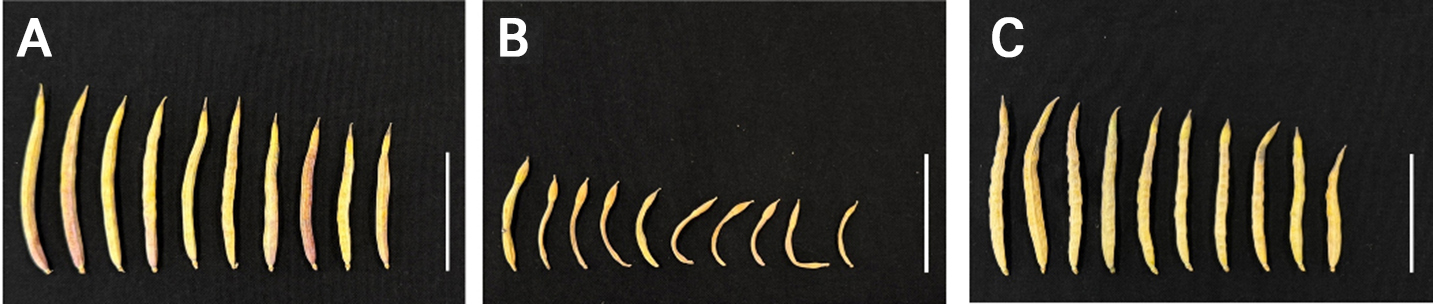
Following self-pollination, pods and seeds were produced by all microspore-derived plants, although the seed productivity and pod morphology varied considerably among the plants (Table 1 and Fig. 2). The tetraploid plants (CDH 1, CDH 2, and CDH 3) produced relatively few pods and seeds, with the number of seeds per pod remaining well below 0.5. The pods in these cases were also noticeably shorter than those of the donor genotype ‘SJ-Ca 13’ (Fig. 2A), often with an enlarged distal end but a poorly developed seed-bearing region (Fig. 2B). Seeds from CDH 2 failed to germinate, preventing progression to the next generation. In contrast, most diploid plants exhibited germination rates of at least 85%. Although CDH 7 was diploid, it also showed relatively poor seed production. Overall, the number of seeds per pod in all microspore-derived plants was lower than that of the donor genotype ‘SJ-Ca 13’ (11.35 seeds per pod).
Table 1.
Pod number, seed number, seeds per pod, and germination rate of self-pollinated microspore-derived plants and the donor genotype ‘SJ-Ca 13’ in cabbage
Horticultural evaluation of selfed progenies derived from DH lines
The horticultural evaluation in Jeju revealed significant differences in the head weight and head diameter between ‘SJ-Ca 13’ and the selfed progenies of five DH lines (Table 2). Among the progenies, CDH 9 showed the greatest head weight at 324.17 ± 48.05 g and the greatest head diameter at 8.83 ± 0.76 cm, both of which were significantly greater than those of the donor genotype ‘SJ-Ca 13’. CDH 8 exhibited a relatively large head diameter of 7.70 ± 0.26 cm, which did not differ significantly from that of the donor genotype. Head height ranged from 7.50 to 9.63 cm and the core ratio from 0.32 to 0.42, neither of which differed significantly among the evaluated progenies. Differences in the external head appearance and longitudinal head morphology were observed among the selfed cases. In particular, CDH 8 showed greater overlapping of the wrapper leaves, whereas CDH 9 exhibited a relatively round head shape in the longitudinal section (Fig. 3).
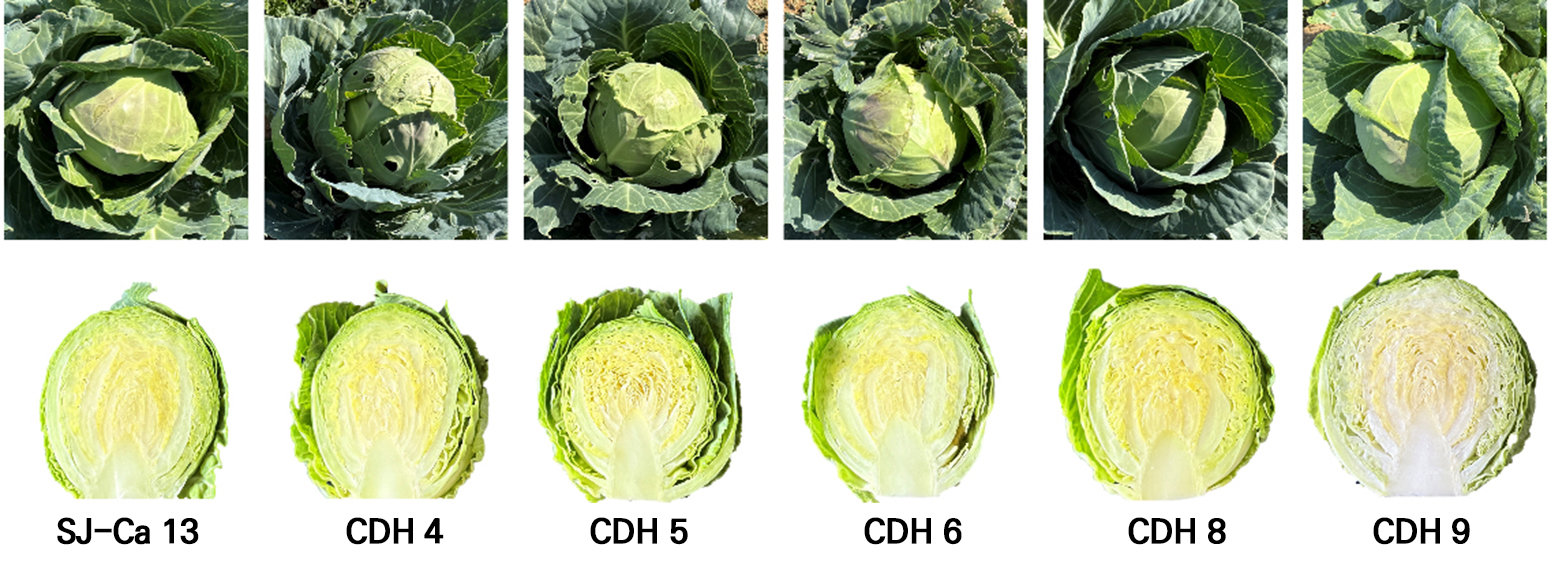
Table 2.
Horticultural traits of self progenies from five DH lines of the cabbage ‘SJ-Ca 13’ at 70 days after transplanting
F1 Seed production from crosses between MS lines and microspore-derived plants
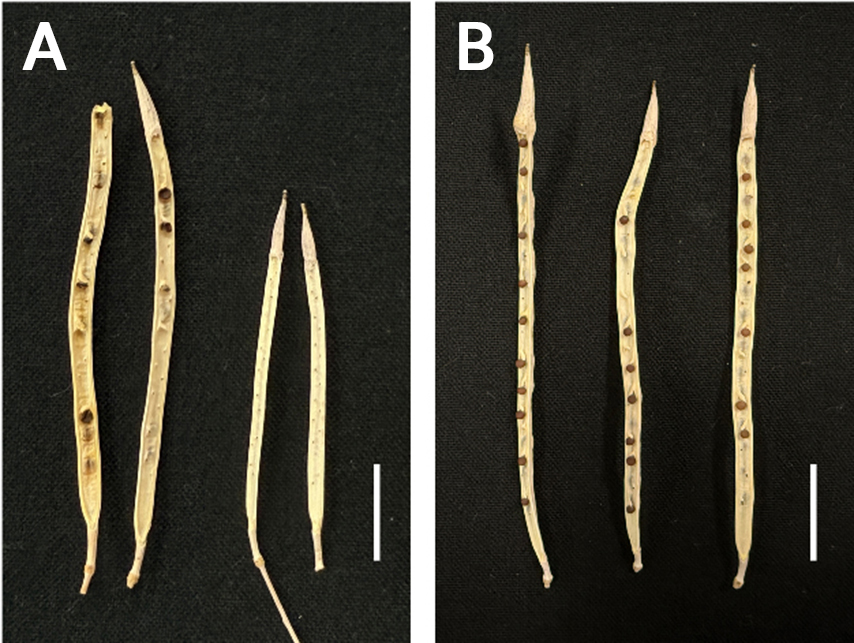
Seed production varied considerably among the 27 crosses between three MS lines and nine microspore-derived plants (Table 3). Crosses with tetraploid plants showed poor seed set. The pods from these crosses were shorter than those from crosses with diploid plants, and few or no mature seeds were found when the pods were opened (Fig. 4). Seeds were obtained from four combinations, but germination was 0% in all cases, confirming failure to produce triploid F1 progeny.
Table 3.
Pod number, seed number, seeds per pod, and germination rate of crosses between MS lines and microspore-derived plants of the cabbage ‘SJ-Ca 13’
| Female parent | Pollen parent | Pod number | Seed number | Seeds per pod | Germination rate (%) |
| SJ-Ca MS 1 | CDH 1 * | 48 | 51 | 1.06 | 0.00 |
| CDH 2 * | 0 | 0 | 0.00 | 0.00 | |
| CDH 3 * | 47 | 14 | 0.30 | 0.00 | |
| CDH 4 | 45 | 235 | 5.22 | 66.67 | |
| CDH 5 | 40 | 288 | 7.20 | 90.48 | |
| CDH 6 | 38 | 77 | 2.03 | 80.95 | |
| CDH 7 | 0 | 0 | 0.00 | 0.00 | |
| CDH 8 | 23 | 120 | 5.22 | 85.71 | |
| CDH 9 | 35 | 181 | 5.17 | 71.43 | |
| SJ-Ca MS 2 | CDH 1 * | 7 | 0 | 0.00 | 0.00 |
| CDH 2 * | 0 | 0 | 0.00 | 0.00 | |
| CDH 3 * | 5 | 0 | 0.00 | 0.00 | |
| CDH 4 | 8 | 18 | 2.25 | 57.14 | |
| CDH 5 | 7 | 8 | 1.14 | 100.00 | |
| CDH 6 | 47 | 37 | 0.79 | 57.14 | |
| CDH 7 | 0 | 0 | 0.00 | 0.00 | |
| CDH 8 | 0 | 0 | 0.00 | 0.00 | |
| CDH 9 | 78 | 105 | 1.35 | 80.95 | |
| SJ-Ca MS 3 | CDH 1 * | 16 | 3 | 0.19 | 0.00 |
| CDH 2 * | 0 | 0 | 0.00 | 0.00 | |
| CDH 3 * | 73 | 65 | 0.89 | 0.00 | |
| CDH 4 | 59 | 12 | 0.20 | 0.00 | |
| CDH 5 | 0 | 0 | 0.00 | 0.00 | |
| CDH 6 | 76 | 378 | 4.97 | 71.43 | |
| CDH 7 | 0 | 0 | 0.00 | 0.00 | |
| CDH 8 | 48 | 346 | 7.21 | 85.71 | |
| CDH 9 | 0 | 0 | 0.00 | 0.00 |
In contrast, crosses with diploid plants produced more seeds, although seed production differed considerably among the cross combinations. When used as the female parent, SJ-Ca MS 1 produced seeds in most combinations, whereas SJ-Ca MS 2 showed the lowest seed production, with no seeds obtained in five combinations. Seed production with SJ-Ca MS 3 differed markedly among pollen parents, with relatively high seed numbers per pod in crosses with CDH 6 and CDH 8, but little or no seed production in several other combinations. Among the diploid combinations, the highest seed numbers per pod were observed in SJ-Ca MS 1 × CDH 5 and SJ-Ca MS 3 × CDH 8, both exceeding 7.0 seeds per pod.
Horticultural evaluations of F1 combinations in Jeju and Yeoju
The horticultural traits of the F1 combinations derived from crosses between MS lines and microspore-derived DH lines were evaluated at two locations, Jeju and Yeoju. Significant variation was observed among the F1 combinations with regard to the head weight, head diameter, head height, and core ratio at each location (Tables 4 and 5).
Table 4.
Horticultural traits of eleven F1 combinations produced from crosses between MS lines and DH lines derived from the cabbage ‘SJ-Ca 13’ at 70 days after transplanting in Jeju
Table 5.
Horticultural traits of 9 F1 combinations produced from crosses between MS lines and DH lines derived from the cabbage ‘SJ-Ca 13’ at 70 days after transplanting in Yeoju
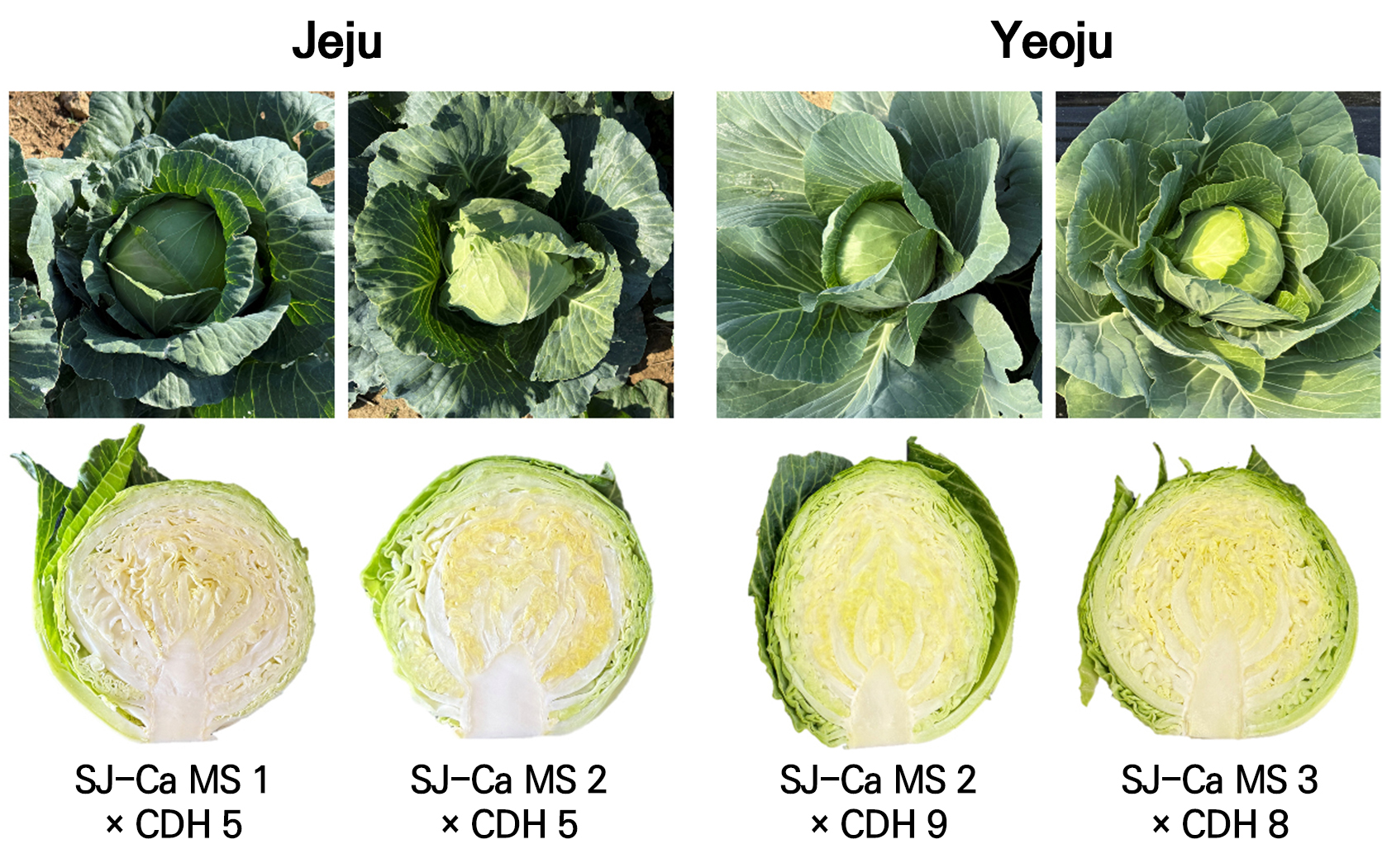
In Jeju, SJ-Ca MS 1 × CDH 5 showed the highest head weight (1462.00 ± 345.94 g) among all F1 combinations, with a value significantly greater than that of the commercial cultivars Matsumo (942.33 ± 133.98 g) and Goeul Plus (356.16 ± 120.55 g). This combination also exhibited a nearly equal head diameter (14.63 ± 2.51 cm) and head height (15.36 ± 1.35 cm), indicating a round head shape, and was selected as a promising F1 combination. SJ-Ca MS 2 × CDH 5 also exhibited a relatively high head weight (959.00 ± 284.96 g) with a compact, well-filled internal structure, a yellowish interior, and a low core ratio (0.29 ± 0.03), indicating favorable head density and internal quality characteristics (Fig. 5).
In Yeoju, SJ-Ca MS 3 × CDH 8 had the highest head weight (1337.00 ± 120.61 g) among all F1 combinations, comparable to the commercial cultivars Matsumo (922.00 ± 388.31 g) and Goeul Plus (1259.66 ± 384.55 g), with a nearly equal head diameter (14.83 ± 0.28 cm) and head height (15.00 ± 0.50 cm), indicating a round head shape, and was selected as a promising F1 combination. SJ-Ca MS 2 × CDH 9 also exhibited a relatively high head weight (1303.33 ± 79.00 g), the greatest head height (17.16 ± 0.76 cm), and a low core ratio (0.27 ± 0.02), but this sample showed a relatively elongated head shape (Fig. 5).
Discussion
Doubled haploid (DH) technology offers substantial advantages for plant breeding and genetic research by enabling the rapid production of completely homozygous lines within a single generation (Dunwell 2010). In cabbage, several studies have aimed to overcome this limitation by optimizing key factors affecting microspore embryogenesis and DH plant regeneration, such as the bud developmental stage, the use of a heat shock treatment, and the culture conditions (Park et al. 2017; Bhatia et al. 2018; Mineykina et al. 2025). Beyond protocol development, DH lines have also been applied to cabbage breeding programs, including those engaged in the development of hybrids with improved resistance and agronomic traits and the rapid fixation of disease resistance traits (Lv et al. 2014; Li et al. 2020).
Despite these advantages, the practical use of DH lines depends on their ability to produce sufficient selfed seeds for subsequent generations. In this study, seed set after self-pollination varied considerably among the nine microspore-derived plants. Among the six spontaneous diploids, CDH 5 produced the highest number of seeds per pod (9.51), whereas CDH 7 showed an extremely poor seed set (0.47 seeds per pod). Several genotype-dependent factors can play a role in this variation. Self-incompatibility (SI), a common barrier to seed propagation in Brassica species, may contribute to seed set differences (Watanabe et al. 2012). Genotype-dependent variations in self-compatibility or seed propagation ability have been reported in DH lines of bok choy, B. rapa, and cabbage (Dewan et al. 1998; Rudolf et al. 1999; Gao et al. 2025). However, self-incompatibility was not directly assessed in the present study. The factors responsible for the reduced seed set observed in CDH 7 remain unclear. Further investigation through controlled self-pollination tests and analyses of pollen germination and pollen tube growth would be required to determine whether self-incompatibility contributes to the reduced seed set of CDH 7. In contrast, the three tetraploid plants exhibited markedly low seed set results, with less than one seed per pod. This poor seed production may reflect reduced fertility in tetraploid plants, as irregular chromosome pairing and segregation during meiosis can produce unbalanced gametes and prevent normal seed development (Swaminathan and Sulbha 1959). These results indicate that the ploidy level is a critical factor during the use of microspore-derived plants, suggesting that diploid DH plants with stable seed production should be preferentially selected for subsequent generation advancement and breeding applications.
In this study, microspore-derived plants were crossed with MS lines to evaluate their ability to produce F1 seeds. MS lines are widely used in F1 hybrid seed production because they prevent self-pollination of the maternal parent and eliminate the need for emasculation, thereby reducing labor and improving hybrid seed purity (Fang et al. 1997; Vasupalli et al. 2025). However, seed productivity varied considerably among the cross combinations in this study. In particular, crosses between diploid MS lines and tetraploid microspore-derived plants failed to produce viable triploid seeds. Although seeds were formed in four of the nine cross combinations, the number of seeds per pod ranged from 0 to 1.06, and germination was not observed in any combination. Because these crosses were performed as diploid ♀ × tetraploid ♂, endosperm development may have been disrupted by a parental genome imbalance under paternal-excess conditions. This type of asymmetric triploid block, in which endosperm cellularization fails under paternal excess, has been reported in B. oleracea (Stoute et al. 2012). Therefore, the failure of triploid seed production observed in this study is most likely attributable to post-fertilization endosperm developmental abnormalities than to pre-fertilization barriers.
Desirable horticultural traits observed in selfed progenies were not always reflected in F1 seed productivity or combination performance outcomes. The selfed progeny of CDH 9 showed high head weights and head diameters, yet CDH 9 showed relatively low seed productivity in crosses with MS lines. Given that stable and sufficient seed production is economically critical in commercial F1 cultivar development (Li et al. 2019), DH line selection should include evaluations of seed productivity and F1 field performance, in addition to the horticultural traits of the selfed progenies.
Promising F1 combinations differed between Jeju and Yeoju, which also differed with regard to the cultivation conditions, and the same combination often showed different head traits depending on the cultivation environment. For example, SJ-Ca MS 1 × CDH 5 showed the highest head weight in Jeju at 1.46 kg but reached only 886 g in Yeoju. In contrast, SJ-Ca MS 3 × CDH 8 showed the highest head weight in Yeoju at 1.33 kg, whereas it reached only 395 g in Jeju. Although the effects of the cultivation environment and G × E interactions could not be statistically separated in the present study, these results suggest that the horticultural performance of F1 cabbage combinations vary depending on the cultivation environment. This finding is consistent with previous reports showing that the cultivar, year, and cultivation conditions can significantly influence head-related traits in cabbage (Kleinhenz and Wszelaki 2003). Therefore, additional replicated trials across multiple locations and years combined with G × E interaction analyses are needed to more clearly evaluate the stability and adaptability of promising F1 combinations. The present study focused primarily on seed productivity and the horticultural performance of the F1 combinations. Further studies incorporating a broader range of agronomic traits, including disease resistance, will be necessary for a more comprehensive assessment of the breeding potential of promising F1 combinations.
Conclusion
This work presents a practical framework for applying microspore-derived DH lines to F1 cabbage breeding through seed propagation, the production of F1 combinations using MS lines as female parents, and field evaluations in Jeju and Yeoju, Korea. Based on seed productivity and field performance outcomes, SJ-Ca MS 1 × CDH 5 and SJ-Ca MS 3 × CDH 8 were identified as promising F1 combinations for further multi-location and multi-year evaluations.
