

Introduction
Materials and Methods
Plant materials and growth conditions
Shading treatments
Growth and flowering measurements
Photosynthetic rate, chlorophyll fluorescence, and spectral reflectance measurements
Statistical analysis
Results and Discussion
Growth responses to shading
Flowering responses to shading
Photosynthetic responses to shading
Chlorophyll fluorescence responses to shading
Spectral reflectance responses to shading
Conclusion
Introduction
Endemic plants are naturally restricted to specific geographical regions and often possess narrow distribution ranges and small population sizes. In consequence, they are particularly vulnerable to anthropogenic disturbances and environmental changes, including climate change, which may ultimately lead to population declines or even extinction of some species. Therefore, efforts to conserve and sustain endemic plants given their various uses are of considerable ecological and biological importance (Cahill et al. 2013; Coelho et al. 2020). Coreanomecon hylomeconoides Nakai is a Korean endemic plant and the only representative of the monotypic genus Coreanomecon (Nakai 1935; Chung et al. 2023). Due to its restricted distribution range and conservation value, it has been designated as a rare plant species and is classified as Near Threatened (NT) by the Korea National Arboretum under the Korea Forest Service (Korea National Arboretum 2021). C. hylomeconoides is a perennial herb belonging to Papaveraceae, producing attractive yellow flowers during early summer and exhibiting considerable potential for ornamental horticulture, including garden and container plant production (Son et al. 2012).
Light is one of the most critical environmental factors regulating plant growth and development. In addition to providing energy for photosynthesis, light influences leaf morphology, chloroplast development, pigment synthesis, flowering, and biomass accumulation (Casal 2013; Lee et al. 2014: Zeiger et al. 2015). Plant species differ considerably in terms of their light requirements, with inappropriate light conditions frequently reducing growth and causing physiological dysfunction. Excessive irradiance can induce photoinhibition and oxidative stress, resulting in chlorophyll degradation and reduced photosynthetic efficiency, while insufficient light can limit carbon assimilation and suppress plant growth and flowering. Under excessive irradiance conditions, shading is necessary to adjust the light intensity to an optimal level for plant growth. By providing a suitable light environment, shading can increase leaf chlorophyll content levels and improve photosynthetic performance outcomes, ultimately resulting in enhanced plant growth and biomass accumulation (Kim et al. 2001; Krishna and van Iersel 2004; Hazrati et al. 2016).
Previous studies have demonstrated that appropriate shading can enhance the growth and ornamental quality of shade-adapted species. In Convallaria keiskei, 50–75% shading was shown to increase the chlorophyll content and photosynthetic capacity compared with non-shaded conditions, while also improving the ornamental quality by increasing the plant height, number of florets, and the flower stalk length (Seo et al. 2002). Likewise, plants of Jeffersonia dubia grown without shading exhibited lower net CO2 assimilation rates, lower Fv/Fm values, and reduced stem dry weights compared with shaded plants, suggesting that approximately 50% shading provides an optimal light environment for this species (Rhie et al. 2014). However, excessive shading can adversely affect plant growth. In Phalaenopsis, shading at 80–90% of natural sunlight resulted in reductions in root and inflorescence biomass and fewer inflorescences and florets. Accordingly, the authors suggested that shading levels of approximately 50–60% are optimal for plant growth and flowering (Lee et al. 2011).
Although ecological studies of C. hylomeconoides have examined population distributions, vegetation characteristics, genetic diversity, and seed dormancy (Son et al. 2012; Son et al. 2013; Beak 2021), information regarding its cultivation physiology remains limited. Field observations indicate that this species typically inhabits deciduous forest understories and valley slopes under partially shaded conditions (Son et al. 2012). However, the optimal light environment for commercial cultivation and ex situ conservation has not yet been determined. Therefore, the present study was conducted to investigate the effects of different shading levels on the growth, flowering, photosynthetic performance, chlorophyll fluorescence characteristics, and spectral reflectance responses in C. hylomeconoides. The results will contribute to the development of cultivation protocols for ornamental production and provide valuable information for the conservation-oriented utilization of this Korean endemic plant.
Materials and Methods
Plant materials and growth conditions
Three-year-old plants of C. hylomeconoides (plant height: 14.3 ± 0.7 cm, four leaves per plant) were obtained from the Wildflower Botanical Garden, Jeongeup, Republic of Korea, and used as experimental materials. The experiment was conducted from May 10 to August 5 in a plastic greenhouse at the experimental farm of Mokpo National University, Republic of Korea. Plants were transplanted on May 10 into 14 cm diameter plastic pots (1.2 L volume) filled with a growing medium consisting of peat moss (Lithuanian Peatmoss, Klasmann-Deilmann GmbH, Geeste, Germany), decomposed granite soil (particle size 2–5 mm, Kimhaemasa, Kimhae, Korea), and perlite (Parat No. 1, Kyungdongone Co., Ltd., Seoul, Korea) mixed at a volumetric ratio of 3:6:1. At 15 days after transplanting, 3 g of a controlled-release fertilizer (Osmocote, 13N–13P–13K+2MgO+ trace elements; Everris International B.V., Geldermalsen, Netherlands) was applied to each pot.
Shading treatments
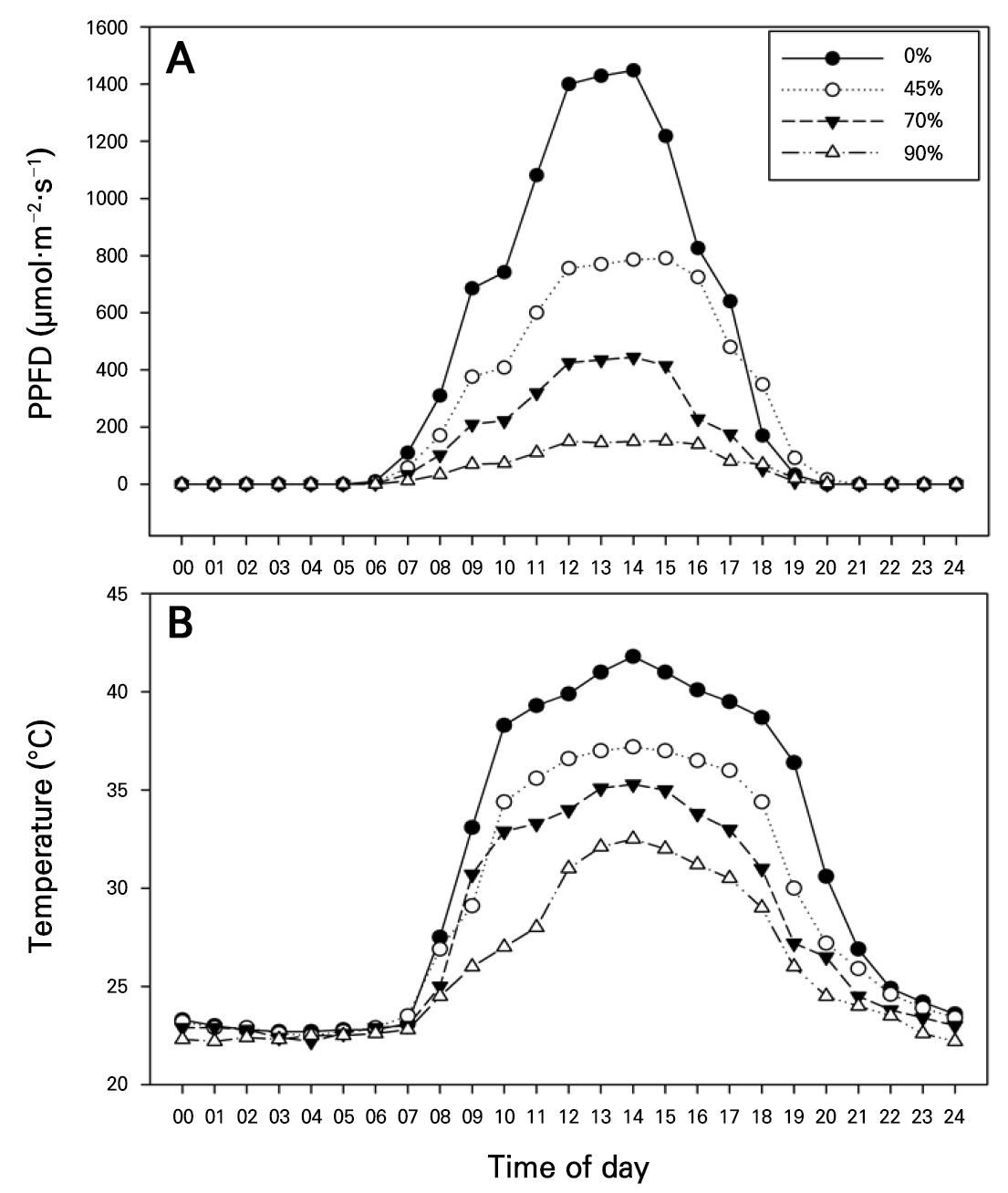
Shading structures (1 m × 1 m × 1 m) were constructed using steel frames inside the greenhouse and were spaced 2 m apart. Four shading treatments were established using black polyethylene shading nets to provide 0% (control), 45%, 70%, and 90% shading levels. The shading nets were installed over the top and side surfaces of each frame. To ensure adequate ventilation, the side nets were attached only up to a height of 0.8 m from the top. The experiment was arranged in a completely randomized design with three replications per treatment, with each replication consisting of four pots. The photosynthetic photon flux density (PPFD) and air temperature under each shading treatment were measured using a data logger (WatchDog 1650 Micro Station, Spectrum Technologies Inc., Illinois, USA) equipped with a solar radiation sensor (Spectrum Technologies Inc., Illinois, USA). Data collected on June 10, a clear and cloudless day, were used to represent the light and temperature conditions of each shading treatment. The data logger and solar radiation sensor were installed at the center of each shading structure at a height of 50 cm above the ground.
Growth and flowering measurements
Growth measurements were conducted 85 days after transplanting. Plant height was measured as the length of the longest pinnately compound leaf. Leaf length and width were determined using the largest fully expanded leaf. The number of pinnately compound leaves and the total leaf number were recorded for each plant. Shoots, excluding flowers and flower stalks, were collected by cutting the plants at the basal stem portion and included both chlorotic and senescent leaves. Shoot fresh weight was measured immediately after harvest, and shoot dry weight was determined after drying the samples at 70°C for three days. Leaf chlorophyll content levels were estimated using a SPAD meter (SPAD-502 Plus; Konica Minolta, Tokyo, Japan). Flowering characteristics were evaluated throughout the experimental period. The total number of flowers, number of flower stalks, and average flower stalk length were recorded for each plant.
Photosynthetic rate, chlorophyll fluorescence, and spectral reflectance measurements
The photosynthetic rate, chlorophyll fluorescence parameters, and spectral reflectance indices were measured 85 days after transplanting using the terminal leaflet of the longest fully expanded pinnately compound leaf from plants grown under each shading treatment. The photosynthetic light-response curves were measured between 09:00 and 12:00 using a portable photosynthesis system (LI-6800; LI-COR Biosciences, Lincoln, NE, USA). The PPFD level was adjusted sequentially to 0, 50, 100, 200, 400, 600, 800, 1,000, 1,200, 1,400, 1,600, 1,800, and 2,000 µmol·m‒2·s‒1. During the measurements, the reference CO2 concentration was maintained at 400 µmol·mol‒1, the leaf chamber temperature at 25°C, relative humidity at 50%, and the air flow rate at 400 µmol·s‒1. Gas-exchange data were recorded after leaves had reached steady-state conditions at each PPFD level (approximately 2–3 min). The photosynthetic light-response curves were fitted using the modified rectangular hyperbola model proposed by Ye (2007). The maximum net photosynthetic rate (Amax) was estimated from the fitted model. The light saturation point (LSP) was defined as the PPFD at which the fitted net photosynthetic rate reached 95% of Amax.
Chlorophyll fluorescence was measured using a portable fluorometer (FluorPen FP100; Photon Systems Instruments, Czech Republic). Prior to each measurement, leaves were dark-adapted for 30 min. The chlorophyll fluorescence parameters, specifically Fv/Fo, Fv/Fm, ABS/RC, ETo/ABS, ETo/TRo, ETo/RC, DIo/RC, TRo/RC and PIABS, were calculated according to the JIP-test methodology (Maxwell and Johnson 2000; Oh et al. 2014).
Leaf spectral reflectance was determined with a portable spectroradiometer (PolyPen RP410; Photon Systems Instruments, Czech Republic). Several spectral vegetation indices associated with pigment composition and physiological status, in this case NDVI, SR, MCARI1, G, MCARI, SRPI, PRI, NPCI, SIPI, and CRI, were calculated (Peñuelas et al. 1995; Barták et al. 2016).
Statistical analysis
All experimental data were subjected to a one-way analysis of variance (ANOVA) employing IBM SPSS Statistics Version 22.0 (IBM Corp., Armonk, NY, USA). Mean separation among the treatments was performed using Duncan’s multiple range test at the 5% significance level (p ≤ 0.05).
Results and Discussion
Growth responses to shading
As the shading level was increased, the PPFD decreased. At noon, the PPFD under the 0% shade treatment was 1,400 µmol·m‒2·s‒1, whereas the corresponding values under the 45%, 70%, and 90% shade treatments were 756, 425, and 150 µmol·m‒2·s‒1, respectively, representing reductions of 46.0%, 69.6%, and 89.3% compared to the 0% shade treatment (Fig. 1A). As the shading level increased, the air temperature also decreased. The 0% shade treatment exhibited the highest maximum air temperature (41.8°C), while the 45%, 70%, and 90% shade treatments recorded maximum temperatures of 37.2, 35.3, and 32.5°C, respectively, corresponding to decreases of 4.6, 6.5, and 9.3°C compared with the 0% shade treatment (Fig. 1B). These results indicate that shading influenced both light availability and the thermal environment surrounding the plants.
The plant height of C. hylomeconoides was lowest under the 0% shade treatment (9.3 cm) and highest under the 90% shade treatment (14.1 cm); however, no significant differences were observed among the 45–90% shade treatments (Table 1). Leaf length and leaf width increased with an increase in the shading level. The shortest leaves were observed under the 0% shade treatment, with leaf length and width outcomes of 5.4 and 4.3 cm, respectively, whereas the greatest leaf length and width were observed under the 70% and 90% shade treatments (Fig. 2). These morphological responses observed in C. hylomeconoides are considered typical manifestations of the shade avoidance response, characterized by stem and shoot elongation under low-light conditions, and shade acclimation, which involves increased leaf expansion to improve light capture (Valladares and Niinemets 2008; Casal 2012; Demotes-Mainard et al. 2016). A similar type of morphological plasticity has also been reported in several understory species, including those focusing on Jeffersonia dubia (Rhie et al. 2014), Convallaria keiskei (Seo et al. 2002), Calanthe discolor (Kim et al. 2012), and Taraxacum coreanum (Lee and Nam 2024).
The number of pinnate compound leaves of C. hylomeconoides was lowest under the 90% shade treatment, with 9.4 pinnate compound leaves per plant, whereas no significant differences were observed among the 0–70% shade treatments, which produced 10.6–11.9 pinnate compound leaves per plant. The number of leaves was relatively low under the 0% and 90% shade treatments, with 44.8 and 37.8 leaves per plant, respectively, while the 45% and 70% shade treatments resulted in significantly higher corresponding leaf numbers of 50.6 and 53.3 leaves per plant. Shoot fresh weight was lowest under the 0% shade treatment (11.0 g), whereas the highest values of 18.5–19.6 g were observed under the 45% and 70% shade treatments. Similarly, shoot dry weight at 1.5 g was lowest under the 0% and 90% shade treatments, with the highest value of 2.6 g recorded under the 70% shade treatment. Chlorophyll content of 28.1 was lowest under the 0% shade treatment, and chlorotic symptoms were also observed on the leaves. In contrast, no significant differences in the chlorophyll content were detected among the 45–90% shade treatments, with values ranging from 33.2 to 35.5.
Table 1.
Effects of shading levels on the shoot growth of Coreanomecon hylomeconoides at 85 days after treatment
|
Shading level (%) |
Plant height (cm) | No. of pinnate compound leaves |
No. of Leaves |
Leaf length (cm) |
Leaf width (cm) | Shoot |
Chlorophyll (SPAD) | |
|
Fresh weight (g) |
Dry weight (g) | |||||||
| 0 | 9.3 ± 2.0 bz | 10.6 ± 0.5 a | 44.8 ± 3.6 b | 5.4 ± 0.4 c | 4.3 ± 0.5 b | 11.0 ± 1.2 c | 1.5 ± 0.1 c | 28.1 ± 1.8 b |
| 45 | 12.8 ± 1.8 ab | 11.9 ± 0.9 a | 50.6 ± 3.6 ab | 7.3 ± 0.5 b | 5.4 ± 0.6 ab | 18.5 ± 1.6 a | 2.1 ± 0.2 b | 35.5 ± 2.2 a |
| 70 | 13.4 ± 2.3 ab | 10.6 ± 0.6 a | 53.3 ± 4.0 a | 9.5 ± 0.6 a | 6.2 ± 0.5 a | 19.6 ± 1.8 a | 2.6 ± 0.2 a | 34.4 ± 2.3 a |
| 90 | 14.1 ± 2.0 a | 9.4 ± 0.3 b | 37.8 ± 3.7 b | 9.6 ± 0.6 a | 6.5 ± 0.6 a | 14.5 ± 1.3 b | 1.5 ± 0.1 c | 33.2 ± 2.1 a |
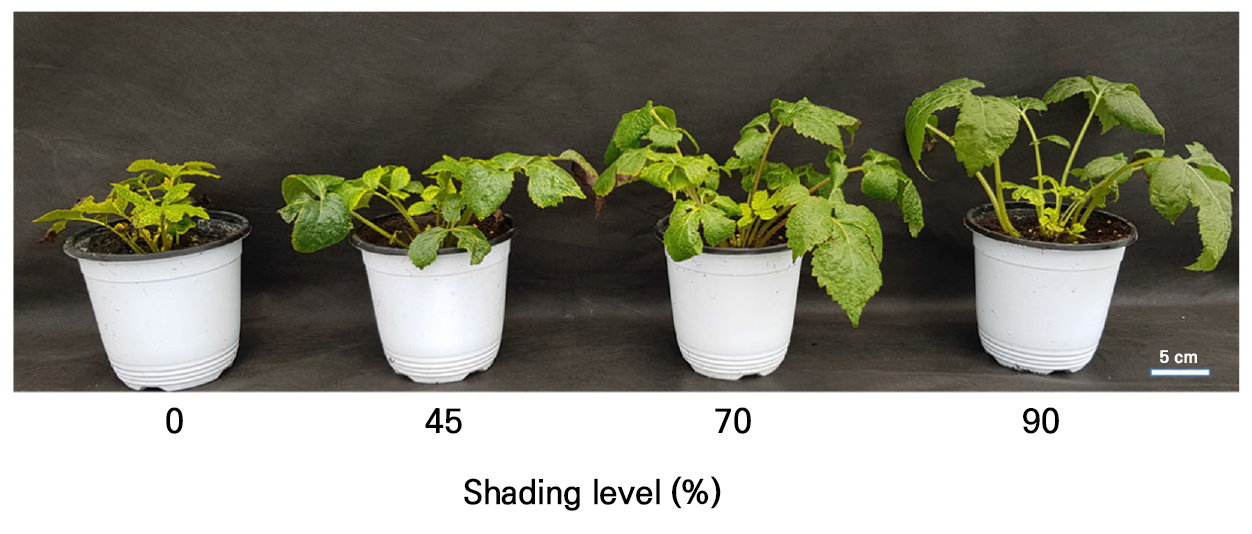
These responses observed in C. hylomeconoides are consistent with characteristics commonly reported in various shade-tolerant herbaceous species. Under severely light-limited conditions, plants exhibit etiolated growth patterns, resulting in reduced dry matter production and biomass accumulation (Semchenko et al. 2012; Dey et al. 2025). In contrast, exposure to full sunlight can impose both excessive irradiance and high-temperature stress on plants. These types of stress are known to accelerate chlorophyll degradation, induce leaf chlorosis, and suppress plant growth (Wahid et al. 2007; Fu et al. 2012; Hazrati et al. 2016). The occurrence of leaf chlorosis and reduced biomass accumulation in C. hylomeconoides under the 0% shade treatment suggest that the plants were unable to acclimate effectively to the combined effects of excessive irradiance and elevated temperatures.
The population size of C. hylomeconoides reportedly declines in densely forested habitats where light availability is limited, whereas its population increases in areas where forest thinning and management practices enhance light penetration (Son et al. 2012). Consistent with these findings, this study demonstrated that C. hylomeconoides exhibited the most favorable shoot growth under the 70% shade treatment, as evidenced by the highest leaf number as well as the greatest shoot fresh weight and shoot dry weight compared to both 0% and 90% shading.
Flowering responses to shading
The flowering responses of C. hylomeconoides were strongly influenced by the shading level. The number of flowers was significantly lower under the 90% shade treatment (9.8) compared to those under the 0–70% shade treatments, which produced 25.9–28.7 flowers (Fig. 3A). A similar trend was observed for the number of flower stalks, which was lowest under the 90% shade treatment (2.8), whereas the 45% and 70% shade treatments produced the highest numbers of flower stalks (10.7–11.0), exceeding the number observed under the 0% shade treatment (Fig. 3B). Flower stalk length was shortest under the 0% shade treatment (11.0 cm), while no significant differences were detected among the 45–90% shade treatments, with values ranging 11.5 to 13.3 cm (Fig. 3C).
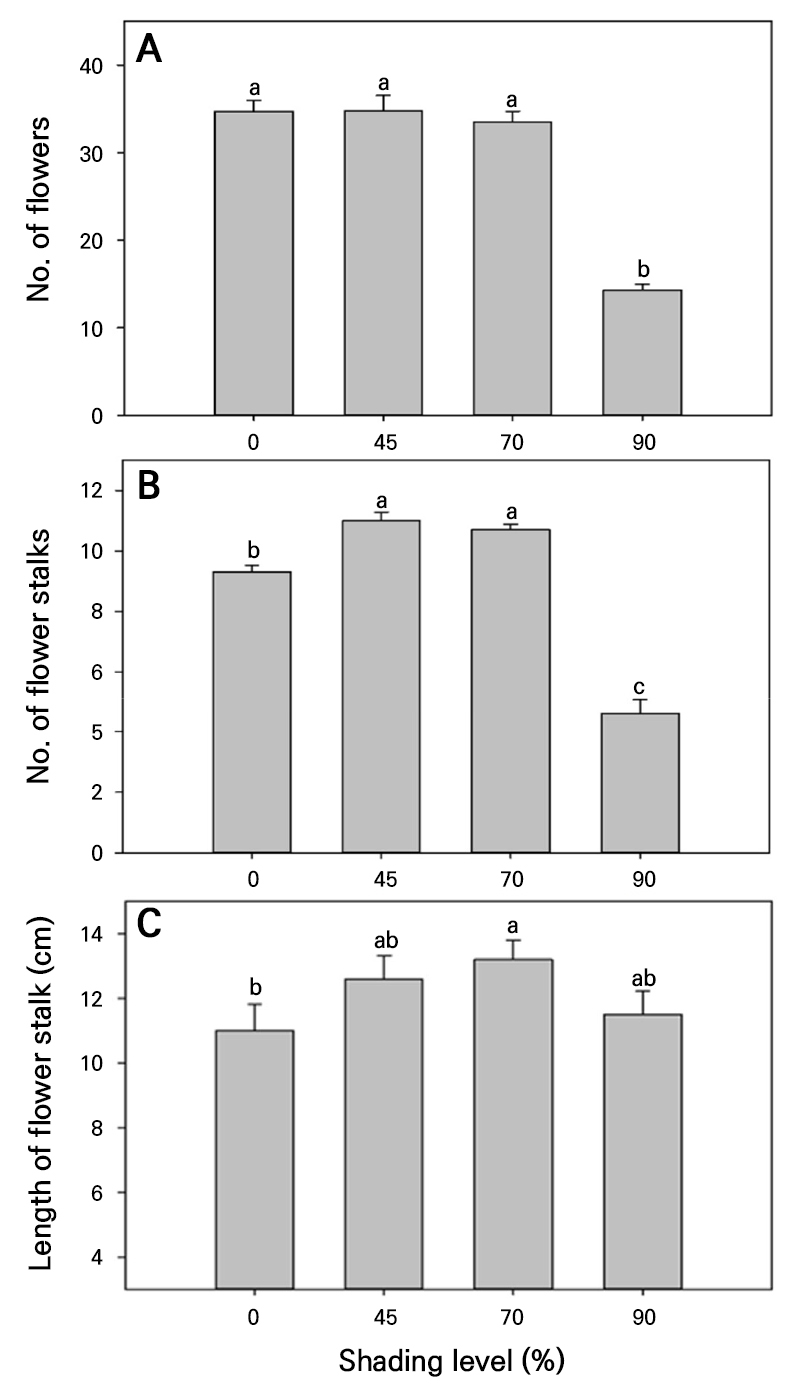
Fig. 3.
Number of flowers (A), number of flower stalks (B), and length of the flower stalk (C) of Coreanomecon hylomeconoides under different shading levels during the growing period after treatment. Vertical bars indicate standard errors of the means (n = 3). Lowercase letters indicate significant differences based on Duncan’s multiple range test at p ≤ 0.05.
In general, excessively low light conditions reduce photosynthetic carbon assimilation, thereby limiting the supply of assimilates and energy required for flower bud differentiation and flower stalk development, ultimately suppressing flowering (Kozlowski et al. 1991). Conversely, exposure to irradiance levels exceeding the optimal range can decrease the photosynthetic efficiency through photoinhibition and induce physiological stress, which may also inhibit flowering (Sessa et al. 2018). In this study, flowering of C. hylomeconoides was suppressed under both the 0% shade and 90% shade treatments, indicating that both excessive and insufficient light availability negatively affected reproductive development.
Similar flowering responses have been reported in other shade-adapted species. Calanthe discolor, a shade-tolerant orchid, exhibited optimal vegetative growth and flowering under 70–80% shade conditions (Kim et al. 2012). Likewise, Convallaria keiskei showed superior flowering performance under 50% shade, a condition that also promoted vigorous leaf growth (Seo et al. 2002). Consistent with these findings, C. hylomeconoides exhibited the most favorable flowering characteristics under the 45% and 70% shade treatments, corresponding to the shading levels that also produced the greatest shoot growth in the present study.
Photosynthetic responses to shading
Under the 0% shade treatment, the photosynthetic rate of C. hylomeconoides increased rapidly as the PPFD was increased to approximately 100 µmol·m‒2·s‒1, after which the rate of increase gradually diminished (Fig. 4A). The Amax and LSP values were 4.5 and 417 µmol·m‒2·s‒1, respectively, both of which were lower than those observed under the 45–90% shade treatments (Fig. 4B and 4C). In contrast, under the 45–90% shade treatments, the photosynthetic rate increased with an increase in the PPFD to approximately 400 µmol·m‒2·s‒1 and then gradually approached a maximum value, with this followed by a slight decline at PPFD levels above 1,600 µmol·m‒2·s‒1. The Amax values under the 45%, 70%, and 90% shade treatments were 7.3, 7.7 and 7.8 µmol·m‒2·s‒1, respectively, with no significant differences among these treatments. The LSP outcomes were 709 and 671 µmol·m‒2·s‒1 under the 70% and 90% shading treatments, respectively, and were higher than those under the 0% and 45% shading treatments.
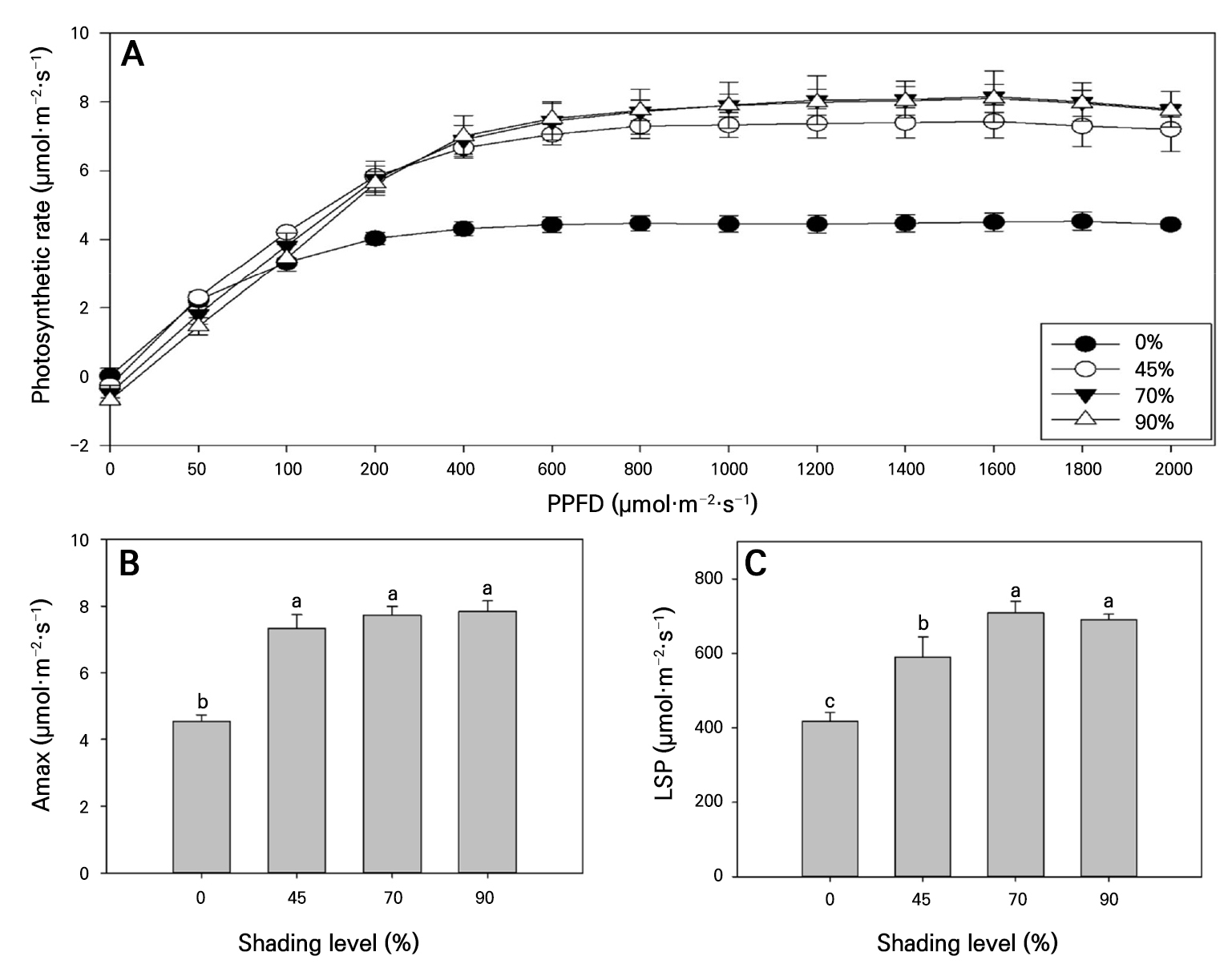
Fig. 4.
Photosynthetic light-response curves according to the light quantity (A), maximum net photosynthetic rate (Amax), and light saturation point (LSP) of Coreanomecon hylomeconoides grown under different shading levels at 85 days after treatment. Vertical bars indicate standard errors of the means (n = 3). Lowercase letters indicate significant differences based on Duncan’s multiple range test at p ≤ 0.05.
Photosynthetic characteristics are strongly influenced by the light environment experienced during plant growth. Boardman (1977) reported that the light environment is a major determinant of both the LSP and maximum photosynthetic capacity. Plants grown under high irradiance generally exhibit higher light saturation points and greater Amax values; however, such responses are species-dependent, and when irradiance exceeds the physiological tolerance of shade-adapted species, they may not occur. In this study, C. hylomeconoides exhibited the lowest Amax value under the 0% shade treatment, while the photosynthetic performance increased markedly under the 45–90% shade treatments. This reduction in the photosynthetic rate of C. hylomeconoides observed under the 0% shade treatment was likely caused by the combined effects of photoinhibition induced by excessive irradiance and elevated temperature stress. Exposure to excessive light is known to reduce the photochemical efficiency, leading to a reduction in the photosynthetic carbon assimilation capacity (Osmond 1994). Furthermore, the increased Amax and LSP outcomes of C. hylomeconoides observed under the 45–90% shade treatments appear to reflect light acclimation to shaded environments, suggesting that under these conditions, the photosynthetic apparatus was maintained in a more stable and functional state. Previous studies have demonstrated that shade-acclimated plants generally maintain higher photosynthetic performance and achieve greater carbon gain levels under low-light conditions (Evans and Poorter 2001; Niinemets 2010). These acclimatory responses are likely to have contributed to the improved photosynthetic performance observed in C. hylomeconoides in this study.
Chlorophyll fluorescence responses to shading
The shading level significantly affected the chlorophyll fluorescence parameters of C. hylomeconoides. The values of Fv/Fo, Fv/Fm, ETo/TRo, ETo/ABS, PIABS, and ETo/RC were lower under the 0% shade treatment than under the 45–90% shade treatments. In contrast, ABS/RC and DIo/RC values were lowest under the 90% shade treatment, whereas the highest values were observed under the 0% and 45% shade treatments (Table 2).
Table 2.
Comparison of chlorophyll fluorescence parameters in leaves of Coreanomecon hylomeconoides grown under different shading levels at 85 days after treatment
|
Shading level (%) | Chlorophyll fluorescence parametersz | ||||||||
| Fv/Fo | Fv/Fm | ETo/TRo | ETo/ABS | PIABS | ABS/RC | TRo/RC | ETo/RC | DIo/RC | |
| 0 | 2.17 ± 0.21 by | 0.68 ± 0.01 b | 0.53 ± 0.02 b | 0.37 ± 0.03 b | 1.28 ± 0.12 b | 2.40 ± 0.03 a | 1.61 ± 0.11 a | 0.84 ± 0.05 b | 0.79 ± 0.09 a |
| 45 | 2.68 ± 0.23 a | 0.72 ± 0.01 a | 0.65 ± 0.04 a | 0.47 ± 0.03 a | 2.30 ± 0.29 a | 2.40 ± 0.04 a | 1.72 ± 0.12 a | 1.12 ± 0.06 a | 0.68 ± 0.07 ab |
| 70 | 2.83 ± 0.33 a | 0.73 ± 0.02 a | 0.66 ± 0.03 a | 0.48 ± 0.04 a | 2.68 ± 0.30 a | 2.32 ± 0.02 b | 1.69 ± 0.15 a | 1.11 ± 0.07 a | 0.63 ± 0.08 ab |
| 90 | 3.04 ± 0.30 a | 0.75 ± 0.03 a | 0.66 ± 0.05 a | 0.50 ± 0.04 a | 2.90 ± 0.36 a | 2.23 ± 0.02 c | 1.66 ± 0.13 a | 1.10 ± 0.06 a | 0.58 ± 0.05 b |
zFv/Fo (maximum primary yield of photochemistry), Fv/Fm (maximum quantum efficiency of PSII), ETo/TRo (efficiency of electron transport beyond QA‒), ETo/ABS (quantum yield of electron, transport), PIABS (performance index on absorption basis), ABS/RC (absorbed energy flux per reaction center), TRo/RC (trapped energy flux per reaction center), ETo/RC (electron transport flux per reaction center), DIo/RC (dissipated energy flux per reaction center)
Chlorophyll fluorescence analysis is widely used as a sensitive indicator for evaluating various environmental forms of stress in plants (Roh and Yoo 2023; Lee et al. 2025; Shin and Lee 2025). Among the fluorescence parameters, Fv/Fo reflects the activity of active PSII reaction centers and the efficiency of electron transport (Baker 2008). Previous studies have reported substantial reductions in Fv/Fo in Chinese cabbage and wheat exposed to heat stress, chrysanthemum subjected to drought stress, and Pseudolysimachion nakaianum grown under nutrient-deficient conditions (Mathur et al. 2011; Oh et al. 2014; Yoo 2026). In this study, the lower Fv/Fo values observed under the 0% shade treatment compared to those under the 45–90% shade treatments suggest that excessive irradiance reduced the photochemical efficiency of PSII, thereby decreasing the electron transport efficiency in C. hylomeconoides.
The fluorescence parameters Fv/Fm, ETo/TRo, and ETo/ABS represent the quantum efficiency of PSII photochemistry and the proportion of trapped energy utilized for electron transport, whereas PIABS reflects the overall photochemical performance index of PSII (Strasser et al. 2004; Boureima et al. 2012). These parameters are generally reduced in plants exposed to unfavorable environmental conditions, such as heat, drought, salinity, nutrient deficiency, and excessive irradiance (Fu et al. 2012; Zushi et al. 2012; Choi and Jeong 2020; Roh et al. 2020; Shin et al. 2020; Lee et al. 2025; Yoo 2026). Similarly, the lower values of Fv/Fm, ETo/TRo, ETo/ABS, and PIABS observed under the 0% shade treatment in this study indicate that excessive light and high-temperature stress reduced both the photochemical efficiency and overall performance of PSII in C. hylomeconoides.
Among the chlorophyll fluorescence parameters, ABS/RC, TRo/RC, ETo/RC, and DIo/RC reflect the amount of absorbed, trapped, transported, and dissipated energy per active reaction center (Oukarroum et al. 2007). Previous studies reported that foliage plants, such as Hedera helix, Chamaedorea elegans, and Spathiphyllum wallisii, when grown under excessive irradiance exhibited increased ABS/RC, TRo/RC, and DIo/RC values (Lee et al. 2022). Similarly, elevated ABS/RC, TRo/RC, and DIo/RC values have also been reported in Triticum aestivum subjected to drought stress, in Pseudolysimachion nakaianum exposed to nitrogen deficiency, and in Taraxacum coreanum grown under excessive shading conditions (Parihar and Soni 2016; Lee and Nam 2024; Yoo 2026). In this study, C. hylomeconoides grown under the 0% shade treatment exhibited higher ABS/RC and DIo/RC values than plants grown under the 90% shade treatments. These results suggest that excessive irradiance induced partial inactivation of PSII reaction centers, thereby reducing the number of active reaction centers available for photochemistry. In consequence, the absorbed excitation energy was distributed among fewer active reaction centers, resulting in increased ABS/RC and DIo/RC values. In addition, a greater proportion of the absorbed energy was dissipated as heat rather than utilized for photochemical electron transport, leading to reduced photosynthetic efficiency. This interpretation is supported by the lower Amax and LSP values observed under the 0% shade treatment.
Spectral reflectance responses to shading
The leaf spectral reflectance indices of C. hylomeconoides varied according to the shading level. Plants grown under the 70% and 90% shade treatments exhibited lower values of MCARI, NPCI, and CRI than those grown under the 0% shade treatment, whereas SRPI and PRI values were significantly higher under the 70% and 90% shade treatments (Table 3). In contrast, NDVI, SR, MCARII, G, and SIPI did not differ significantly among the shading treatments.
Table 3.
Comparison of spectral reflectance parameters in leaves of Coreanomecon hylomeconoides grown under different shading levels at 85 days after treatment
|
Shading level (%) | Spectral reflectance indicesz | ||||||||
| NDVI | SR | G | MCARI | SRPI | PRI | NPCI | SIPI | CRI | |
| 0 | 0.61 ± 0.05 ay | 4.2 ± 0.3 a | 1.54 ± 0.12 a | 0.34 ± 0.03 a | 0.71 ± 0.01 b | ‒0.031 ± 0.005 c | 0.17 ± 0.01 a | 0.70 ± 0.05 a | 2.7 ± 0.3 a |
| 45 | 0.61 ± 0.04 a | 4.2 ± 0.3 a | 1.44 ± 0.11a | 0.30 ± 0.02 ab | 0.69 ± 0.01 c | ‒0.012 ± 0.004 b | 0.18 ± 0.01 a | 0.69 ± 0.04 a | 2.6 ± 0.1 a |
| 70 | 0.64 ± 0.06 a | 4.6 ± 0.4 a | 1.46 ± 0.13 a | 0.26 ± 0.02 bc | 0.73 ± 0.01 a | 0.014 ± 0.006 a | 0.16 ± 0.01 b | 0.71 ± 0.04 a | 2.5 ± 0.1 ab |
| 90 | 0.64 ± 0.05 a | 4.5 ± 0.4 a | 1.47 ± 0.15 a | 0.24 ± 0.01 c | 0.78 ± 0.04 a | 0.025 ± 0.006 a | 0.13 ± 0.01 c | 0.70 ± 0.06 a | 2.2 ± 0.2 b |
zNDVI: Normalized difference vegetation index, SR: Simple ratio, G: Green index, MCARI: Modified chlorophyll absorption ratio index, SRPI: Simple ratio pigment index, PRI: Photochemical reflectance index, NPCI: Normalized pigment chlorophyll index, SIPI: Structure insensitive pigment index, CRI: Carotenoid reflectance index.
By assessing the balance between chlorophyll and carotenoid pigments, spectral reflectance indices provide valuable information pertaining to the plant physiological status, stress responses, and senescence (Peñuelas et al. 1995; Barták et al. 2016; Roh et al. 2020). Previous studies reported that drought-stressed sunflower leaves exhibited higher MCARI and NPCI values, which are associated with changes in the chlorophyll content relative to total pigments, whereas SRPI and PRI values, which are related to the carotenoid-to-chlorophyll balance and photosynthetic efficiency, were lower than those of healthy leaves (Peñuelas et al. 1994). Similarly, in the Argentinean lichens Parmotrema conferendum and Ramalina celastri, SRPI values were significantly lower under drought stress conditions than under hydrated conditions (Barták et al. 2016). In this study, C. hylomeconoides grown under the 0% shade treatment exhibited higher MCARI, NPCI, and CRI values but lower SRPI and PRI values than plants grown under shaded treatments. These results suggest that the 0% shade treatment imposed excessive light stress on C. hylomeconoides, leading to alterations in its leaf pigment composition. Under such conditions, the synthesis of photoprotective pigments, including carotenoids and other accessory pigments, was likely enhanced relative to chlorophyll, thereby increasing the capacity to dissipate excess absorbed light energy and mitigate photooxidative damage.
Conclusion
This study demonstrated that Coreanomecon hylomeconoides exhibits a typical semi-shade adaptation, with both excessive irradiance and severe shading impairing plant growth and physiological performance. Moderate shading (45–70%) maintained a favorable balance between carbon assimilation and photoprotection, resulting in superior vegetative growth, flowering, and photosynthetic performance compared with both the 0% and 90% shading conditions. In particular, the integrated analyses of the photosynthetic characteristics, chlorophyll fluorescence, and spectral reflectance demonstrated that excessive irradiance impaired PSII photochemical activity and pigment stability, whereas moderate shading maintained photochemical function and enhanced physiological stability. These findings demonstrate that chlorophyll fluorescence and spectral reflectance indices provide effective physiological indicators for evaluating light stress and determining suitable cultivation environments for this species. Overall, approximately 70% shading is recommended as the optimal cultivation condition for C. hylomeconoides. This study provides a physiological basis for the commercial cultivation, ornamental utilization, and ex situ conservation of this valuable Korean endemic species and offers practical information for optimizing light management in shade-adapted native plants.
