

Introduction
Materials and Methods
Description of study structure
Design load calculation
Structural analysis
Probabilistic variables considering uncertainties
Experiments for foundation boundary condition setup
Results
Uncertainties according to ground conditions
Greenhouse safety based on foundation conditions
Comparison of greenhouse reliability based on foundation joint conditions
Discussion
Introduction
Agricultural greenhouses are essential facilities in modern agriculture, providing optimal growing conditions for stable crop cultivation. Single-span greenhouses in particular are widely adopted by many farmers owing to their low installation costs, simple construction, and high practicality. However, these structures are exposed to various natural disasters, such as snow loads, strong winds, and hail, making structural safety paramount (Briassoulis et al. 2016; Kang et al. 2019; Wang et al. 2021). In response, the government established design standards for disaster-resistant agricultural greenhouses in 2007 (Ministry of Agriculture Notice No. 2007-19). Owing to the increasing frequency of extreme weather events caused by climate change, the initial design standards were deemed insufficient to ensure structural safety, leading to eight revisions, with the most recent update in 2024.
Several uncertainty factors have remained unaddressed in the current design standards. The foundation joints exhibited uncertainties depending on the construction conditions. While domestic design standards for disaster-resistant greenhouses specify independent concrete foundations for multi-span structures, single-span greenhouses are designed with pipes that directly penetrate 40–50 cm into the ground without independent foundations. Under these conditions, single-span greenhouses exhibit semi-rigid behavior at the foundation joints (Ryu et al. 2012; Ryu et al. 2014; Yun et al. 2015). The behavior of semi-rigid joints significantly influences structural deformation and the stress distribution, making it a crucial design consideration. However, most design standards and related studies assume foundation-to-ground joints as fixed supports in their analyses and designs (Ogawa et al. 1989; Lee et al. 2008), potentially leading to discrepancies with actual structural behavior.
Many studies have utilized finite element analyses to examine the structural behavior of single-span greenhouses. Shin et al. (2021) studied the effects of rafter joint connections and foundation support conditions on the structural behavior of single-span greenhouses, reporting that models with fixed foundation conditions showed greater differences in the structural performance compared to those assuming hinged foundation connections. Lee et al. (2008) analyzed greenhouse behavior based on foundation support conditions, concluding that modeling buried foundations as fixed supports provided the best correlation with experimental results. Lee and Ryu (2022) proposed a new interface element for modeling greenhouse connections with semi-rigid behavior, suggesting that the conventional assumptions of fully fixed or pinned connections may not adequately reflect actual structural behavior. Uematsu and Takahashi (2020) investigated the impact of strong wind loads on the collapse of single-span greenhouses, analyzing wind-structure interaction by combining computational fluid dynamics with a finite element analysis. Wang et al. (2023) conducted both static and time-history dynamic analyses to evaluate the structural responses of greenhouses under various loading conditions, identifying structural vulnerabilities caused by snow and wind loads.
Previous studies have typically analyzed single-span greenhouses by setting nodal conditions as either fixed or hinged, with some recent attempts considering semi-rigid behavior. However, comprehensive research evaluating the impact of foundation nodal conditions on the structural safety of single-span greenhouses is lacking. In particular, existing studies have primarily approached foundation connection conditions using deterministic methods, failing to quantify the effects of semi-rigid behavior uncertainties and variabilities on the overall structural reliability. This represents a significant research gap because it does not consider the probabilistic distribution of connection stiffness resulting from various field conditions, the construction quality, and material property variations.
Despite recognition that foundation connections in single-span greenhouses exhibit semi-rigid behavior, current design standards continue to rely on simplified assumptions that may not accurately represent the actual structural behavior. The discrepancy between idealized models (fixed or hinged supports) and actual conditions introduces significant uncertainty in structural safety assessments. A comprehensive reliability analysis framework quantifying the impact of connection condition uncertainties on the overall structural performance has not yet been developed. This research gap is particularly concerning given the increasing frequency and intensity of extreme weather events that challenge the structural integrity of greenhouses.
The Monte Carlo simulation (MCS) is a particularly suitable methodology for modeling structural uncertainties, effectively handling probabilistic distributions of multiple variables with complex interactions (Lisnianski and Levitin 2003; Jahani et al. 2013; Melchers and Beck 2018). Unlike conventional deterministic approaches, MCS enables more realistic structural reliability assessments by explicitly considering variabilities in the semi-rigid characteristics of foundation connections, loading conditions, and material properties. This probabilistic approach is essential for structures such as single-span greenhouses, which employ standardized construction methods but exhibit significant variability depending on the site condition (Hong et al. 2017; Kim et al. 2019; Jeon et al. 2022; Li et al. 2022).
This study aims to analyze the impact of foundation connection semi-rigid behavior uncertainties on the structural reliability of single-span greenhouses. Using MCS, we comprehensively evaluate various uncertainty factors, including external loads, material properties, and connection conditions, to quantitatively determine the failure probability and reliability indices for structural limit states. A comprehensive assessment of the structural behavior of a single-span greenhouse was conducted by considering both the displacement and rotational stiffness of semi-rigid connections. This probabilistic approach seeks to complement the limitations of traditional deterministic design methods and provide a foundation for more accurate predictions of actual structural behaviors.
Materials and Methods
Description of study structure
The target structure selected for this study was the most recently standardized single-span greenhouse according to the Disaster-Resistant Design Standards for Horticultural and Special Crop Facilities (RDA 2019). According to standard specifications, the greenhouse has a width of 3,000 mm, an eave height of 2,000 mm, and a ridge height of 4,000 mm; the foundation penetrates 500 mm into the ground. In addition, the specifications call for strip footings to be placed longitudinally at both ends of the structure at a height of 300 mm above ground level. However, this study excluded the modeling of the strip footings in order to isolate and evaluate the pure influence of footing condition uncertainties on the structural behavior through model simplification. Moreover, field conditions such as the installation depth, connection type, and interaction with the ground can vary significantly depending on the construction context, and there is a lack of empirical data with which to model these factors accurately. Therefore, we conducted the structural analysis under conservative conditions without considering the effects of the strip footings to emphasize the need for improvements in the current design standards. The rafters are constructed using structural steel pipes (SPVHS, Steel Pipe Vinyl House Structure) with dimensions of Ø42.1 mm × 2.1t, conforming to the KS D 3760 standard (the Korean Industrial Standards for steel pipes); they are installed at 650 mm intervals. Fig. 1 shows the cross-sectional dimensions of the greenhouse structure, including the total span width and foundation depth of 8,000 mm and 400 mm, respectively.
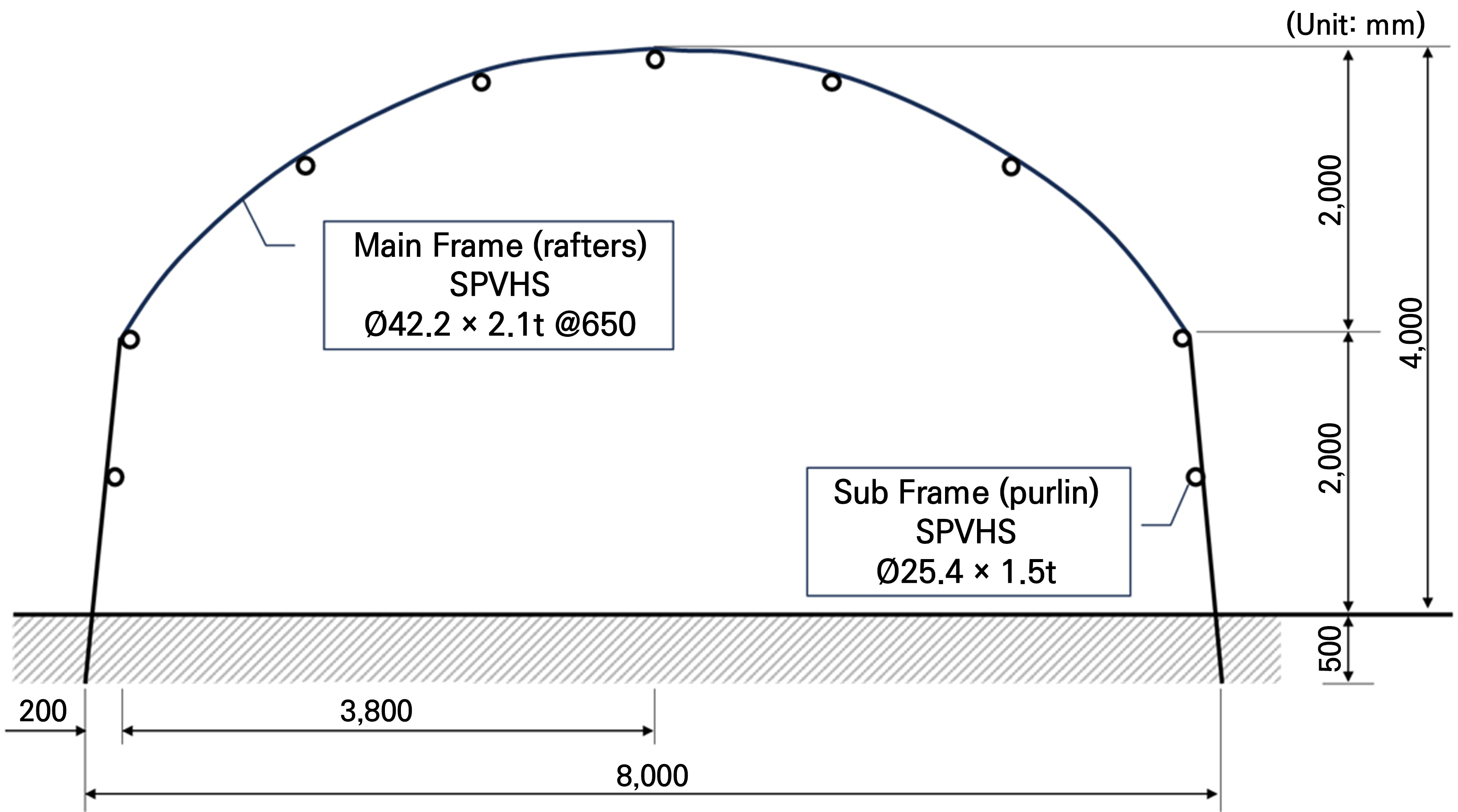
Fig. 1.
Cross-sectional diagram of the single-span greenhouse with standard dimensions. The main frame consists of SPVHS Ø42.2 × 2.1t pipes spaced at 650 mm intervals, with a total span width of 8,000 mm. The structure has an eave height of 2,000 mm, a ridge height of 4,000 mm, and a foundation depth of 500 mm. Sub-frame purlins are made of SPVHS Ø25.4 × 1.5t pipes.
Design load calculation
In greenhouse structural design, wind and snow loads are considered to be the primary external loads. Unlike conventional buildings, greenhouses are constructed using lightweight frames and thin covering materials, making external loads more significant than the weight of the structure. Snow loads, in particular, have a substantial impact on ground behavior as they are transmitted vertically through the foundation directly to the ground (Choi et al. 2015). Excessive snow loads can cause differential settlement of the foundation, leading to deformation and increased stress in the superstructure, potentially resulting in a collapse of the greenhouse. Furthermore, agricultural greenhouses are often constructed on soft ground conditions, such as rice paddies or fields, requiring careful consideration of snow-load effects based on ground conditions (Jeon et al. 2025). It is essential to calculate snow loads rationally by considering the stiffness and strength characteristics of the foundation soil and incorporating these factors into the foundation design.
In contrast, wind loads act horizontally according to wind pressure patterns, having relatively less impact on foundations and ground conditions, which primarily handle vertical load transfers. While wind loads can induce horizontal forces and moments on foundations, their influence is less significant than that of snow loads (Yun et al. 2013). Therefore, as ground condition variations are more critical under snow-load environments than wind-load conditions, this study applies snow loads as the design load for the structural analysis reflecting ground conditions. The snow load (kN/m) acting on greenhouse roofs based on the snow depth was calculated using Equation (1):
where 𝜌 is the unit weight of snow (kgf/cm·m2), is the snow depth (cm), 𝛼 is the snow-load reduction factor according to the roof slope, and is the rafter spacing (cm). The snow-load reduction coefficient was applied according to the roof slope, as shown in Table 1, by RDA (2019), and the rafter spacing was set to 65 cm. These parameters were used to determine the snow load, which was applied as a uniformly distributed load on the greenhouse roof.
Table 1.
Reduction factor of snow loads based on roof slope angles in the greenhouse
| Roof slope (°) | 10–20 | 20–30 | 30–40 | 40–60 | over 60 |
| Reduction factor | 0.90 | 0.75 | 0.50 | 0.25 | 0.00 |
Structural analysis
We developed an analytical model using the finite element method (FEM, a numerical technique that analyzes structures by dividing them into small elements) implemented in Python for the structural analysis of the single-span greenhouse. The model was used to perform both safety and reliability analyses through MCS. For the structural analysis, we employed beam-column elements, which represent members subjected to both bending and axial forces. We defined the member joints as rigid connections with free ends. To account for realistic behavior at the base, we considered three different boundary conditions: (1) fully fixed, (2) hinged, and (3) semi-rigid—an intermediate condition allowing limited rotation and displacement, reflecting the ground properties. These variations enabled a comparative analysis of how different foundation boundary conditions influence the structural behavior. The snow load was applied perpendicular to the surface of the greenhouse roof. The stiffness matrix, which mathematically expresses the load-displacement relationship in structural systems, for the beam-column element finite element analysis is defined by Equation (2):
where is the cross-sectional area, is the elastic modulus (a material property that represents resistance to elastic deformation), is the length, and is moment of inertia (MOI, a geometric property that indicates the member’s resistance to bending). In the local coordinate system, and represent the displacement along the - and -axes, respectively. 𝜃 is the rotation angle, denotes the nodal forces, and represents the nodal moments. For boundary conditions, fixed supports are defined as or ; hinged supports are defined as or as ; while semi-rigid fixed supports are set as or , where , and represent the allowable displacement and rotation angle values based on the ground conditions.
The structural safety of the greenhouse was evaluated based on the von Mises stress induced by snow loads on the members. According to domestic steel structure design standards (KDS 14 30 10, KDS 14 31 10) and the greenhouse structural design standards (RDA 2017), structural members are categorized as compression, tension, bending, or combined members depending on the type of external load, and specific design criteria are applied accordingly. These standards require an individual evaluation for each type of member, which increases the complexity of the structural analysis model. Therefore, in this study, we used the von Mises stress as a scalar value to represent the combined stress state most effectively, where the axial force, shear force, and bending moment act simultaneously. The von Mises stress () was calculated using Equation (3), which combines the axial stress (), shear stress (𝜏), and bending stress ():
Here, , 𝜏, and denote , , and , respectively. is the axial force, is the shear force, is the bending moment, is the cross-sectional area, is the MOI, and is the distance from the neutral axis to the outermost fiber.
For a reliability analysis, we defined a limit-state function—a function that distinguishes between the safe and failure states of a structure— based on the von Mises stress in individual members under snow loads and their corresponding amounts of allowable stress. While the conventional Load and Resistance Factor Design (LRFD) method ensures structural safety by applying strength reduction and load amplification factors, this study adopted a probabilistic approach. Specifically, we directly incorporated uncertainties in variables such as loads, the material strength, and ground conditions into the reliability analysis. This approach reflects the inherent variability of real-world phenomena without introducing additional safety factors, which typically represent the structural margin before failure. Consequently, the limit-state function used in this study is defined by Equation (4):
where is the limit-state function, is the resistance, and is the load. The and values are determined by and , representing the allowable stress and von Mises stress, respectively. We set to 295 MPa based on the yield strength—the stress level at which a material begins to undergo permanent deformation and a key criterion for assessing structural safety—according to the domestic steel standard (KSD 3760).
Based on the limit-state function, the probability of failure through MCS can be defined by Equation (5):
Here, represents the probability of failure, is the number of iterations in MCS, and is an indicator function which takes a value of 1 when the limit-state function is less than zero (considered as the failure state), and 0 otherwise.
MCS is a numerical simulation method that incorporates the uncertainties of probabilistic variables through random number generation. This study conducted 100,000 iterations, considering both the probability distribution of snow loads and the material strength uncertainties. This approach enables a direct calculation of the structural failure probability, establishing a quantitative basis for structural reliability assessments.
Probabilistic variables considering uncertainties
For the reliability analysis of agricultural greenhouses considering uncertainties, probabilistic variables were established for the unit weight and depth of the snow loads, the dry unit weight of the foundation soil, and the yield stress and elastic modulus of the greenhouse members (Table 2).
Table 2.
Probabilistic parameters used in the reliability analysis
The unit weight of snow represents the weight per unit volume on the horizontal surface of the greenhouse roof, typically applied as 1.0 kN/m3 for snow depths under 50 cm (Jung et al. 2015; NAAS 2015; Shin et al. 2021). However, this value varies significantly between dry and wet snow conditions. According to Yu et al. (2014), the unit weights for dry and wet snow are 1.47 kN/m3 and 2.94 kN/m3, respectively. Kariyawasam (1998) investigated snow unit weights in Canada, reporting values between 1.86 and 4.22 kN/m3 with a coefficient of variation (COV) of 0.17, assuming a normal distribution. Bartlett et al. (2003b) suggested that actual snow unit weights should be set 10% higher than the nominal values in the design code, assuming a normal distribution. Lee et al. (2015) analyzed snow unit weights at three mountainous locations in Korea, finding values ranging from 0.39 to 3.92 kN/m3, with a mode of 1.47 kN/m3. Yu et al. (2017) analyzed data from 69 weather stations, reporting a mean of 1.37 kN/m3 and standard deviation of 0.29 kN/m3 (COV = 0.21). Based on these findings, this study adopted a normal distribution with a mean of 1.40 kN/m3 and COV of 0.18 for the snow unit weight.
The disaster-resistant design standards suggest a maximum snow depth of 40 cm based on a 30-year return period, varying by region. Yu et al. (2017) reported a national average snow depth of 32.7 cm, while Jeon et al. (2022) suggested 38.0 cm, both confirming adequate safety margins. However, snow depths in Korea show high variability depending on the topography and altitude. Yu et al. (2017) reported a standard deviation of 21.4 cm (COV = 0.65), while Jeon et al. (2022) suggested 30.2 cm (COV = 0.79). Other researchers proposed average COVs of 0.42 (Hong and Ye 2014) and 0.491 (Bartlett et al. 2003a, 2003b), preferring Gumbel distributions. Li (2023) reported annual maximum snow depth COVs ranging from 0.08 to 1.34, with a mean of 0.49. Based on these studies, this analysis employed a Gumbel distribution with a mean of 35 cm and COV of 0.5.
To account for ground condition uncertainties, the dry unit weight (𝛾) was considered as a probabilistic variable. Because single-span greenhouse foundations are directly embedded in the ground, their behavior varies with the soil strength. This study modeled the foundation as semi-rigid, allowing displacement and rotation, with soil properties characterized by the dry unit weight. Akbas and Kulhawy (2010) suggested that for the clay subgrade, the wet unit weight ranges from 17.5 to 19.5 kN/m3 and the COV ranges from 2 to 8%. Kulhawy et al. (2007) suggested that the wet unit weight of clay ranges from 15 to 17 kN/m3 with a COV of 3 to 7%, and the wet unit weight of sand ranges from 17 to 20 kN/m3 with a COV of 2 to 6%. In the case of Kasama et al. (2012), the dry unit weight was set to 15 kN/m3, and the COV was set to 1% for the simulation. In this study, we set the dry unit weight to 15 kN/m3 and the COV to 0.05 (5%).
Finally, the yield stress and elastic modulus were considered as probabilistic variables for greenhouse structural members. The structural steel pipes (SPVHS) used in agricultural greenhouses conformed to the KS D 3760 standard, with a nominal elastic modulus of 200 GPa and yield stress of 295 MPa. To account for material property uncertainties, COVs of 0.03 and 0.05 were applied for the elastic modulus and yield stress, respectively.
Experiments for foundation boundary condition setup
The experimental results under various conditions are required to analyze the displacement and rotation occurring at boundary points when external loads act on the structure. This study referenced the experimental results from Lee et al. (2020) to consider the displacement and rotation under snow loads. In their study, as shown in Fig. 2, Loads 1 and 2 were applied to an embedded member to implement the axial force and moment, enabling the measurement of the foundation displacement and rotation angle. Loads were incrementally applied corresponding to snow depths from 5 to 50 cm at 5 cm intervals. For the soil properties, the researchers sampled five locations from a sandy soil site and calculated average values: a dry density of 14.9 kN/m3, a moisture content of 16.8%, and a soil hardness of 947.4 kPa. Based on these results, they established the experimental conditions by varying the average dry density (14.9 kN/m3) by ±10% while maintaining a design moisture content of 16.8%. The experiment was performed in three replicates for each dry density condition, allowing an analysis of the displacement and rotation behavior under varying ground conditions (Table 3).
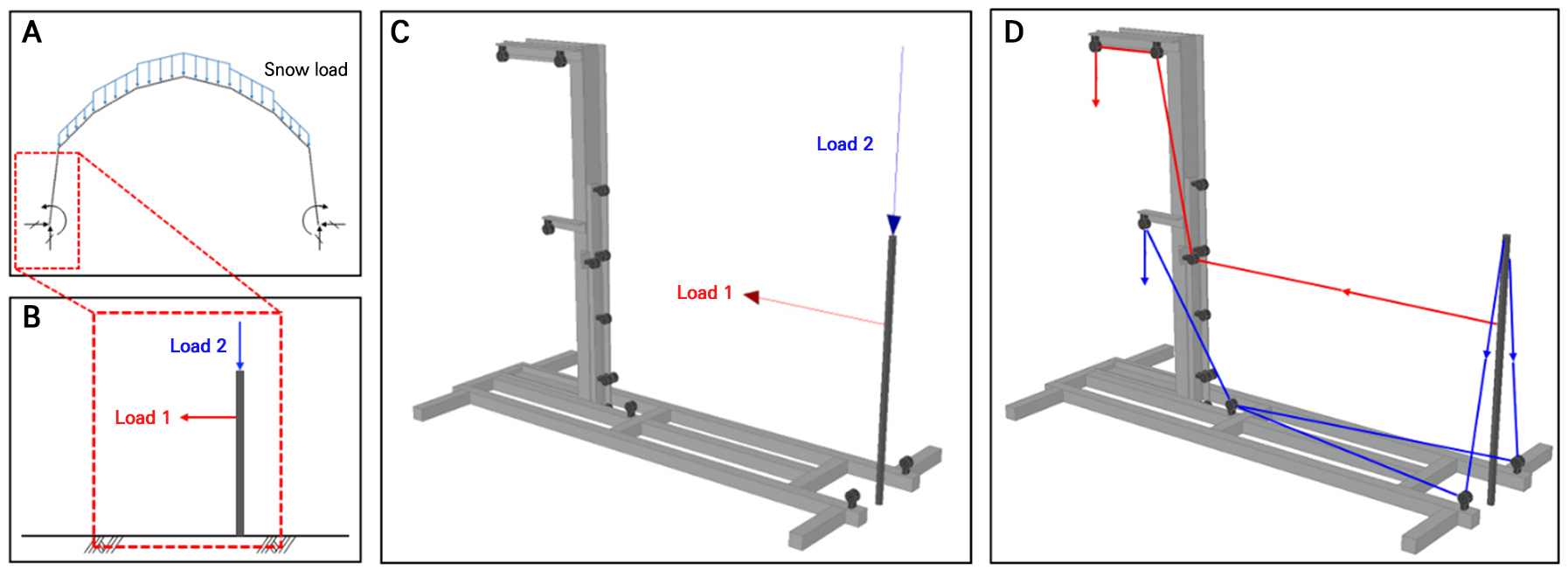
Table 3.
Design of ground conditions for the structure experiment
Results
Uncertainties according to ground conditions
The experimental results demonstrated that both the displacement and rotation of the greenhouse foundation exhibited nonlinear behavior under varying snow depths and soil conditions (Fig. 3). The foundation responses exhibited distinct patterns depending on the soil unit weight, with significant differences observed among the three test conditions (16.5, 14.9, and 13.4 kN/m3).

The horizontal displacement analysis revealed that weaker soil conditions led to substantially larger displacements under the same snow load. For instance, at a snow depth of 50 cm, the foundation in soil with a unit weight of 13.4 kN/m3 experienced approximately 80 mm of displacement, while the stronger soil condition (16.5 kN/m3) resulted in only 20 mm of displacement. This four-fold difference highlights the critical role of the soil strength in determining the foundation stability. Furthermore, the displacement curves demonstrate an increasing rate of deformation with the snow depth, particularly in the range of 20–30 cm of snow, which indicates a potential critical threshold for structural stability.
The rotation angle measurements showed trends similar to those of the displacement results, but with more pronounced nonlinearity. The maximum observed rotation angle reached approximately 0.3 radians (17°) in the weakest soil condition under the maximum snow load, representing a significant deviation from the initial position. This substantial rotation could significantly affect the structural behavior of the greenhouse, potentially leading to increased stress concentrations in structural members. The rotation behavior also exhibited a marked sensitivity to soil conditions, with the rate of increase in the rotation becoming more pronounced as the soil unit weight decreased.
The results above indicate that conventional assumptions of either fully fixed or hinged foundation conditions may not accurately represent the actual behavior of single-span greenhouse foundations embedded directly in soil. The observed nonlinear responses and the significant dependence on the soil conditions suggest that semi-rigid connection modeling, incorporating both displacement and rotation capabilities, provides a more realistic representation of the foundation behavior. Moreover, the dramatic differences in the foundation response under varying soil conditions emphasize the importance of site-specific geotechnical considerations in greenhouse design and the potential need for soil improvements in locations with weak ground conditions.
Greenhouse safety based on foundation conditions
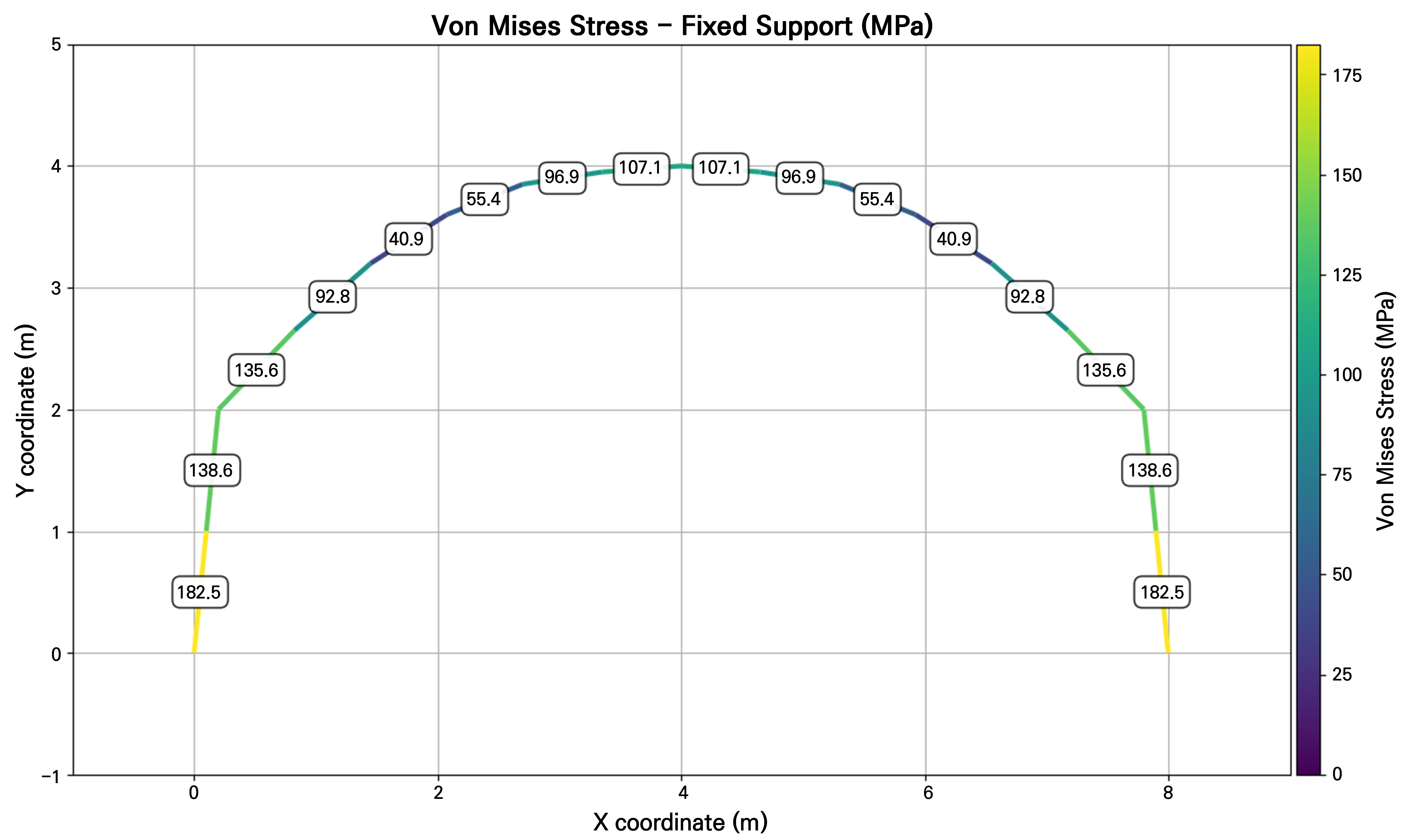
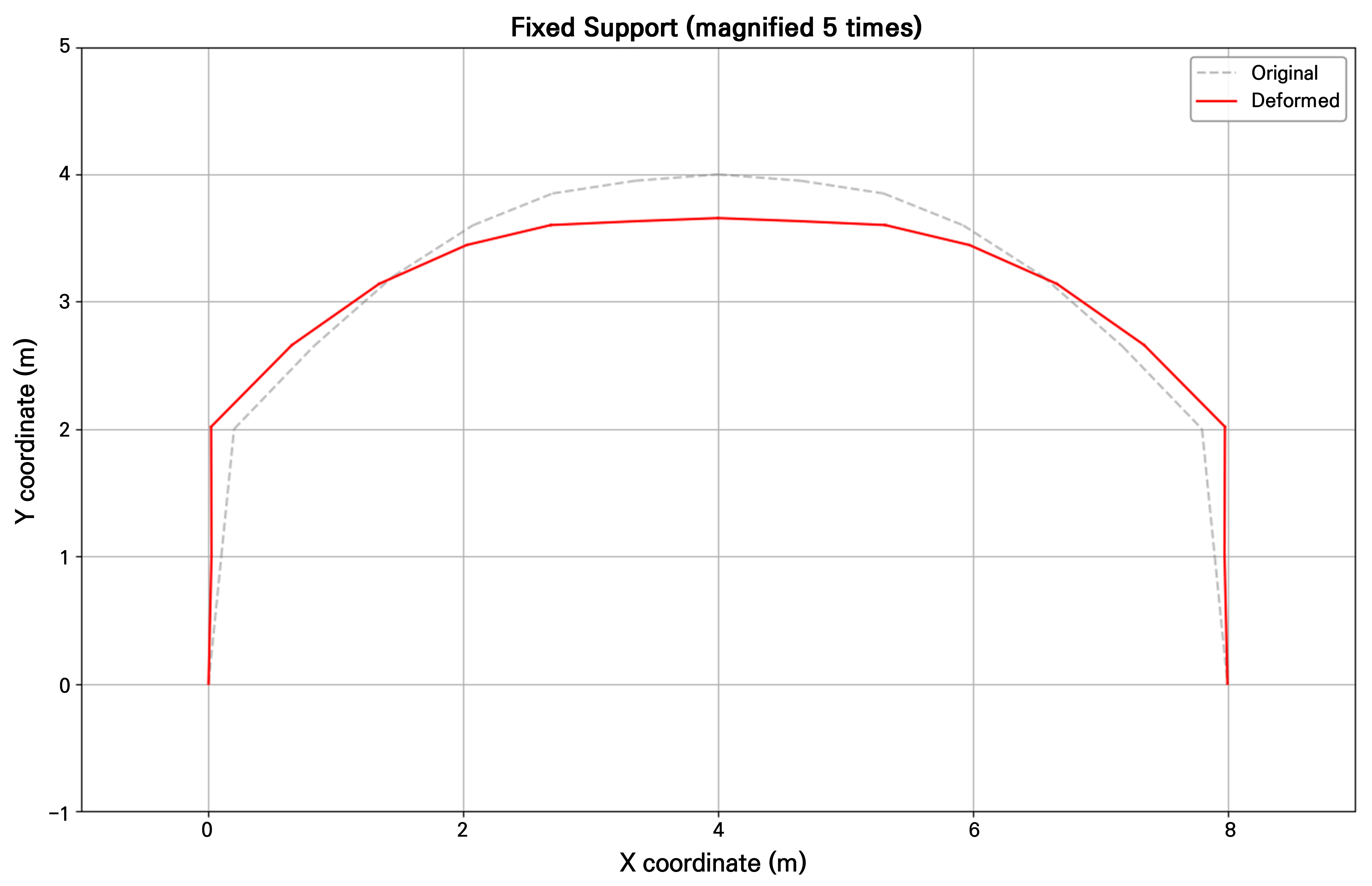
When the foundation was modeled as a fixed support, the maximum stress was 182.6 MPa at the foundation joint connected to the ground (Fig. 4). This corresponds to a safety factor of 1.62 when calculated as the ratio of the allowable stress, indicating that the entire structure supports loads within a safe range. The stresses in the central portion remained relatively low, ranging from 55.4 to 107.2 MPa, demonstrating that the main structural members evenly distributed the loads. The deformation analysis under fixed-support conditions (Fig. 5) showed a maximum x-axis displacement of 36.04 mm at the column-roof junction node and a maximum y-axis deflection of 68.66 mm at the central roof node. These results suggest that the overall structural deformation did not significantly deviate from its original configuration.
When the foundation was modeled as a hinge, the structural behavior exhibited characteristics distinct from those under fixed-end conditions. As shown in Fig. 6, the maximum von Mises stress increased to 205.8 MPa, resulting in a reduced safety factor of 1.34 compared to the fixed-end case. The stress distribution pattern revealed higher stress concentrations in the structural members connecting the foundation to the roof. Notably, significant stress concentrations occurred at the column-to-roof joints.
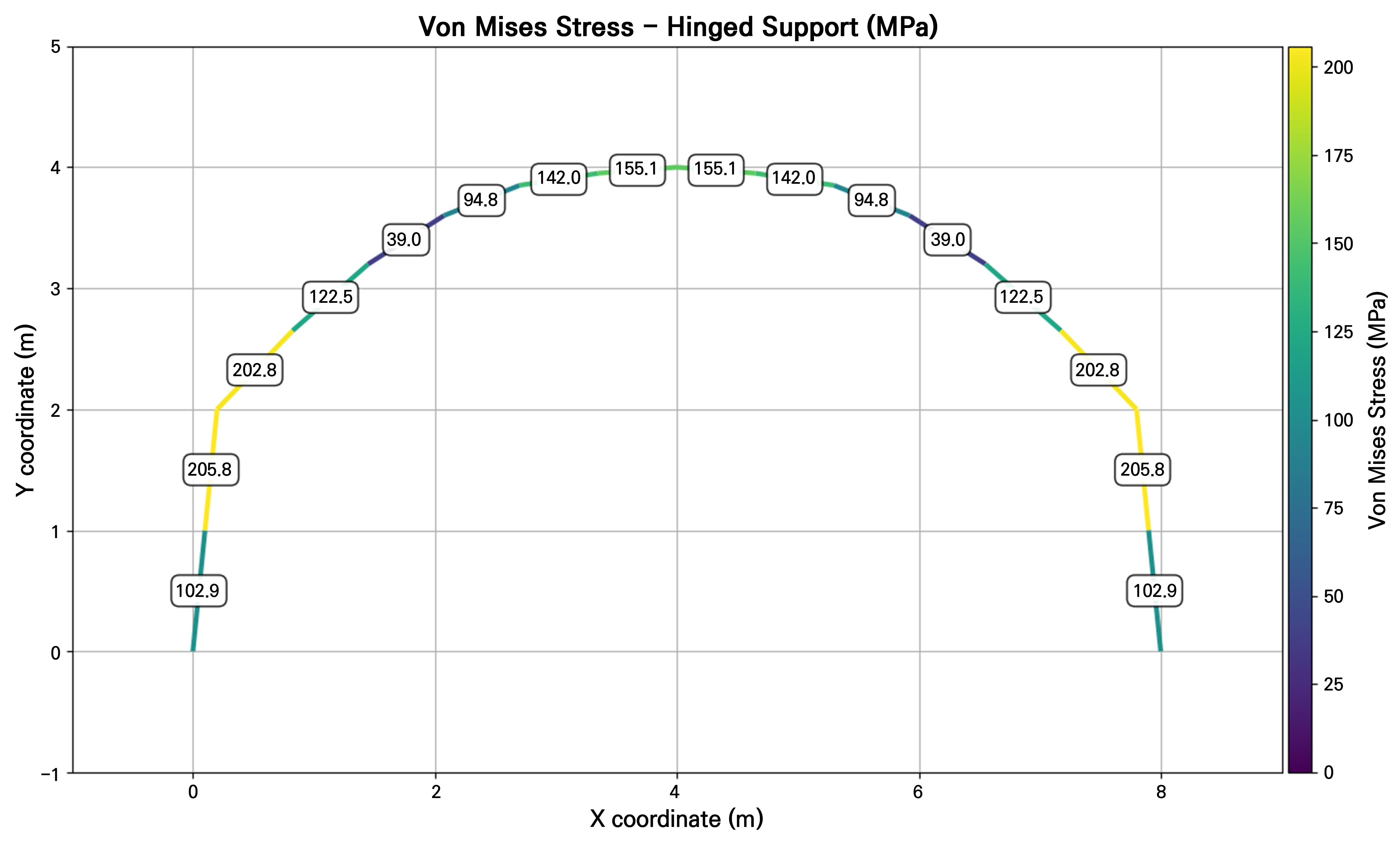
Under the hinge condition, the deformation analysis indicated a maximum displacement of 70.03 mm along the x-axis at the node where the column connects to the roof and a deflection of 119.2 mm along the y-axis at the center roof node. These values represent nearly twice the displacement observed under fixed-end conditions (Fig. 7). This result highlights a critical discrepancy: unlike the idealized fixed-end assumption used in current design standards, actual greenhouse foundations are directly embedded into the soil, which inevitably allows a certain degree of rotation. Consequently, the real structural safety may be significantly lower than the values estimated using conventional design assumptions.
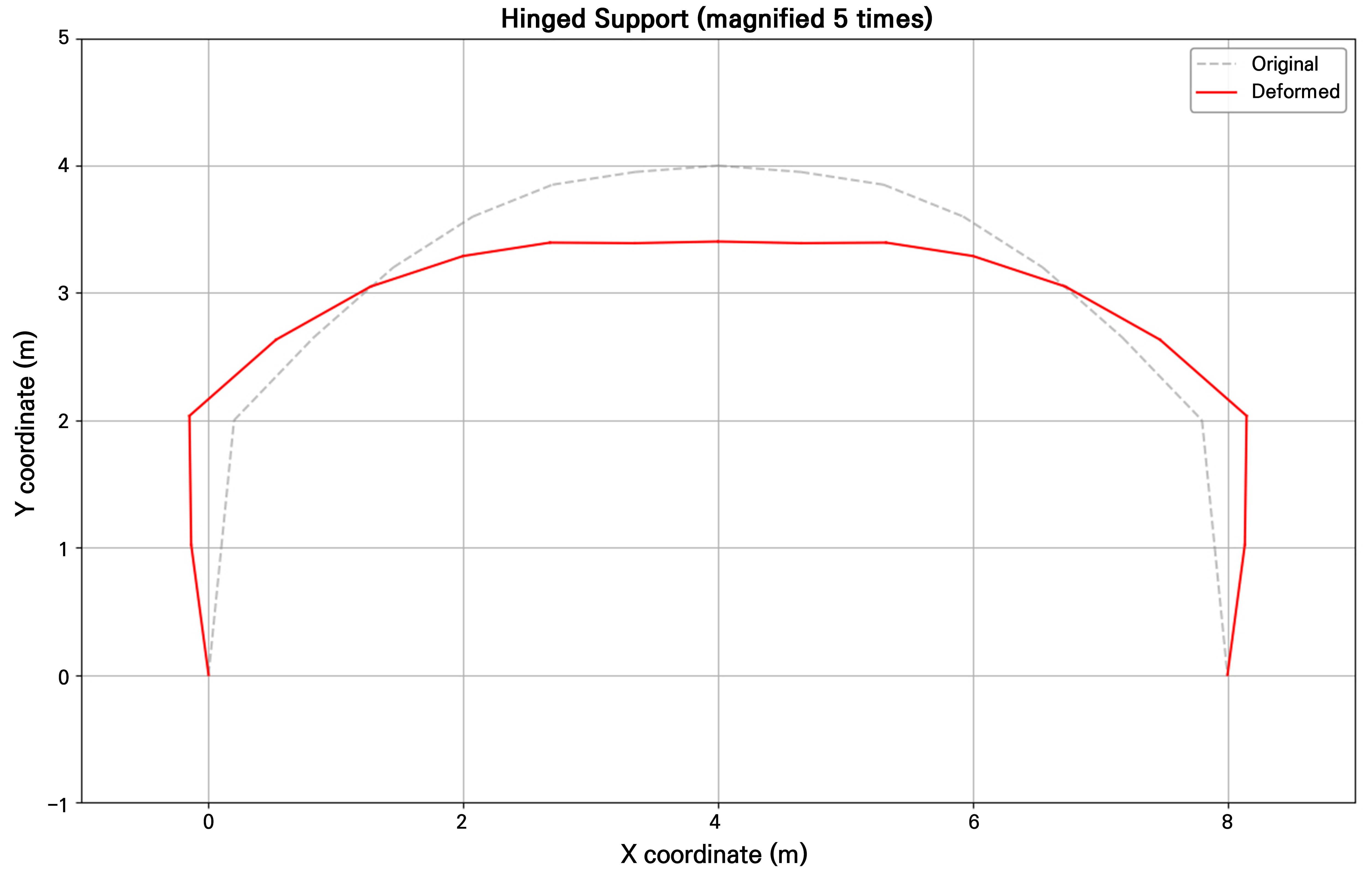
Fig. 7.
Deformation of the greenhouse structure under hinged support conditions (magnified 5 times). The gray dashed line represents the original shape, while the red solid line shows the deformed shape under a snow load. Maximum vertical deflection of 119.2 mm occurs at the center of the roof, approximately 1.7 times greater than that under fixed support conditions.
In contrast, when displacement and rotation at the foundation were allowed, significantly different behavioral patterns emerged compared to the fixed-support analysis. The maximum stress reached 445.4 MPa, exceeding the allowable stress of 295 MPa by approximately 50.8%. As shown in Fig. 8, the column members exhibited a dramatic stress increase, reaching maximum stresses of 404.3 MPa and 445.4 MPa. Such stress concentrations suggest potentially critical impacts on the overall structural safety.
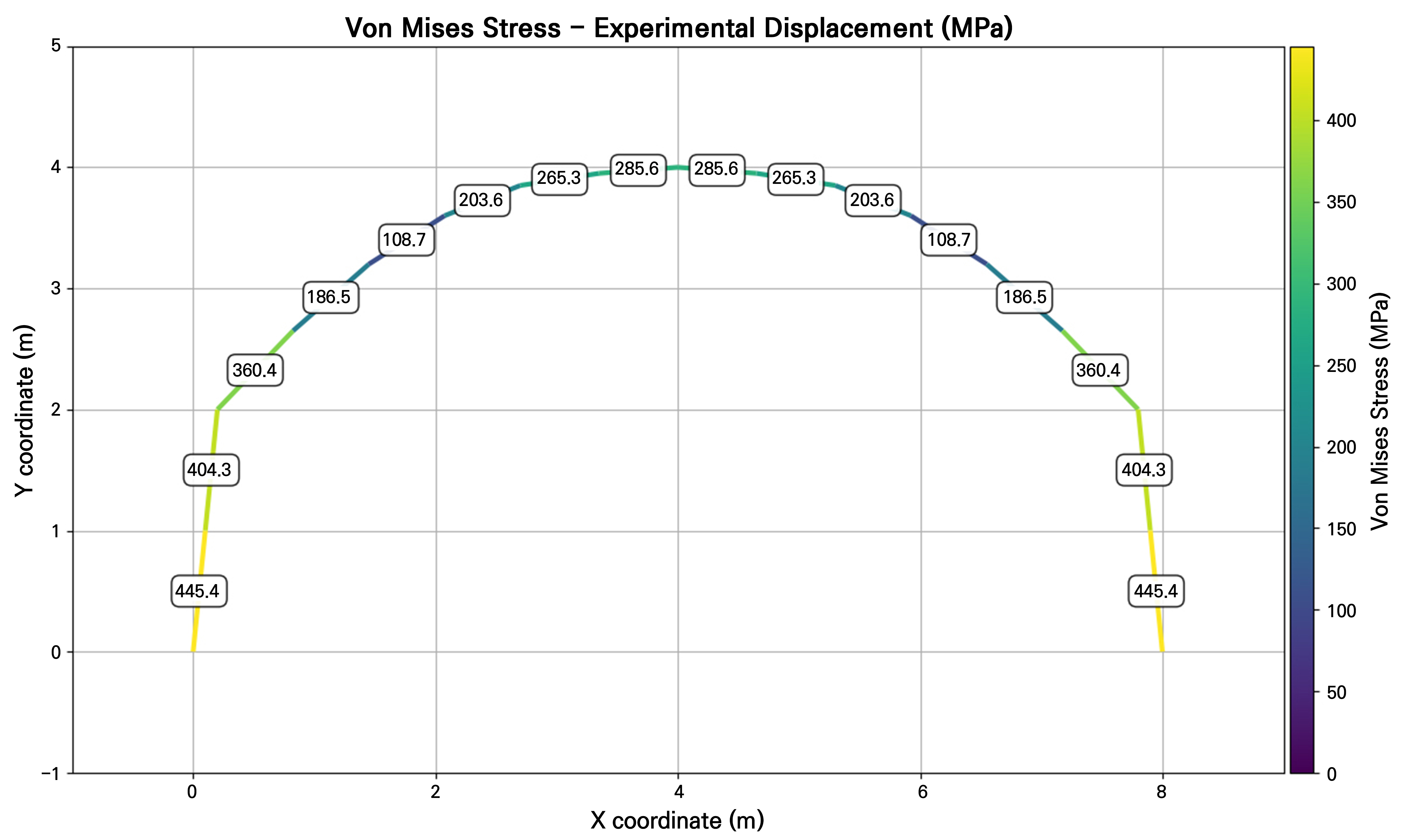
Fig. 8.
Distribution of the von Mises stress in the greenhouse structure under experimental displacement conditions. Maximum stress of 445.4 MPa occurs at the foundation joints, exceeding the allowable stress limit of 295 MPa, with high stress concentrations of 404.4 MPa also observed in the column members.
The deformation analysis revealed a maximum x-axis displacement of 169.3 mm at the column-roof junction node, attributed to ground movement at the foundation. This column displacement, resulting from an insufficient foundation bearing capacity, triggered a chain reaction in which ground movement negatively affected the column safety, ultimately leading to roof deflection. As shown in Fig. 9, the roof center experienced maximum y-axis deflection of 267.8 mm, indicating insufficient support against snow loads at the central portion of the roof.
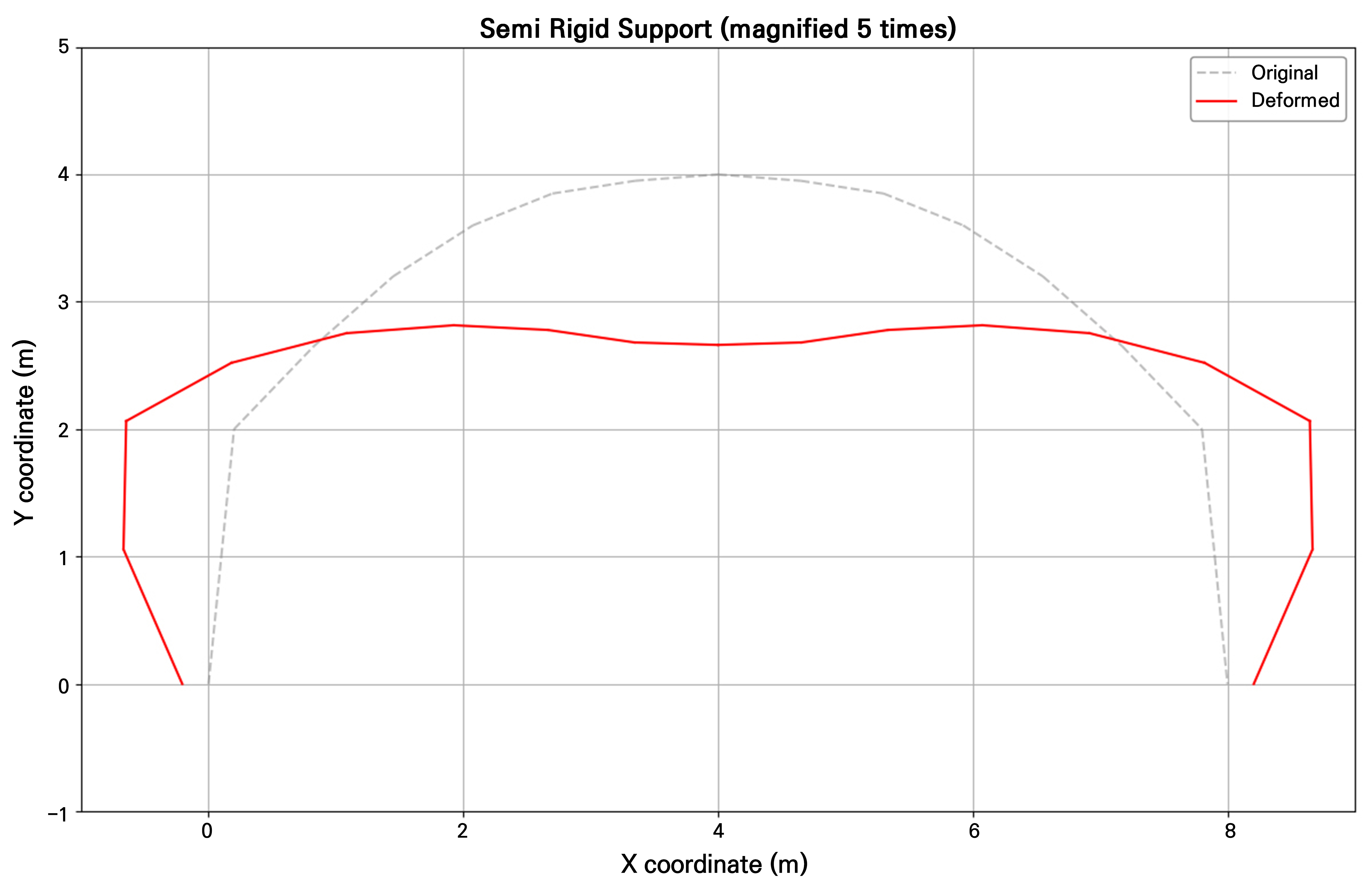
Fig. 9.
Deformation of the greenhouse structure under semi-rigid support conditions (magnified five times). The gray dashed line represents the original shape, while the red solid line shows the deformed shape under a snow load. Maximum vertical deflection of 267.8 mm occurs at the center of the roof, with significant horizontal displacement of 169.3 mm at the column-roof connections, approximately four times greater than that under fixed support conditions.
A node-by-node rotation analysis showed that the maximum rotation angle reached 0.1638 rad at the column-roof junction nodes. Specifically, the column nodes (nodes 2 and 3) experienced rotations of 0.0624 rad and −0.0292 rad, respectively, indicating substantial rotation at the column-roof connections. These rotations, which are closely related to the ground movement at the foundation, affected roof members through column tilting.
Consequently, an insufficient ground-bearing capacity leads to foundation displacement and rotation, causing cascading effects that generate additional stresses throughout the structural members. The displacement in the columns amplified the roof member deflection, while the additional rotation at the column-roof joints concentrated the stress. These results suggest potentially serious issues with regard to long-term structural durability and stability, representing major risk factors for structural failure.
Finally, to evaluate the serviceability of the greenhouse structure according to different boundary conditions at the joints, we compared the analysis results with displacement limit criteria. According to general greenhouse design guidelines, the allowable displacement for rafters is limited to 1/100 of the span length (L), and for columns, it is limited to 1/60 of the height (h) (JGHA 1997; Kim et al. 2000; Yun et al., 2016). Based on these criteria, the allowable displacement for rafters is 80 mm, and for columns, it is 33.3 mm.
The analysis showed that under the fixed-end condition, the mid-span deflection of the rafters was 68.66 mm, which falls within the allowable limit. However, under the hinged and semi-rigid conditions, the deflections increased to 119.2 mm and 267.8 mm, respectively, both exceeding the limit. For horizontal displacement, all conditions exceeded the column displacement limit, with the semi-rigid condition showing the most significant deviation—169.3 mm, more than five times the allowable limit (Table 4).
Table 4.
Serviceability assessment according to the foundation joint condition (Unit: mm)
It is important to note that these results do not account for the structural effect of purlins. Purlins, which are longitudinally installed elements that support the entire roof structure, could reduce overall displacement in actual greenhouse structures. Nevertheless, the observed trend of increased displacement due to changes in foundation conditions remains valid. This has important implications for greenhouse serviceability, indicating that displacement assessments must consider foundation boundary conditions in the design process.
Comparison of greenhouse reliability based on foundation joint conditions
We compared reliability results based on MCS with 1,000,000 iterations using probabilistic variables for the loading conditions (snow depth, snow unit weight), ground conditions (dry unit weight), and material properties (elastic modulus, yield strength) (Table 5). For fixed-support conditions, the analysis yielded a failure probability of 2.82 × 10⁻¹ with a reliability index of 0.58, simulating 282,308 failure cases. Under the hinge condition, the analysis simulated 365,868 failure cases, resulting in a reliability index of 0.34. In contrast, under conditions allowing displacement and rotation, the failure probability increased significantly to 6.06 × 10⁻¹ with a reliability index of −0.27, resulting in 605,825 failure cases. The high failure probability exceeding 50% and negative reliability index under displacement-rotation conditions indicate structural vulnerability.
Table 5.
Comparison of reliability analysis results between fixed support, hinged support, and semi-rigid support conditions
| Contents | Fixed support | Hinged support | Experimental displacement |
| Failure probability | 2.82e–01 | 3.66e–01 | 6.06e–01 |
| Reliability index | 0.58 | 0.34 | ‒0.27 |
To evaluate the influence of probabilistic variables on the failure probability, we analyzed the Pearson correlation coefficients (), Spearman rank-order correlation coefficients (), and sensitivity indices (Table 6). Under fixed-support conditions, the snow depth showed a strong negative correlation with the safety margin ( = ‒0.922), while the snow unit weight demonstrated a significant negative correlation ( = ‒0.332). Sensitivity indices showed similar values (‒0.922 and ‒0.332, respectively), indicating that the snow depth was the dominant factor affecting structural safety under fixed-support conditions.
Table 6.
Sensitivity analysis results of probabilistic variables
Even under the hinge condition, the snow depth exhibited a strong negative correlation with structural reliability ( = ‒0.923), while the unit weight of snow showed a similar negative correlation ( = ‒0.332), consistent with the fixed-support condition. Both the sensitivity index and the rank correlation coefficient followed a similar pattern, confirming that the snow depth is the dominant factor influencing structural reliability.
For conditions allowing displacement and rotation, the snow depth maintained the strongest negative correlation ( = ‒0.885), while dry unit weight showed a weak positive correlation ( = 0.293). The influence of the snow unit weight decreased significantly ( = ‒0.069), likely due to the load redistribution from the allowable joint displacement. The Spearman rank-order correlation revealed similar trends for fixed-support conditions but showed a stronger correlation for the snow depth ( = ‒0.944) under displacement-rotation conditions, suggesting a nonlinear relationship between the snow depth and safety margin.
These sensitivity analysis results have important implications for current greenhouse design standards. First, under fixed- and hinged-support conditions, both the snow depth and snow unit weight significantly influenced the structural safety, suggesting that current design standards considering only the snow depth may introduce considerable uncertainty. Second, under displacement-rotation conditions, the snow depth and dry unit weight emerged as the primary influencing factors. This indicates that the ground-structure interaction must be considered in the design, particularly when allowing joint displacement and rotation. Therefore, it is recommended that current disaster-resistant greenhouse design standards be supplemented with criteria for the snow unit weight and guidelines for considering ground-structure interaction effects. These would contribute to more accurate assessments and stronger assurances of greenhouse structural stability.
Discussion
This study conducted structural and reliability analyses of single-span agricultural greenhouses using both fixed-support conditions and conditions allowing displacement and rotation, employing a Monte Carlo simulation (MCS). The structural analysis results showed that under fixed-support conditions, the maximum von Mises stress was 182.6 MPa for a 30-year return period snow depth of 40 cm, remaining within allowable stress limits. Under the hinge condition, the maximum stress increased to 205.8 MPa, reducing the safety factor to 1.34, and the deformation approximately doubled compared to the fixed-support case. However, when displacement and rotation were allowed, the maximum stress reached 445.4 MPa—exceeding the allowable stress by approximately 50.8%—and the deformation increased by nearly four times. This reduction in structural safety was attributed to displacement and rotation at the foundation, caused by an insufficient ground-bearing capacity.
The reliability analysis yielded similar findings. Under fixed-support conditions, the failure probability was 28.2%, with a reliability index of 0.58, indicating relatively safe structural behavior. Under the hinge condition, the failure probability increased to 36.6% and the reliability index dropped to 0.34, indicating a more vulnerable structural response than in the fixed-support case. However, when displacement and rotation were allowed, the failure probability further increased to 60.6%, with a reliability index of ‒0.27, demonstrating a significant rise in structural risk. These results suggest that an insufficient foundation bearing capacity induces displacement and rotation in the column and roof members, ultimately leading to structural instability.
The current disaster-resistant greenhouse design standards in Korea primarily consider the snow depth; however, this study confirmed that the unit weight of the snow also has a significant impact on structural safety. Notably, under both fixed and hinge support conditions, the snow depth and unit weight demonstrated comparable levels of influence on structural reliability, indicating the need to include the snow unit weight as a design parameter in future revisions of the standards. Additionally, the interaction between the soil and the structural system had a pronounced effect on structural behavior. The failure probability of 60.6% under the displacement-and-rotation-allowed condition highlights that uncertainties in ground conditions can be a decisive factor with regard to structural performance.
These implications hold substantial relevance for field applications. In reality, some single-span greenhouses omit or inadequately construct strip footings due to convenience or cost considerations. These greenhouses may exhibit vulnerabilities similar to those observed under the displacement-and-rotation-allowed condition in this study. Therefore, it is essential to adhere strictly to construction guidelines, particularly in mountainous regions with heavy snowfall or areas prone to wet snow, where the snow unit weight tends to be greater. Reinforcement of foundation structures and proper design practices are necessary to ensure structural safety and protect farmers’ assets.
Moreover, when assessing the safety of existing greenhouses, it is critical to examine the foundation conditions thoroughly. If signs of ground settlement or deformation are observed, the actual structural behavior may resemble that of a semi-rigid connection, necessitating a reassessment of the structural reliability. Uncertainties in foundation connections also have horticultural implications. Excessive deformation in greenhouse structures can damage covering materials and cause leakages, disrupting internal environmental control. This can increase condensation, leading to higher risks of pest and disease outbreaks. Furthermore, repeated structural deformations can accelerate fatigue failure at the joints, reducing the service life of the facility and increasing maintenance costs.
Considering the projected increase in extreme weather events due to climate change, the high failure probabilities observed in this study suggest that current design standards may not be sufficiently conservative. The finding that even under a 30-year return period snow load, structural safety was inadequate, emphasizes the urgency of revising the standards. Therefore, future guidelines should incorporate snow unit weight and soil-structure interaction effects and propose design strategies that ensure both structural integrity and horticultural functionality.
However, this study has several limitations. First, it did not consider the effects of strip foundations prescribed in the current disaster-resistant greenhouse design standards. In practice, such strip footings, constructed beneath the pipe foundations can significantly influence the ground-bearing capacity and deformation characteristics. Second, this study did not account for the spatial variability of soil properties or inconsistencies in construction quality, which can introduce greater uncertainty under actual field conditions. Additionally, although this study employed the von Mises stress as a unified criterion for an integrated evaluation, actual design standards evaluate each member separately—under compression, tension, shear, or combined loading. The study also did not consider buckling, which can be critical in compression members. Because the allowable compressive stress varies with the slenderness ratio (a parameter representing the ratio of a member’s length to its cross-sectional dimension and a key indicator of buckling stability), columns subjected to greater compressive forces may be more vulnerable when uniform allowable stress is applied. Future research should include buckling assessments considering member slenderness and conduct detailed analyses for each structural behavior type. In particular, hinge and semi-rigid conditions can increase the effective buckling length of columns, which may significantly elevate the risk of buckling and thus require in-depth investigations.
