

Introduction
Materials and Methods
Plant Materials
Defoliation Treatments
Fruit Quality Analysis
Statistical Analysis
Results and Discussion
Fruit Development
Fruit Quality Indices, Sugar Composition and Incidence of Watercore
Skin Coloration
Introduction
Apple (Malus × domestica) is one of the most important and widely cultivated deciduous fruit crops around the world (Jackson, 2003). Consumers increasingly demand high quality fruits that are not only sweet but also have an appealingly “artistic” red blush to the skin (Krissoff et al., 1997; Li et al., 2002). Researchers from various countries have investigated the use of reflective film (Ju et al., 1999; Layne et al., 2002), application of methyl jasmonate (Rudell et al., 2005), and fruit bagging (Sharma et al., 2013, 2014) to improve apple skin coloration.
In Japan, many apple orchards are planted at low density with trees pruned to a flat, open-center form grafted on M. prunifolia Borkh. var. ringo Asami rootstock. Fruit bagging, artificial defoliation (AD) and fruit rotation are used to harvest high quality fruits (Arakawa and Komori, 2006).
AD is used to improve the appearance of apples. However, it is labor-intensive and cost-ineffective: in apple production, approximately 22% of total working hours are given to AD and fruit rotation to produce ideally colored fruits (Fukuda, 2006). Fruit bagging and the use of reflective films to produce high quality apples have become more common around the world (Ju et al., 1999; Layne et al., 2002; Sharma et al., 2013, 2014). However, since these cultivation practices increase production costs, growers may use non-bagging apple cultivation methods (Arakawa and Komori, 2006; Osanai, 2006). Some Japanese growers practice apple cultivation that omits all of the above efforts, this, no artificial defoliation (NAD) method (Fukuda and Masuda, 2006).
Compared to the skin blush of ‘Fuji’ apples grown from defoliated trees, apples grown using NAD are relatively inferior in color (Li et al., 2002). However, since NAD treatment remove no leaves from the tree, it might improves the internal quality of the apple fruit, including its sugar content. However, to date, there is no scientific evidence that this is the case.
In this study, we compared the effects of AD timing and NAD practices on fruit coloration and quality of ‘Fuji’ apples over the course of 3 years. These results contribute to current knowledge of the best leaf management practices to employ in the production of high quality ‘Fuji’ apples.
Materials and Methods
Plant Materials
Experiments were conducted between 2011 and 2013 using five 15-year-old ‘Fuji’ apple trees grafted on M. prunifolia and grown on an experimental farm of Hirosaki University (Fujisaki Farm, 40°39ʹ25ʺ N, 140°29ʹ9ʺE). Trees were trained to a flat, open-center form (7.0 m×7.0 m planting) with four primary scaffolds. The experimental design was a randomized complete block with three treatments and five primary scaffold replications. To equilibrate the effect of the preceding year, the treatment applied to each primary scaffold was randomly changed every year.
Defoliation Treatments
Three defoliation treatments were applied to the trees: 1) no artificial defoliation (NAD), 2) early defoliation (ED), and 3) conventional defoliation (CD). Treatments followed the methods used by growers in practical cultivation areas. For the NAD treatment, fruit rotation was performed only once (on October 23) for 3 years and leaves were not removed. For the ED and CD treatments, fruit rotation was performed twice (on October 12 and October 23) for 3 years and AD was performed by hand. For the ED group, defoliation was performed on September 13 or 14 and on October 1 or 2, and for the CD group, defoliation was performed on October 1 or 2 and on October 12. Regardless of the timing of defoliation, leaves of fruit clusters were removed during the first defoliation, and in the second defoliation, leaves within 30 cm of the fruit were removed. About 25-30 leaves were removed in total (5-6 in the first treatment and 20-25 in the second treatment).
Fruit Quality Analysis
Thirty fruits per primary scaffold per tree were harvested on November 7, 16 or 12 in 2011, 2012 or 2013, respectively. Fruits harvested from five trees in each condition were mixed (150 fruits in total). All harvested fruits were measured as follow. Fresh weight of fruits was measured using a digital scale (EB-3200D, Shimadzu, Kyoto, Japan). Fruit length and diameter were measured using digital calipers (DIGIPA, Mitutoyo, Kanagawa, Japan). Flesh firmness was measured at two points on the equator of the fruit after removing skin with an 11.1 mm tip penetrometer (FT327, Facchini srl, Alfonsine, Italy). Soluble solids content of the juice was determined using a digital refractometer (N-1 Atago, Tokyo, Japan). Juice collected from 30 fruits was passed through a membrane filter (0.45μm, Centricut MF, Kurabou, Japan). A 5 μL aliquot of filtrate was injected into a high performance liquid chromatography system (PU2089 Plus, JAS. Co., Japan) equipped with a differential refractive index detector (RI2031 Plus, JAS. Co., Japan). Sugars were separated using an SC1011 column (Shodex, Japan) with water as the solvent maintained at 85°C and a flow rate of 0.6 mL·min-1. Fructose, glucose, sorbitol, and sucrose were identified and quantified by comparing peaks produced by a known standard sugar solution with a reporting integrator (807IT, JAS. Co., Japan).
Total titratable acidity was measured by titration with 0.1N NaOH up to pH 8.3 and calculated as malic acid. As reported by Enseikai (2014), incidence of watercore was scored on a scale of 0-4 with 0=no incidence, 1=very little, occurring only in vascular bundles, 2=little, occurring around vascular bundles, 3=medium, covering 20% of the equatorial area, and 4=high, covering 50% of the equatorial area. Area of skin blush was also scored on a scale of 0-4 with 0=red color covering less than 30% of the fruit, 1=red color covering less than 50%, 2=red color covering more than 50%, 3=red color covering more than 80% and 4=red color completely covering the peel). Differences in skin color difference (L*, a*, b*, and hue angle) were measured using a color difference meter (NF333, Nippon Denshoku, Tokyo, Japan).
Statistical Analysis
Data were subjected to two-way analysis of variance (ANOVA ) using JMP IN software (SAS Institute, Cary, NC). Significant differences between treatments in each year were determined using Tukey–Kramer’s honest significant difference (HSD) tests. Unless otherwise stated, differences were considered statistically significant at p < 0.05.
Results and Discussion
Fruit Development
Fruit weight, length, diameter, and length/diameter different across the 3 years of the study. However, fruits in the ED treatment had a slightly lower average weight than those in the NAD and CD treatments (Table 1). In the 2011 and 2013 season, apples in the ED treatment group were shorter in length and smaller in diameter than apples from the NAD group. CD-treated apples were almost the same length and diameter as NAD apples. The effect on the length/diameter ratio was limited in all treatments, and there were no consistent patterns (Table 1).
As shown in a previous study (Oba et al., 1996), CD treatment produced fruits that were similar in size to those produced by the NAD treatment. However, in this study, ED-treated fruits were slightly smaller than those in the NAD treatment group (Table 1). These results may be attributed to differences in cultivation environment and crop loads. Generally, fruit growth is divided into cell division and cell enlargement phases (Zhang et al., 2006). In the present experiment, trees from all treatment plots were managed in same way until mid-September. The difference in fruit size most likely occurred during the cell enlargement phase, as fruit cell division normally occurs only during the first stage of growth (Yokota, 2000). In the NAD treatment, no leaves around the fruit were removed prior to harvest, whereas in the ED treatment, leaves were removed 2 months before harvest. Fruits in the NAD group therefore benefited longer from the photosynthetic products made in the leaves.
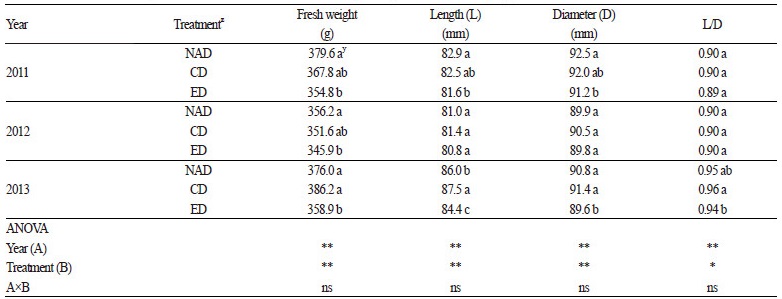
In a study of ‘Fuji’ apples, Wang et al. (2005) reported that photosynthetic products synthesized at the bourse shoot leaves were mainly translocated to the fruit. Watanabe et al. (2011) also reported high photosynthetic activity of bourse shoot leaves from early June to late August, and it gradually decreased as harvest approached. They also reported higher amounts of translocated photosynthetic product synthesized at both bourse shoot leaves and bourse leaves in late August compared to late October. AD in mid-September reduced the fresh weight of ‘Fuji’ apples, depending on the intensity of defoliation (Suzuki et al., 1987). These results indicate that defoliating trees too-early suppresses the accumulation of photosynthetic products in the fruit, and suppresses fruit enlargement. Although fruits grown from ED-treated trees had fully red skin, fruits were smaller and overall fruit yield was lower.
Fruit Quality Indices, Sugar Composition and Incidence of Watercore
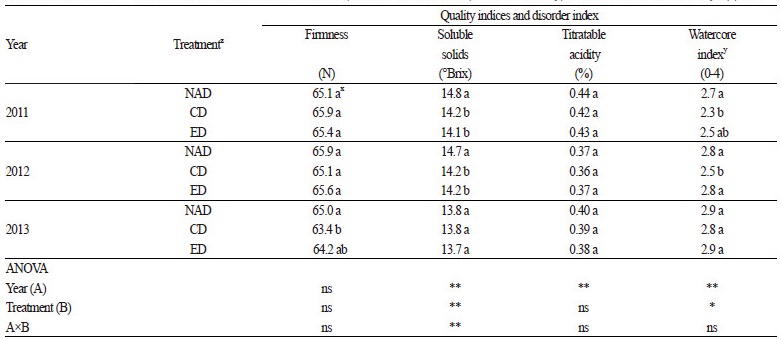
Flesh firmness was not affected by treatment or year, although there was some variation between treatments in 2013 (Table 2). The titratable acidity and sugar/acid ratio were not affected by treatment, although they varied somewhat by year (Table 2). These results indicate that fruit taste, a factor of great importance to consumers, is not affected by different defoliation regimes. The watercore index varied somewhat by year, and the value of CD apples was slightly lower than that of the other treatments in 2011 and 2012 (Table 2).
We hypothesized that the NAD treatment would increase soluble solids content. Indeed, we found the soluble solids content of NAD apples to be higher than that of CD and ED apples in both 2011 and 2012. However, no difference was observed in 2013 (Table 2). This might be attributed to heavy rainfall in October 2013 (data not shown). The increase in soluble solids content was less than 1% (Table 2).
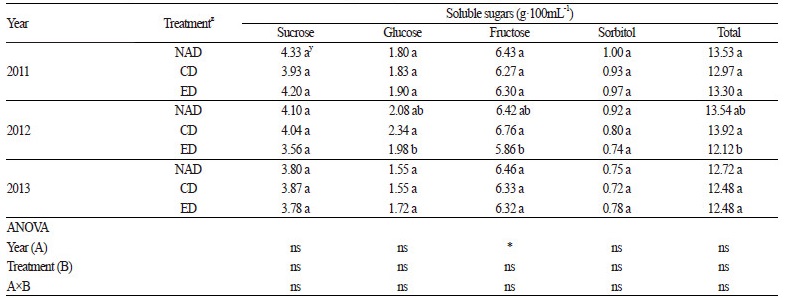
Treatment group had no effect on sugar composition and total sugar content, although the amounts of glucose, fructose, and total sugar differed between CD and ED apples in 2012 (Table 3). ANOVA analysis showed that only fructose content varied by year, other sugars and total sugar content did not change by year or treatment. Sugar composition did not vary across the three treatments, and there was no effect of treatment or year on sugar content, except on fructose (Table 3). In the present study, we used 150 fruits to analyze fruit quality, and were able to detect small differences in soluble solids content. However, limitation of our method to analyze sugar composition is that we measured samples containing the mixed juice of just 5 apples. It is attractive for growers to produce sweeter fruit with less labor. However, there is a trade-off between reduced production costs and the drop in market value caused by poor fruit appearance. Growers can only make up for the reduced value of fruit with poor appearance if they can present scientific evidence to demonstrate extremely high sugar content instead. Some studies have reported higher sugar accumulation in fruits from trees with low crop load (Jakopič et al., 2013; Link, 2000). Crop load is usually defined at the time of fruit thinning (4-5 months before harvest). However, in the present experiment, leaves were removed about 1.5 and 2 months (ED) or 1 and 1.5 months (CD) before harvest. Therefore, sugar content and composition did not differ greatly between treatments.
Some growers state that no-removing leaves improves the sugar content of fruit compared with CD. However, these growers typically combine NAD cultivation with other management methods, such as the addition of organic compost, proficient pruning, and maintenance of a suitable fruit load, thus introducing many other variables into cultivation. In the present study, only a slight increase in soluble solids content was observed in NAD-treated fruits, suggesting that to produce high-sugar fruits, growers must manage the leaves as well as manipulating other cultivation techniques.
Skin Coloration
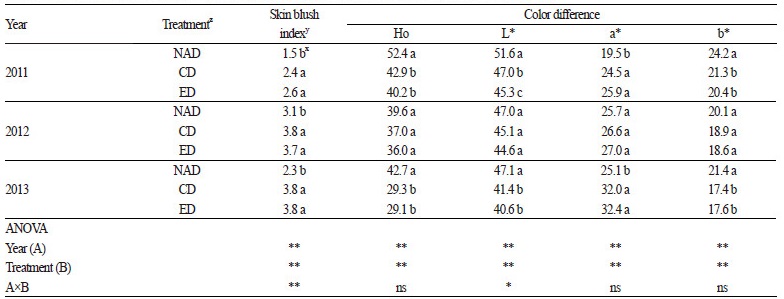
Parameters related to fruit skin blush were very different between treatments (Table 4). In 2011 and 2013, the skin blush of apples in ED and CD treatment group was superior to that of NAD apples. Specifically, ED and CD apples had higher skin color index scores, higher a* values, and lower L*, b*, and Ho values (Table 4). In 2012, the skin blush of apples in all treatments was better than in the other years, this was the only significant treatment effect that year. These results demonstrate that AD is useful for improving fruit skin blush, especially during a poor year for skin color.
Use of NAD treatment is well known to produce fruit with poor skin color (Oba et al., 1996). In Japan, AD of ‘Fuji’ is generally considered essential, and is usually performed in mid- to late October (Enseikai, 2014). Some reports have warned that intense AD in mid-September negatively affects fruit skin blush and induces a decline in fruit quality (Oba et al., 1996; Suzuki et al., 1987). The present experiment evaluated two levels of AD and the NAD, and we conclude that leaf removal protected fruit skin blush, even in ED-treated apples.
This study originally intended to investigate problems of early, rapid AD. In previous studies investigating the effect of rapid defoliation treatment time from late August to early September, the quality of harvested fruits was lower than untreated fruits, expression of skin pigmentation was delayed and sun burn damage caused by direct sunlight was increased (Goto and Kudo, 2014). Therefore, in the present study, we adjusted the initial defoliation treatment timing to the middle of September to avoid these problems. However, excessive leaf defoliation before harvest causes inferior fruit quality and results defective accumulation of stored carbohydrate in trees, causing poor flowering and fruit set in the next year (Aomori Apple Expt. Sta., 1985; Lee and Kang, 1996; Srisook et al., 2015). Because of this, and based on a report that removal of 17.3-58.3 leaves in ‘Fuji’ resulted in there was no difference in the total carbohydrate or nitrogen contents of bark tissues of bourse shoot, current shoot, and branches (Yim and Lee, 1999), we removed only 25-30 fruit cluster leaves and current shoot leaves within 30cm of the fruits. We conclude that the degree of AD in this study was insufficient to affect the accumulation of stored carbohydrates, which in turn would affect cold tolerance and flowering in the following year.
NAD treatment induced a small increase in soluble solids content compared with the CD and ED treatments. However, the skin blush of NAD apples was inferior to those of CD and ED apples. It is unlikely that the slight increase in soluble solids content will be attractive enough to consumers to compensate for the reduced appeal of the skin blush. However, ED treatment produced smaller fruit than did the NAD treatment, resulting in a remarkable decrease in yield, although there was no difference in fruit size between the NAD and CD treatments.
