

Introduction
Materials and Methods
Experimental design
Film treatment characteristic analysis
Soil characteristic analysis
Crop characteristic analysis
Suitability for mechanized operations
Statistical analysis
Results and Discussion
Film degradation
Soil properties
Onion performance
Suitability for mechanized operations
Conclusion
Introduction
Proper soil management is essential for maintaining favorable root-zone conditions during the growing season, particularly in the hot and humid environment of the Korean Peninsula, where climate extremes such as heatwaves, heavy rainfall, drought, and freezing events are becoming increasing frequent (Kasirajan and Ngouajia 2012; El–Metwally et al. 2022; Jeon et al. 2022). Inorganic polyethylene (PE) mulch films are widely used in agricultural soils to suppress weeds, prevent soil erosion and the loss of water and nutrients, improve the soil structure, and increase the productivity of winter and summer crops (Kasirajan and Ngouajia 2012; Amare and Desta 2021). However, when PE mulch films are buried in soil after harvest, they can take more than 100 years to decompose, thereby adversely affecting the soil ecosystem. Alternatively, burning these films releases various toxic substances and increases greenhouse gas emissions during combustion (Di Mola et al. 2021; Dewi et al. 2024). As environmental pollution, carbon neutrality, and global warming have become increasingly important agricultural concerns, efforts to adopt environmentally friendly ground-cover materials have expanded throughout Korean agriculture. Biodegradable (BD) films, which can be decomposed naturally by microorganisms and ultimately converted into water and CO2, were introduced in the 1980s to reduce plastic waste and address agricultural labor shortages (Kasirajan and Ngouajia 2012; Sintim et al. 2021; Akhir and Mustapha 2022; El–Metwally et al. 2022; Dewi et al. 2024; Song et al. 2024). The degradation rate of BD films is primarily determined by their composition but also varies according to the cultivation environment, climatic conditions, and crop type (Akhir and Mustapha 2022; Mansoor et al. 2022; Dewi et al. 2024; Song et al. 2024; Kim et al. 2025; Ryu et al. 2025).
The agricultural BD mulch-film market in Korea is highly reliant on imports owing to the limited availability of domestic technologies for the manufacturing of the principal raw materials used in poly(butylene adipate-co-terephthalate) (PBAT)- and polylactic acid (PLA)-based bioplastics (Kim et al. 2025; Lee 2025; Ryu et al. 2025). Consequently, large quantities of raw materials and semi-finished polymers, certified according to European agricultural biodegradability standards, such as EN 17033, are imported and subsequently processed domestically through compression molding before distribution (Kim et al. 2025; Lee 2025; Ryu et al. 2025). To reduce dependence on the imported PBAT and PLA biopolymers, mulch films composed of PBAT and supplemented with starch-based materials have been developed by domestic companies and national research institutes and are currently undergoing field testing (Jung et al. 2023; Lee 2025; Park et al. 2025; Choi et al. 2026). However, domestically developed PBAT-based films have been found to deteriorate physically on the soil surface during crop growth, but they do not decompose rapidly enough after incorporation into the soil through tillage to permit the timely transplantation of subsequent crops. Multilayer BD mulch films have therefore been developed both domestically and internationally. These films combine an outer layer with high mechanical strength, which prevents premature degradation before harvest, with an inner layer containing a rapid degradable component such as thermoplastic starch (TPS). Nevertheless, these films may still exhibit inadequate degradation during crop growth and after incorporation into the soil (Choi and Jung 2025; Kansara et al. 2025; Kim et al. 2025; Choi et al. 2026).
Mid- to late-maturing onions (Allium cepa L.) are cultivated in Korea over an extended period, from planting in October to harvesting in June, and have shallow-root systems that require stable soil conditions to achieve high yields, particularly under increasingly variable climate conditions (Vavrina and Roka 2000; El–Metwally et al. 2022). Therefore, investigating the degree of degradation and potential issues associated with biodegradable mulching films in onion fields, as well as determining their mechanical suitability for covering and harvesting, is expected to provide innovate information for achieving mechanized onion farming methods. The recent incorporation of hydrolysis inhibitors and starch- and lignin-based materials into domestically developed PBAT-based films or transparent multilayer BD films has been considered a promising strategy for preventing degradation during onion cultivation while facilitating effective decomposition after tillage (Yang et al. 2021; Park et al. 2025), though few field evaluations have been conducted in relation to these prototype BD mulch films. Therefore, in this study we evaluated the biodegradability and suitability for mechanized operations of BD and PE mulch films used in an onion field, as well as their effects on crop productivity.
Materials and Methods
Experimental design
Black PE film (S Co., Ltd., Cheonan, Korea) and four BD mulch films, each 120 cm wide, were evaluated as experimental treatments. The films were laid on the soil surface using a Mitsubishi M858A cultivator (Mitsubishi Co., Ltd., Matsue, Japan) equipped with a mulching-laying roller at a commercial farm with sandy loam soil in Yeongcheon, Korea (36.0° N, 128.9° E), on October 20, 2025.
Basic soil fertilizer was applied over the entire soil surface in the form of a compound fertilizer (N–P2O5–K2O = 18–7–9, 60 kg ha-1, Chobi Co. Ltd., Seoul, Korea) and livestock manure compost (N–P2O5–K2O = 18–7–9, 20 Mg ha-1, Hyosung ONB Co. Ltd., Asan, Korea), applying a basal dressing before transplanting, and with a compound fertilizer (N–P2O5–K2O = 25–0–15, 80 kg ha-1, Hyeopwha Co. Ltd., Seoul, Korea) as a topdressing after transplanting at the standard rates recommended for onion cultivation by the Rural Development Administration (RDA 2021). Pests were controlled using various synthetic insecticides with bifenthrin·terbufos granules (bifenthrin 0.1%+terbufos 1.5%, FarmHannong Co. Ltd., Seoul, Korea) or a broflanilide emulsifiable concentrate (EC; broflanilide 5%, Hankooksamgo Co. Ltd., Seoul, Korea) in accordance with integrated pest management guidelines (RDA 2021; Park et al. 2025). Diseases were controlled using a product containing Bacillus subtilis (1.0×10⁶ CFU g-1, Saehanagro Co., Ltd., Gumi, Korea) or a 25% EC formulation of tebuconazole (a triazole fungicide, FarmHannong Co., Ltd., Seoul, Korea). On October 30, 2025, defined as 0 days after transplanting (0 DAT), 120 ‘Katamaru’ onion seedlings were transplanted into each experimental plot, which measured 100 cm wide × 320 cm long.
Weather conditions during the cultivation period from November of 2025 to May of 2026 were characterized using the monthly mean air temperature and cumulative monthly precipitation. These data were compared with the corresponding long-term averages reported by the Korea Meteorological Administration (KMA 2026).
The principle experimental assessments were conducted using a method similar to those employed in previous studies of BD films for onion cultivation (Jung et al. 2023; Park and Choi 2025; Park et al. 2025). Film degradation soil properties, crop growth and yield, and the films’ suitability for mechanized field operations were evaluated before and after harvest.
Film treatment characteristic analysis
Black conventional BD (CBD) mulch film (I Chemical Co., Ltd., Ansan, Korea), which is widely used on Korean farms, served as the reference BD film. The CBD film was manufactured domestically through compression molding using imported PBAT, PLA, and CaCO3 as raw materials. The remaining three BD films, designated as NBD-I, NBD-II, and NBD-III, were newly developed prototypes. The black NBD-I and NBD-II films (I Chemical Co., Ltd., Ansan, Korea) were composed of domestically developed PBAT combined with PLA and either a lignin (NBD-I) or a hydrolysis inhibitor (NBD-II). The transparent NBD-III film (R Co., Ltd., Hanam, Korea) had outer layers composed of imported PBAT, PLA, and CaCO3 and a middle layer composed of TPS. The PE, CBD, NBD-I, and NBD-II films were 0.015 mm thick, whereas the multilayer NBD-III film was 0.020 mm thick.
Mulch film degradation was evaluated at 30-day intervals from 0 to 210 DAT based on mechanical properties, visual degradation, weight retention, and light transmittance. Weight retention was determined using 10.0 × 10.0 cm film specimens and was calculated based on the change in the specimen weight at each sampling time (Bianchini et al. 2022; Choi et al. 2026). Film tensile strength and elongation were measured using a texture analyzer (TA-XT Plus, Stable Micro Systems Ltd., Surrey, UK). Degradation in the central and lateral portions of each film was assessed separately by visual inspection on a scale from 0 to 5, with 0 indicating no degradation, 1 meaning minor cracking, 2 indicating approximately 25% cracking, 3 indicating cracks 2.0–2.5 cm long, 4 signifying numerous regular mesh-like cracks and extensive degradation; and 5 meaning fragmentation into pieces smaller than 4.4 cm2 (Yin et al. 2019; Choi et al. 2026). Light transmittance through the films laid in each treatment plot was subsequently measured using a digital illuminance meter (Hioki Co., Ltd., Tokyo, Japan).
Film samples were collected from each treatment plot at 0 and 210 DAT, coated with platinum, and examined at 10,000× magnification using an SU-8600 scanning electron microscope (SEM; Hitachi High-Tech Co., Ltd., Tokyo, Japan).
After the onion bulbs were harvested, the experimental plots were tilled to a depth of 10 cm using a cultivator, thereby incorporating the residual films into the soil. Film weight loss (or decomposition) was subsequently determined at 225, 240, 255, 270, and 285 DAT to evaluate the decomposition of residual films in the soil.
Soil characteristic analysis
A wireless soil moisture data logger (Efento Co., Wroclaw, Poland) was installed at a depth of 10 cm in each treatment plot. Hourly soil moisture and temperature data were recorded and retrieved using a mobile application.
Soil samples were collected from the 0–20 cm layer of each treatment plot at 0 and 180 DAT. Soil pH and electrical conductivity (EC) as well as organic matter (OM) and macronutrient concentrations were analyzed according to the soil survey and analysis guidelines of the RDA (2012). Soil OM was determined by the loss-on-ignition method at 550°C for four hours, after drying at 105°C for at least two hours to remove soil moisture; total nitrogen (T-N) and nitrate nitrogen (NO3‒-N) contents were determined using the Kjeldahl method; available phosphate (Av. P2O5) was determined using the Lancaster method; and exchangeable K, Ca, and Mg were extracted using 1-N NH4OAc.
Soil surface hardness was measured at a depth of 5 cm in each treatment plot at 120 and 210 DAT using a portable cone penetrometer (DIK-5553; Daiki Rika Kogyo, Co., Ltd., Tokyo, Japan).
Weeds were collected from each treatment plot at each designated sampling time and were oven-dried at 65ºC for seven days. Their dry weights were measured and summed to determine the cumulative weed biomass during the onion-growing season.
Crop characteristic analysis
Five onion crops were randomly selected from each treatment plot for measurements of the plant height, stem diameter, and leaf number at 120 and 210 DAT. All onion bulbs were harvested at 210 DAT, when more than 50% of the leaves had lodged naturally and turned yellowish brown (RDA 2021). Marketable bulb yield per hectare was calculated after excluding bulbs deemed as substandard with a diameter of <3 cm (RDA 2021).
Suitability for mechanized operations
The suitability of the PE and BD films for mechanized installation was evaluated during the film laying step using a mulch-laying machine equipped with a roller before onion transplanting. Film winding around the machine was rated using the following scale: 0, no winding; 1, advance more than 10 m; 2, advance more than 5 m; 3, advance more than 3 m; 4: advance more than 1 m; and 5, no advance. A lower value on this scale for winding tendency after cultivation indicates greater machine suitability.
After the onion bulbs were harvested, the plots were tilled to a depth of 5 cm using a rotary tiller equipped with 20-cm-long blades and operated at a forward speed of 20.0 km h-1 and a rated power of 10 hp (DT100N, Daedong Co., Seoul, Korea). The degree to which the mulch films wound around the rotary tiller was assessed using the same scale. After tillage, residual film fragments were collected from the 0–10 cm soil layer in each treatment plot and classified into four size categories: <1.0, 1.0–5.0, 5.0–10.0, and >10.0 cm. The number and total weight of the film fragments in each category were then determined.
Statistical analysis
The experiment was arranged in a randomized complete block design with three replicate plots per treatment. Differences among treatments in the soil properties, film characteristics, crop characteristics, and suitability for mechanized operations were analyzed by means of a one-way analysis of variance in SAS software (version 14.1). When significant treatment effects were detected, mean values were separated using Duncan’s multiple range test at the p < 0.05 level.
Results and Discussion
Film degradation
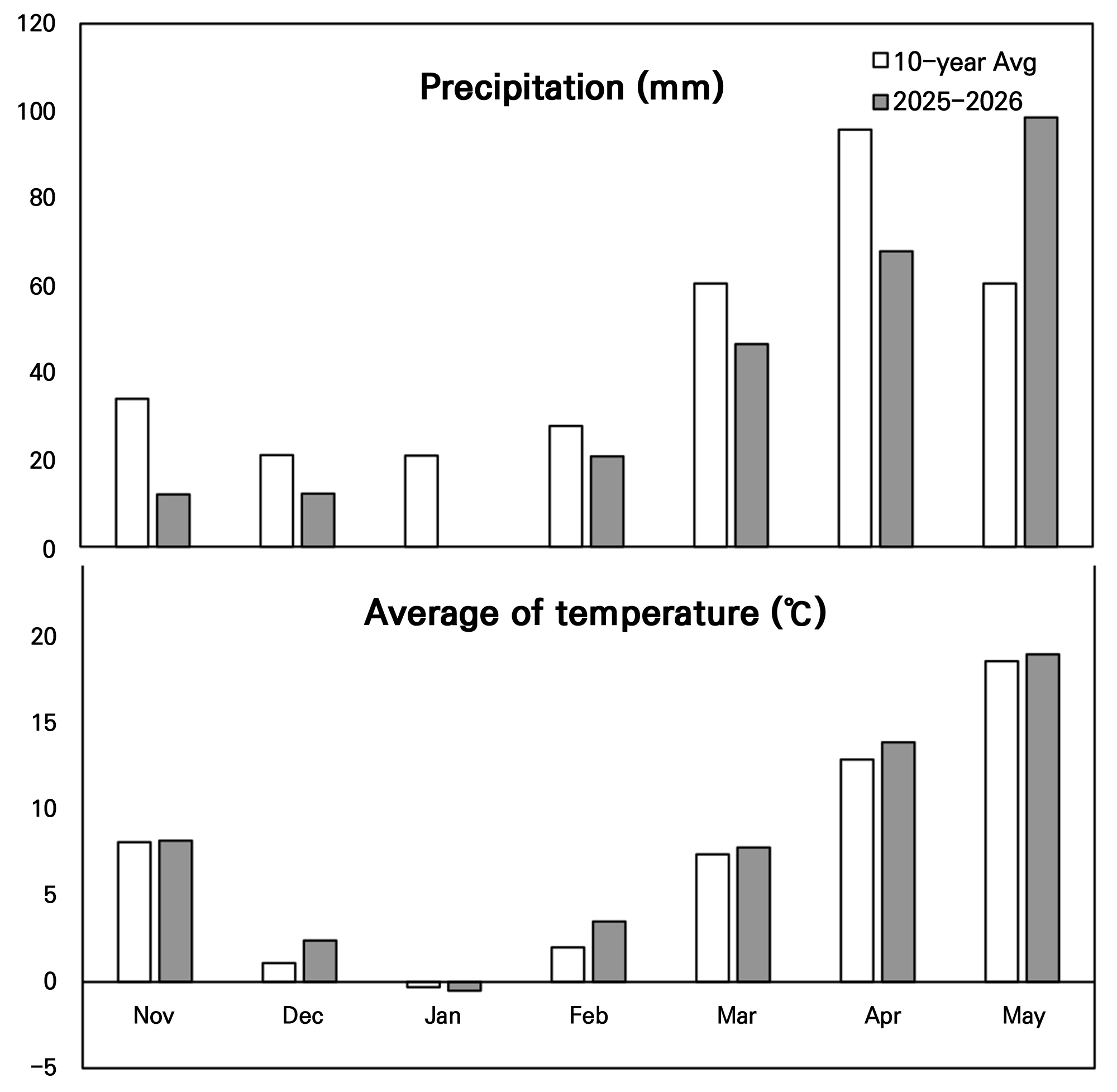
Monthly precipitation during the 2025–2026 onion-growing season remained below the long-term average until April but reached 98.5 mm in May because of heavy rainfall shortly before harvest (KMA 2026; Fig. 1). The monthly mean air temperatures during the growing season were approximately 0.7°C higher than the corresponding long-term averages, except in January, when the mean temperature was 0.2°C lower than the long-term average. Low temperatures during this period can temporarily suspend bulb development without causing chilling injuries (Miedema 1994; Kim et al. 2026).
The tensile strength levels of all BD mulch films were lower than those of the PE film at all sampling times and generally began to decrease between 30 and 60 DAT, with this decline continuing through 90 DAT (Fig. 2A). The tensile strengths of PE, NBD-II, and NBD-III films decreased significantly after 180 DAT, coinciding with higher temperatures and heavy rainfall near the end of the cultivation period. At 210 DAT, the transparent NBD-III film had the lowest tensile strength at 783.6 N·cm-1, whereas the tensile strength of the lignin-containing NBD-I film remained relatively stable throughout the cultivation period. The NBD-III film also showed a pronounced reduction in elongation (Fig. 2B). Consistent with its weak mechanical properties, NBD-III exhibited increasing visual degradation in both the central and lateral portions of the film between 60 and 180 DAT, followed by substantial degradation at 210 DAT, prior to harvest (Figs. 2C and 2D), suggesting that this film would facilitate easier harvesting and tilling operations. Weight retention decreased over time in all BD films. At 210 DAT, NBD-III and NBD-II retained approximately 29.4% and 23.3% of their initial weights, respectively (Fig. 2E), indicating markedly greater mass loss than the <10% degradation reported for BD mulch films in previous onion studies (Park and Choi 2025). Heavy rainfall in May would have accelerated the degradation of the BD films (Fig. 1), indicating that pre-harvest precipitation significantly influenced the biodegradation process. Light transmittance remained highest for the transparent NBD-III film throughout the cultivation period, ranging from 83.2% to 89.0% (Fig. 2F). Its high transparency may have reduced the durability of benefits expected from its multilayer structure and greater thickness because the film was more susceptible to heat- and ultraviolet-induced photo-oxidation than the black CBD, NBD-I, and NBD-II films, in which carbon black may have acted as a photo-stabilizer (Anunciado et al. 2021; Yang et al. 2021; Akhir and Mustapha 2022; Shao et al. 2026). However, given that NBD-III was transparent while the other films were black, film color and light transmittance may act as confounding factors when interpreting the effects of the film composition and multilayer structure.
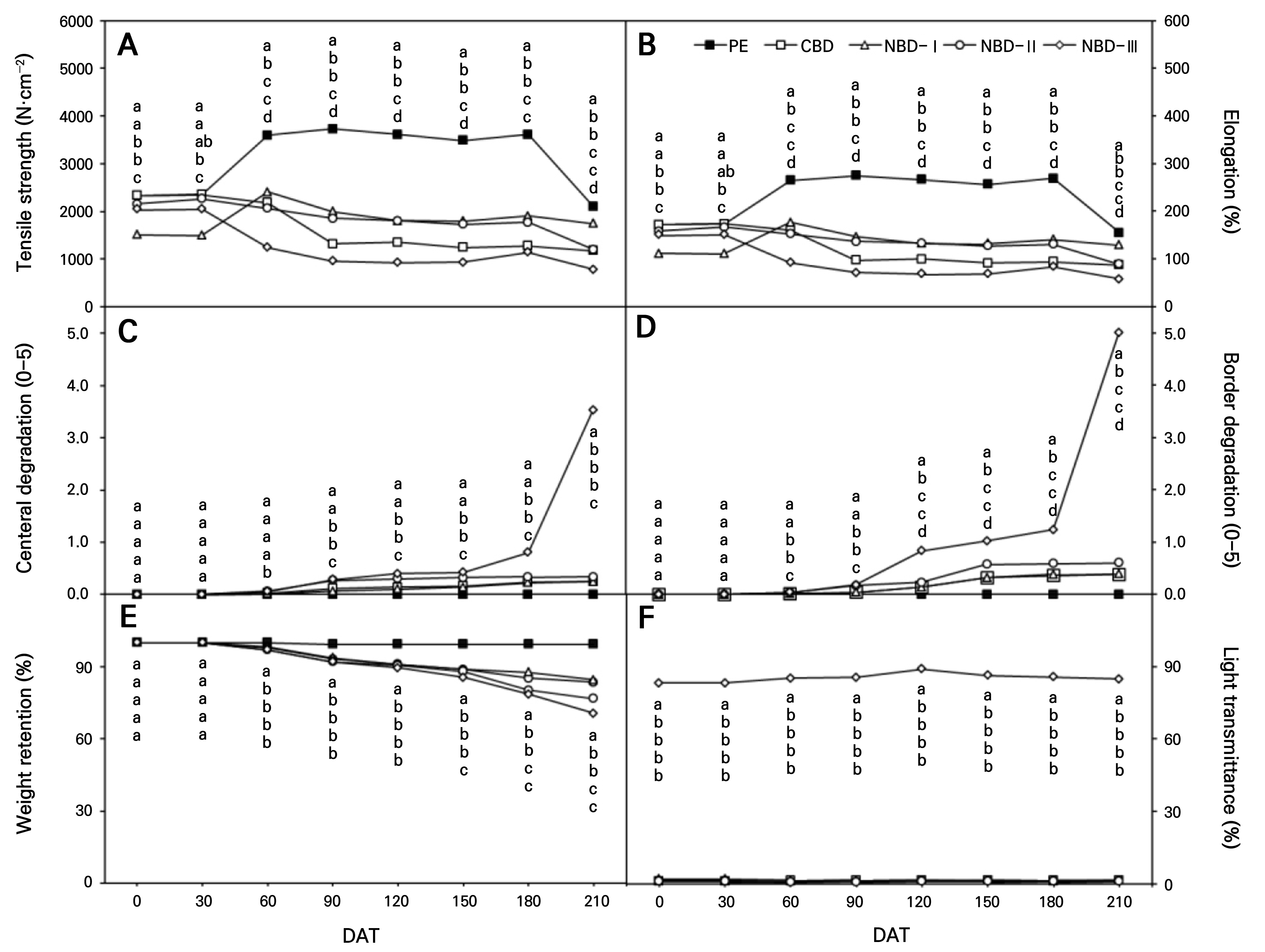
Fig. 2.
Changes in the physical properties of the polyethylene (PE), conventional biodegradable (CBD), and new biodegradable I, II, and III (NBD-I, NBD-II, and NBD-III) films mulched in an onion field at 30-day intervals from 0 to 210 days after transplanting (DAT). Different lowercase letters on each phase indicate significant differences as determined using Duncan’s multiple-range test at p < 0.05.
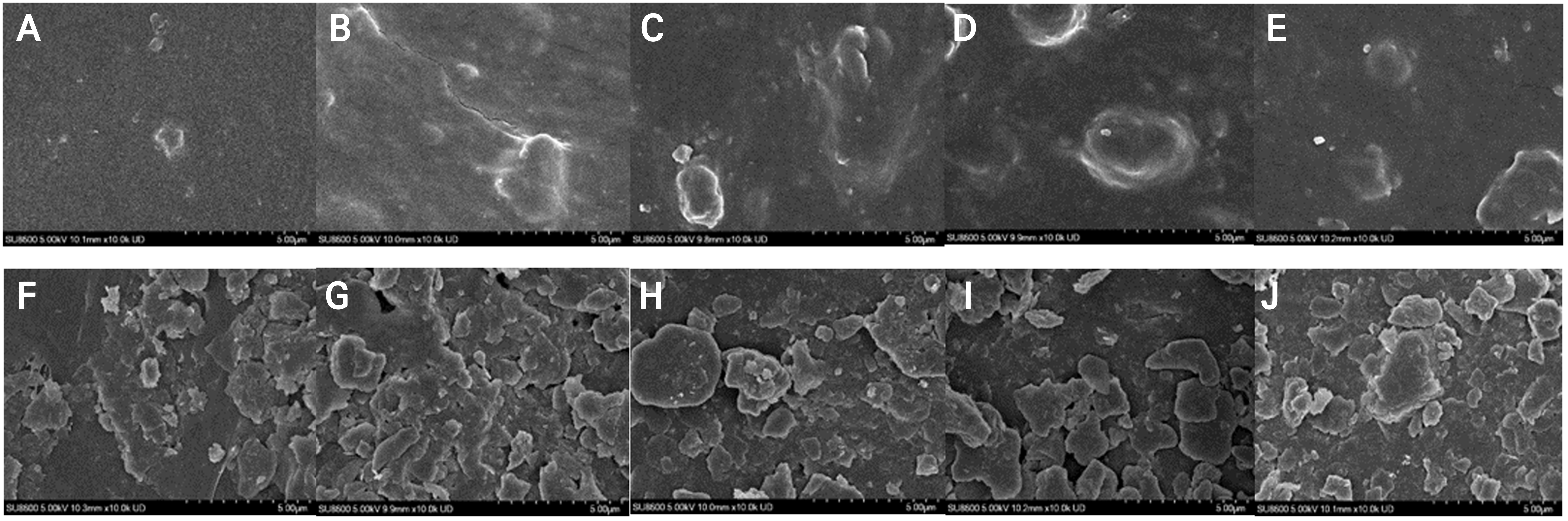
The SEM analysis showed that the surfaces of all mulch films were intact at 0 DAT (Figs. 3A–3E). At 210 DAT, the BD films exhibited more pronounced surface irregularities and fragmentation than the PE film (Figs. 3F–3J). NBD-II and NBD-III, in particular, exhibited numerous small fragments, consistent with the rapid loss of mechanical strength and extensive disintegration observed for these films. This fragmentation may have increased the surface area available for microbial colonization and subsequent degradation (Liu et al. 2010; Sintim et al. 2021; Akhir and Mustapha 2022; Griffin-LaHue et al. 2022).
Soil properties
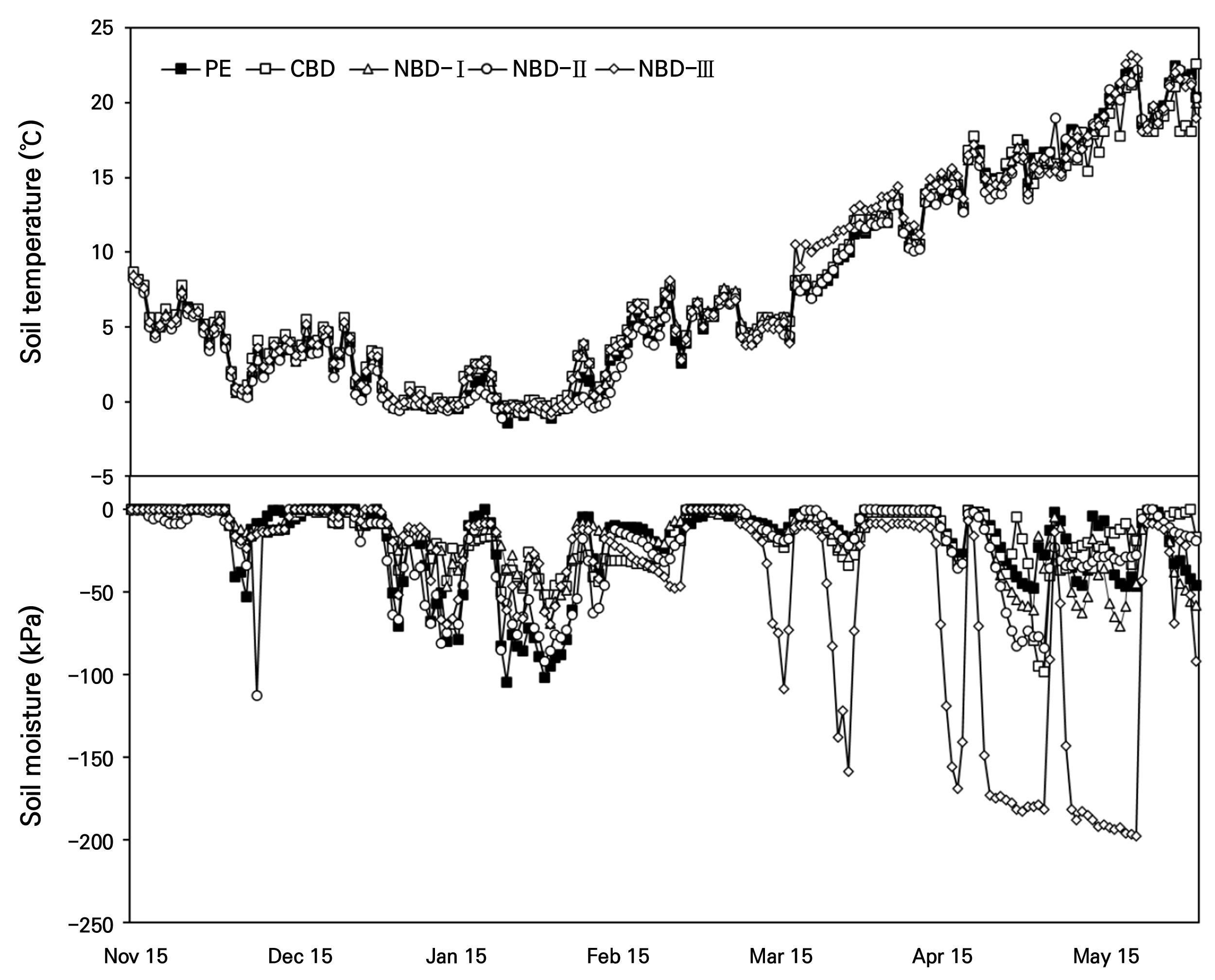
Soil temperatures decreased from November onward and began to increase in February (Fig. 4A), whereas the soil water potential was generally low in approximately January and May (Fig. 4B). The NBD-III treatment increased the mean soil temperature during the cultivation period, with a particularly pronounced increase in April. In January, mean soil temperatures fell below 0°C in the PE and NBD-II treatments. In the NBD-III plots where the degree of film disintegration was highest, the soil water potential began to decline in March and reached −198 kPa in mid-May. In May, film degradation was strongly and negatively correlated with the water potential in the central (R2 = 0.982) and border sections (R2 = 0.977), indicating that film degradation significantly contributed to the decline in the water potential (data not presented). This reduction in soil water availability may have constrained bulb enlargement, particularly if it coincided with the period of high crop water demand (Silva et al. 1994; Nasreen et al. 2007).
Soil hardness was significantly greater in the BD-film treatments than in the PE treatment, particularly in the NBD-II and NBD-III plots (Table 1). Although plastic residue can potentially alter the soil-pore structure, restrict root growth, and impede water and nutrient uptake (Zhou et al. 2023; Dewi et al. 2024; Withana et al. 2025), the observed differences in soil hardness cannot be attributed conclusively to film fragments based on the present results alone. Soil pH and EC did not differ significantly among the mulch-film treatments. Soil OM decreased in all NBD treatments, whereas T-N decreased in both the NBD and CBD treatments. The concentrations of NO3‒-N, Ca, and Mg also decreased in the NBD-III treatment. Available P2O5 increased significantly in the NBD-II and NBD-III plots, consistent with observations from studies of rapidly degrading BD films in garlic, onion, and corn fields (Zhang et al. 2022; Jung et al. 2023; Kim et al. 2024). The inconsistent effects of mulching on inorganic nutrient concentrations would have been from the results of the active movement and consumption of nutrients within the crop-microbe-soil system as well as the vigorous nutrient uptake during the mid-growth stage of onions. Because previous studies of BD films in onion production have reported findings that differ from the present results (Park and Choi 2025; Park et al. 2025), further research is required to provide additional analyses of bisphenol A or other appropriate marker compounds/products associated with the degradation of the film, as well as seasonal soil nutrient variations and microbial activity.
Table 1.
Soil hardness levels and nutrient concentrations as affected by PE, CBD, and NBD-I, NBD-II, and NBD-III films mulched in an onion field
| Treatment |
Hardness (kgf·cm-2) |
pH |
EC (dS/m) |
OM (%) |
T-N (%) |
NO3-N (%) |
P2O5 (mg·kg-1) | K2O (cmolc·kg-1) | CaO (cmolc·kg-1) | MgO (cmolc·kg-1) |
| 0 days after transplanting | ||||||||||
| Pre-treatment | 5.9 | 7.2 | 0.52 | 7.1 | 0.15 | 0.04 | 186.2 | 13.4 | 0.74 | 2.3 |
| 180 days after transplanting | ||||||||||
| PE | 8.1 c | 7.2 a | 0.24 a | 10.7 ab | 0.42 a | 0.18 b | 666.4 c | 11.1 a | 0.95 a | 2.4 ab |
| CBD | 8.9 b | 7.2 a | 0.23 a | 11.1 a | 0.31 b | 0.19 ab | 415.3 e | 9.4 b | 0.83 b | 2.2 b |
| NBD-I | 9.0 b | 7.2 a | 0.23 a | 8.0 b | 0.31 b | 0.21 a | 583.2 d | 10.7 ab | 0.95 a | 2.7 a |
| NBD-II | 9.3 ab | 7.3 a | 0.23 a | 8.2 b | 0.25 c | 0.17 b | 1022.3 a | 11.2 a | 0.93 a | 2.7 a |
| NBD-III | 9.5 a | 7.3 a | 0.23 a | 8.2 b | 0.22 c | 0.13 c | 994.6 b | 10.8 ab | 0.77 c | 2.2 b |
Onion performance
Weed biomass was greatest in the NBD-III plots and was also relatively high in the NBD-II plots (Table 2), likely because these films deteriorated rapidly from the early stages of growth. Moreover, the transparency of NBD-III may have increased the soil temperature and allowed sufficient light transmission to promote the germination of light-responsive weed species (Pyon 1985). Onion plant height, stem diameter, and leaf number were lowest in the NBD-III treatment, potentially because weed competition, reduced soil water availability, and greater soil hardness limited access to water and nutrients (Dewi et al. 2024). Bulb length and diameter were lower in the NBD-III treatment and were also reduced in the NBD-II treatment, whereas larger bulbs were observed in the CBD and NBD-I treatments. The increased available P2O5 in the NBD-II and NBD-III plots may have altered the timing of bulb development before sufficient vegetative growth was achieved (Abdissa et al. 2011). Collectively, premature lodging and a shortened bulb-enlargement period, together with insufficient water and nutrient availability, may have restricted cell division and radial bulb growth in the NBD-II and NBD-III treatments. These effects can explain the smaller bulb size, lower fresh weight, more elongated bulb shape, as indicated by length-to-diameter ratios >1.0, and lower total yields relative to the CBD and NBD-I treatments (Nasreen et al. 2007).
Table 2.
Weed dry weight, and stem and blub growth as affected by PE, CBD, and NBD-I, NBD-II, and NBD-III films mulched in an onion field
| Treatment |
Weed dry weight (g) | Stem |
Lodging (%) | Bulb | ||||||
| Length (cm) | Thickness (mm) | No. leaves | Length (mm) |
Diameter (mm) |
Length/ Diameter |
Avg. FW (g) |
Yield (ton·kg-1) | |||
| PE | 491.0 c | 66.9 a | 21.1 a | 6.5 a | 4.3 c | 65.4 ab | 68.1 a | 0.96 b | 146.8 b | 52.9 b |
| CBD | 386.7 d | 70.1 a | 21.6 a | 6.5 a | 5.3 a | 67.7 a | 68.3 a | 0.99 ab | 156.6 a | 56.4 a |
| NBD-I | 463.7 cd | 69.6 a | 22.0 a | 6.5 a | 4.6 b | 66.7 a | 68.3 a | 0.98 ab | 154.5 a | 55.6 a |
| NBD-II | 638.1 b | 68.2 a | 21.2 a | 6.5 a | 5.5 a | 65.5 ab | 64.1 ab | 1.02 a | 144.0 b | 51.8 b |
| NBD-III | 1178.1 a | 51.4 b | 15.4 b | 5.0 b | 5.2 a | 61.4 b | 59.2 c | 1.04 a | 119.8 c | 43.1 c |
Suitability for mechanized operations
PE film showed the greatest suitability for mechanized laying before onion transplanting, whereas CBD and NBD-II received slightly less favorable scores. However, the numerical differences among these treatments were small, ranging from 0.30 and 0.40 units (Table 3). During postharvest rotary tillage, film winding around the machinery was most severe for PE and least severe for the extensively degraded NBD-II and NBD-III films. After tillage, the NBD-III plots contained the greatest number of residual film fragments that were <5 cm within the 0–10 cm soil layer. The smaller fragments may have reduced interference with subsequent field operations, although their persistence and environmental effects require separate consideration. Although smaller residual film fragments can reduce interference with mechanized operations, these fragments could temporarily act as microplastics during the degradation process, having potential negative environmental implications (Sutkar et al. 2023). In contrast, large fragments were most abundant in the PE plots, consistent with the greater mechanical strength of this film.
Table 3.
Suitability of PE, CBD, and prototype BD mulch films for mechanized film laying and postharvest rotary tillage in an onion field
Treatment Suitability | PE | CBD | NBD-I | NBD-II | NBD-III |
| Convenience to mulch film (0‒5) | 0.30 b | 0.37 a | 0.30 b | 0.37 a | 0.33 ab |
| Film wrapping around rotary blades (0‒5) | 0.53 a | 0.33 b | 0.33 b | 0.30 bc | 0.23 c |
| Residual small film (< 5 cm) | 16.3 c | 24.3 b | 17.3 c | 18.3 c | 34.0 a |
| Residual large film (> 15 cm) | 15.3 a | 9.7 b | 7.7 b | 9.0 b | 7.3 b |
| Photo after tillage |  | ||||
The post-tillage assessment showed that 15 days after burial (225 DAT) NBD-III had the greatest weight loss at the soil surface (Table 4). At a depth 10 cm, referring to the depth at which the film was most deeply mixed in after rotary tillage, all BD films showed greater weight loss than the PE film, and the weight loss was generally greater at 10 cm than at the soil surface. At 30 days after burial, NBD-II had the greatest weight loss at both the soil surface (28.6%) and at a depth of 10 cm (49.9%). At the 10-cm depth, it was followed by NBD-III (39.0%), NBD-I (34.9%), CBD (31.0%), and PE (0.0%). At 45 days after burial, NBD-II again showed the greatest weight loss at the soil surface (52.3%), whereas no recoverable residue of the BD films remained at a depth of 10 cm, which should not be interpreted as complete biodegradation as there may be unmeasured micro-scale microplastics. In previous onion-field experiments, BD mulch films exhibited only 50–70% degradation even at 60 days after burial (Park and Choi 2025; Park et al. 2025). The more rapid loss observed in the present study may have resulted partly from the heavy rainfall before harvest, as abundant soil moisture can stimulate microbial activity and thereby promote film degradation (Bo et al. 2022). Carbodiimide-based additives at concentrations >1.5% can inhibit hydrolysis of PLA polymer chains and retard moisture-mediated degradation (Stloukal et al. 2016; Akhir and Mustapha 2022). Thus, the rapid degradation of NBD-II may reflect a low concentration of the hydrolysis inhibitor, whose protective effect may have been reduced further by the unusually high precipitation near the end of the growing season (Stloukal et al. 2016). Interestingly, 60 days after burial, the NBD-III film in the soil surface exhibited a lower degradation rate (36.2%) compared to other BD films, showing no significant increase in degradation over time.
Table 4.
Decomposition of PE, CBD, and NBD-I, NBD-II, and NBD-III films mulched at 0 cm and 10 cm soil depths at 210, 225, 240, 255, and 260 days after transplanting (DAT)
| Treatment | 210 DAT | 225 DAT | 240 DAT | 255 DAT | 260 DAT |
| Decomposition (%) at 0 cm soil depth | |||||
| PE | 0.0 a | 1.3 c | 1.3 c | 1.3 c | 1.3 c |
| CBD | 0.0 a | 7.5 ab | 16.7 b | 26.9 b | 39.6 ab |
| NBD-I | 0.0 a | 8.2 ab | 18.1 ab | 29.5 b | 41.9 ab |
| NBD-II | 0.0 a | 5.5 b | 28.6 a | 52.3 a | 55.4 a |
| NBD-III | 0.0 a | 14.3 a | 18.5 ab | 30.2 b | 36.2 b |
| Decomposition (%) at 10 cm soil depth | |||||
| PE | 0.0 a | 0.0 b | 0.0 c | 0.0 b | 0.0 b |
| CBD | 0.0 a | 19.1 a | 31.0 b | 100.0 a | 100.0 a |
| NBD-I | 0.0 a | 18.8 a | 34.9 b | 100.0 a | 100.0 a |
| NBD-II | 0.0 a | 20.7 a | 49.9 a | 100.0 a | 100.0 a |
| NBD-III | 0.0 a | 19.4 a | 39.0 ab | 100.0 a | 100.0 a |
The mean values in each column followed by the same lowercase letters are not significantly different according to Duncan’s multiple range test at p < 0.05. PE, polyethylene; CBD, conventional biodegradable film; NBD-I, NBD-II, and NBD-III, prototype biodegradable films I, II, and III, respectively.
A regression analysis indicated that central-film degradation and light transmittance were significantly associated with the post-burial degradation response, whereas tensile strength and weight retention also contributed to variations in this response (Figs. 5A, 5C, 5E, and 5G). For films buried at a depth of 10 cm, the degradation response was negatively associated with retention (R2 = 0.628) and tensile strength (R2 = 0.409; Figs. 5B, 5D, 5F, and 5H). These results suggest that weight retention and tensile strength measured before soil incorporation help predict the subsequent loss of recoverable film after tillage.
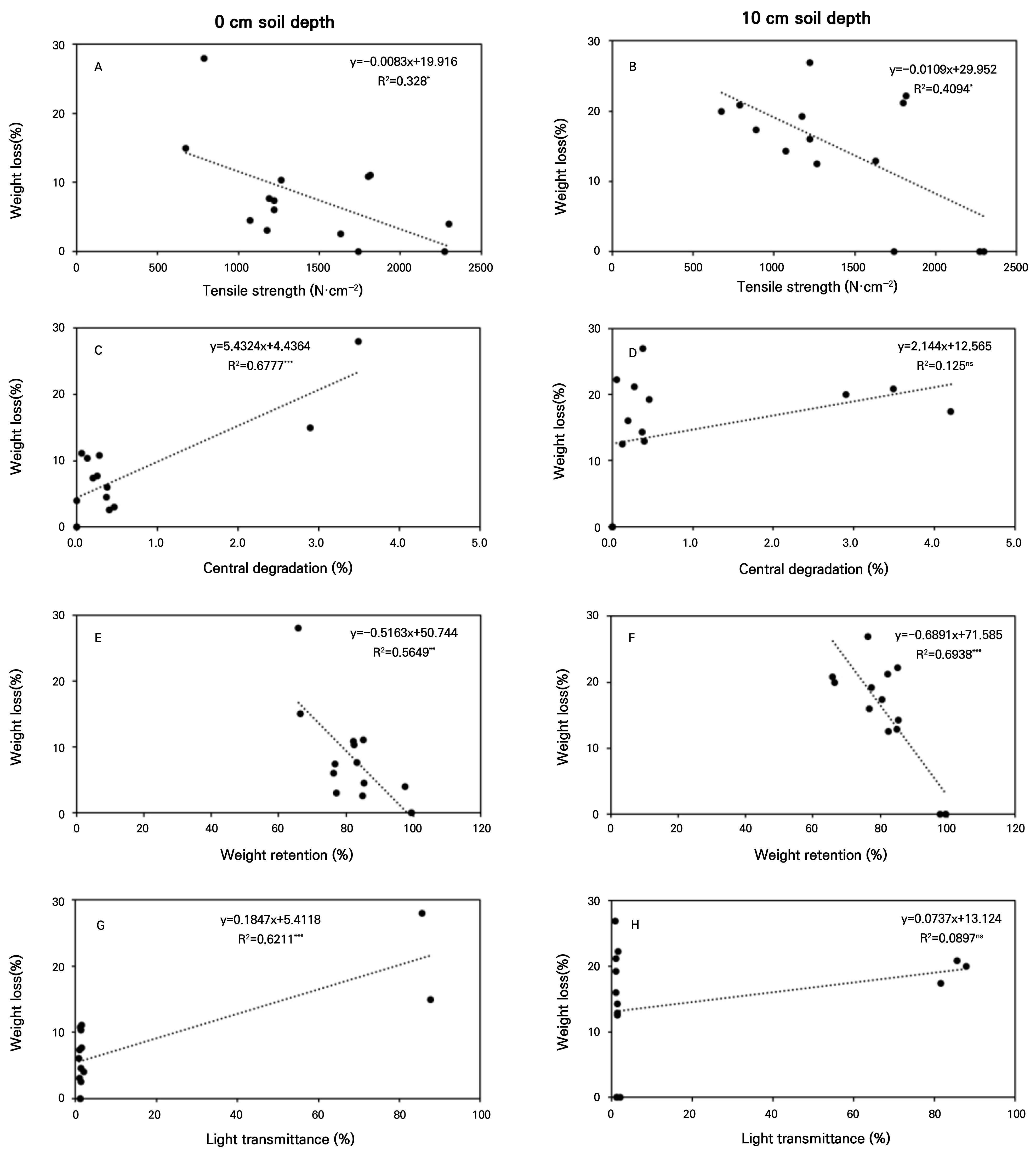
Fig. 5.
Film weight loss at a soil depth of 10 cm after tillage as affected by the tensile strength (A and B), central degradation (C and D), weight retention (E and F), and light transmittance (G and H) at soil depths of 0 and 10 cm before tillage of polyethylene and biodegradable films mulched in an onion field. *, 46, and 46* represent significant differences as determined by Duncan’s multiple-range test at p < 0.05, 0.01, or 0.001, respectively; ns, not significantly different.
Conclusion
Overall, among the BD mulch films evaluated in this study, the conventional CBD and domestically developed NBD-I films exhibited degradation rates that were compatible with the onion-growing period and maintained relatively favorable soil temperature and water conditions. These films consequently supported better onion growth and bulb development than the more rapidly degrading NBD-II and NBD-III films. In contrast, NBD-II and NBD-III deteriorated rapidly during the latter half of the growing season, potentially restricting bulb enlargement through increased weed emergence, reduced soil water availability, and altered soil nutrient conditions, including increased available phosphorus. After harvest, the BD films caused less winding around the tillage equipment than the PE film and fragmented more readily during soil incorporation. No recoverable residue of the BD films remained at a soil depth of 10 cm by 45 days after burial, indicating that these films may reduce interference with subsequent field operations and permit earlier establishment of the next crop. Collectively, the results indicate that the timing and extent of mulch-film degradation can influence the soil microenvironment and onion performance. Long-term studies incorporating direct measurements of biodegradation, soil microbial abundance and community composition, as well as interactions between microorganisms and soil nutrients, are needed to clarify the mechanisms through which BD mulch films affect soil properties and crop growth.
