

Introduction
Materials and Methods
Experimental Site and Treatments
Soil Mineral Nutrients
Shoot Growth
Fruit Composition
Data Analysis
Results and Discussion
Introduction
Grapevine (Vitis spp.) ranked third in fruit production area and volume in South Korea, following apple (Malus×domestica Borkh.) and satsuma mandarin (Citrus unshiu Marcovitch; KREI, 2014). Grapevine production is mostly concentrated on table grape cultivars including ‘Campbell Early’ (70.6%), ‘Kyoho’ (14.1%), and ‘MBA’ (8.2%). ‘Campbell Early’ (Vitis labruscana B.) is a hybrid of 16 Korean Journal of Horticultural Science & Technology ‘Moore Early’ × (‘Belvidere’בMuscat Hamburg’), crossed in USA in 1892, and is an early-maturing cultivar, typically harvested around late-August in the USA (Synder and Harmon, 1952). ‘Campbell Early’ grapevine is well-suited to hot and humid growing conditions and have good cold tolerance.
Annual organic fruit production in South Korea increased, approximately 10-20% annually from 1990 to 2010, due to increased interest in sustainability, improved soil ecology, perception of better nutritional and health values of organic fruit, and the premium paid to organic growers (Kim, 2010). However, growth of the organic grape market has lagged due to little available information on disease and insect control methods to prevent cracking, and a shortage of technologies designed to meet the demand of increased organic fruit production. We previously showed that rain-shelter system reduced the occurrence of disease and cracking of grapevine (Park et al., 2006). Cracking frequently occurs in Vitis labruscana species and ‘Campbell Early’ grapevine, and results from improper water management in both conventional and organic farming systems. Berry cracking is likely to result from a rapid increase of water uptake under excessive soil moisture or the presence of surface water on the berry during berry growth. Cracked berries result in decreased fruit yield through desiccation or microbial spoilage (Clarke et al., 2010; Considine and Kriedemann, 1972; Lang and Düring, 1990). To date, most irrigation studies in grapevine have focused on conventional wine grapevine to prevent skin cracking and to increase juice and wine quality (Blanco et al., 2010; Fereres and Soriano, 2007).
The objective of this study was to evaluate the effect of various intervals and amounts of irrigation on the growth, fruit quality, and fruit cracking of ‘Campbell Early’ table grapevine grown in sandy loam soil in an organic orchard.
Materials and Methods
Experimental Site and Treatments
Own rooted ‘Campbell Early’ grapevine plants were planted in a private vineyard in Damyang (Latitude: 35°N; Longitude; 127°E), South Korea in 2005. Vine spacing was 2.5 m between rows and 2.5 m within rows, resulting in a vine density of 1,600 vines ha-1. Vine spacing was wider than conventionally managed planting density to increase ventilation between vines and to reduce disease occurrence in an organic farming system. The vines were trained to a Wakeman system, widely used in South Korea, and were grown under rain-shelter systems to prevent damage from excessive rainfall during the monsoon season (from June to August). Soil was mostly sandy-loam in the root zone. The vineyard has been organically certified by the National Agricultural Products Quality Management Service since 2008. Short pruning, leaving one or two buds on the short cane, was performed during the winter, with thinning of flowers, fruits, and shoots during the growing season. Primary pinching was performed on undeveloped terminal leaves when 7-8 leaves were present per shoot, and secondary pinching of shoot tips and small axillary buds was performed in mid-July to promote berry set and development.
Composted cattle manure (approximately 1% of N) was applied annually at a rate of 20 tㆍha-1 between October – November. Powdered bones of a liquefied fertilizer (powdered bones, mycelium, molasses, bamboo vinegar, and crude sugar) were additionally applied at a seven-day interval 10 times during the growing season. White clover (Trifolium repens) and rye (Secale cereale) were seeded in the vineyard row to provide natural organic biomass as a green manure crop, and mowed two to three times per year. White polyethylene nets were installed on both sides of the vines to prevent insect and bird depredation. Bait traps were installed to capture grape leafhoppers (Empoasca vitis). Certified organic pyroligneous liquor was additionally sprayed to control the most common fungal diseases including phomopsis blight (Phomopsis juniperovora), grapevine leaf spot (Pseudocercospora vitis), and anthracnose (Discula destructiva).
An irrigation of 30 mm is typically applied every 10 days in many vineyards; however, in the well-drained sandy-loam soil present, approximately 2.0 times (i.e., 30 mm every 5 days) the amount of irrigation conventionally applied was needed. Irrigation was supplied using a sprinkler at the following levels and intervals: 10 mm daily (10 mm-IR), 20 mm every two days (20 mm-IR), and 30 mm every five days (30 mm-IR) as a control over two years, 2012 and 2013. Irrigation was turned on during the period from 10 June to 20 August of both years. Irrigation was discontinued when daily precipitation exceeded 10 mm.
Soil Mineral Nutrients
Soils were randomly collected at depths of 0-10 cm and 10-20 cm using a 2-cm diameter soil probe within 50 cm from the trunk at the 30 mm-IR treatment plots following harvest in 2012 and 2013. The soil samples were air-dried in the shade and sieved through a 2-mm mesh to measure soil mineral nutrients according to the RDA method (2000). Soil pH and electrical conductivity (EC, dSㆍm-1) were measured with a 1:5 (v/v) mix of soil:water in a pH/EC meter (2182A; Spectrum Technologies, Inc., Aurora, IL, USA). Soil organic matter (OM) content (gㆍkg-1) was determined using the Tyurin method (Kononova, 1966). The extracted soil samples were analyzed colorimetrically using a UV-spectrophotometer (UV-1601; Shimadzu, Tokyo, Japan) at 470 nm to determine the available P2O5 in the soil according to the Lancaster method (Cox, 2001). Concentrations of exchangeable cations such as K, Ca, and Mg in the extracted soil samples were measured using an Inductively Coupled Plasma Atomic Emission Spectrometer (ICP Integra XL; GBC Inc., Arlington Heights, IL, USA).
EC, temperature, and moisture content of the soil were measured with a portable soil moisture sensor (WT-2000; RDA Inst., Suwon, Korea) at mid-points between trees, where the irrigated water from the sprinkler did not reach, at a depth of 0-20 cm. Soil EC and temperature were recorded at the end of July each year. Soil moisture contents were measured from the initial fruit growth stage to harvest, but the soil moisture data were only presented on July 2013 when the precipitation > 10 mm was not recorded. Soil bulk density and porosity were measured at a depth of 0-10 cm in August 2012 and 2013. The 10-cm long cylindrical cores (100 mL volume) were inserted into the soil to measure soil bulk density (kgㆍm-3) and porosity (%, air filled).
Shoot Growth
Numbers of leaves were counted in each treatment vine in 2012 and 2013. Average length (cm) and diameter (mm) of all shoots on each vine were measured at the end of July in 2012 and 2013 when shoot growth ceased.
Fruit Composition
The grapes were harvested on 25 August in 2012 and in 2013. The average fresh weight (FW, g), diameter (cm), and height (cm) of the clusters and berries were then measured. Soluble solids content (SSC, °Brix) was measured with a handheld refractometer (N1; Atago Co., Tokyo, Japan). Juice titratable acidity (TA, gㆍL-1) was determined by titrating 10 ml of fruit juice with 0.3 M NaOH up to an end point of pH 8.1. The SSC/acidity ratio was then calculated. Berry skin color parameters, including [L* (light), a* (red), and b* (blue)], were determined using a color difference meter (CR-200; Minolta Co., Tokyo, Japan).
Cracking occurrence of more than two berries per fruit cluster was considered as cracked fruit, and from this measurement, the proportion of all fruit and fruit cracked in a vine was estimated. Marketable fruit yield (tㆍha-1) did not include defective and cracked fruit.
Data Analysis
Each treatment was comprised of three plots in a completely randomized design with a repeated-measure of vines in each plot. Each treatment plot was comprised of three vines, and the center vine was used for data collection, while the adjacent two vines were used as buffers. All data were subjected to ANOVA using Minitab Software Version 14.1 (Minitab, Inc., State College, PA, USA). Means were separated using Duncan’s multiple range test at p ≤ 0.05.
Results and Discussion
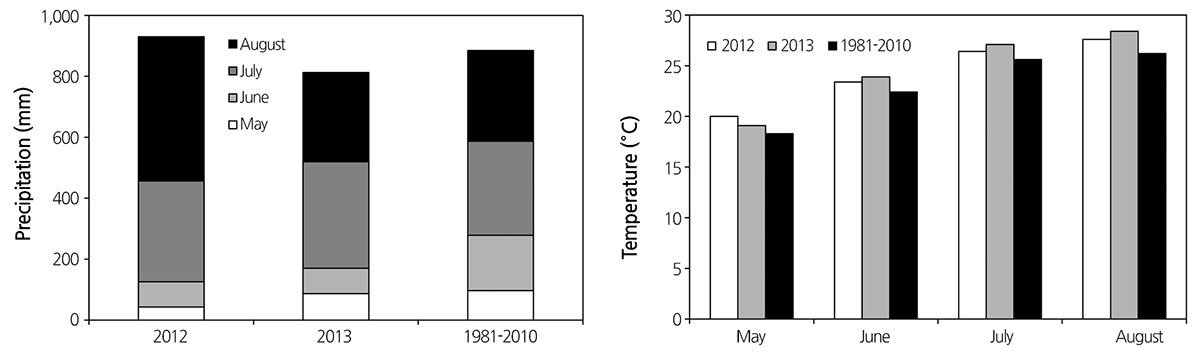
The total amount of precipitation from May to August was 930 mm in 2012 (Fig. 1), which was higher than that in 2013 (813 mm) and the average of the last 30 years (885 mm; KMA, 2012 and 2013). The mean temperature from May to August was 24.4°C in 2012 and 24.6°C in 2013, with an average of 23.1°C over last 30 years.
| |
Fig. 1. Precipitation and monthly average temperature from May to August in an organic ‘Campbell Early’ vineyard. | |
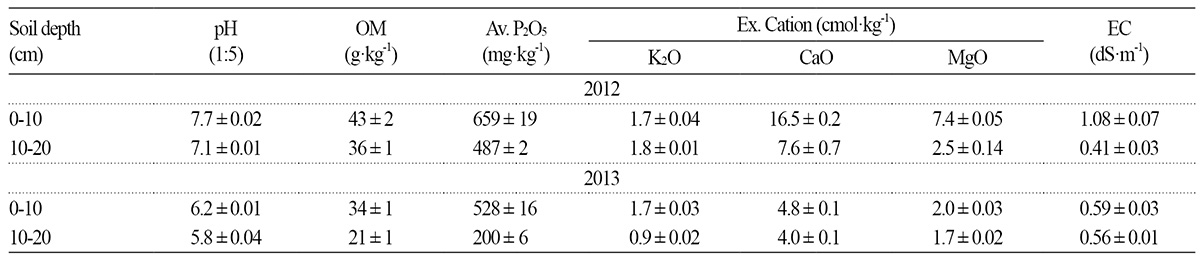
Manure compost applied around vines in November 2011 would have likely resulted in an increase in soil pH, OM, macro-nutrients, CEC, and EC in 2012 as compared to in 2013, when compost was not applied (Table 1). However, soil pH, OM, and mineral nutrients in 2013 were mostly suitable levels for annual growth of grapevine based on the criteria of soil mineral nutrients in a conventional vineyard (RDA, 2011). These sufficient nutrient levels would have been maintained by supplementation by vegetation growing around the vines after mowing two or three times each year.
Table 1. pH, organic matter (OM) content, concentrations of P2O5, K2O, CaO, and MgO, and electrical conductivity (EC) at depths of 0-10 and 10-20 cm soil in an organic ‘Campbell Early’ vineyard.
| |
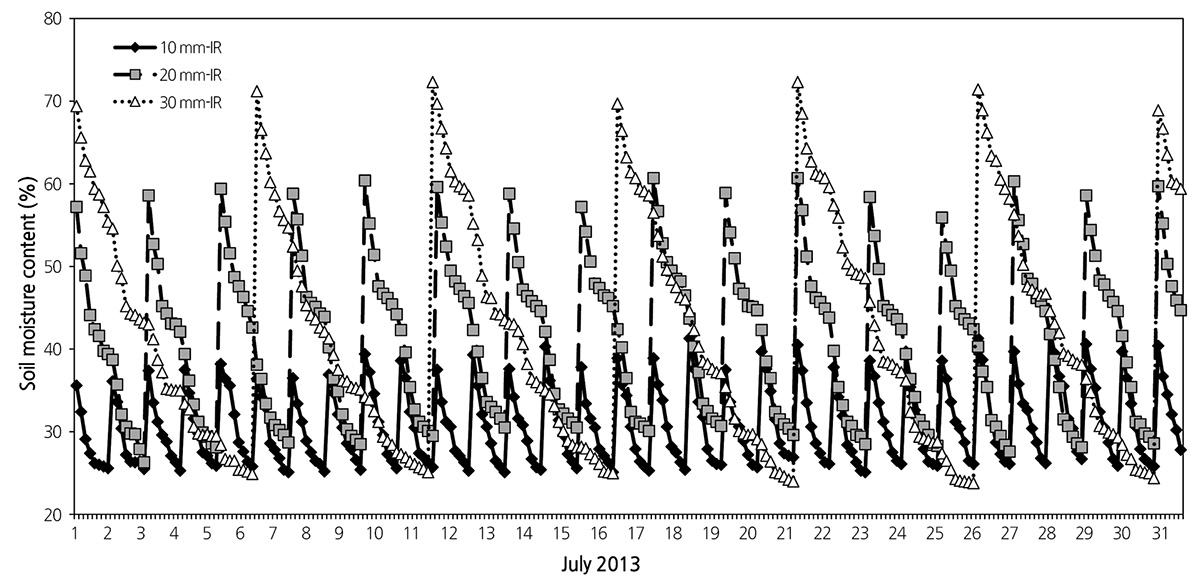
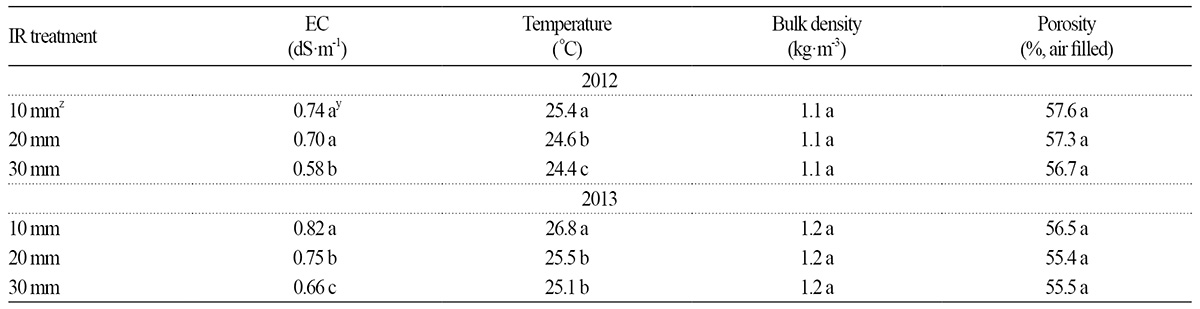
The 10 mm-IR-treated plots had a soil moisture content of between 20-40% in July, while the 20 mm-IR and 30 mm-IR treatment plots ranged from 20 to 60% and from 20 to 70%, respectively (Fig. 2). Soil moisture in the 30 mm-IR treatment plots decreased to 26.5% before the subsequent irrigation, similar to the moisture content of the 10 mm-IR-treated plots. The 10 mm-IR treatment reduced the moisture fluctuation in the root zone during the growing season. The higher frequency irrigation treatment would have likely minimized the rapid increase of osmotic water uptake related to the losses in cell vitality in the pericarp of the berry skin (Clarke et al., 2010; Considine and Kriedemann, 1972). The 10 mm-IR treatment significantly increased soil EC and temperature in both experimental years (Table 2). The 10 mm-IR, 20 mm-IR, and 30 mm-IR were supplied with 50, 50, 30 mm of water, respectively, per five-day period, which may have affected levels of nutrient mineralization and salinity in the soil. The 10 mm-IR treatment plots maintained lower soil moisture contents compared to the 20 mm- and 30 mm-IR plots, possibly increasing soil temperature. High levels of irrigation could compact soils, but there were no significant differences between the three treatments for soil bulk density and porosity, two key parameters of soil physical properties.
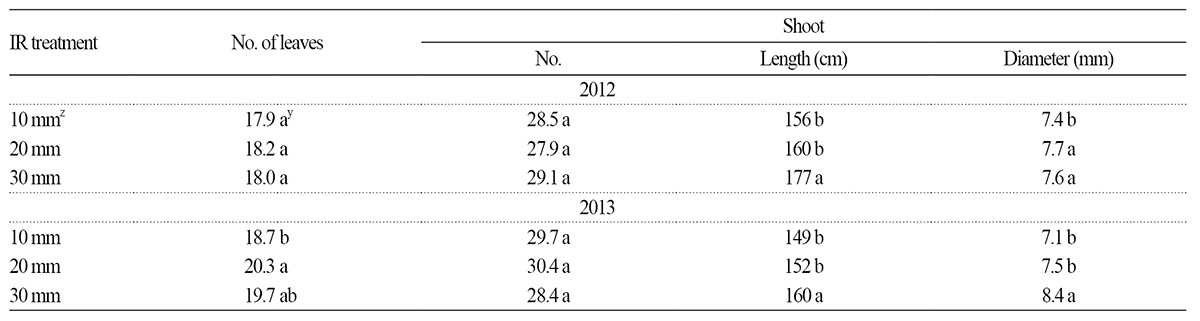
The number of leaves per tree was not significantly different between the irrigation treatments in 2012 but was increased by the 20 mm-IR treatment (20.3), followed by the 30 mm-IR (19.7) and 10 mm-IR (18.7) treatments in 2013 (Table 3). The number of shoots per vine was similar for the treatments, but the average length and diameter of shoots were increased significantly in the 30 mm-IR treatment in both years, although two rounds of pinching were performed during the growing season. The primary pinching was performed before the termination of the shoot growth, and the shoot growth would have been affected by the water and nutritional status of the soil. The second pinching back lightly removed shoot tips, which did not affect the final shoot length. The 30 mm-IR treatment extended the total shoot length of each tree by up to 51.5 cm in 2012 (data not presented), mostly due to the increase of average shoot length. The 30 mm-IR treatment plots had the highest soil moisture content once irrigation was initiated, maintaining over 25% soil moisture between irrigation intervals, which would have likely contributed to increased vegetative growth. High soil moisture levels have been shown to increase the growth of leaves, shoots, roots, and fruit of non-astringent persimmon trees, partially by increasing nutrient mineralization in the soil (Park, 2002). However, differences in total shoot length were not significant between treatments in 2013 (data not presented).
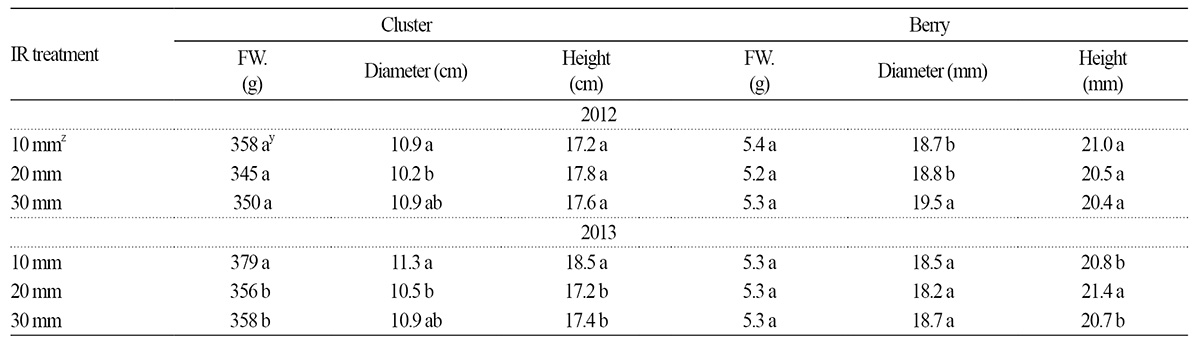
Significant differences in average FW, diameter, and height of clusters were observed between the treatments in 2013, with greatest differences observed for the 10 mm-IR-treated grapevine plants (Table 4). Maintaining low soil moisture contents in the 10 mm-IR plots may have contributed to the less vigorous growth (Table 3). Root pruning reduced shoot growth but increased cluster weight of ‘Campbell Early’ grapevine due to the restriction of excessive water and mineral nutrients (Jin et al., 2002). Average cluster weight was lower than that of conventional ‘Campbell Early’ grapevine, ranging between 400-500 g (Jin et al., 2002; Kim et al., 2009). This may have been due to reduced mineralization rates from the manure compost, lack of fertilizer (in 2013), or cultivation differences between organic and conventional systems. However, these possibilities need to be assessed through soil and foliar nutrient analyses to evaluate differences in fruit growth. Berry FW, diameter, and height were not consistently affected by treatments in 2012 and 2013.
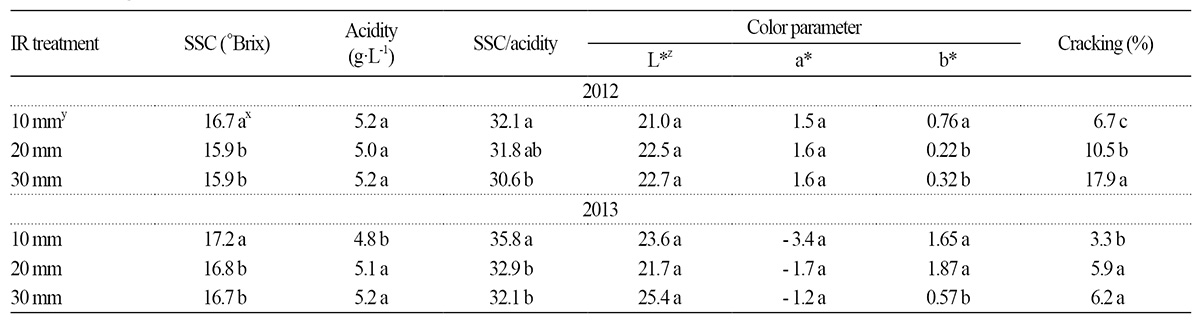
The 10 mm-IR treatment increased fruit SSC and SSC/acidity ratio and may advance fruit ripening (Table 5). Fruit acidity was increased by the 20 mm-IR and 30 mm-IR treatments in 2013. Fruit surface color, in terms of light (L*) and red (a*), was not significantly different between the treatment fruits. The 10 mm-IR-treated fruit skin had high blue (b*) values in both experimental years. L* values were less than 25.0, and a* and b* values were nearly zero, indicating blackened skin (Shiraishi and Watana, 1994). The 10 mm-IR treatment markedly reduced the occurrence of fruit cracking in 2012 and 2013. The 30 mm-IR-treated vines had the highest incidence of cracking, up to 17.9% in 2012, consistent with another study in ‘Autumn Royal’ table grapevine (Blanco et al., 2010) and ‘Campbell Early’ grapevine (Jin et al., 2002) in response to different irrigation levels. The occurrence of cracking was low in 2013 compared to that in 2012, when a high amount of precipitation was observed in August (474 mm; Fig. 1). Cracking was attributed to an increase in osmotic water uptake into the pericarp cells from the sudden excessive water uptake (Clarke et al., 2010). High initial water uptake and high humidity difference advanced berry cracking as elevated soil moistures responding to the 30 mm-IR treatment would have likely contributed to the increased occurrence of cracking. This was also observed for the 20 mm-IR treatment plot, which consistently maintained approximately 40% of soil moisture at one day after irrigation.
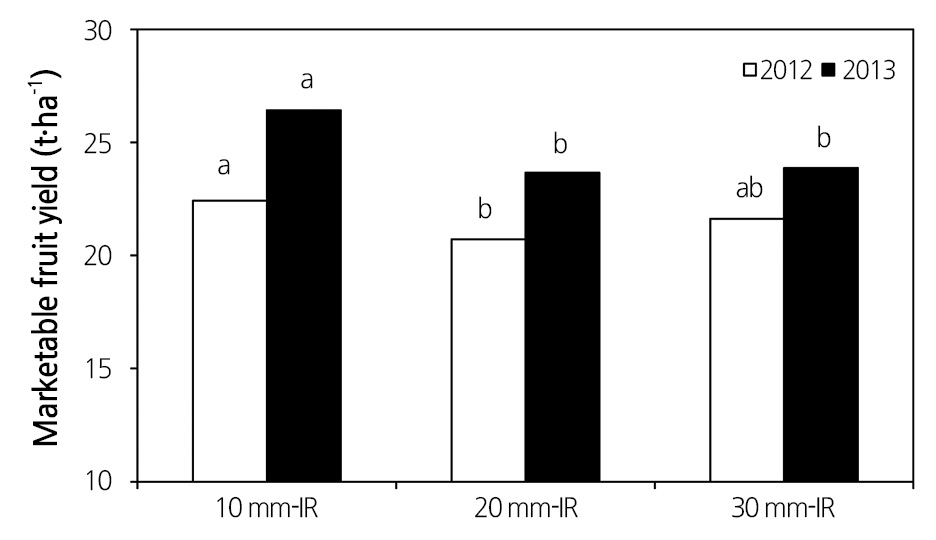
Marketable fruit yield was higher in 2013 (24.6 tㆍha-1) than in 2012 (21.6 tㆍha-1) in all treatments (Fig. 3). The 10 mm-IR treatment increased the marketable fruit yield to 22.4 tㆍha-1 in 2012 and 26.4 tㆍha-1 in 2013 as the incidence of cracking was lower, which would have slightly increased the cluster weight compared to the other treatments. The 30 mm-IR treatment slightly increased marketable fruit yield (21.6 tㆍha-1) in 2012 compared to 20 mm-IR (20.7 tㆍha-1), although a higher incidence of cracking was observed. Longer shoots grown under the 30 mm-IR treatment would have increased the fruit load and resulted in higher yield compared to the 20 mm-IR treatment.
‘Campbell Early’ grapevine was found to be quite susceptible to cracking at veraison associated with a rapid increase in water supply in warm and humid climates during a summer season in South Korea, which was the major factor in reducing fruit productivity (Becker and Knoche, 2012). However, organic grapevine cultivation can be successfully undertaken by minimizing changes in soil moisture contents, and thereby reducing the occurrence of cracking. The 30 mm-IR treatment, in which plants were irrigated every 5 days, induced excessive soil moisture contents more than 50% within the first two days of irrigation. This would have temporarily induced root stress and partially increased the occurrence of cracking. The 10 mm-IR treatment controlled vine growth in plants grown in sandy loam soils, but improved fruit sweetness and skin coloring with a decline of fruit cracking.
