

Introduction
Materials and Methods
Plant Materials and Experimental Conditions
Analysis of Ca, Mg and K Contents in Leaves, Petioles and Guttated Fluids
Induction of Tipburn in Detached Leaves
Electron Probe Micro Analysis of Leaf Tip Area
Cell Wall Components in Strawberry Leaves
Results
Discussion
Introduction
Most strawberry fruits in Korea are harvested during the winter and early spring in plastic greenhouses, hence it is inevitable to raise and transplant young plants during the summer when environmental conditions are not particularly favorable for plant growth and flower initiation. High aerial temperature associated with high humidity, high planting density, and hence subsequent physiological disorders are common, one of which is a tipburn. Tipburn is known to result from calcium (Ca) deficiency (Bradfield and Guttridge, 1979); however, recovery from tipburn in strawberry plants can be supported by low Ca treatment, although it is not totally effective in reversing the condition. This effect on plant recovery indicates that environmental conditions could be more important in the development of disorders than Ca concentration in the growing medium as well as in plant tissues. Moreover, if strawberry plants are grown in soil conditions, they show hardly any tipburn symptoms that have been otherwise observed in lettuce (Barta and Tibbitts, 1991).
In Korea, tipburn in strawberry is much more severe during the winter season but plants subsequently recover during following spring when temperature and light conditions become suitable for strawberry plant. The occurrence of tipburn may become serious both in favorable environmental conditions that encourage vegetative growth and in unfavorable conditions that reduce vegetative growth (Saure, 1998). San Bautista et al. (2009) described ‘converse’ results on the effect of cation proportions in strawberry plants, which vary year to year. Although Ca is directly involved in the development of tipburn, increasing the exogenously applied Ca concentrations did not decrease the risk of tipburn (Palencia et al., 2010). Since Ca transport occurs mainly in the xylem by mass flow, the presence of positive xylem pressure observed in strawberry plants during guttation appears to reduce the incidence of tipburn through Ca transport (Bradfield and Guttridge, 1979; Guttridge et al., 1981). Tipburn, however, is still found in strawberry plants grown in plastic greenhouses under high relative humidity resulting in positive xylem pressure. This indicates a complex interaction between Ca transport and the environment in which the strawberry plants are grown. The present study aims to understand the causes of tipburn on the leaves of two popular strawberry cultivars grown in either soilless culture or soil conditions.
Materials and Methods
Plant Materials and Experimental Conditions
Strawberry cultivars ‘Seolhyang’ and ‘Redpearl’ commercially grown in both Damyang-gun and Hwasun-gun were utilized. In Damyang-gun, the ‘Seolhyang’ strawberry was planted in heated or non-heated multi-covered plastic greenhouses in the middle of September and fruit harvest finished by the middle of April or beginning of May, 2010-2012. Plants in plastic greenhouses were either grown in soil (non heated) or in coir with regular feeding of nutrient solution (heated). Strawberries in soil were grown organically without using any chemical fertilizers or sprays. In Hwasun-gun, ‘Seolhyang’ and ‘Redpearl’ strawberry cultivars were grown hydroponically in coir with regular feeding of nutrient solution (EC 1.2-1.4 dS·m-1). The composition of the nutrient solution including the concentration of ground water for hydroponic cultures was: N 12.55, P 2.33, K 6.1, Mg 1.32, Ca 4.99, S 1.63 mM and Fe 40, Mn 26.7, B 12, Cu 1.0, Zn 7.0, Mo 0.5 µm, respectively.
Analysis of Ca, Mg and K Contents in Leaves, Petioles and Guttated Fluids
The Mg, Ca and K content in leaves, petiole extract and guttated fluids were regularly analyzed from plants grown by two local farmers. Leaves from strawberry ‘Seolhyang’ and ‘Redpearl’ were collected from two counties during the 2010-2012 growing seasons. Leaves were placed into two categories based on leaf age. Young and old leaves were defined as the 1st leaves to the 8th and 9th to 20th leaves, respectively. Plant materials were dried at 75°C, ashed at 450°C and digested with HCl. Petioles were cut from growing strawberry plants and brought it to the laboratory, finely sliced, and homogenized in distilled water in 1:5 ratio of sample to water (Ikeda et al., 1998). The Ca, Mg and K content were measured by Inductively Coupled Plasma Atomic Emission Spectroscopy (Optima 4300 DV ICP-AES, PerkinElmer Inc., USA). Guttation fluid formed on the edges of the leaves was collected early in the morning and analyzed for Ca, Mg and K content.
Induction of Tipburn in Detached Leaves
In order to measure the distribution of Mg, Ca and K within a leaf, electron probe micro analysis was used to measure the concentration of these ions in discrete areas of the leaves. Young and fully expanded strawberry leaves with petioles were placed in 10 mg·L-1 gibberellic acid (GA3), 2mM EGTA or 2mM EGTA with 2mM CaCl2 either under dry or humid conditions (Aloni et al., 1986). All of the solutions were adjusted to pH 6.5 with NaOH. Petioles were held in solutions and incubation was carried in the lab for 4-5 d at 20-25°C room temperature. Humid conditions were obtained by placing plastic film on the top of the incubation container and reached almost full saturation. Ten detached leaves were analyzed and the experiments were repeated 4-5 times.
Electron Probe Micro Analysis of Leaf Tip Area
Young healthy and tipburn affected leaves were prepared for examination with EPMA (Electron Probe Micro Analyzer) operated at 15 kV. The samples were freeze-dried, mounted on aluminum stubs with double-sided carbon tape, and coated with gold. The stubs were then placed on the chamber stage and observed under an Electron Probe Microanalyzer (EPMA-1600, Shimadzu Corporation, Kyoto, Japan and Genesis XM2 EDX, EDAX, Tokyo, Japan) for the analysis of Ca, Mg and K (Barta and Tibbitts, 1991, 2000). Standard elements were used for spectrum matching and for quantitative elements. The element contents were calculated as a percentage on the basis of the dry weight of the analyzed area.
Cell Wall Components in Strawberry Leaves
Composition of cell walls was based on leaf age and analyzed in order to clarify the susceptibility between differently aged leaves. Leaves were separated into three categories that included young, middle and old leaves based on leaf age. Young, middle and old leaves refer to 1st to 6th, 7th to 11th and 12th to 20th leaves, respectively. Quantitative and qualitative analyses of monosaccharides in strawberry leaves were conducted using a gas chromatograph (Wi et al., 2011). A two-step acid hydrolysis was performed to quantify sugar polymers based on leaf age. The first hydrolysis step was performed at 30°C for 60 min with H2SO4 (72%), followed by dilution with water to give 4% sulfuric acid. The second hydrolysis step was performed at 121°C for 60 min. Myo-inositol was added as an internal standard and the solution was neutralized with an ammonia solution. An aliquot was reduced using 2% sodium tetrahydroborate and the excess sodium tetrahydroborate was dissolved with acetic acid. Alditol was acetylated with methylimidazole as a catalyst, followed by acetic anhydride, and then extracted with dichloromethane. The sample was analyzed with a gas chromatography (CP-9100, Chrompack, Middelburg, The Netherlands) equipped with a DB-225 capillary column (30 m × 0.25 mm ID, 0.25 μm film thickness, J&W Scientific, CA, USA) and a flame ionization detector. The operating conditions were: detector temperature 250°C, injector temperature 220°C, with oven temperature programmed to rise from 100°C (1.5 min) to 220°C at 5°C ·min-1. Compounds were determined by comparing retention times with standard compounds.
Results
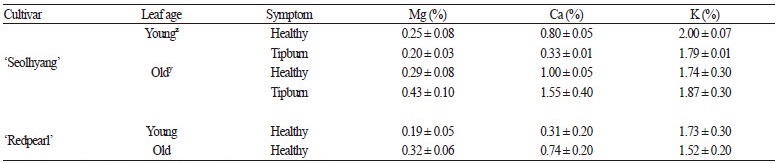
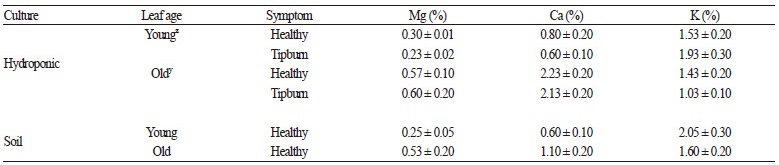
Occurrence of tipburn in strawberry plants grown by the same local farmers varied greatly year to year, even though similar management practices were consistently employed. It was observed that while hardly any tipburn-affected plants were found in soil-grown strawberry plants during the three study years; plants grown in soilless culture had a different sensitivity depending on the year. It is interesting to note that the plastic greenhouses used for soilless culture were heated, air movement was facilitated and ample nutrient solution was regularly supplied, but serious tipburn occurred in 2010 and 2011. In several occasions, tipburn occurred in only one out of all the greenhouses surveyed, even though they all had similar environmental management. Strawberry leaves used for the analysis of Mg, Ca and K content were collected from representative Damyang-gun and Hwasun-gun growing farms in different areas where tipburn occurred. ‘Redpearl’ did not show any symptoms, whereas ‘Seolhyang’ was heavily affected in 2010 (Tables 1 and 2). Since the distribution of Ca differs depending on leaf age (Choi et al., 1997) and tip burn mainly occurs in young leaves, we hypothesized that Ca concentrations would be lowest in the affected young leaves. While the content of K did not differ based on leaf age, Mg and Ca accumulated more in old leaves than in young leaves. The most notably tipburn-affected young leaves in ‘Seolhyang’ contained less than half of Ca compared to healthy leaves (Table 1). Hydroponically grown strawberry leaves contained higher Ca content but showed heavy tipburn symptoms (Table 2). In 2011, the Ca content in tipburn-affected leaves was considerably lower than the previous year. Strawberry plants grown in Damyang-gun contained particularly low Ca, while Mg and K contents were similar between the two counties (Table 3). Compared to previous years, there were hardly any tipburn symptoms in 2012 in both cultivars when grown in both soil and soilless culture. It is interesting to note that the Ca content was particularly low in young leaves but these leaves did not display the tipburn symptoms (Table 4).


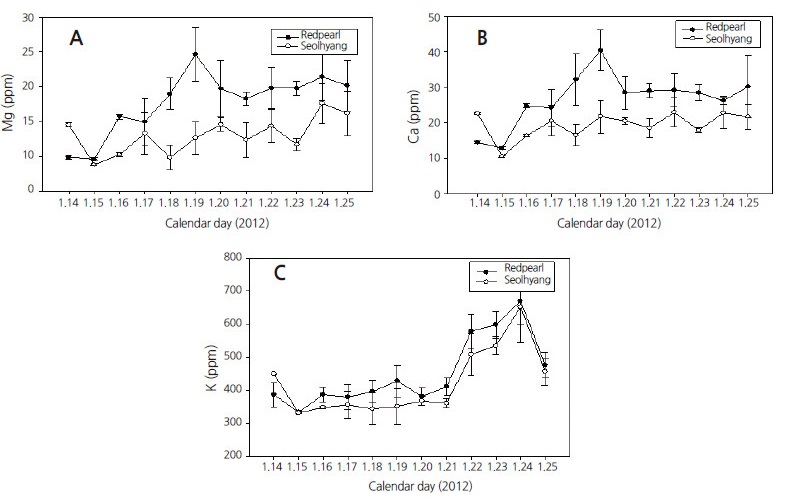
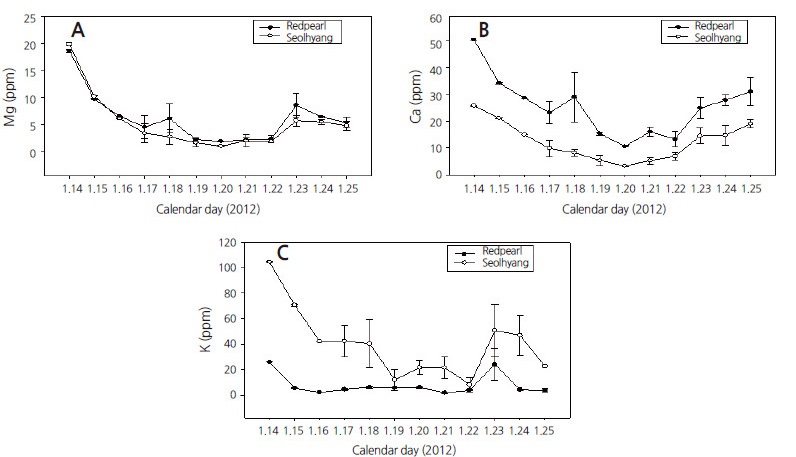
In 2012, fresh sap analysis of leaf petioles without tipburn symptoms was conducted. Concentrations of Mg, Ca and K varied throughout the measurement period and depended on the feeding of nutrient solution (Fig. 1). Interestingly, ‘Seolhyang’, which is known to be sensitive to tipburn, contained less Ca and Mg than ‘Redpearl’. Guttated fluids were collected from the leaves when they appeared at the leaf edges and were analyzed for Mg, Ca and K along with healthy plants (Fig. 2). Compared to petiole sap analysis, guttated fluid contained considerably low K content, whereas Mg and Ca content were similar to that of petiole sap. Plants were intentionally starved of nutrients until January 20th after complete nutrients were provided to the plants. The ion concentration in guttated fluids gradually decreased until the 20th and increased thereafter. Mg content was not different between cultivars whereas ‘Red pearl’ had a higher Ca content than ‘Seolhyang’. The K content was fairly stable but especially low in ‘Red pearl’ throughout the measurement period.
Analysis of the leaf tip areas about 50 μm from leaf edge with tipburn symptoms were performed with EPMA (Table 5). Dark-brown colored areas due to tipburn were excluded and neighboring areas were analyzed. Elemental content was measured in the central area of the leaf and were not different regardless of whether the leaves had the tipburn symptoms or not. Compared to the whole leaf analysis (Tables 1, 2, and 3), analysis of the small tip areas showed a considerably lower concentration of K, while the Mg concentration was not affected by tipburn. Therefore, Ca and K content were extremely low in discrete tipburn affected areas of strawberry leaves.

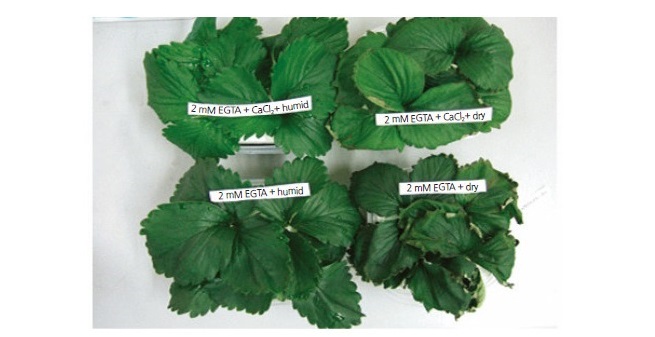
Hydroponically grown healthy strawberry plants were used for the induction of tipburn symptoms. Detached strawberry leaves placed in either distilled water or 2 mM CaCl2 did not show any tipburn symptoms (Results not shown); however, the chelating agent EGTA induced severe necrotic lesions at the leaf tips but the addition of CaCl2 reduced the severity of this necrosis (Fig. 3). GA3 at a concentration of 10 mg·L-1 did not induce any leaf damage (Results not shown). The severity of EGTA-induced necrosis was considerably attenuated by high humidity (Fig. 3).
Since the tipburn symptoms generally occur only in young leaves, we hypothesized that the monosaccharide composition of the cell wall might be different depending on the age of the leaf. As shown in Table 6, glucose was the predominant saccharide followed by galactose and mannose was the least contained. Old leaves tended to contain more rhamnose and galactose than young leaves, whereas arabinose was higher in young leaves, although the difference was minor. Only trace amount of fucose and ribose were detectable in strawberry fruits (Fugel et al., 2004).

Discussion
Experimental and environmental treatments to induce tipburn symptoms on the strawberry leaves was difficult in the greenhouse as well as in the growth room with the exception of using detached leaves treated with the chelating agent EGTA under the dry condition as shown in Fig. 3. It was clear that the humid condition significantly attenuated the occurrence of tipburn symptoms; therefore, it is tempting to conclude that Ca uptake (effect of chelating agent) and transport (effect of water transport by root pressure) are the key factors that induce the tipburn symptoms. It is generally known that Ca deficiency symptoms appear when the atmospheric humidity is high or too low such as when the difference in saturated water vapor is too low or two high and the soil pH is acidic. These factors may decrease the uptake of Ca and contribute to tipburn in the plants.
Since detached leaves were used in several of our analyses, there was no internally generated positive xylem pressure. However, the humid growth conditions clearly reduced tipburn symptoms. The experimental results from the present study suggest the importance of Ca nutrition in tipburn development, as indicated by the low Ca content in the affected leaves (Tables 1 and 2) especially in the discrete leaf tip areas (Table 5), and the effect of EGTA had on the development of tipburn symptoms. On the other hand, the absolute concentration of Ca did not distinguish the presence or absence of tipburn symptoms (Tables 1, 2, 3, and 4). Palencia et al. (2010) also reported that there was no correlation between the amount of exogenous Ca applied and incidence of tipburn in different strawberry cultivars. The hydroponic system employed by farmers contains enough Ca and hence, it is understood that the absolute values of Ca concentration is not a deciding factor for the occurrence of tipburn in strawberry.
The use of EGTA, which is a non-penetrating agent used to displace Ca in the cell wall, induced tipburn symptoms (Fig. 3), which is consistent with results from studies in Chinese cabbage (Aloni et al., 1986). However, keeping detached leaves under humid conditions greatly reduced the occurrence of tipburn, indicating the importance of environmental factors (Saure, 1998; Guttridge et al., 1981). Since Ca content in detached leaves is not altered, factors involved in the occurrence or absence of tipburn are the deciding factors in the present system; Ca concentration in the cell wall and humid aerial condition. There are, however, different views on the effect of humidity on the occurrence of tipburn in important crop plants. For instance, Barta and Tibbitts (1986) have shown that there is a positive correlation between high ambient humidity and the occurrence of tipburn in lettuce, while the converse relationship has been reported in Chinese cabbage (Aloni, 1986). The fact that field-grown strawberry plants hardly showed any symptoms may indicate the importance of a hardening process. Saure (1998) concluded that mild stresses might reduce the risk of tipburn incidence by increasing stress tolerance. In this study, only young emerging leaves showed tipburn symptoms and hence, it was expected that composition of the cell wall might be different based on leaf age. However, qualitative and quantitative analysis of monosaccharide composition of different aged leaves was similar (Table 6), again indicating the importance of environmental factors rather than concentration of Ca and composition of the cell wall in tipburn development.
Petiole fresh sap analysis showed that the concentrations of Mg, Ca and K did not greatly vary despite irregular feeding of nutrient solution (Fig. 1). Similar results were found by He et al. (1998) in tomato petiole. Concentrations obtained by the present method provide information on the nutrient status of the plants. It was possible to diagnose nutrient deficiency based on the Ca concentration in the tomato petiole sap from the leaf just below the fruit truss at the early flowering stage (He et al., 1998). Although such analysis may not provide the exact concentration of xylem sap compared to samples collected from intact plants using the meadow spittlebug (Malone et al., 2002), it is interesting to note that ‘Seolhyang’, a tipburn sensitive cultivar, contained far less Ca and Mg than ‘Red pearl’, which is considered a tipburn tolerant cultivar. It is likely to occur even when a large amount of cations, especially NH4 and K, which inhibit the absorption of Ca, are present. This may be especially true for the ‘Seolhyang’ strawberry, which has a higher absorption capacity for monovalent cations than ‘Redpearl’, which in turn, has a unique absorption characteristic that changes the pH of the root zone to strong acidic and is an important cause of soil Ca deficiency (Choi et al., 2013). Lee et al. (2015) reported that the pH in the root system was significantly lowered by the acidity of the fertilizer used on the plants, and the amount of absorption of Ca and Mg decreased. Therefore, it is suggested that fertilizer for strawberry cultivation is to be more alkaline than acidic. Compared to the stable concentration found in petiole extract, analysis of guttated fluid showed a dependence on the nutrient supply (Fig. 2). The potassium concentration of guttated fluid (less than 30 ppm) in the ‘Red pearl’ variety was particularly low compared to that of the petiole extract (300-700 ppm), whereas Mg and Ca concentrations were similar between the two sample types. Again, ‘Seolhyang’ contained considerably low Ca concentrations throughout the measurement period. Further experiment will be needed to investigate the possibility of using guttated fluid analysis to predict the occurrence of tipburn.
In conclusion, Ca concentration in strawberry leaves may not be a deciding factor in the induction of tipburn symptoms, although affected leaves tend to contain less Ca. In addition, the tipburn sensitive strawberry cultivar contained less Ca in leaves, petiole extract and guttated fluid, suggesting that the surrounding environment of strawberry plants and aerial humidity, may initiate the development of symptoms. Young strawberry plants are raised and planted during the summer and these plants are physiologically quite different from those grown in the field, which show hardly any occurrence of tipburn. These results indicate the importance of mild environmental stress to harden plants against abiotic disease-eliciting factors, as well as the choice of the environmental conditions in which plants are grown.
