

Introduction
Materials and Methods
FEM-based deep neural network
Formulation of physics-based loss functions
Physics-informed neural networks (PINN) model for an agricultural greenhouse
Results
Target greenhouse specifications
Training of the PINN model
Section force prediction results using the PINN model
Structural deformation and displacement analysis
Validation of physical meaningfulness with loss reduction
Model generalization under eccentric loading conditions
Discussion
Introduction
The increasing frequency of climate change and extreme weather events has highlighted concerns regarding the structural safety of agricultural facilities (Lee et al. 2020; Jeon et al. 2024). Among agricultural facilities, greenhouses represent the predominant form of horticultural structures in Korea, requiring assured structural safety under extreme weather conditions, such as heavy snowfall and strong winds (Lee et al. 2005; Lee et al. 2008; Uematsu and Takahashi 2020). Accurate predictions of internal forces and deformations in frame elements are essential when evaluating the structural safety of greenhouses. Traditionally, this is accomplished through a finite element method (FEM) analysis, which has been widely employed for structural assessments of agricultural greenhouses under snow and wind loads (Liu and Tang 2004; Lee et al. 2005; Park et al. 2010; Nayak and Rao 2014; Paik 2019; Jeon et al. 2022). However, the conventional FEM-based structural analysis presents several limitations. First, it demands substantial computational resources, making it ineffective for analyzing complex structures (Shmigelskyi et al. 2011). Second, it necessitates a complete reanalysis when structural configuration or loading conditions are modified (Farmaga et al. 2011). These limitations become particularly pronounced in scenarios requiring iterative analyses, such as during the design phase or structural reliability assessments (Kirsch 2003; Kim and Eun 2018).
Over the past decade, rapid advances in computing resources and deep learning, particularly deep neural networks (DNNs), have revolutionized computer modeling. Raissi et al. (2019) introduced physics-informed neural networks (PINNs), which directly integrate the laws of physics expressed as partial differential equations (PDEs) into neural networks. PINNs offer the advantage of accurate solution predictions using minimal data by leveraging the laws of physics as prior knowledge. In the PINN framework, fully connected feedforward neural networks predict solutions, while automatic differentiation computes the differential operators in the governing equations. Automatic differentiation, as a continuous differentiation procedure requiring no discretization or approximation, eliminates the discretization and truncation errors inherent in traditional numerical methods, such as FEM (Yuan et al. 2022).
The traditional FEM has the advantages of high reliability and intuitive physical interpretation through decades of validation. However, in complex structures, it incurs high computational costs and requires a complete reanalysis when structural changes occur, such as external loads or cross-section modifications. Additionally, the accuracy of the results depends heavily on the mesh quality, and inefficiencies arise from repetitive calculations when exploring various design parameters (Kirsch 2003; Pepper and Heinrich 2006; Haider 2024). In contrast, PINNs enable rapid predictions after training, making them efficient for iterative analyses, and they require no meshing, allowing flexible applications even in complex geometries. By integrating physical constraints into the loss function, PINNs can generate physically valid results even with limited data, and they naturally connect with gradient-based optimization, making them advantageous for design optimization (Fuchi et al. 2020; Bolandi 2023; de Almeida et al. 2023; Grossmann et al. 2024). However, PINNs require significant time and computing resources for initial training, present difficulties in determining the optimal network architecture and learning parameters, and currently have relatively few validation cases compared to the FEM, necessitating ongoing research to establish reliability (Lawal et al. 2022; Sharma and Shankar 2022; Kaplarevic-Malisic et al. 2023).
PINNs have demonstrated their utility in various fields, such as fluid dynamics, heat transfer analysis, and materials mechanics given their advantages of computational efficiency, mesh independence, and physics-based prediction capabilities. The effectiveness of PINNs has been demonstrated across various fields, particularly in fluid mechanics (Falas et al. 2020; He et al. 2020; Mao et al. 2020; Cai et al. 2021; Wong et al. 2021; Zhu et al. 2021), heat transfer analysis (He and Pathak 2020; Laubscher 2021), and materials science (Chen et al. 2020; Goswami et al. 2020; Zhang et al. 2020; Yin et al. 2021), where they facilitated solutions to forward and inverse problems involving nonlinear PDEs. However, their application to structural analysis remains limited (Mai et al. 2023). Existing applications primarily focus on simple structures amenable to differential equation analysis (Roy et al. 2024). The application of PINNs to complex structures, such as agricultural greenhouses, presents additional challenges due to the difficulty in implementing direct differential equation constraints. To address this limitation, Mai et al. (2023) proposed a novel approach that directly incorporates FEM-based mechanical principles into the loss functions of truss structures.
This study aims to implement a FEM-based loss-function approach for single-span agricultural greenhouses. We predicted the member forces and member deformations using FEM-based deep neural networks incorporating the laws of physics. We developed a prediction model that satisfies structural mechanics constraints by designing loss functions that incorporate equilibrium equations, compatibility conditions, and constitutive relationships for the frame elements. The prediction accuracy of the model was evaluated using a frame model based on standard greenhouse specifications.
Materials and Methods
FEM-based deep neural network
Physics-informed neural networks (PINNs) have gained attention as a viable alternative to traditional finite element method (FEM) structural analysis approaches (Hu et al. 2024). While the FEM calculates member forces using stiffness matrices and load vectors through the linear relationships between loads and deformations (Nath et al. 2024), it has inherent limitations. The method requires substantial computational resources for complex structures and necessitates a complete reanalysis whenever the structural configuration or loading conditions are modified.
PINNs can obtain physically valid solutions with minimal data by reflecting the laws of physics expressed as partial differential equations into the loss function by substituting missing data through the incorporation of additional information (Guo et al. 2020; Karniadakis et al. 2021). However, conventional PINNs primarily adopt a direct learning approach for differential equations, limiting their application to complex structures such as greenhouses. To address the direct learning approach, this utilizes a structural analysis with a novel method that directly incorporates FEM-based laws of physics into the loss function.
Formulation of physics-based loss functions
The loss functions in PINNs must be established based on the laws of physics. This study constructed a total loss function, as shown in Equation (1).
Here, represents the mean squared error (MSE) of the loss term, is the boundary condition of the loss term, is the compatible condition of the loss term, and is the constitutive equation of the loss term. The coefficients , , and are weighting factors that control the relative contribution of each physics-based constraint. Of the weighting coefficients of the loss function, the values are set independently by applying a dynamic weighting method to reflect the physical constraints appropriately. The dynamic weighting method, as shown in equation (2), was selected to adjust the relative ratio between the main loss term (MSE) and each physics-based loss term automatically.
is the main loss term, and represents the boundary condition loss, compatible condition loss, and constitutive equation loss depending on the case. The constant 0.1 is a factor that adjusts the scale of the weighting coefficients, and 1e-8 is a stabilization term that prevents the denominator from becoming zero. This dynamic weighting setting method automatically adjusts the corresponding weights according to changes in the magnitude of each physical loss term during the training process, ensuring that all physical constraints are reflected in a balanced manner during learning.
evaluates the difference between the predicted and actual values derived from FEM analysis and serves as the most fundamental indicator to ensure the prediction accuracy, as shown in Equation (3).
In this equation, denotes the number of sectional nodes of the greenhouse. In addition, , , and correspondingly represent the axial force, shear force, and bending moment as calculated by the FEM, while , , and likewise indicate the predicted the axial force, shear force, and bending moment as estimated by the PINN. Finally, and are the corresponding displacement vectors in and directions. All predicted values were normalized by the standard deviation to prevent a learning imbalance caused by scale differences between the section forces, displacements, and moments.
is a constraint term that serves to satisfy zero displacement at fixed nodes, evaluating the physical constraint that the displacement should be zero at fixed points. This functions as a necessary constraint term to reflect the boundary conditions accurately when the PINN predicts the actual behavior of the structure. The boundary condition loss was formulated as shown in Equation (4).
Here, and represent the predicted displacements in and directions at each fixed node by the PINN, respectively. Given that the displacement at fixed nodes should be zero, this loss term becomes more accurate as it approaches zero.
is a constraint term to ensure compatibility between the displacement and deformation, restricting any abrupt changes between displacements at adjacent nodes. This is a constraint term that ensures that the structural deformation and internal distribution are physically consistent. The compatibility condition loss was formulated as shown in Equation (5).
Finally, is a constraint term to ensure the relationships between the stress-strain responses, which evaluate linear elastic behavior based on Hooke’s law. This function is a necessary constraint term that ensures physically consistent relationships between the applied force and structural response. The constitutive equation loss was formulated as shown in Equation (6).
In this equation, is the strain vector representing the displacement difference between the start and end points of each element in the and directions, and is the predicted force vector at the start point of the element.
Physics-informed neural networks (PINN) model for an agricultural greenhouse
The proposed model was designed to predict the section forces (normal force, shear force, and bending moment) and displacements ( and direction) simultaneously using the frame element characteristics as inputs. The input layer was configured to receive six characteristic values for each frame element, including the node - and -coordinates, element length, boundary conditions at the start and end nodes, and applied loads.
The neural network consists of four hidden layers, each containing 512 neurons. A hyperbolic tangent (tanh) activation function was applied to each hidden layer to introduce nonlinearity. The tanh function was chosen considering that the physical quantities in the structural analysis can have both positive and negative values, making it well suited for a structural analysis. Additionally, its output range of ‒1 to 1 aligns with the scale of the normalized input data, improving the training efficiency.
The output layer consists of five neurons responsible for predicting the normal force, shear force, moment, and - and -direction displacements. No activation function was applied to the output layer, maintaining a linear output to allow unrestricted predictions of the actual section force magnitudes.
Model training was conducted using the Adam optimization algorithm with an initial learning rate of 0.0001. A ReduceLROnPlateau scheduler was implemented during training to reduce the learning rate by 50% if no improvement in the loss value was observed over 500 epochs. This approach enables rapid convergence in the early stages while allowing fine-tuning through minor adjustments to approach optimal solutions in later stages.
The model architecture was specifically designed with sufficient complexity to internalize the FEM physical principles, ensuring that it learns structural behavior patterns rather than simply learning data patterns. The four hidden layers used here, each with 512 neurons, provided adequate capacity to model the structural responses accurately while maintaining an appropriate scale to prevent overfitting.
Results
Target greenhouse specifications
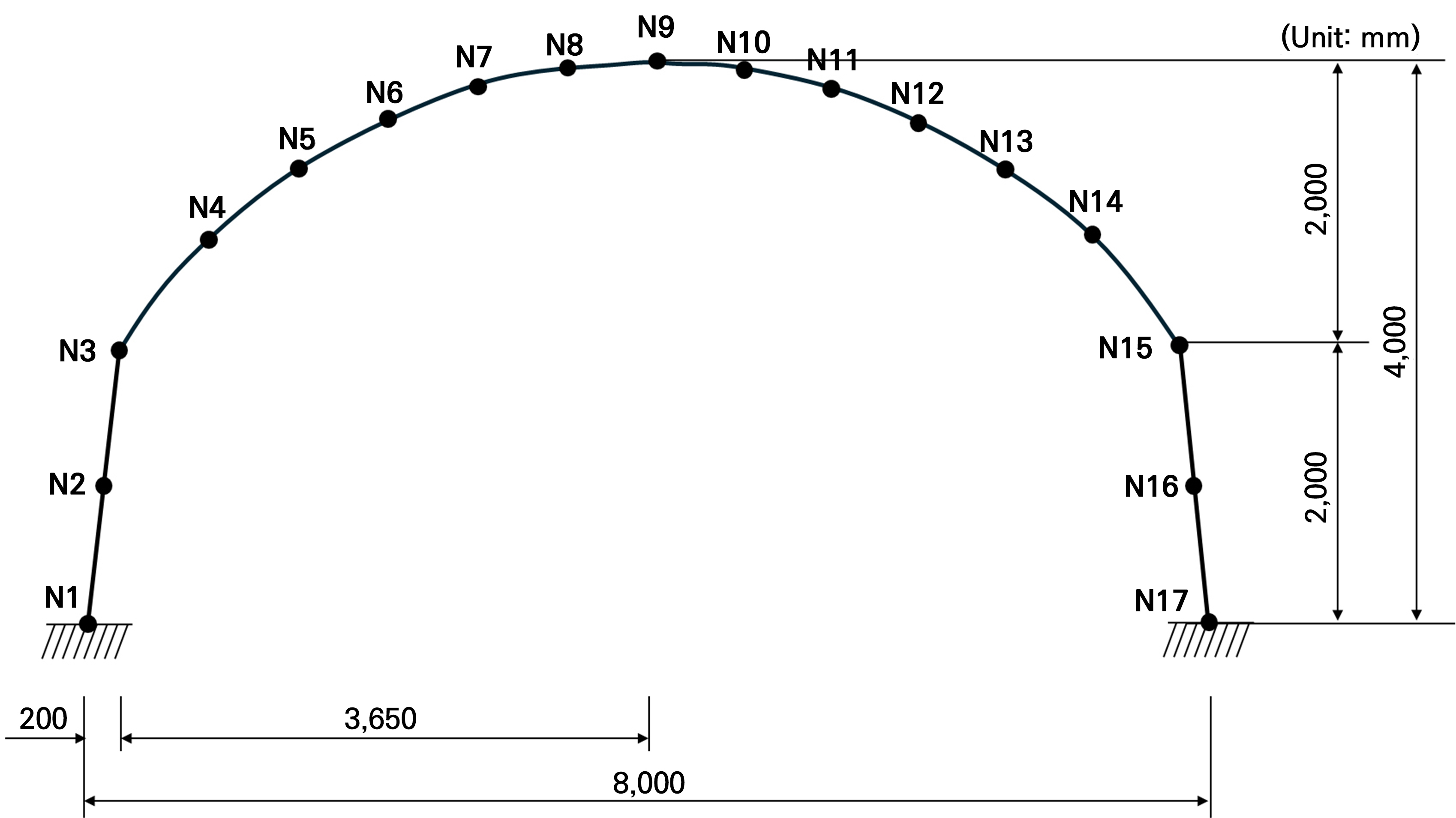
To predict the section forces in frame structures using the PINN, this study selected an agricultural single-span greenhouse that adhered to the domestic standard specifications for non-disaster-resistant horticultural facilities in Korea. According to the standard specifications for agricultural single-span greenhouses, as shown in Fig. 1, the eave height was 2 m, the ridge height was 4m, and pipes were embedded 40 cm into the ground. The structural members for the rafters are structural steel pipes (SPVHS) with dimensions of Ø42.1 mm × 2.1 t, conforming to KS D 3760 standards. These rafters are installed at 65 cm intervals to ensure structural integrity.
Additionally, the load applied to the single-span greenhouse was established as a snow load. Snow loads act as a continuous vertical load on agricultural greenhouses, serving as a static external load that increases the possibility of a structural collapse. Among greenhouse collapse accidents due to external loads, it has been found that collapses due to snow loads account for 47% of all cases (Ryu et al. 2019). Snow loads can be considered as an appropriate load for the first step of verifying the performance of the PINN, as their distribution patterns are relatively clear and allow for a static analysis.
The snow load was applied according to standard specifications, corresponding to a design load for a maximum snow depth of 40 cm, with the unit weight of snow set to 1.0 kN/m3. Considering the rafter spacing of 65 cm, the final design load was established as 250 N/m. Furthermore, to verify the performance of the PINN model under various load conditions, an eccentric snow load was also applied. An eccentric snow load simulates an asymmetric load condition where more snow accumulates on one side of the greenhouse structure, potentially causing more extreme stress states in the structure. For the eccentric load configuration, the load was set to change linearly according to the distance from the central axis (x-axis) of the greenhouse. By applying an eccentricity coefficient of 0.7, the load increases to approximately 130% (‒325 N/m) of the basic load at the left end of the greenhouse, maintains the basic load (‒250 N/m) at the center, and decreases linearly to approximately 60% (‒150 N/m) of the basic load toward the right end. This linear eccentric load distribution reasonably simulates the asymmetric load conditions that could occur in actual snow conditions while allowing an evaluation of the PINN’s prediction performance under complex load conditions.
Training of the PINN model
The PINN model results were validated by comparing them with the results from a conventional FEM analysis of an agricultural single-span greenhouse. The PINN model training showed stable convergence, with an initial loss value of 1.701, which decreased to 1.900×10⁻⁵ after 5,000 iterations (Fig. 2). During the initial 500 iterations, the loss value decreased rapidly to 2.578×10⁻³, indicating that the model quickly learned the overall structural behavior characteristics. In the middle phase of training (from 500 to 2,500 iterations), the loss gradually decreased to 8.636×10⁻⁴, demonstrating stable learning progress. Notably, the loss curve in this phase followed an almost linear downward trend, suggesting that the model consistently learned the detailed structural behavior characteristics.
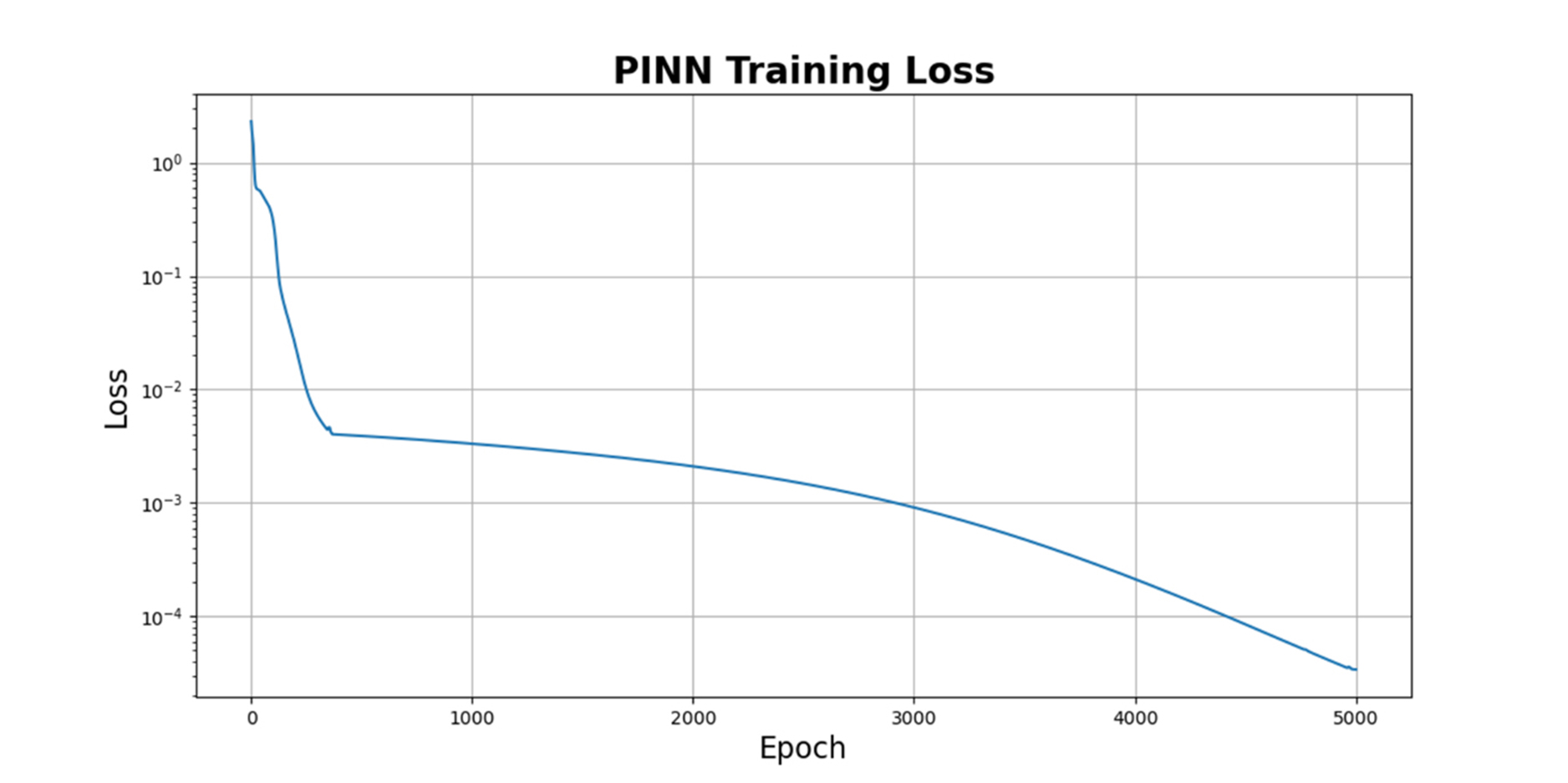
After 2,500 iterations, when the rate of loss reduction became more gradual, a continuous performance improvement was achieved, ultimately reaching a very low loss value. The training process exhibited stability, confirming the effective implementation of the physics-based loss function and the appropriate selection of the learning rate and model architecture. In particular, the gradual convergence characteristics in the later training phase suggested that the model achieved good generalization performance without overfitting.
Section force prediction results using the PINN model
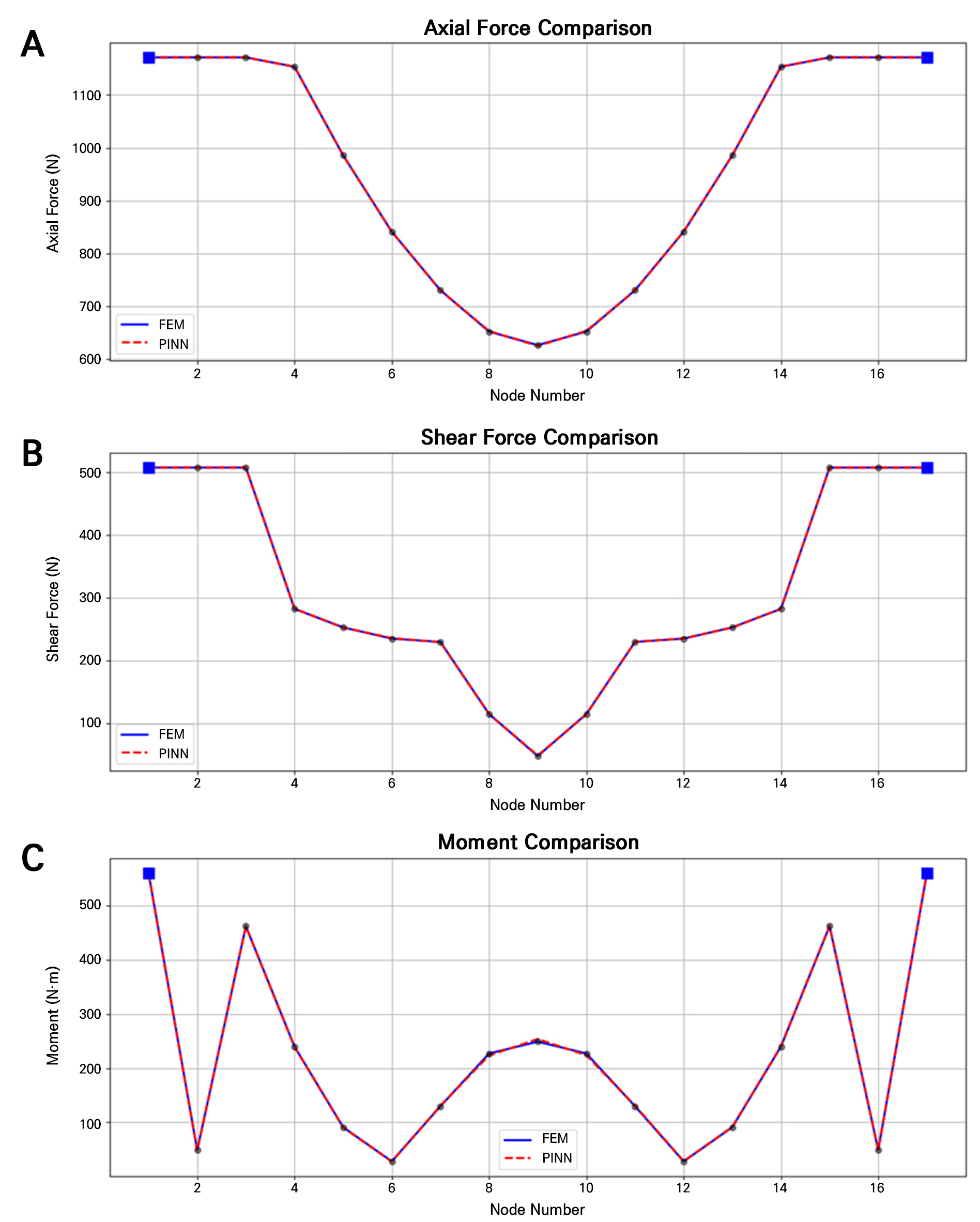
The PINN model demonstrated high accuracy in predicting section forces compared with the FEM analysis results. For the normal force, at the support (node 1), the model predicted 1,171.12 N, compared to the FEM analysis value of 1,171.11 N. At the midspan (node 9), the prediction was 626.74 N, whereas the FEM yielded 626.38 N, resulting in an error of 0.06%. For the shear force at the support, the model’s prediction was 507.96 N, precisely matching the FEM result. At the midspan, it predicted 47.66 N compared to the FEM value of 47.94 N, yielding an error of 0.58%. For the bending moment, at the support, the PINN prediction precisely matched the FEM value of 559.28 N·m. Also at the midspan, it predicted 251.84 N·m, compared to 248.75 N·m from the FEM, with an error of 1.24% (Table 1).
Table 1.
Comparison of predicted section forces (PINN) with FEM analysis results at each node
The distribution of section forces across the entire structure is shown in Fig. 3. The normal force exhibits a symmetrical nonlinear decrease from a maximum value of 1,171.11 N at the supports to a minimum value of 626.38 N at midspan, which the PINN predicted accurately. The shear force decreases sharply, from 507.96 N at the supports to 47.94 N at the midspan, with the PINN successfully capturing the steep transition in the region of nodes 8–10. The bending moment follows a complex distribution pattern, starting at 559.28 N·m at the supports, dropping to local minima of 48.79 N·m at nodes 2 and 16, and reaching 248.75 N·m at the midspan. The PINN prediction matched these variations with high accuracy. These results confirm that the PINN effectively learns and generalizes the mechanical behavior of the structure using its physics-based loss function.
Structural deformation and displacement analysis
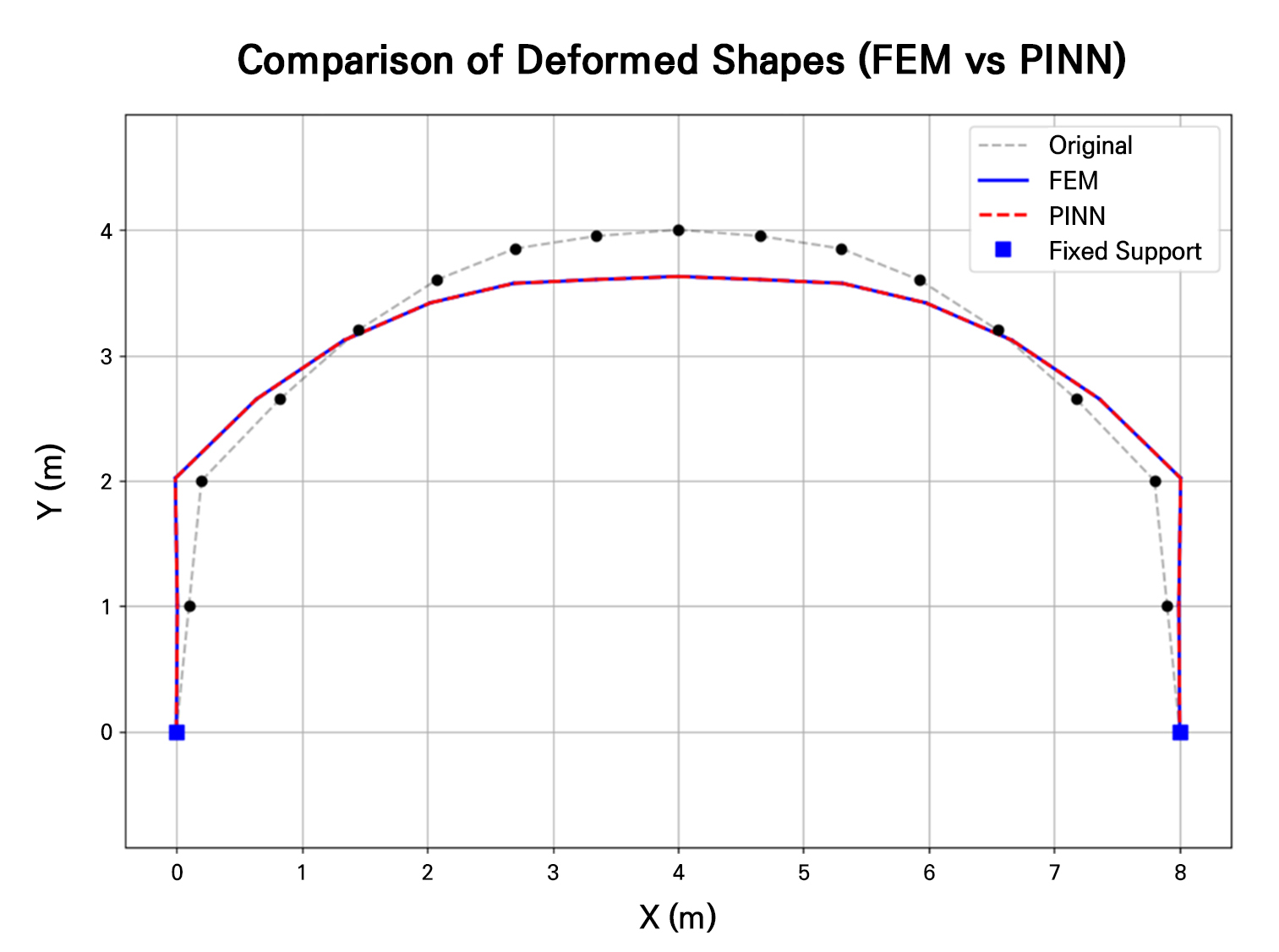
The maximum displacement difference in the -direction was observed at node 10, measuring 0.119 mm (1.19×10⁻⁴ m), while in the -direction, the largest difference occurred at node 9 at 0.100 mm (1.00×10⁻⁴ m). At the boundary conditions (nodes 1 and 17), both the and directions showed minimal differences at the micrometer (10-6 m) level. Across all nodes, the average displacement difference was 2.47×10⁻⁵ m in the -direction and 7.80×10⁻⁶ m in the -direction, indicating relatively high accuracy during -direction predictions. Notably, at nodes experiencing maximum displacements - nodes 3 and 15 (±4.16 cm in the -direction) and node 9 (‒7.44 cm in the -direction) - the differences remained below 0.1 mm, confirming the PINN’s accuracy in predicting major structural deformations (Table 2).
Table 2.
Comparison of nodal displacements between FEM and PINN analyses with corresponding absolute differences
As illustrated in Fig. 4, the deformed shapes under a snow load predicted by the FEM (blue solid line) and the PINN (red dotted line) closely align with the original shape (dotted line). The agreement was particularly evident at critical points, specifically the midspan with maximum vertical deflection (‒7.44 cm) and the sides with maximum horizontal displacements (±4.16 cm). These results validate the capability of the PINN to capture the global deformation behavior of such structures accurately.
Validation of physical meaningfulness with loss reduction
Using the PINN, predictions of sectional forces and displacements were made when a snow load acts on a single-span greenhouse. An additional analysis was conducted to verify whether the model maintains physically meaningful solutions as the loss function value decreases during the PINN model training process. For this purpose, the errors in the sectional forces (axial force, shear force, bending moment) and displacements (, directions) were quantitatively evaluated according to changes in the loss function values.
The change in the absolute error of the sectional forces according to the training epoch is visualized in Fig. 5. Initially, the errors started at approximately 180 N for the axial force, 100 N for the shear force, and 140 Nm for the moment, and these errors decreased rapidly as training progressed. In particular, after approximately 1,000 epochs, the absolute errors of all sectional force elements decreased significantly, and after 2,000 epochs, they became even more stable. At the completion of training at 5,000 epochs, the absolute errors of the axial force, shear force, and moment were reduced to 0.022 N, 0.019 N, and 0.023 N, respectively. Fig. 6 visualizes the changes in the absolute errors for the displacements. The displacement errors started at approximately 0.015 m in the direction and at 0.024 m in the direction at the beginning of training and decreased rapidly as training progressed. After about 500 epochs, they maintained very small errors below 0.0005 m (0.5 mm). Finally, at 5,000 epochs, the absolute errors of displacement in the and directions both converged to 1.36 µm.
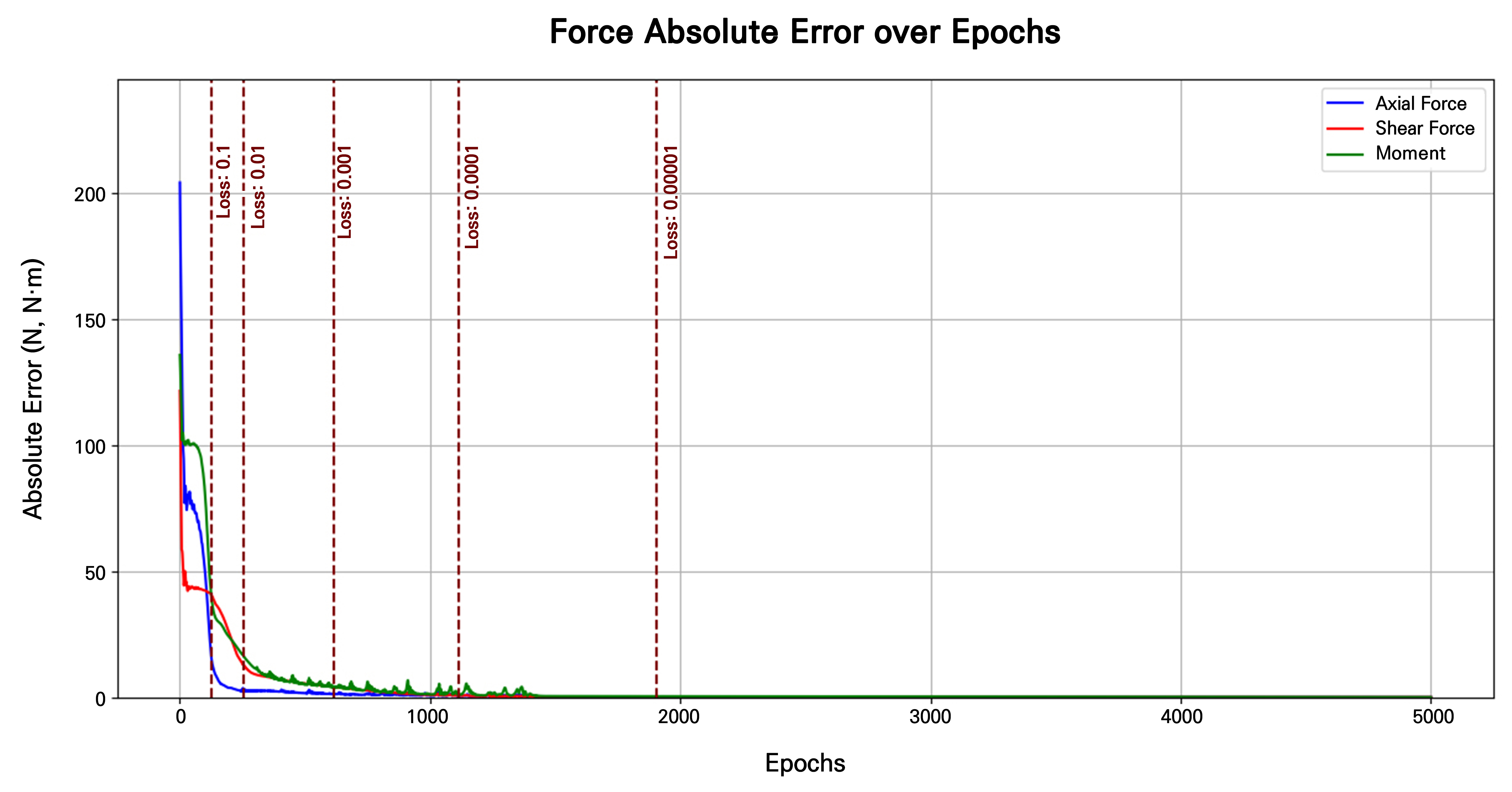
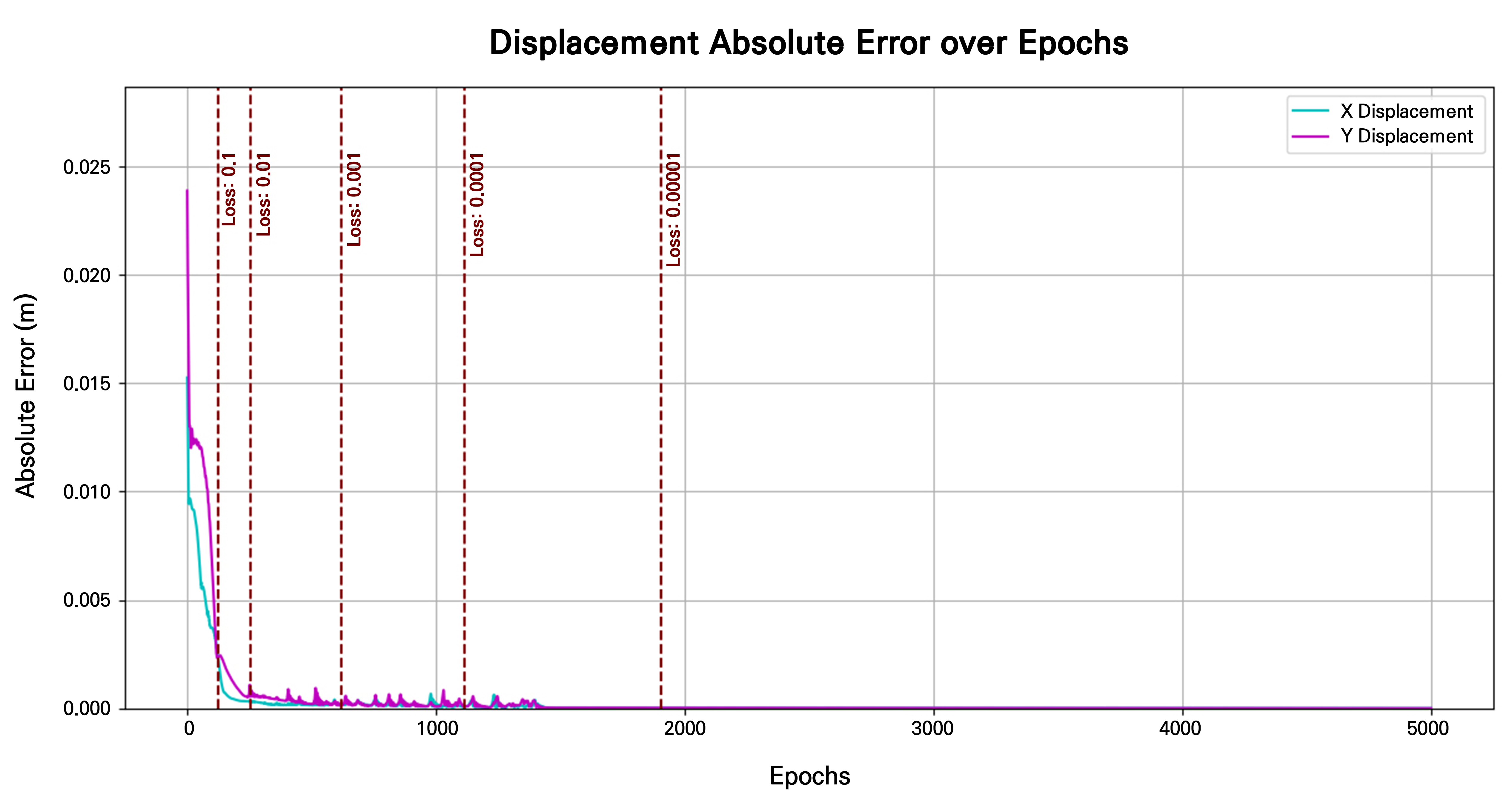
An analysis of physical significance when the loss function decreased below specific threshold values is presented in Table 3, clearly showing how the absolute errors in the sectional forces and displacements improve as the loss function decreases. When the loss function was approximately 0.1 (around 200 epochs), the absolute error in the sectional forces was 17.5 N and the absolute error in the displacements was 671 µm. When the loss function decreased to approximately 0.00001 (around 1500 epochs), the absolute error in the sectional forces improved significantly to 0.302 N, while the absolute error in the displacements to 20.7 µm. Particularly noteworthy is that when the loss function value decreased below approximately 0.0001 (above 1200 epochs), the prediction errors decreased to physically meaningful levels. At this point, the sectional force error decreased to below 0.522 N, and the displacement error fell to less than 45 µm. This demonstrates a level of accuracy that can be used for safety assessments of actual structures. Finally, at 5000 epochs, when the loss function decreased to 9.29×10⁻⁸, the absolute error in the sectional forces converged to 0.0222 N, the absolute error in the displacements went to 1.36 µm, and the boundary condition violations fell to the level of 0.089 µm. These outcomes represent very high accuracy at the level required for high-precision structural analyses, proving that the PINN model successfully learned the physical laws.
Table 3.
Error reduction patterns across loss function thresholds
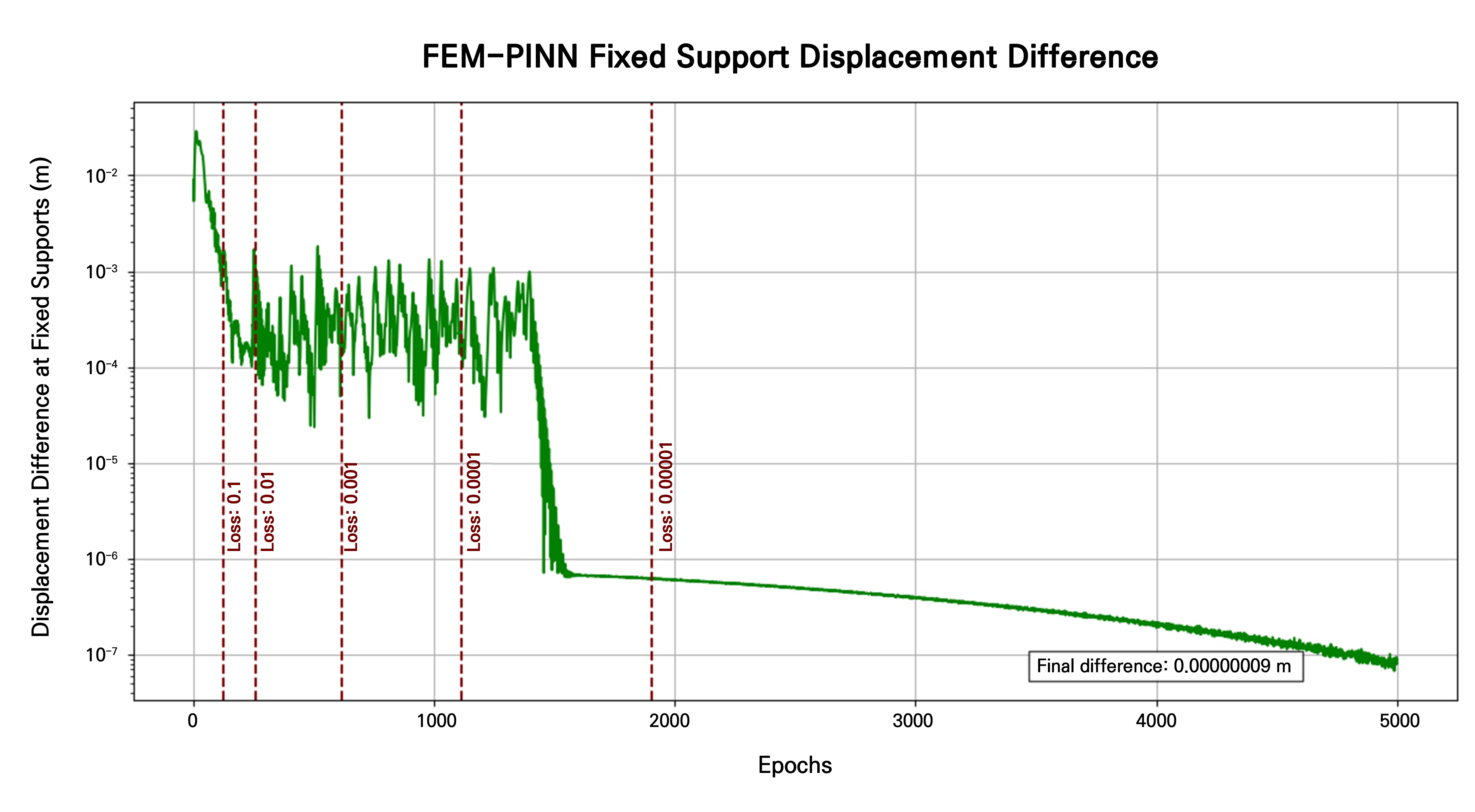
The degree of boundary condition violations also improved with a decrease in the loss function. As shown in Fig. 7, the fixed point displacement difference, which was initially about 2×10⁻² m (20mm), decreased to the range of 10-3 ~ 10-4 m as the loss function decreased to levels of 0.1 and 0.01. Notably, at approximately 1,500 epochs, a rapid decrease occurred, improving to below 10-6 m (1 µm), and as training continued, it steadily decreased, finally converging to a level of 8.9×10⁻⁸ m (0.089 µm). As can be confirmed from the graph, the final result is indicated as “Final difference: 0.00000009 m,” which represents a very small error at the nanometer (nm) level, signifying that the PINN model satisfied the boundary conditions almost perfectly. Through these results, it is demonstrated that the FEM-based PINN model proposed in this study provides physically meaningful solutions reliably when subjected to sufficient training and specifically adheres to boundary conditions, which are important in a structural analysis, with high accuracy.
Model generalization under eccentric loading conditions
To evaluate the generalization performance of the PINN model, validation was conducted not only under uniform load but also under eccentric load conditions. The eccentric load was set to change linearly according to the distance from the central axis, with a load of 334.75 N/m applied at the left end and 62.25 N/m at the right end of a single-span greenhouse with an eccentricity coefficient of 0.7.
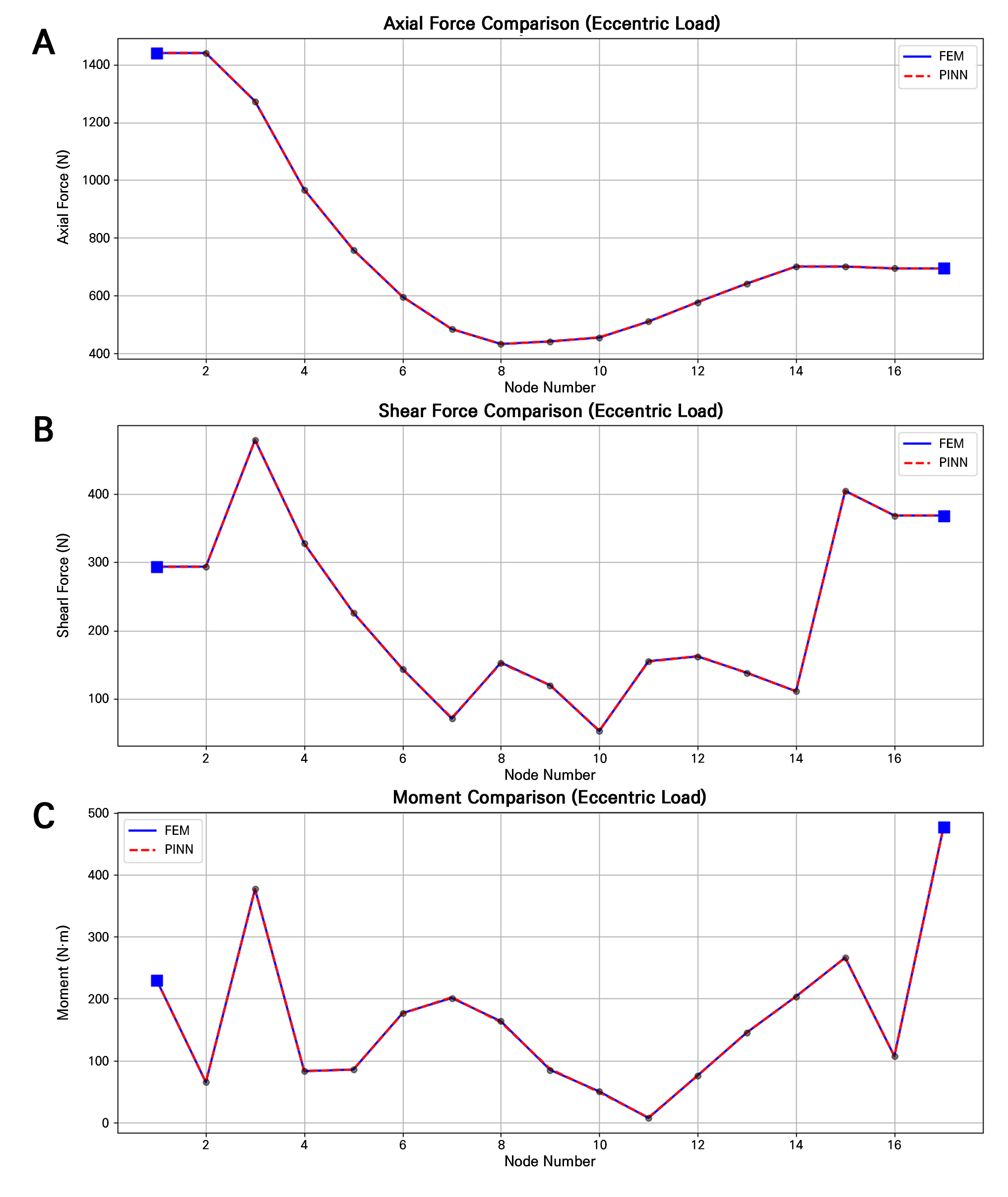
The PINN model demonstrated excellent agreement with the FEM results in predicting sectional forces under eccentric load conditions (Fig. 8). For the axial force, it predicted an asymmetric pattern with a maximum value of 1440.69 N at the left support (node 1) and a minimum value of 431.59 N at the center part (node 8) with an average error of 0.06%. The shear force showed a maximum value of 478.32 N at the left part (node 3) and was predicted with an average error of 0.43%. Although a relatively high maximum error of 3.13% occurred near node 10, where the value was small, the absolute error was only 1.67 N. Due to the eccentric load, the bending moment showed distinct asymmetry with 476.98 N·m at the right support (node 17) and 229.79 N·m at the left support (node 1). The PINN model predicted this bending moment distribution with an average error of 2.03%. The relatively higher error in the bending moment is considered to be due to increased nonlinearity in the complex distribution pattern caused by the eccentric load.
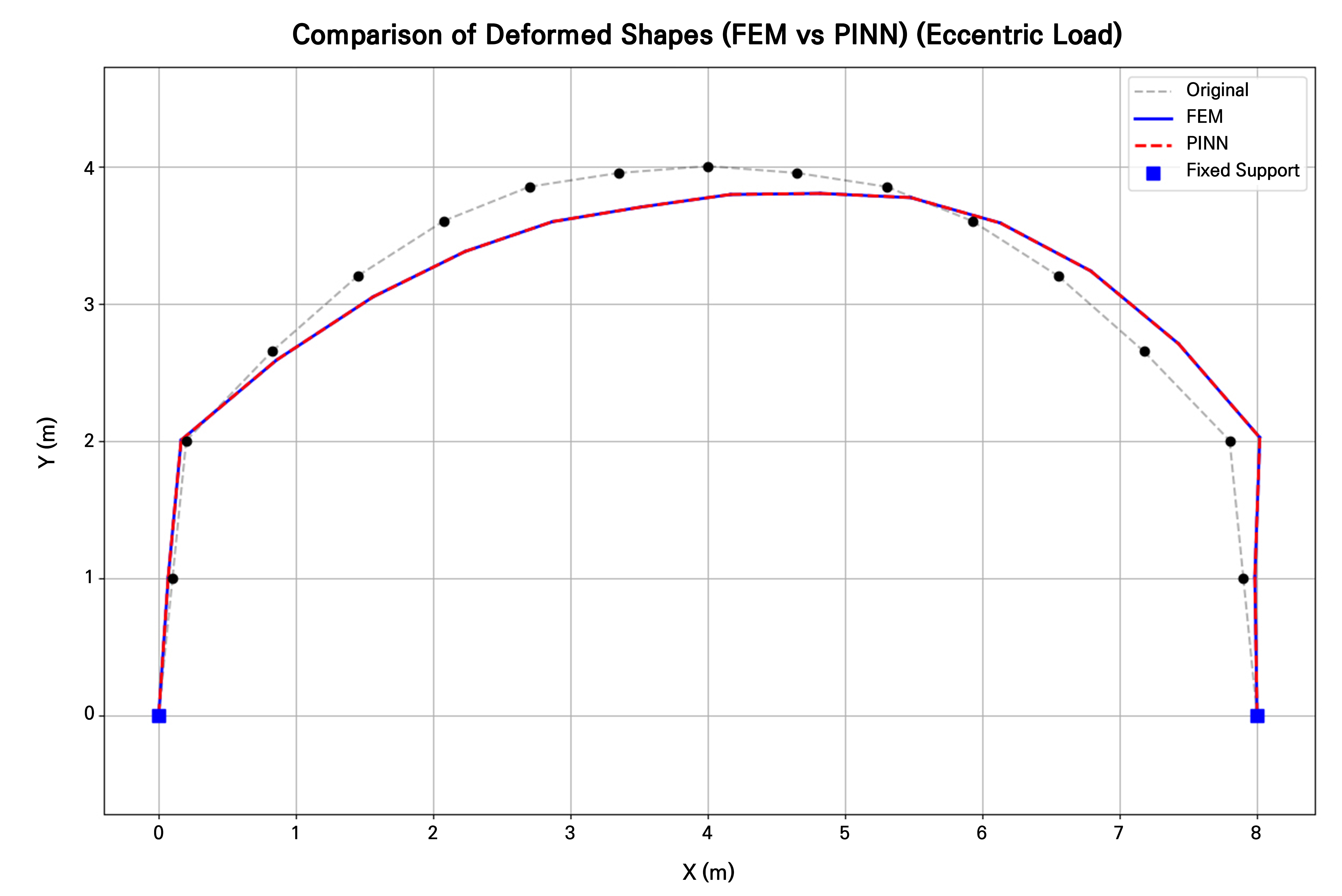
Additionally, as shown in Fig. 9, the deformation shape of the structure under an eccentric load was also accurately predicted by the PINN model. Comparing the deformed shape from the original structure shape (dotted line), it can be seen that the FEM (blue solid line) and PINN (red dotted line) results are very similar. A quantitative analysis of the displacement prediction accuracy level showed that the average error in the -direction displacement was 0.022 mm with a maximum error of 0.105 mm, while the average error in the -direction displacement was 0.030 mm, with a maximum error of 0.130 mm. Considering the maximum displacement magnitude of the structure (about 50 mm), these are very small levels, showing that the PINN model accurately predicts the deformation shape even under eccentric load conditions. Furthermore, the displacement analysis results showed that the structure exhibited an asymmetric deformation pattern due to the eccentric load, with the maximum vertical deflection of ‒5.10 cm occurring at node 7 and the maximum horizontal displacement of 5.08 cm arising node 14. The PINN model successfully captured the characteristics of this complex asymmetric deformation pattern, indicating that the approach of integrating physical constraints into the loss function worked effectively.
Discussion
This study has established a foundation for implementing physics-informed neural networks within structural analysis contexts and identified both their capabilities and present constraints. The methodology shows particular promise for applications in horticultural engineering, especially with regard to structural safety assessments of greenhouses. Modern greenhouse structures present unique challenges due to their irregular loading conditions, seasonal variations, and the complex interactions between the structural components and the cultivation systems. These structures face dynamic loading conditions from wind, snow, and equipment installations, while simultaneously requiring precise environmental control for optimal crop growth. This combination makes structural integrity assessments of these structures crucial not only for crop protection and economic sustainability but also for maintaining stable growing conditions and good energy efficiency.
The PINN approach’s capacity to manage intricate geometries and deliver swift safety evaluations holds considerable promise to benefit greenhouse designers and operators. Its ability to provide rapid structural assessments becomes particularly valuable when evaluating the impact of modifications such as the installation of additional growing systems, climate control equipment, or when assessing the effects of adaptations to changing environmental loads on the structural stability. This capability could significantly improve the design optimization of greenhouse structures, leading to the more efficient use of materials while ensuring structural safety.
We explore an implementation of PINNs for structural analysis applications, demonstrating their capability to address structural mechanics challenges that conventional methods find difficult. A key innovation of this work involves the direct incorporation of structural physical governing equations within the neural network architecture, enabling the system to discover solutions conforming to both structural equilibrium requirements and boundary conditions. The integration of FEM physical principles into the PINN’s loss function represents a significant advancement in structural analysis methodologies, addressing the limitations of both conventional PINN implementations and traditional FEM analyses. While traditional PINNs have limited applicability to complex structural geometries due to their reliance on direct differential equation learning, our FEM-based approach enables practical applications to actual structures while maintaining feasible computational efficiency.
The PINN approach presents a mesh-independent analytical approach, in contrast to the FEM, which necessitates mesh creation. PINNs employ stochastically selected points across the domain, thereby preserving the solution continuity and non-linearity without segmented approximations (Lee 2022). Through the elimination of response linearization (commonly employed in the FEM), PINNs exhibit an enhanced ability to represent intricate structural behaviors with less than 1% error (Mouratidou et al. 2024).
Our study revealed that the PINN approach delivered exceptional accuracy in structural response predictions, achieving results that were closely aligned with FEM solutions across the test scenarios here. The accuracy achieved in section force and displacement predictions suggests the robustness of the PINN. Maintaining micrometer-level accuracy in displacement predictions and capturing complex bending moment distributions indicate that the physics-based constraints effectively guide the learning process. This level of accuracy was achieved with minimal training data, demonstrating the value of incorporating physical principles into the neural network architecture.
The PINN model proposed in this study demonstrated excellent generalization performance even under eccentric load conditions. Under asymmetrically distributed snow loads of ‒334.75 N/m at the left end and ‒65.25 N/m at the right end, the model accurately predicted the asymmetric distributions of internal forces and deformations. The axial force showed a very low error rate of 0.06% on average, the shear force 0.43%, and the bending moment 2.03%. These successful predictions under non-uniform load conditions demonstrate that the model robustly learned the fundamental physical principles of the structure rather than demonstrating simple pattern recognition. Particularly noteworthy is that it accurately captured the complex asymmetric deformation pattern caused by the eccentric load. The average errors in the displacement predictions were very low at 0.022 mm in the -direction and 0.030 mm in the -direction, and the model accurately predicted both the location and magnitude (‒5.10 cm) of the maximum vertical deflection. These results prove that the PINN model can accurately predict structural behaviors not only under uniform loads but also under complex load patterns, showing strong potential for effective use in assessing the structural safety of greenhouses under various environmental conditions.
Additionally, this study verified the physical significance of the prediction results according to decreases in loss function values. As the loss function value decreased from 0.1 to 0.00001, the sectional force error decreased sharply from 17.5 N to 0.302 N, and the displacement error fell from 0.671 mm to 0.021 mm. Particularly, when the loss function value decreased to less than 0.0001 (around 1200 epochs), the sectional force error reached practical accuracy of less than 0.522 N, with the displacement error below 0.045 mm. These results show that the proposed physics-based loss function works effectively during the learning process, with the model converging toward finding physically meaningful solutions. The degree of the boundary condition violation also greatly improved from about 20 mm initially to 0.089 µm at the end as learning progressed. These results demonstrate that after sufficient training, the PINN model can provide solutions that almost perfectly satisfy the boundary conditions required in a conventional FEM analysis, suggesting that the PINN approach can serve as a valuable alternative in the field of structural analysis given how it provides solutions that comply with physical laws as well as good numerical accuracy.
While acknowledging this adaptability, it becomes essential to examine how PINNs measure up against the FEM regarding computational performance. PINN training demands resource-intensive iterative optimization processes, whereas FEM solutions follow a more straightforward path for given mesh configurations (Grossmann et al. 2024). Grossmann et al. (2024) demonstrated that FEM solutions achieved high-accuracy convergence one to three orders of magnitude more rapidly than PINN methodologies in specific benchmark PDE scenarios. This finding of this study supports that the traditional FEM maintains advantages in terms of raw computational speed and precision across numerous applications.
Regarding accuracy metrics, our PINN approach effectively captured broad response characteristics; however, stress concentrations showed slightly reduced precision compared to refined FEM models. This discrepancy is likely attributable to the PINN’s loss function balancing requirements and the potential necessity for an augmented network capacity or longer training duration to capture fine-scale phenomena. The current validation is limited to a single loading condition and specific structural configuration. While the results are promising, comprehensive validation across different load conditions and structural configurations is necessary. The present implementation also does not address structural nonlinearities or dynamic behaviors, which are essential aspects of a comprehensive structural analysis.
Further research should focus on extending these capabilities to more complex scenarios, including nonlinear material behaviors and dynamic loading conditions. The method proposed here shows particular promise for applications requiring iterative analyses, such as optimization studies and reliability assessments, which are increasingly important for agricultural structures under extreme weather conditions. Through systematic investigations of these research directions, scholars can strengthen PINN reliability and applicability, potentially establishing these models as standard analytical tools alongside, or complementary to, conventional methods such as the FEM. The implementation of PINNs in greenhouse structural analysis could revolutionize how we approach safety assessments in horticultural facilities, ultimately contributing to more resilient and efficient protected cultivation systems.
