

Introduction
Materials and Methods
Plant materials and experimental design
Morphological characterization
Quantitative leaf color analysis
Statistical analysis
Results
Vegetative growth and canopy architecture
Leaf morphology, pigmentation, and petiole characteristics
Quantitative characterization of ontogenetic foliage color changes
Storage root characteristics
Floral morphology and flowering behavior
Multivariate phenotypic differentiation: principal component analysis
Discussion
Conclusions
Introduction
Sweet potato (Ipomoea batatas (L.) Lam.) is one of the most widely cultivated crops worldwide (FAO 2024), primarily valued for its storage root yield, nutritional attributes, and industrial applications (Jung et al. 2011; Ayeleso et al. 2016; Du et al. 2019). In recent years, however, several sweet potato cultivars have attracted substantial interest as ornamental plants owing to their attractive foliage color, diverse leaf shapes, and vigorous trailing growth habits suited to landscape plantings, hanging baskets, container gardens, and urban greening applications (Pérez et al. 2006; Sousa et al. 2018).
Commercial ornamental sweet potato cultivars such as the ‘Sweet Caroline™’ series, first released in 2002 (Winslow 2012), have been widely adopted in international horticulture. Earlier ornamental introductions such as ‘Margarita,’ released by the University of Georgia in 1996, and ‘Black Heart’ (syn. ‘Ace of Spades’) were among the most widely grown ornamental sweet potatoes prior to the ‘Sweet Caroline’ series (Winslow 2012). In ornamental plant breeding, such distinctive visible traits—novel foliage color, leaf shape, and growth habit—are themselves established breeding objectives (Henny and Chen 2003; Van Huylenbroeck and Bhattarai 2022). In Korea, while ornamental cultivars including ‘Morning White’—bred with white flower color as an explicit breeding objective—and ‘Morning Purple’ have been domestically bred and released (Lee et al. 2008), their horticultural utilization remains limited relative to their potential value, partly because systematic morphological characterization under standardized, replicated field conditions remains unfinished.
Previous research on sweet potato focused primarily on storage root yields, nutritional compositions, and the physiological characteristics of edible cultivars (Pérez-Pazos et al. 2021; Meng et al. 2024; Merga et al. 2025; Wu et al. 2025). Although a limited number of studies have described the ornamental characteristics of individual sweet potato accessions, comprehensive morphological comparisons between ornamental and edible cultivars under equivalent growing conditions remain scarce. Three gaps are particularly evident: standardized characterization of ornamental cultivars under replicated field conditions is lacking, direct comparisons between ornamental and edible cultivars under equivalent growing conditions are scarce, and dynamic traits such as ontogenetic foliage color transitions have not been quantitatively evaluated.
A morphological evaluation is among the most practical and reproducible approaches for cultivar characterization, as the ornamental phenotype is characterized by visible traits such as the foliage color, leaf architecture, growth habit, and flowering behavior. Quantitative assessment of these traits, supported by multivariate analysis, can provide objective information for germplasm management, cultivar registration, and breeding target selection.
Therefore, the objectives of this study were to (1) characterize the major morphological traits of six ornamental and two edible sweet potato cultivars under replicated field conditions, (2) identify the traits that most clearly characterize the ornamental phenotype, (3) quantitatively characterize ontogenetic foliage color transitions using image-based CIELAB analysis, and (4) determine the principal components contributing to phenotypic differentiation among cultivars. The results are intended to establish an objective morphological evaluation framework applicable to ornamental sweet potato breeding and horticultural utilization.
Materials and Methods
Plant materials and experimental design
The field experiment was conducted at Gongchon-dong, Seo-gu, Incheon, Korea (37°33'17.2"N, 126°41'19.2"E) from June to October of 2022 under open-field conditions. Eight sweet potato (Ipomoea batatas (L.) Lam.) cultivars were evaluated: two edible cultivars (‘Beniharuka’ and ‘Shinyulmi’) and six ornamental cultivars (‘Sweet Caroline Purple,’ ‘Black Heart,’ ‘Margarita,’ ‘Gold Finger,’ ‘Morning White,’ and ‘Morning Purple’) (Fig. 1). All eight cultivars were obtained from the plant collection maintained at the University of Seoul. Plantlets were propagated in vitro on Murashige and Skoog (MS) media at the Plant Genetic Engineering Laboratory of The University of Seoul and were maintained at 25°C under a 16/8 h (light/dark) photoperiod. In vitro-derived plantlets were acclimatized for approximately 20 days and then grown under greenhouse conditions at approximately 28°C for approximately two months before transplantation.
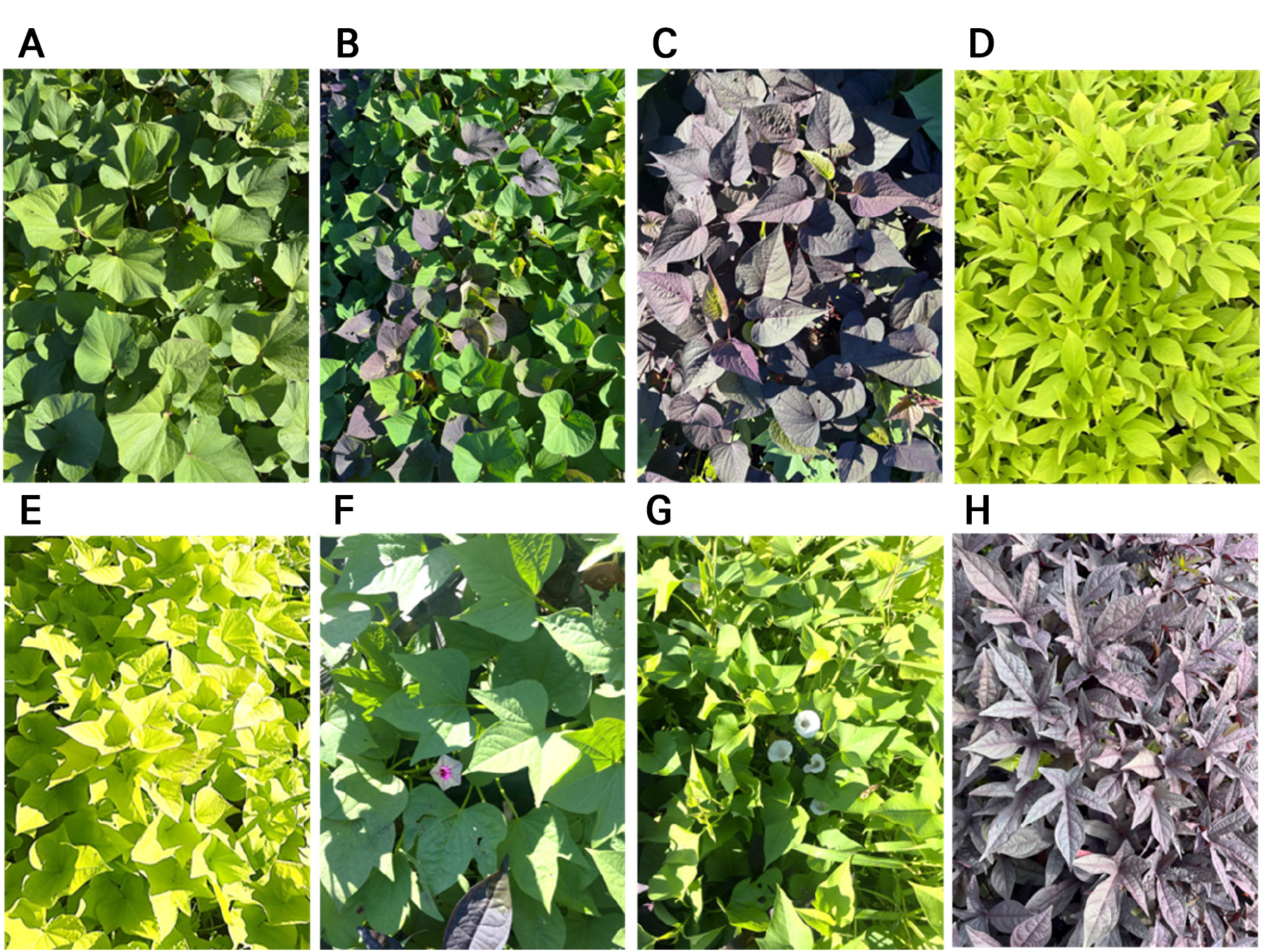
Fig. 1.
Canopy appearance of edible and ornamental sweet potato (Ipomoea batatas (L.) Lam.) cultivars at 90 days after transplanting under open-field conditions: (A) Shinyulmi, (B) Beniharuka, (C) Black Heart, (D) Gold Finger, (E) Margarita, (F) Morning White, (G) Morning Purple, and (H) Sweet Caroline Purple.
The experiment was arranged in a randomized complete block design (RCBD) with three blocks. Each block contained 10–15 plants per cultivar, planted at 30 × 60 cm spacing distances. Plants were transplanted to the open field in early June of 2022. Drip irrigation was applied at approximately 4 mm·day-1 during dry periods, and basal fertilization (N-P-K: 120-80-100 kg·ha-1) was applied at transplanting. The trial site was a conventional upland field under standard cultivation management; a soil analysis was not conducted. The region has a temperate monsoon climate; according to the 1991–2020 climatological normals of the Korea Meteorological Administration (Incheon station), the annual mean temperature is approximately 12.5°C, with the warmest month in August and precipitation concentrated in the summer months, coinciding with the main vegetative growth period of the crop.
Morphological characterization
Morphological traits were recorded according to Huamán (1991) and the guidelines of the Rural Development Administration (RDA) of Korea. Twenty-six qualitative and quantitative traits were assessed (Table 1). Aboveground traits—in this case the stem length, internode length, stem diameter, branch number, node number, leaf shape and color, immature and mature leaf length, petiole length and diameter, and inflorescence characteristics—were evaluated at 90 days after transplanting (DAT). Storage root traits—specifically the shape, length, width, skin color, flesh color, and number per plant—were evaluated at 120 days after planting (DAP). Five plants per block per cultivar were randomly selected for quantitative trait measurements (total n = 15 per cultivar); block means were used as the analytical unit. Floral developmental stages were documented for each of six consecutive stages from closed bud to post-anthesis collapse, and diurnal flowering progression was recorded at 5 AM, 9 AM, 1 PM, and 5 PM on the same day.
Table 1.
Twenty-six morphological traits assessed in edible and ornamental sweet potato cultivars according to Huamán (1991) and RDA (Korea) guidelines
| Plant part | Trait type | Parameter |
| Stem (assessed at 90 DAT) | ||
| Quantitative | Main stem length (cm) | |
| Quantitative | Internode length (cm) | |
| Quantitative | Stem diameter (mm) | |
| Quantitative | Number of branches (plant-1) | |
| Quantitative | Number of nodes (plant-1) | |
| Leaf (assessed at 90 DAT) | ||
| Qualitative | Leaf lobe shape | |
| Qualitative | Leaf lobe type | |
| Qualitative | Leaf lobe number | |
| Qualitative | Immature / Mature leaf color | |
| Quantitative | Immature / Mature leaf length (cm) | |
| Petiole (assessed at 90 DAT) | ||
| Quantitative | Petiole length (cm) | |
| Quantitative | Petiole diameter (mm) | |
| Inflorescence (assessed at 90 DAT) | ||
| Qualitative | Flowering habit | |
| Qualitative | Style color | |
| Quantitative | Corolla length (mm) | |
| Quantitative | Corolla width (mm) | |
| Qualitative | Shape of limb | |
| Qualitative | Sepal shape | |
| Qualitative | Stigma exsertion | |
| Storage root (assessed at 120 DAP) | ||
| Qualitative | Root general shape | |
| Qualitative | Root surface defects | |
| Qualitative | Root skin color | |
| Qualitative | Root flesh color | |
| Quantitative | Root length and width | |
| Qualitative | Root formation pattern | |
| Quantitative | Number of roots per plant | |
Quantitative leaf color analysis
Leaf color was quantified from standardized digital images of representative immature and mature leaves of each cultivar, photographed under identical illumination and background conditions (Fig. 2). Leaf lamina regions were segmented from the background by thresholding the CIE color difference (ΔE > 12) relative to the median background color estimated from image margins, followed by one-pixel morphological erosion to exclude edge-mixed pixels; specular highlights were removed by excluding high-lightness, low-chroma pixels. RGB values of segmented lamina pixels were converted to the CIELAB color space (D65 illuminant, 2° standard observer), and mean L* (lightness), a* (green–red), and b* (blue–yellow) coordinates were computed over all lamina pixels of each leaf. Images were acquired without a physical color reference chart; the derived values are therefore internally comparable within the standardized imaging setup rather than absolute colorimetric measurements. Ontogenetic color changes were expressed as the color difference between immature and mature leaves using both the Euclidean metric (ΔE*ab) and the CIEDE2000 formula (ΔE00), together with shifts in the hue angle (h°) and chroma (C*ab). Because one representative leaf per cultivar per stage was analyzed, these values are presented as a descriptive quantification of the visually documented color phenotypes; no inferential statistics were applied. Image processing was performed in Python using scikit-image.
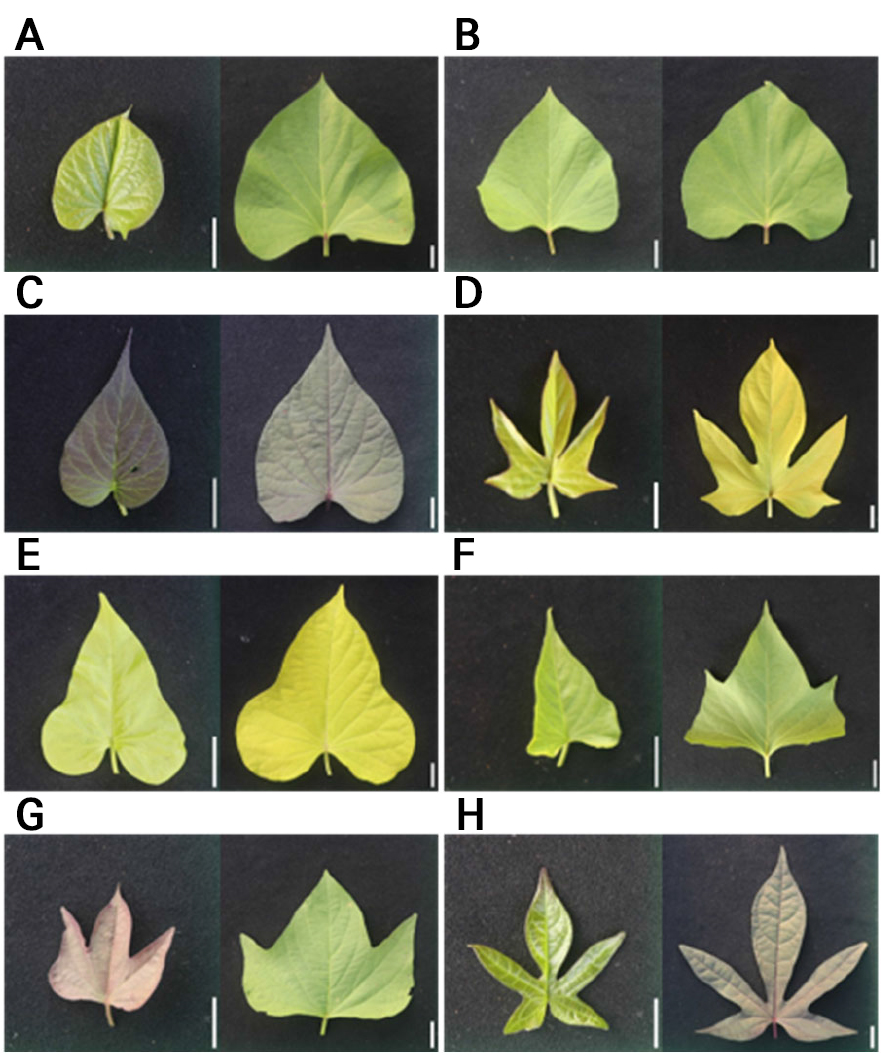
Fig. 2.
Leaf shape and foliage pigmentation of edible and ornamental sweet potato cultivars at 90 days after transplanting. Each panel shows an immature leaf (left) and a mature leaf (right) to illustrate ontogenetic pigmentation dynamics. (A) Shinyulmi, (B) Beniharuka, (C) Black Heart, (D) Gold Finger, (E) Margarita, (F) Morning White, (G) Morning Purple, and (H) Sweet Caroline Purple. Scale bar = 2 cm.
Statistical analysis
All data were analyzed using SAS v9.4 (SAS Institute Inc., Cary, NC, USA). Homogeneity of error variance was confirmed using Levene’s test prior to the analysis. Cultivar effects were tested by analysis of variance (ANOVA) for a randomized complete block design performed on block means (n = 3 per cultivar), with block as the blocking factor, followed by Tukey’s honestly significant difference (HSD) test at p ≤ 0.05. Principal component analysis (PCA) was performed on standardized (z-score) data for 13 continuously measurable quantitative traits using the PROC PRINCOMP procedure. Qualitative categorical traits were excluded from the PCA as they cannot be meaningfully standardized on a continuous scale. Block means (n = 3 per cultivar) were used as PCA observations to maintain consistency with the RCBD experimental design. Although the use of block means results in a limited number of observations per cultivar in PCA (n = 3), this approach maintains consistency with the RCBD experimental design and is appropriate for comparative cultivar characterization under the present experimental conditions. Genotype-mean-based multivariate characterization is an established practice in evaluations of sweet potato germplasm (Yada et al. 2010); accordingly, the PCA was interpreted as an exploratory, descriptive summary of the cultivar-level phenotypic structure. PCA results are presented as the final integrative summary following all individual trait characterizations.
Results
Vegetative growth and canopy architecture
Significant variation was observed among the cultivars in all measured stem growth traits (Table 2). Stem elongation ranged from 86.9 ± 10.5 cm in ‘Sweet Caroline Purple’ to 268.5 ± 64.9 cm in ‘Shinyulmi.’ Among the ornamental cultivars, ‘Morning White’ produced the longest stems (180.3 ± 42.8 cm), exceeding the edible cultivar ‘Beniharuka’ (134.4 ± 18.4 cm; Fig. 1).
Table 2.
Stem growth characteristics of edible and ornamental sweet potato cultivars measured at 90 days after transplanting (means ± SD of 15 plants from three blocks; block means served as the experimental unit for ANOVA)
| Cultivar |
Main stem length (cm) |
Internode length (cm) |
Stem diameter (mm) |
Branches (plant-1) |
Nodes (plant-1) |
| Edible cultivars | |||||
| Shinyulmi | 268.5 ± 64.9 az | 6.6 ± 0.9 b | 6.1 ± 0.4 bc | 3.9 ± 0.8 a | 45.8 ± 10.5 b |
| Beniharuka | 134.4 ± 18.4 bc | 4.4 ± 0.6 cd | 5.7 ± 0.6 bc | 3.9 ± 0.8 a | 40.8 ± 6.3 bc |
| Ornamental cultivars | |||||
| Black Heart | 157.1 ± 18.6 b | 5.7 ± 1.4 bc | 4.5 ± 0.4 c | 3.2 ± 0.7 ab | 36.4 ± 5.9 cd |
| Gold Finger | 132.9 ± 27.7 bc | 4.5 ± 0.9 cd | 5.3 ± 0.6 bc | 3.1 ± 0.7 ab | 41.4 ± 7.3 bc |
| Margarita | 145.3 ± 24.2 bc | 3.7 ± 0.7 d | 6.6 ± 1.1 a | 2.8 ± 0.8 b | 53.5 ± 8.5 a |
| Morning White | 180.3 ± 42.8 b | 5.7 ± 1.7 bc | 4.3 ± 0.4 c | 1.7 ± 0.7 c | 40.4 ± 7.5 bc |
| Morning Purple | 129.2 ± 31.3 bc | 4.8 ± 1.2 cd | 5.8 ± 0.9 bc | 2.5 ± 1.3 bc | 39.5 ± 9.9 bc |
| Sweet Caroline Purple | 86.9 ± 10.5 d | 3.8 ± 0.8 d | 5.8 ± 0.4 bc | 3.3 ± 0.6 ab | 28.3 ± 4.5 d |
Internode length was greatest in ‘Shinyulmi’ (6.6 ± 0.9 cm) and shortest in ‘Margarita’ (3.7 ± 0.7 cm). Stem diameter was greatest in ‘Margarita’ (6.6 ± 1.1 mm), which exceeded both edible cultivars. Branch number was lowest in ‘Morning White’ (1.7 ± 0.7 per plant), which produced fewer branches than all other cultivars despite its vigorous stem elongation. Node number was greatest in ‘Margarita’ (53.5 ± 8.5) and lowest in ‘Sweet Caroline Purple’ (28.3 ± 4.5).
Leaf morphology, pigmentation, and petiole characteristics
Leaf morphology exhibited the greatest phenotypic diversity among all evaluated traits (Table 3 and Fig. 2). The edible cultivars produced uniformly cordate leaves with stable green pigmentation throughout the cultivation period. In contrast, the ornamental cultivars displayed considerably greater variation in the leaf shape, lobe dissection, and pigmentation pattern.
Table 3.
Leaf and petiole characteristics of edible and ornamental sweet potato cultivars measured at 90 days after transplanting (means ± SD of 15 plants from three blocks; block means served as the experimental unit for ANOVA)
zMeans within a column followed by different lowercase letters are significantly different at p ≤ 0.05 (Tukey’s HSD test).
Arrows (→) indicate an ontogenetic pigmentation change from the immature to the mature leaf stage (see Fig. 2).
Four distinct leaf architectural types were identified among the eight cultivars. ‘Black Heart’ maintained persistent dark purple-brown cordate leaves throughout the growing season. ‘Sweet Caroline Purple’ exhibited deeply dissected pentalobed leaves with a pronounced green-to-purple developmental color transition, while ‘Morning Purple’ displayed trilobed leaves with a purple-to-green transition during leaf maturation. ‘Morning White’ produced trilobed silver-green leaves without a color transition. ‘Margarita’ and ‘Gold Finger’ maintained consistent bright yellow-green foliage with cordate and deeply dissected pentalobed architectures, respectively (Fig. 2).
The petiole length range was 14.6 ± 3.7 cm in ‘Morning Purple’ and 30.3 ± 4.3 cm in ‘Beniharuka,’ while that of the petiole diameter was 2.6 ± 0.5 mm in ‘Morning White’ and 4.6 ± 0.8 mm in ‘Shinyulmi’ (Table 3). These differences were statistically significant according to Tukey’s HSD.
Quantitative characterization of ontogenetic foliage color changes
The quantitative CIELAB analysis confirmed that the ontogenetic color transitions in ‘Morning Purple’ and ‘Sweet Caroline Purple’ were of a fundamentally different nature from the color stability observed in the remaining cultivars (Fig. 3 and Table 4). The shift along the green–red (a*) axis cleanly discriminated the two transition cultivars from all others: ‘Morning Purple’ shifted from positive to strongly negative a* (Δa* = ‒25.1; purple → green), whereas ‘Sweet Caroline Purple’ shifted in the opposite direction (Δa* = +14.6; green → purple), while all six non-transition cultivars showed |Δa*| ≤ 3.5. The corresponding total color differences (ΔE*ab = 34.0 and 28.1, respectively) were several-fold larger than those of the color-stable edible cultivars (ΔE*ab = 6.3–6.4), indicating conspicuous, directionally opposite color reorganization during leaf maturation. The ontogenetic transition is here defined as a change in the hue class, reflected in considerable displacement along the a* axis; moderate chroma or lightness adjustments occurred in some non-transition cultivars but did not alter their hue class. The two edible cultivars exhibited essentially invariant hue angles (112–117°) with ΔE*ab values of 6.3–6.4, quantitatively substantiating their description of maintaining stable green foliage. ‘Margarita’ retained its yellow-green hue (h° 111 → 103) while chroma increased (C*ab 45.0 → 60.5), indicating intensified yellow expression within a stable hue class. Notably, the color change in ‘Black Heart’ (ΔE*ab = 19.3) was almost entirely achromatic (ΔL* = +19.2 with near-constant hue and persistently low chroma, C*ab = 6.9–8.5), consistent with its characterization of maintaining persistent dark purple foliage, whereas the chroma reduction in ‘Sweet Caroline Purple’ (C*ab 38.3 → 11.3) and the chroma gain in ‘Morning Purple’ (13.1 → 37.9) reflect hue transitions consistent with changes in anthocyanin-related pigmentation.
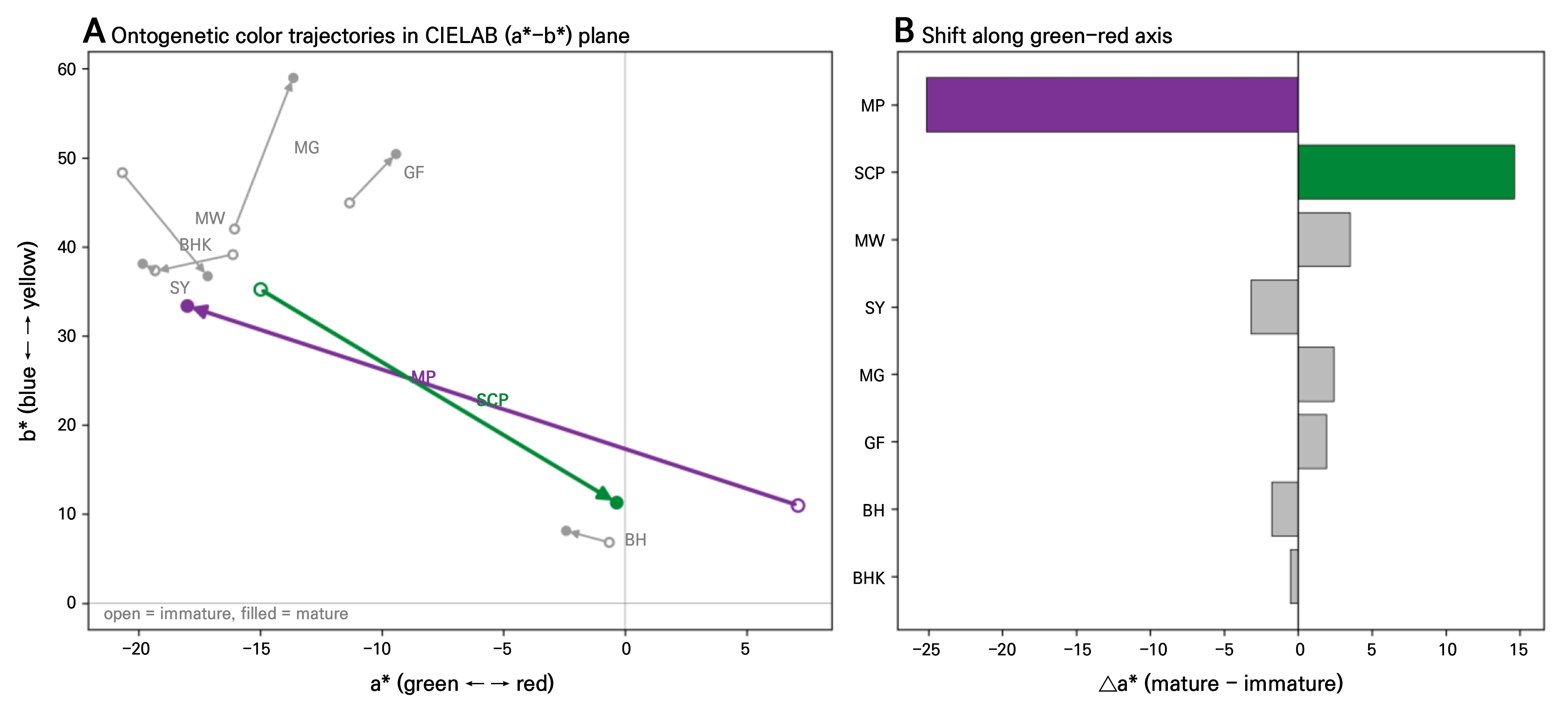
Fig. 3.
Quantitative characterization of ontogenetic foliage color changes in eight sweet potato cultivars based on a CIELAB analysis of standardized leaf images (one representative leaf per cultivar per stage; Fig. 2): (A) Color trajectories from immature (open circles) to mature (filled circles) leaves in the a*–b* chromaticity plane. (B) Shift along the green–red axis (Δa* = mature − immature). The two transition cultivars ‘Morning Purple’ (purple) and ‘Sweet Caroline Purple’ (green) show large, opposite shifts along a*, whereas all other cultivars remain essentially unchanged (|Δa*| ≤ 3.5). Cultivar abbreviations as in Fig. 6.
Table 4.
CIELAB color coordinates of immature and mature leaves and ontogenetic color-change indices of eight sweet potato cultivars, derived from standardized leaf images (one representative leaf per cultivar per stage)
| Cultivar | Immature leaf | Mature leaf | Δa* | ΔE*ab | ΔE00 | |||||
| L* | a* | b* | L* | a* | b* | |||||
| Shinyulmi | 70.3 | ‒16.1 | 39.1 | 65.2 | ‒19.3 | 37.3 | ‒3.2 | 6.3 | 4.7 | |
| Beniharuka | 75.2 | ‒19.3 | 37.4 | 68.9 | ‒19.9 | 38.1 | ‒0.5 | 6.4 | 4.8 | |
| Black Heart | 42.6 | ‒0.7 | 6.8 | 61.8 | ‒2.4 | 8.1 | ‒1.8 | 19.3 | 19.1 | |
| Gold Finger | 65.4 | ‒11.3 | 45.0 | 71.5 | ‒9.4 | 50.4 | 1.9 | 8.4 | 5.4 | |
| Margarita | 78.1 | ‒16.1 | 42.0 | 76.6 | ‒13.7 | 59.0 | 2.4 | 17.2 | 6.4 | |
| Morning White | 71.7 | ‒20.7 | 48.3 | 66.8 | ‒17.2 | 36.8 | 3.5 | 13.0 | 5.5 | |
| Morning Purple | 67.7 | 7.1 | 11.0 | 72.8 | ‒18.0 | 33.4 | ‒25.1 | 34.0 | 24.1 | |
| Sweet Caroline Purple | 64.3 | ‒15.0 | 35.2 | 62.2 | ‒0.4 | 11.3 | 14.6 | 28.1 | 14.8 | |
Storage root characteristics
Storage roots showed wide variation in shape, size, skin color, and flesh color among the cultivars (Fig. 4 and Table 5). The edible cultivars produced the largest, most uniform roots with reddish-purple and red-purple skin and orange-yellow to yellow flesh. Among the ornamental cultivars, root development varied considerably.
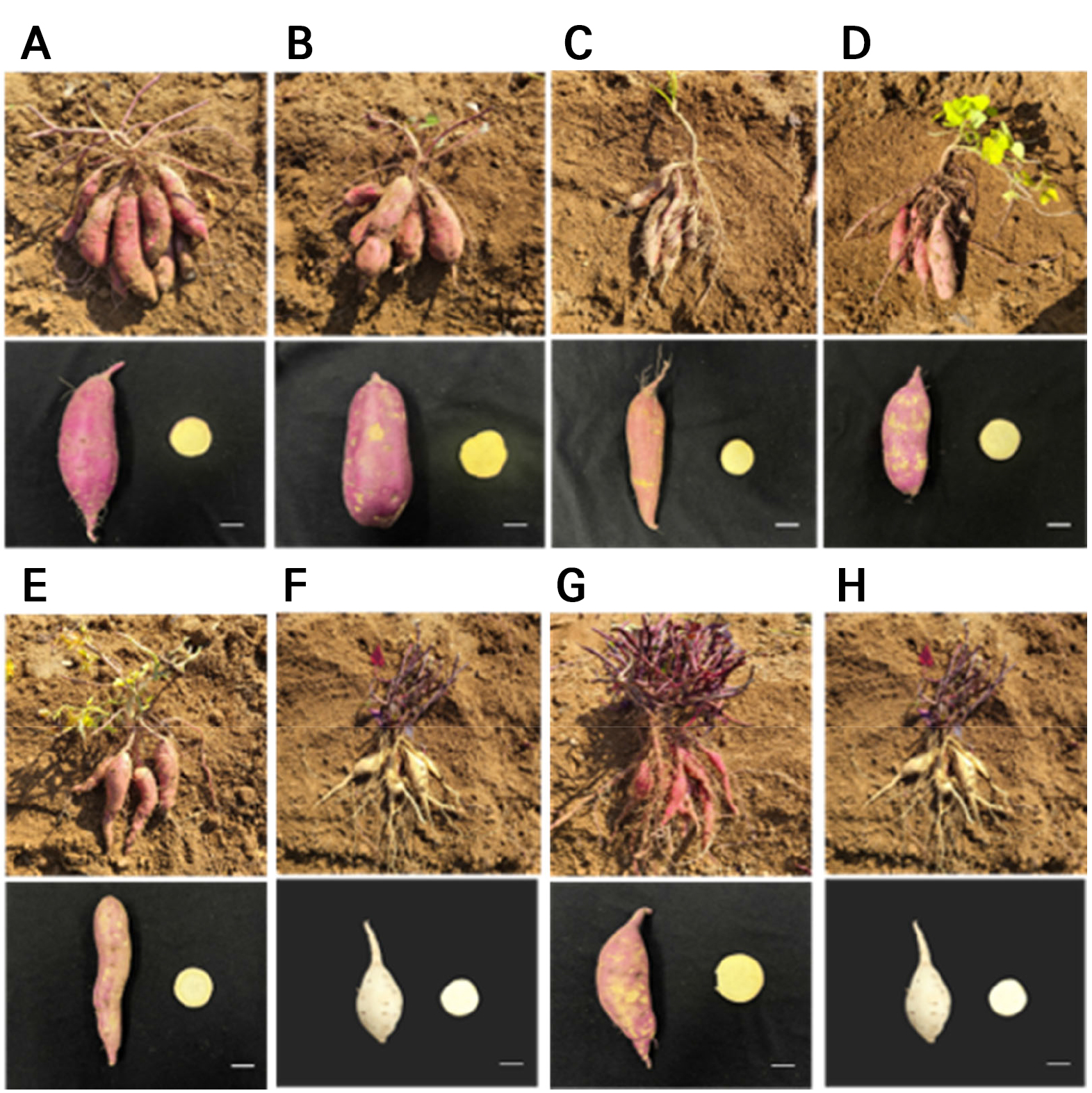
Fig. 4.
Storage root morphology and pigmentation of edible and ornamental sweet potato cultivars at harvest (120 days after planting). Each panel presents a field view at harvest (upper row) and a cross-sectional view showing skin and flesh color (lower row). (A) Shinyulmi, (B) Beniharuka, (C) Black Heart, (D) Gold Finger, (E) Margarita, (F) Morning White, (G) Morning Purple, and (H) Sweet Caroline Purple. Scale bar = 1 cm.
Table 5.
Storage root characteristics of edible and ornamental sweet potato cultivars at harvest (120 days after planting; means ± SD of 15 plants from three blocks, with block means as the experimental unit for ANOVA)
| Cultivar | Root length (cm) | Root width (mm) | Roots (no. per plant) | Skin color | Flesh color |
| Edible cultivars | |||||
| Shinyulmi | 19.6 ± 1.6 az | 60.4 ± 4.3 a | 4.9 | Reddish-purple | Orange-yellow |
| Beniharuka | 17.8 ± 1.5 ab | 54.1 ± 3.6 b | 6.1 | Red-purple | Yellow |
| Ornamental cultivars | |||||
| Black Heart | 13.6 ± 1.8 cd | 38.1 ± 2.4 c | 3.9 | Dark purple | White |
| Gold Finger | 4.4 ± 0.6 ef | 5.4 ± 0.4 e | 4.9 | Cream | White |
| Margarita | 3.6 ± 0.6 f | 6.5 ± 0.9 e | 2.6 | Cream-pink | Cream-yellow |
| Morning White | 19.9 ± 1.5 a | 30.5 ± 2.7 d | 4.9 | White | White |
| Morning Purple | 18.7 ± 3.6 ab | 32.3 ± 6.3 d | 3.2 | Purple-white | White |
| Sweet Caroline Purple | 16.0 ± 1.8 bc | 37.1 ± 1.7 c | 4.6 | Purple | White |
Contrary to the common assumption that ornamental selection universally suppresses root productivity, ‘Morning White’ (19.9 ± 1.5 cm) and ‘Morning Purple’ (18.7 ± 3.6 cm) produced roots comparable in length to the edible ‘Shinyulmi’ (19.6 ± 1.6 cm) and ‘Beniharuka’ (17.8 ± 1.5 cm) cultivars, with no statistically significant pairwise differences according to Tukey’s HSD (p > 0.05). In contrast, ‘Margarita’ (3.6 ± 0.6 cm) and ‘Gold Finger’ (4.4 ± 0.6 cm) showed markedly suppressed root development, representing the smallest roots of all cultivars evaluated.
Root width provided clearer discrimination between the cultivar groups than root length. The edible cultivars produced significantly wider roots (‘Shinyulmi’: 60.4 ± 4.3 mm; ‘Beniharuka’: 54.1 ± 3.6 mm) than all of the ornamental types (5.4–38.1 mm).
Floral morphology and flowering behavior
Three ornamental cultivars—‘Morning White,’ ‘Morning Purple,’ and ‘Sweet Caroline Purple’—flowered consistently under field conditions (Fig. 5 and Table 6). The remaining five cultivars, including both edible types and the ornamental ‘Black Heart,’ ‘Gold Finger,’ and ‘Margarita’ types, produced no flowers throughout the observation period, indicating that flowering occurrence was cultivar-specific rather than a group-level characteristic under the present field conditions.
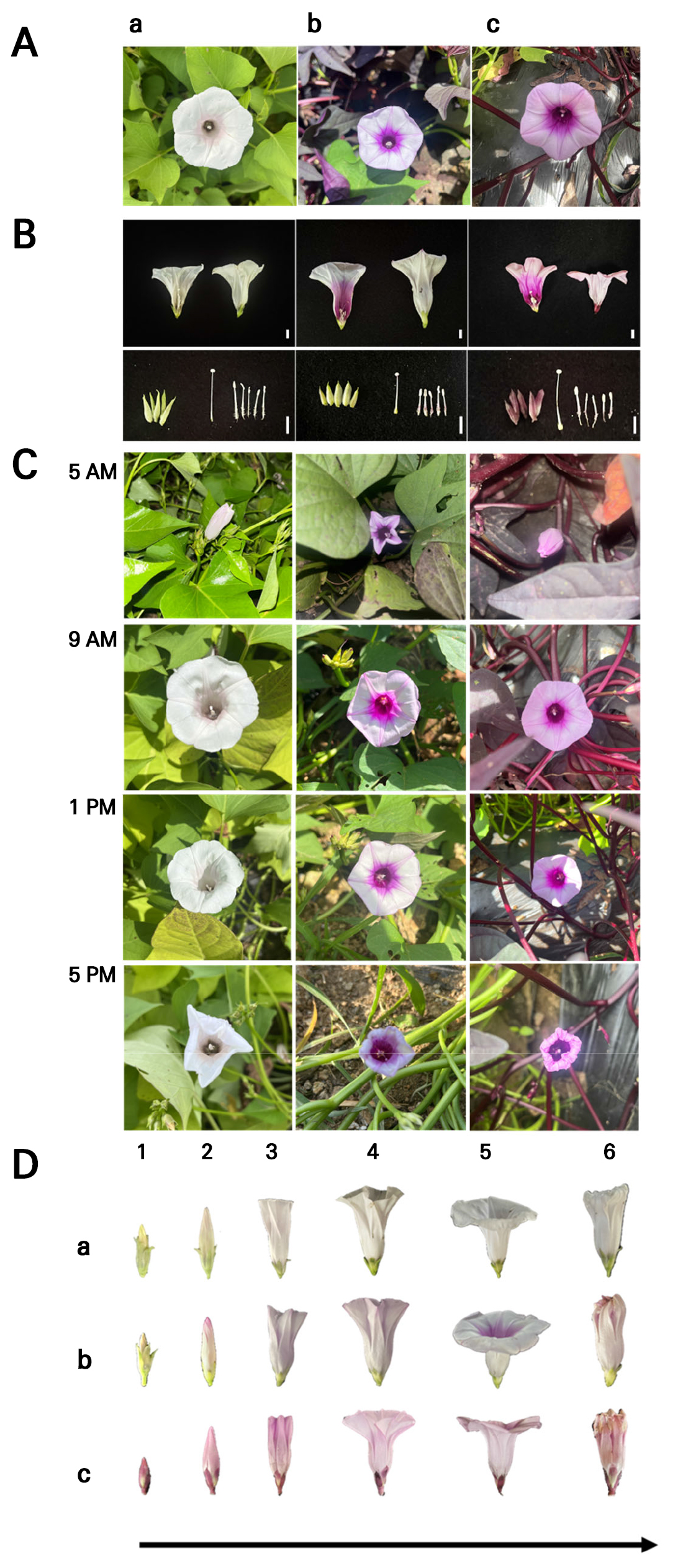
Fig. 5.
Comprehensive floral characterization of three ornamental sweet potato cultivars (Ipomoea batatas) that flowered under field conditions. Columns represent (a) Morning White, (b) Morning Purple, and (c) Sweet Caroline Purple throughout all panels. (A) Gross flower morphology at peak anthesis. (B) Floral anatomy. Upper row: opened corolla in lateral. Lower row: dissected floral organs showing five sepals (left cluster), five stamens (center), and single pistil with stigma (right). Scale bar = 1 cm; (C) Diurnal progression of flower opening and wilting at four time points. (D) Six-stage developmental sequence. Stages 1–6: (1) tightly closed green bud; (2) elongating bud, color visible through sepals; (3) pre-anthesis, corolla partially unfurled; (4) full anthesis; (5) post-anthesis, corolla collapsing; (6) wilted corolla prior to abscission.
Flower size differed significantly among the three flowering cultivars. ‘Morning White’ produced the largest flowers (corolla length 43.6 mm; width 48.4 mm) with white corollas and a prominent dark purple throat. ‘Morning Purple’ produced medium-sized flowers (38.9 mm; 43.9 mm) with pale white-purple corollas and a vivid purple throat. ‘Sweet Caroline Purple’ produced the smallest flowers (32.6 mm; 31.8 mm) with light purple corollas (Table 6 and Fig. 5A). Sepal morphology differed among the cultivars: lanceolate with slightly exserted stigma in ‘Morning White,’ ovate in ‘Morning Purple,’ and elliptic in ‘Sweet Caroline Purple’ (Fig. 5B).
Table 6.
Flowering characteristics of ornamental sweet potato cultivars that flowered under field conditions (n = 15 plants per cultivar from three blocks; block means served as the experimental unit for ANOVA)
| Cultivar |
Corolla length (mm) |
Corolla width (mm) | Flowering onset (DAP) | Corolla color | Sepal shape |
| Morning White | 43.6 az | 48.4 a | ~60 | White; dark purple throat | Lanceolate |
| Morning Purple | 38.9 b | 43.9 ab | ~60 | White–purple; purple throat | Ovate |
| Sweet Caroline Purple | 32.6 c | 31.8 b | ~70 | Light purple; deeper purple throat | Elliptic |
Diurnal flowering progression followed typical Ipomoea behavior (Yada et al. 2010): flowers remained as closed buds at 5 AM, reached full anthesis with maximum ornamental display at 9 AM, began to fold inward at 1 PM, and had completely wilted by 5 PM (Fig. 5C). Despite the short longevity of individual flowers, sequential blooming along the main stem with 4–6 flower buds per node ensured a continuous floral display throughout the season. Six developmental stages from a tight bud to a complete corolla collapse were documented for each cultivar (Fig. 5D).
Multivariate phenotypic differentiation: principal component analysis
PCA performed on 13 standardized quantitative traits (block means, n = 3 per cultivar) explained 35.5% of the total phenotypic variance in PC1 and 27.9% in PC2, together accounting for 63.4% of the total variation (Fig. 6). The edible cultivars were grouped in the positive PC1 region. ‘Shinyulmi’ (SY) occupied the extreme positive PC1 position with high PC2 scores, reflecting its outstanding vegetative vigor and large storage root dimensions. ‘Beniharuka’ (BHk) was positioned at positive PC1 with near-zero PC2, reflecting high root productivity but moderate vegetative traits. Their positional separation confirms cultivar-level phenotypic variation within the edible group.
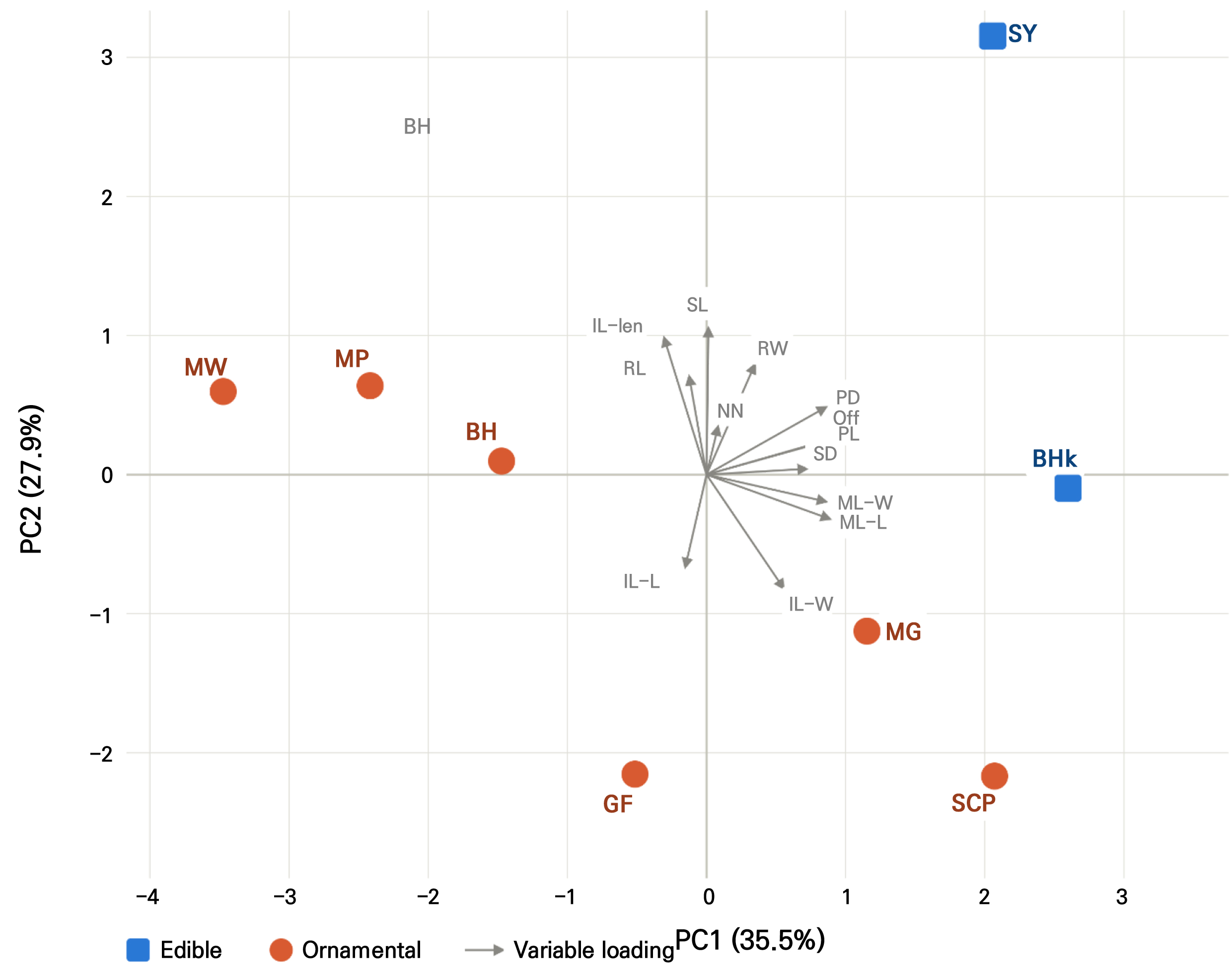
Fig. 6.
Principal component analysis (PCA) biplot of edible (blue squares) and ornamental (red circles) sweet potato cultivars based on 13 standardized quantitative morphological traits. Arrows indicate variable loadings (eigenvectors) for each trait; arrow direction and length reflect the contribution and direction of each variable to PC1 and PC2. Abbreviations: ML-W, mature leaf width; ML-L, mature leaf length; PL, petiole length; Off, number of offshoots; PD, petiole diameter; SD, stem diameter; IL-W, immature leaf width; RW, storage root width; IL-L, immature leaf length; RL, storage root length; NN, number of nodes; SL, main stem length; IL-len, internode length. SY, Shinyulmi; BHk, Beniharuka; BH, Black Heart; GF, Gold Finger; MG, Margarita; MW, Morning White; MP, Morning Purple; SCP, Sweet Caroline Purple.
Among the cultivars evaluated, the six ornamental cultivars showed a broader distribution along PC1 than the two edible reference cultivars, although this comparison is necessarily influenced by the unequal group sizes (six vs. two). Four ornamental cultivars—‘Black Heart’ (BH), ‘Gold Finger’ (GF), ‘Morning White’ (MW), and ‘Morning Purple’ (MP)—were positioned in the negative PC1 region, reflecting smaller leaf dimensions and shorter petioles. ‘Morning White’ and ‘Morning Purple’ clustered together in the upper-left region, reflecting their shared trilobed leaf architecture and shorter petioles. ‘Sweet Caroline Purple’ (SCP) and ‘Margarita’ (MG), however, were positioned in the positive PC1 region, partially overlapping with the edible cultivar area. This is consistent with the relatively large mature leaf dimensions of ‘Sweet Caroline Purple’ (mature leaf length 12.4 ± 1.0 cm; Table 3) and the high node number and wide stem diameter of ‘Margarita.’ ‘Black Heart’ (BH) occupied an intermediate position near the biplot origin.
Discussion
This study provides a systematic morphological evaluation of ornamental and edible sweet potato cultivars under replicated field conditions and identifies foliage-related traits as the traits most strongly associated with the ornamental phenotype.
Vegetative growth characteristics alone cannot reliably distinguish ornamental from edible sweet potato cultivars. The overlap in stem elongation between the ornamental ‘Morning White’ and edible ‘Beniharuka’ and the unexpected ranking of the stem diameter in ‘Margarita’ indicate that growth habit is not a categorical marker of cultivar type. This result is consistent with the broad genetic diversity of hexaploid Ipomoea batatas, within which ornamental selection has acted on foliage and reproductive traits rather than uniformly suppressing vegetative vigor (Monteros-Altamirano et al. 2020; Yan et al. 2022). This finding has direct implications for landscape application, where cultivar selection should be based on individual growth habits rather than group-level classifications. The low branching of ‘Morning White’ (1.7 per plant)—the fewest of all cultivars—is an important secondary consideration for breeding programs, as the simultaneous improvement of floral display and canopy density may be physiologically constrained and would require specific attention in selection programs.
Leaf morphology—particularly dynamic ontogenetic foliage pigmentation—proved to be the most diagnostically powerful and morphologically distinctive trait differentiating ornamental from edible cultivars, with direct implications for breeding target prioritization. The progressive color transitions in ‘Sweet Caroline Purple’ and ‘Morning Purple’ produce contrasting visual patterns during leaf maturation and may provide changing visual interest throughout the growing season. PC1 (35.5% of total variance) was most strongly loaded by mature leaf width (0.399), mature leaf length (0.397), petiole length (0.394), number of offshoots (0.392), and petiole diameter (0.387), all with positive loadings, collectively indicating that foliage size and petiole architecture were the primary axes of phenotypic differentiation. PC2 (27.9%) was most strongly loaded by main stem length (0.473) and internode length (0.443), reflecting vegetative vigor, and by storage root width (0.358), reflecting underground productivity. Variable loading vectors are displayed in the biplot (Fig. 6). These traits can be assessed non-destructively at early developmental stages, making them practical, non-destructively assessable variables for early-generation cultivar evaluation. Breeding programs targeting novel pigmentation dynamics—including accelerated or delayed color transition timing, or new transition color sequences—may benefit from screening accessions in the hexaploid germplasm pool, which harbors considerable unexploited foliage diversity (Yan et al. 2022).
The image-based CIELAB analysis introduced here places these pigmentation dynamics on a quantitative footing. An ontogenetic transition, defined as a change in hue class reflected in a large displacement along the green–red (a*) axis, cleanly separated the two transition cultivars (Δa* = ‒25.1 and +14.6) from all stable cultivars (|Δa*| ≤ 3.5) and further distinguished genuinely chromatic transitions from the achromatic lightness change of ‘Black Heart.’ In ornamental horticulture, such distinctive visible traits are themselves established breeding objectives, because the commercial value of foliage plants lies in their aesthetic qualities (Henny and Chen 2003; Van Huylenbroeck and Bhattarai 2022); the cultivars evaluated here are products of precisely such trait-directed breeding, and the continued commercial availability of foliage-oriented cultivars over two decades suggests sustained horticultural interest in these trait dimensions. Consumer research further indicates that foliage traits can significantly influence purchase decisions (Behe et al. 1999), although consumer preference for the specific color transitions quantified here was not directly evaluated. Because established morphological descriptor systems record leaf color categorically at fixed developmental stages (Huamán, 1991), the directional, continuous color transition quantified here represents a trait dimension not captured by such descriptors, and the associated indices (Δa*, ΔE) provide measurable descriptors of pigmentation dynamics for future breeding evaluations.
Storage root suppression was not a universal feature of the ornamental cultivars evaluated, challenging a common assumption in the field. The root length equivalence between ‘Morning White’ and ‘Morning Purple’ and the edible cultivars indicates that storage root elongation was not suppressed in these ornamental types despite selection for ornamental foliage and flowering traits; root length alone, however, does not fully represent storage capacity, and confirmation with root weight and volume measurements is warranted (Ravi et al. 2014). This is consistent with the observation by Sousa et al. (2018) that ornamental sweet potato accessions can exhibit a wide range of root development patterns. Root diameter, rather than root length, provided clearer discrimination: root width in edible cultivars averaged 54.1–60.4 mm compared with 5.4–38.1 mm for ornamental cultivars. This distinction has practical implications for plant breeders and growers: ‘Morning White’ and ‘Morning Purple’—which combine attractive foliage, seasonal flowering, and edible-type root lengths—warrant further evaluation as candidates for dual-purpose applications in edible landscaping, an emerging horticultural concept in which plants simultaneously serve aesthetic and food production functions (Keatinge et al. 2010). Conversely, ‘Margarita’ and ‘Gold Finger,’ which showed near-complete root suppression, are best suited to applications where underground biomass accumulation is undesirable, such as container planting on rooftops or balconies.
The flowering behavior documented in this study further supports the conclusion that ornamental characteristics in sweet potato are cultivar-specific rather than group-level phenomena. The complete absence of flowering in three ornamental cultivars (‘Black Heart,’ ‘Gold Finger,’ ‘Margarita’) under the present field conditions, despite their classification as ornamental types, suggests that short-day photoperiodic conditions are required to trigger reproductive growth in these cultivars. Sweet potato is recognized as a quantitative short-day plant whose floral induction requires night lengths exceeding a critical threshold, typically achieved under natural field conditions only in late season or at lower latitudes (Hammett 1985; Takeno 1991). The cultivar-specific nature of flowering observed in this study is consistent with previous reports indicating that flowering capacities vary considerably among sweet potato cultivars depending on their genetic background and photoperiodic sensitivity. Investigations of inductive conditions for non-flowering ornamental cultivars could substantially broaden the commercial utility of these cultivars by enabling reliable floral displays under controlled or modified growing regimes.
Because all cultivars were grown side by side in a common-garden RCBD, the cultivar differences observed here represent phenotypic differences expressed under the common environmental conditions of this trial, and the core conclusions rest primarily on categorical, qualitatively scored traits—leaf architectural type, pigmentation class and transition direction, and flowering occurrence under the present field conditions. The principal limitation of the present study is that evaluations were conducted at a single location during a single growing season; this constrains generalization of the absolute values and rankings of environmentally sensitive quantitative traits, and genotype × environment interactions affecting foliage color expression, vine elongation, and flowering onset remain uncharacterized. Multi-environment trials across representative Korean horticultural growing regions would be necessary to confirm the stability of key ornamental traits under diverse growing conditions and to validate the PCA-based cultivar classification framework. The image-based CIELAB analysis was based on one representative leaf per cultivar per developmental stage and should therefore be interpreted as a descriptive quantification of the visually documented pigmentation phenotypes; replicated colorimetric characterization across leaves, plants, and environments together with extension to storage root and flower color remains a subject for future work. Additionally, structured consumer preference data were not collected; future studies integrating consumer surveys with the morphological and colorimetric framework established here would further refine trait weighting for commercial cultivar development.
Conclusions
This study provides a systematic morphological evaluation of six ornamental and two edible sweet potato cultivars under replicated field conditions and identifies objective criteria for ornamental cultivar assessments. The following principal conclusions are drawn: (1) Vegetative growth traits alone do not reliably distinguish ornamental from edible sweet potato cultivars. The considerable overlap in stem elongation and other growth parameters between the groups indicates that individual cultivar characterization is necessary for appropriate horticultural application recommendations. (2) Leaf morphology and foliage pigmentation are the most prominent traits characterizing the ornamental phenotype among the cultivars evaluated. Dynamic developmental color transitions in ‘Sweet Caroline Purple’ and ‘Morning Purple’ represent morphologically distinctive characteristics with potential to enhance seasonal landscape interest. The image-based CIELAB analysis conducted here quantified these transitions as large, opposite shifts along the green–red axis (Δa* = ‒25.1 and +14.6; ΔE*ab = 34.0 and 28.1), providing objective and measurable descriptors of pigmentation dynamics. Petiole architecture is an additional component of ornamental leaf presentation and may serve as an additional descriptor in cultivar characterization and future breeding evaluations. (3) Storage root development varies considerably among ornamental cultivars and is not universally suppressed by ornamental selection. Root width—rather than root length—provides more reliable discrimination between cultivar groups. ‘Morning White’ and ‘Morning Purple,’ which combine ornamental foliage with edible-type root lengths, are for dual-purpose edible landscaping applications. (4) Flowering occurrence was cultivar-specific under the present field conditions. Three ornamental cultivars exhibited sequential flowering that may contribute additional ornamental interest beyond foliage, whereas three other ornamental cultivars produced no flowers under the present field conditions. Identification of inductive conditions for non-flowering cultivars warrants further investigation. (5) Principal component analysis confirmed that foliage-related traits—particularly mature leaf width, mature leaf length, petiole length, and petiole diameter (PC1 loadings: 0.399, 0.397, 0.394, and 0.387, respectively)—are the dominant factors driving phenotypic differentiation among the cultivars evaluated (PC1 = 35.5%), representing objective descriptors for cultivar characterization and candidate variables for future breeding evaluation and germplasm characterization efforts.
Collectively, these findings provide a practical morphological framework with which to evaluate ornamental sweet potato cultivars and will support future breeding, germplasm characterization, and the expanded horticultural utilization of sweet potato as an ornamental crop.
