

Introduction
Materials and Methods
Disclosure Materials and Cultivation Environment
Anion Treatment
Analysis of Growth Characteristics for Lettuce
Measurement of Antioxidant Capacity and Total Phenolic Content
Statistical Analysis
Results
Anion Concentration According to Generation Position
Leaf Length and Leaf Width
Shoot Fresh Weight
Shoot Dry Weight
Leaf Area
Chlorophyll Content
Antioxidant Ability
Total Phenolic Content
Discussion
Introduction
Due to recent climate change, disease and insect damage caused by global warming, the cultivation area and yield per unit area are decreasing every year (Jang et al., 2011). Vegetable production in
Korea has been decreasing every year since 2005 (KREI, 2017). For this reason, there is an increasing interest in the plant factory system, which is capable of producing agricultural products throughout the year without being affected by the climate. A plant factory system is a facility that can artificially control the environment such as light, temperature, humidity, carbon dioxide concentration, and nutrient solution (Kozai, 2007; Kim, 2010, Park et al., 2016). Since plant factory systems are disconnected from the outside, it is possible to safely produce a stable supply of agricultural products without being affected by disease, insect damage and climate. However, due to the fact that plant factory systems are expensive to set up and run, it has been difficult to commercialize them. In order to allow agricultural products produced in plant factory systems to compete with similar products produced in the field, new cultivation techniques are needed to increase the productivity of the plants and to reduce the cost of production.
Anions are negatively-charged particles that come from neutral atoms or neutral molecules. Usually anions exist in the form of air anions. When the anions are applied to crop plants, they improve photosynthesis and respiration in the crops, thereby promoting plant growth and increasing production (Wachter and Widmer, 1976; Pohl, 1977). Air anions promote photosynthesis in leafy vegetables such as lettuce and kale, and have positive effects on growth (Song, 2014; Lee et al., 2015), and also enhance growth and sterilization of sprouts (Song et al., 2015). In this way, research on how anion treatment affects the growth of agricultural products has been carried out in Korea, but it is insufficient.
Anion generators can be placed in various positions in plant factory systems, which may affect the anion concentrations reaching the plants. Thus, it is important to verify the anion concentration and the growth characteristics of the plants according to anion generation position. In this study, we investigated the growth of lettuce in a closed-type plant factory to identify the optimum position to generate air anions in relation to the plants.
Materials and Methods
Disclosure Materials and Cultivation Environment
The lettuce is known as an optimum crop for cultivation in the plant factory because of its characteristics such as short growth period and easy cultivation (Cha, 2012). Therefore, lettuce (Lactuca sativa L. ‘Jeokchima’) was used as disclosure materials. Lettuce seeds were sowed on rock wool and cultivated on a growth chamber for 2 weeks. Then the plants were transplanted to a closed-type plant factory with the anion generation system and cultivated for 4 weeks.
The experimental conditions of growth chamber and plant factory were as follows. The temperature, humidity and carbon dioxide concentration were 20 ± 2°C, 50 ± 5% and 1000 ± 200 ppm, respectively. Fluorescent lamps (200±30 µmol·m-2·s-1) were used as light source and the photoperiod was 16/8 h (light/dark).
Nutrient solution for lettuce was supplied using NFT (nutrient film technique). At this time, the pH and electric conductivity (EC) of the Yamazaki nutrient solution (N:P:K = 17.3:4.0:8.0) were adjusted to 6 ± 0.5 and 1.8 ± 0.2 dS·m-1, respectively, and supplied for 5-min at 25-min intervals using a timer (Park and Lee, 1999; Cha et al., 2012; Lee et al., 2016).
Additionally, the lettuces were rearranged every day to reduce growth differences caused by the imbalance of light and air anion distribution.
Anion Treatment
The anion generators (TFB-YA249, Trumpxp, China) used in this study used an electrospinning method based on the principle that the electrons emitted into the air by the pulsed high voltage are combined with the surrounding oxygen or moisture to generate anions.
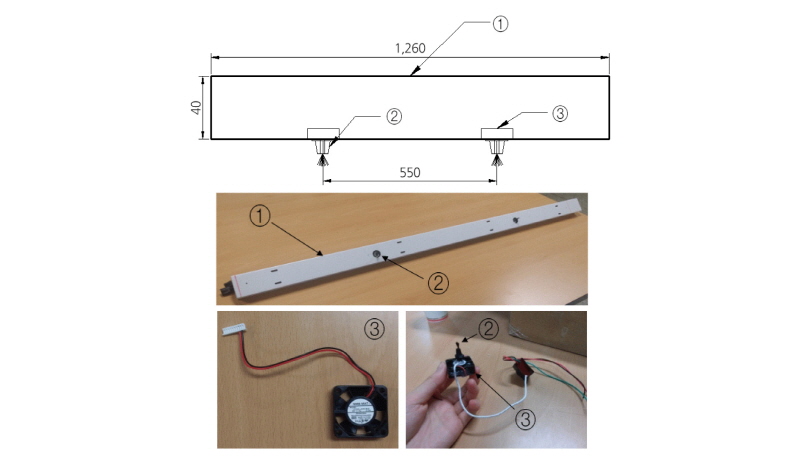
The anion generation system was made with dimensions of 1,260 × 60 × 40 mm (L × W × H) and two anion generators were installed per anion generation system. The distance between the anion generators was set to 550 mm. The fan (1204KL-04W-B40, Minebea Moter, Japan) with a blowing rate of 0.046 m3·min-1 and an air velocity of 0.27 m·s-1 was installed behind the anion generator (Fig. 1) to smoothly supply the anion to the lettuce.
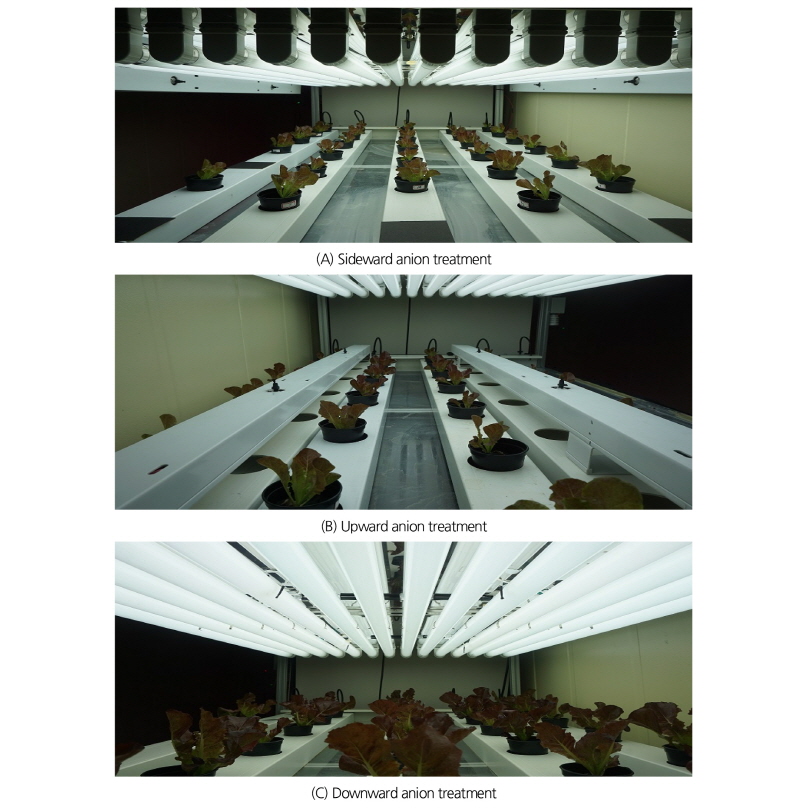
As shown in Fig. 2, two anion generation systems were installed in each 1,300 × 450 mm culture bed. The anion generation position was set to three conditions: sideward (A), upward (B), and downward (C). The distance between the bed and the anion generator was set to 200 mm for the sideward and downward anion conditions.
The anion concentrations were measured using an air anion counter (COM-3200 PRO, COM System Inc., Japan) according to the position of each anion generation system. Since anions are lighter than the air, differences in air flow can cause very high deviation or measurement errors. Therefore the power to the fan in the closed-type plant factory was cut off just before the anion concentration was measured to block the flow of air as much as possible. The culture bed was divided into 9 equally sized sections and the anion concentrations were measured at the center of each section and expressed as the average value.
Analysis of Growth Characteristics for Lettuce
Growth characteristics of lettuce were measured at 21 days (3 weeks) and 28 days (4 weeks) after seedlings were transplanted into the factory system. The leaf length, leaf width, fresh weight, dry weight, leaf area, SPAD, antioxidant ability and total phenolic content were measured. For the leaf length and width measurements, the longest and widest parts of the third leaf from the growth point were measured using vernier calipers (CD-15CP, Mitutoyo, Kanagawa, Japan). The fresh shoot weight of lettuce leaves was measured with electronic scales (HF-200GD, And, Tokyo, Japan). The shoot dry weight was measured with electronic scales after drying for 72 h at of 70°C in a dry oven (OF-11E, JeioTech, Korea). The leaf area was measured by placing the leaves of decomposed lettuce in a leaf area meter (LI-3100C, LI-Cor, Lincoln, USA) and the average of 3 measurements calculated. To measure the SPAD, the third leaf from the growing point was placed in a chlorophyll meter (SPAD-502, Konica Minolta, Japan) and the average value of 5 measurements calculated.
Measurement of Antioxidant Capacity and Total Phenolic Content
About 0.2 g of the third leaf from the growth point was sampled and stored in a deep freezer (NF-300SF, Nihon Freezer Co. Ltd., Tokyo, Japan) at -70°C. After extraction with Folin & Ciocalteu's phenol reagent and 2,2'-azino-bis (3-ethylbenzothiazoline-6-sulfonic acid) diammonium salt reagent, a spectrophotometer (UV-1800, Shimadzu, Japan) was used to measure absorbance for antioxidant capacity and total phenolic content at 730 nm and 765 nm, respectively. (Lee et al., 2013).
Statistical Analysis
Statistical analysis was performed using SPSS (Statistical Package for the Social Sciences, IBM, USA) statistical program. Duncan's one-way ANOVA was used to analyze the significance according to the anion generation position at significance level 0.05.
Results
Anion Concentration According to Generation Position
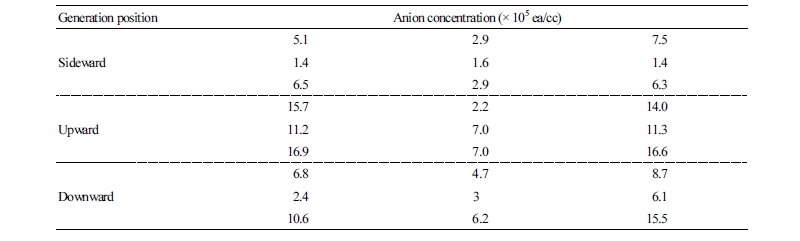
Table 1 shows the anion concentrations measured in the 9 sections of the bed according to the position of anion generation. The anion concentration in the upward position was highest with an average of 11.3 × 10⁵ ea/cc, compared to 4.0 × 10⁵ ea/ccand 7.1 × 10⁵ ea/cc for the sideward and downward conditions, respectively. In the control condition where there was no anion treatment the anion concentration was measured to be about 70 ea/cc.
Leaf Length and Leaf Width
The lengths of lettuce leaves at 3 and 4 weeks were different under the various experimental conditions (Fig. 3).
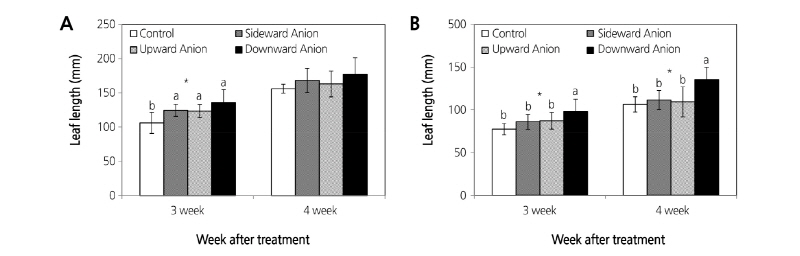
Fig. 3. (A) Leaf length of lettuce according to generation position of air anion in fluorescent light. The data are the averages and the bars indicate standard errors (n = 3). Significant at * p ≤ 0.05. (B) Leaf width of lettuce according to generation position of air anion in fluorescent light. The data are the averages and the bars indicate standard errors (n = 3). Significant at *p ≤ 0.05.
The average leaf length after 3 weeks was 111.13 mm for the control, 120.34 mm for the sideward anion condition, and 118.91 and 127.55 mm for the upward and downward anion conditions, respectively (Fig. 3A). In this way, the anion-treated lettuce had a tendency to grow more than the control, with the plants grown in the downward anion condition having the longest leaves. A similar tendency was observed at 4 weeks, with average leaf lengths of 158.68 mm for the control, and 163.28 mm, 163.22 mm and 184.41 mm for the sideward, upward and downward anion conditions, respectively. Overall, the growth rate of lettuce treated with anions was 2.8-14% higher than that of the control plants.
As shown in Fig. 3B, the average leaf width at 3 weeks was 77.19 mm in the control plants compared with 85.77 mm, 86.99 mm and 97.95 mm in the plants grown in sideward, upward and downward anion conditions, respectively. The average leaf width at 4 weeks was 106.25 mm for the control and 111.38 mm, 109.15 and 135.36 mm for the sideward, upward and downward anion conditions, respectively. As shown above, leaf width was about 4.6-21.5% greater for plants grown in the sideward anion and downward anion conditions than in the control plants.
Shoot Fresh Weight
At 3 weeks there was no significant difference in the shoot fresh weight of lettuce grown with anion treatment compared with the control plants (24.12, 25.04, 22.78, and 29.03 g/plant for the control, and sideward, upward and downward anion conditions, respectively). At 4 weeks, there were differences in the fresh weight between the experimental conditions, but these differences were not statistically significant (Fig. 4). At 4 weeks, the average shoot fresh weights were 58.46 g/plant in the control and 62.52, 65.70 and 93.00 g/plant in the sideward anion, upward and downward anion conditions, respectively. Overall, the plants grown in anion generation conditions had fresh weights that were of 6.5-37.1% higher than the control.

Shoot Dry Weight
At 3 weeks, there was a slight difference in average shoot dry weight under the different experimental conditions (1.27, 1.33, 1.22 and 1.57 g/plant in the control, and sideward, upward and downward anion conditions, respectively). At 4 weeks, there was a difference in plant growth depending on anion generation and generation position (Fig. 5). The average shoot dry weights were 2.91, 3.18, 3.27 and 4.16 g/plant in the control, and sideward, upward and downward anion conditions, respectively.

Leaf Area
Fig. 6 compares the average leaf area of lettuce grown under the various experimental conditions. At 3 weeks, no significant differences was observed in average leaf area (541.71 cm2/plant for the control, and 602.83, 553.70 and 658.96 cm2/plant for the sideward, upward and downward anion conditions, respectively). At 4 weeks, the plants grown with anion treatment had larger average leaf areas (1467.97, 1449.94, 1809.78 cm2/plant for the sideward, upward and downward conditions) than the control plants (1249.91 cm2/plant). The plants grown in the downward anion condition had the largest average leaf area.

Chlorophyll Content
Fig. 7 compares average chlorophyll content of lettuce according to the anion generation position. At 3 weeks, the average SPAD value was measured as 20.7 for the control, and 20.0, 21.6 and 22.3 for the sideward, upward and downward anion conditions, respectively. The plants grown under the downward anion condition tended to have SPAD values that were 0.7-2.3 higher than the other conditions. At 4 weeks, the average SPAD value was 21.2 for the control, which represents a 0.5 increase over the value at 21 day. The average SPAD values were 18.7, 19.3 and 19.5 in the sideward, upward and downward anion conditions, respectively, which represent decreases of 1.3, 2.3, and 2.8, respectively, since 21 days.

Antioxidant Ability
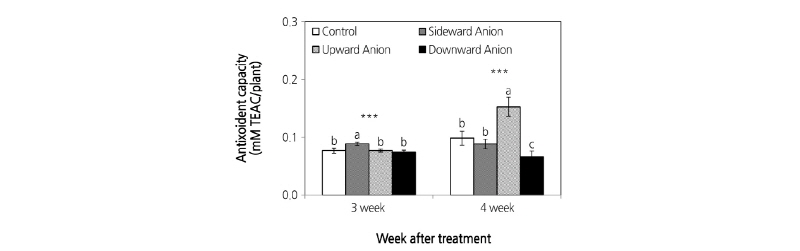
There were no significant differences in antioxidant capacity of lettuces between the various experimental conditions (Fig. 8). However, at 4 weeks the antioxidant capacity tended to be higher than at 3 weeks in all the conditions except the downward anion condition. At 3 weeks the values were 0.077 mM Trolox Equivalent Antioxidant Capacity (TEAC) per plant in the control condition, and 0.089, 0.077, and 0.074 mM TEAC/plant for the sideward, upward and downward anion conditions, respectively. The antioxidant capacity in the control and upward condition at 4 weeks was 0.099 and 0.153 mM TEAC/plant, respectively. This is an increase of 0.022 mM and 0.079 mM TEAC/plant, respectively, compared with the value at 3 weeks. The antioxidant capacity in the sideward anion side condition at 4 weeks was 0.089 mM TEAC/plant, which is no different from the value at 3 weeks. For the downward anion condition, the value was 0.066 mM TEAC/plant at 4 weeks, which showed a tendency to decrease by 0.008 mM TEAC/plant compared with 3 weeks.
Total Phenolic Content
The total phenolic content of lettuce according to the position of generation from the fluorescent light source is shown in Fig. 9. The total phenolic content at 3 weeks was 0.266, 0.249, and 0.257 mg Gallic Acid Equivalents (GAE) pre plant for the control, and sideward and upward anion conditions, respectively. On the other hand, total phenolic content of the plants grown in the downward anion condition was slightly lower compared with the other conditions (0.234 mg GAE/plant). The total phenolic content at 4 weeks was measured as 0.313, 0.262, 0.383 mg GAE/plant for the control, sideward anion, and upward conditions, respectively, representing increases of 0.047, 0.013, and 0.126 mg GAE/plant compared with the values at 3 weeks.

Discussion
In this study, the average anion concentrations measured in the plant factories were different according to the position of the anion generator. The upward anion condition produced the highest anion concentration and the sideward anion condition produced the lowest anion concentration. Anion concentration decreases further away from an anion generator (Song, 2014). The differences in anion concentration observed in this study are thought to be due to differences in the distances from the anion generators. As shown in Table 1, the anion concentration of sideward anion condition expressed the distribution of low anion concentration such as the low anion concentration in the middle bed of far distance from the anion generator, in this results, average anion concentration was lower than other anion conditions. The upward and the downward anion conditions had similar anion distributions, but the average anion concentration in the upward anion condition was higher because the anion generators were positioned closer to the culture bed than they were in the downward anion condition.
The growth characteristics of lettuce were affected by the position of anion generation. The measured values were higher in the anion generation conditions compared with the control, with the downward anion condition producing the highest values for several growth characteristics such as leaf length, leaf width, shoot fresh weight, shoot dry weight and leaf area.
These results are consistent with previous studies showing that the dry weight of barley and Antirrhinum majus exposed to air anions increased compared to untreated plants (Elkiey et al., 1985) and that air anions have an effect on the shoot fresh weight of lettuce (Song et al., 2015). The growth-enhancing effect of anion generators appears to be due to the fact that photosynthesis and respiration are accelerated by air anions (Song, 2014).
Moreover, the anion concentration observed in the downward anion condition is concluded to be most suitable for promoting the growth of lettuce. The anion concentration was highest in the upward anion condition, but the downward anion condition was the most effective at promoting the growth of lettuce. Song (2014) reported that air anion treatment of a medium concentration (7 × 10⁵-12 × 105 ion/cm3) promoted lettuce growth better than a lower concentration (1 × 10⁵-5 × 10⁵ ion/cm3) or a higher concentration (15 × 105-20 × 105 ion/cm3). Thus, because the anion concentration of downward anion condition was optimum for growth of lettuce, the downward position may have the highest value in lettuce production.
On the other hand, the reason the antioxidant capacity and the total phenolic content of lettuce in the downward anion condition were lower than in the other conditions was that these lettuces had the highest leaf area. The tendency of decreasing functional material according to the degree of growth was similar to the results of Lee et al. (2011).
This study demonstrates that the position of anion generators and the anion concentration in plant factories must be controlled according to the purpose of growing the plants. For example, the downward generation position may be used to maximize the size of the plants, and the sideward generation position may be used to increase the antioxidant capacity and total phenolic content. Moreover, when an anion generator is installed in a plant factory, it is necessary to consider the anion distribution in the culture bed and the distance between anion generators to optimize the anion concentration for the plants.
