

Introduction
Materials and Methods
Plant Materials and Culture
Data Collection and Analysis for Nutrients in Growing Media and Leaf Tissues
Data Analysis
Results
Growth and Flowering Response of Salvia
Comparison of Nutrients in Growing Media
Discussion
Introduction
Previous investigations have evaluated whether various pellets containing poultry feather fibers could be used as an additive to commercial growing medium for floral and ornamental crops (Evans, 2004; Roh, 2013; Roh et al., 2012a, b, c). Traditionally, growing medium was composed of soil, sand, perlite (PL), and peat moss (PM) prior to the introduction of peat-lite soilless medium (Boodley and Sheldrake, 1984). The peat-lite medium has been widely used to grow seedlings in plugs and potted floral plants (Martinez et al., 2001; Oezguemues et al., 1997).
Among many types of pellets, pellet 45 (P45) processed with 30% feather keratin fibers and 0% glycerol (Roh et al., 2012a) is a good inert material if a slow release fertilizer is supplemented to the growing medium for cultivating Begonia boliviensis A. DC. ‘Bonfire’ and Lilium hybrids (Roh et al., 2012b; Roh and Huda, 2014). Additional supplement of a slow release fertilizer is necessary because the P45 is low in nitrogen, phosphorus, potassium, and calcium (Roh et al., 2012b). Other types of pellets containing 20% glycerol and 50% feather keratin fibers are not recommended due to the high soluble salt and nitrogen concentrations (Roh et al., 2012a, b; Roh, 2013).
However, the effect of replacing PL, which is considered as a “nuisance dust” (Maxin et al., 2014) with pellets in soilless media has not been evaluated yet. If adequate nutrients from pellets can be released and act like a slow release fertilizer, it will benefit the growth of young seedlings upon transplanting. Nitrogen can be released from white feather keratin in the first five weeks following steam hydrolysis and treatment with Bacillus licheniformis (Choi and Nelson, 1996a, b). Nitrogen concentration in leaves of tomato (Lycopersicon esculentum Mill) grown in a container containing feather fibers is reported to be higher than that grown in plastic pot or peat pots (Evans and Hensley, 2004). However, nitrogen fertilizer is needed at later stages for growth and development in Begonia ‘Bornfire’ (Roh et al., 2012b). Other types of pellets containing 20% glycerol and 50% feather keratin fibers are not recommended due to their high soluble salts and nitrogen concentrations (Roh et al., 2012a, b; Roh, 2013).
Although PM can be replaced with composted dairy cow manure (Bannister et al., 2013), coconut fiber, and wood substrates including bark (Arenas et al., 2002; Holman et al., 2013; Robbins and Evans, 2015), rice hulls, saw dust, or spent mushroom compost (Roh and Wilkins, 1975; Roh and Wilkins, 1976) have been tested. The choices for inorganic materials to substitute PL are limited to pumice and other types of volcanic rocks that lack uniformity. Therefore, pellet 45-1 (P45-1) processed with 30% shredded feather fibers, or pellet 45-2 (P45-2) processed with 20% powdered and 10% shredded feather fibers was mixed with PM at various ratios to study the feasibility of replacing PL to grow salvia (Salvia splendens ‘Vista Red’) for marketing as a edding plant. The growth and flowering response of salvia were evaluated, and nutrients in growing media, leachates from the growing media and leaf tissues were analyzed to formulate the optimal growing media composed of PM and P45-1 or P45-2 for salvia.
Current Status of Genome Sequencing in Vegetable Crops
Plant Materials and Culture
Salvia ‘Vista Red’ (Ball Horticultural Co., Chicago, IL, USA) seeds were sown in 105-cell plug trays filled with growing medium composed of coco peat processed from coconut husks (64.8%), PM (15%), zeolite (7%), PL (10%), dolomite (2.6%), wetting agent (0.03%), and 14N-7P-13K fertilizer (0.47%) (Biosangto®, Dongbu Farm Hannong, Co., Ltd, Seoul, Korea) on March 20, 2014. Trays were placed in a greenhouse maintained at 25/15°C day (06 : 00 - 20 : 00 h)/night (20 : 00 - 06 : 00 h), and were irrigated twice a day with tap water at 09 : 00 and 15 : 00 h.
On May 12, 2014, 6 cm tall seedlings with six developed leaves were transplanted into 10 cm pots (9 cm tall, 0.3 L) filled with individual growing medium of Biosangto®, PM, PL, P45-1, or P45-2 or growing media composed of PM and PL (PM:PL), PM and P45-1(PM:P45-1), or PM and P45-2 (PM:P45-2) at ratios of 0 : 1, 1 : 0, 1 : 1, 1 : 2, 2 : 1, 1 : 3, or 3 : 1 (v/v). The PM used was Pindstrup Sphagnum Peat moss (pH 5.5 - 6.0, treated with 100 mL wetting agent, 50 g micro fertilizer per m3, Pindstrup Mosebrug A/S, Denmark), and the PL used was Parat (1 - 5 mm in diameter, Kyungdongone Co. Ltd, Korea). P45-1 and P45-2 (4 - 5 mm in diameter, Feather Fiber Corporation, Nixa, MO., USA) were processed with powdered and shredded forms of feather fibers, respectively. In addition, P45-1 and P45-2 contained 10% Epolene® E-43 (MAGP, Westlake Chemical Co., Houston, TX, USA) and 59.7- 60% polypropylene (Pro-Fax PH920S, Basell Polyolefins, Elkton, MD,USA) (Roh et al., 2012a).
Slow release fertilizer (Osmocote; 15N:4.3P:7.4K+2MgO+TE, Everris International B.B., Geldermalsen, Netherlands, http://www.everris.com/Files/MSDS/en/87000225.pdf; accessed on June 19) at 3 g per pot was applied to the surface of all media seven days after transplanting. There were 10 plants per treatment, with each plant serving as an experiment unit, and all pots were completely randomized during the greenhouse experiment. The seedlings were cultured in a greenhouse maintained at 25/20°C day/night, and were irrigated twice a day with tap water. Starting on June 1, a shade cloth was applied to reduce the light irradiance by 50%.
Data Collection and Analysis for Nutrients in Growing Media and Leaf Tissues
The number of days to flowering from transplanting seedlings was counted at anthesis of the first floret. Eight weeks after potting, the number of florets and leaves were counted, and plant height and inflorescence length were measured. Plant height was measured from the surface of the growing medium to the tip of the inflorescence. Plants were harvested to collect the fresh weight of florets, leaves, and roots.
Eight weeks after potting, Biosangto® and growing media of PM mixed with PL, P45-1, or P45-2 was sampled from the midportion where the root mass was distributed and air-dried for four days. Leaf samples from the middle of the main and lateral shoots were collected, dried at 65°C for 48 h, and ground with a mortar and pestle. For nutrient analysis of growing media and leaf tissues, samples were sent to J.R. Peters Laboratory (Allentown, PA, USA). Analyses of samples were performed in duplicate.
Analyses for acidity (pH), electrical conductivity (EC), ammonium-nitrogen (NH4-N), nitrate-nitrogen (NO3-N), phosphorus (P), potassium (K), calcium (Ca), magnesium (Mg), sulfur (S), boron (B), iron (Fe), manganese (Mn), copper (Cu), and zinc (Zn) were performed as described by Roh et al. (2012a). Recommended rates for pH, EC, and nutrients followed the suggested ranges established by J.R. Peters Inc. as described in detail (Kim et al., 2017).
Data Analysis
Data on the growth and flowering and nutrient content of media and leaf tissues were subjected to the analysis of variance (ANOVA) using IBM SPSS Statistics for Windows (Version 20.0 software, IBM Corp., 2011). Growing media of PM:PL, PM:P45-1, and PM:P45-2 and various mixing ratios (Table 1) were includedas variables in two-way analysis. All means excluding Biosangto® were compared by Duncan’s Multiple Range Test at p < 0.05. .
Results
Growth and Flowering Response of Salvia
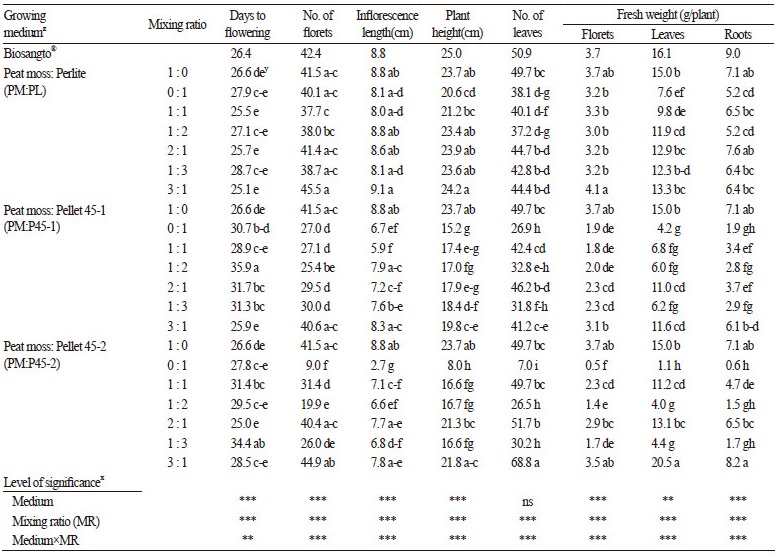
When salvia ‘Vista Red’ was grown in the individual growing medium PM, PL, P45-1, and P45-2 without mixing with PM, it took between 26.6 (PM:PL/1:0) and 30.7 days to flower (PM:P45-1/0:1), which was not significantly different from each other. (Table 1). Flowering was delayed for plants grown in media composed of PM mixed with pellet 45-1at PM:P45-1/1:2 (35.9 days), and PM:P45-1/1:3 (31.3 days), or pellet 45-2 at PM:P45-2/1:1 (31.4 days) and PM:P45-2/1:3 (34.4 days) mixing ratios. Flowering was the earliest when plants were grown in PM:P45-1/3:1 (25.9 days) and PM:P45-2/2:1 media (25.0 days) among PM:P45-1 and PM:P45-2.
The number of florets on plants grown in PM:P45-2/0:1 (9 florets), PM:P45-1/0:1 (27 florets), or PM:P45-1/1:1 (27.7 florets) were reduced as compared with the numbers (> 40 florets) on plants grown in individual growing medium Biosangto®, PM, or PL. If grown in PM:PL medium, the number of florets per plant was greater than 45.4 in PM:PL/3:1. If grown in PM:P45-1 media, the number of florets did not differ significantly among the different mixing ratios except PM:P45-1/3:1 (40.6 florets) and individual growing medium PM (41.5 florets) (Fig. 1). However, the number of florets on plants grown in PM:P45-2/3:1 (44.9 florets) was significantly higher than the other growth conditions, even when compared to the number of florets on plants grown in PM:P45-2/1:2 or PM:P45-2/1:3 that produced 19.9 an 26.0 florets, respectively, and the number of florets were higher were compared to that of plants grown in individual growing medium P45-2 medium (Table 1).
Fig. 1.
Appearance of salvia ‘Vista Red’ eight weeks after transplanting seedlings to individual growing medium Biosangto®, Peat moss (PM), perlite (PL), pellet 45-1 (P45-1), or pellet 45-2 (P45-2)(A) and PM media mixed with PL (B), P45-1 (C), or P45-2 (D) at 1 : 1, 1 : 2, 2:1, 1 : 3, or 3 : 1 mixing ratios (v/v).
When salvia plants were grown in PM:PL media, the length of inflorescences were 8.0 - 9.1 cm, which did not differ significantly (Table 1). When plants were grown in individual P45-1or PM:P45-1/1:1 inflorescence length was significantly shorter, 6.7 cm and 5.9 cm, respectively than those when grown at PM:P45-1 at all other mixing ratios In individual PM:P45-2, the length of inflorescence was 2.7 cm which was significantly shorter than in growing medium PM:P45-2 at all mixing ratios.
The height of plant grown in individual growing medium PM was 23.7 cm, which was significantly taller than when plants were grown in P45-2 (8.0 cm), P45-1 (15.2 cm), PM:P45-1, and PM:P45-2 media of all mixing ratios, ranged from 16.6 cm to 21.3 cm (Table 1). Among the media mixed with PM and pellets, the height of plants grown in PM:P45-2/2:1 or /3:1 was greater (21.3 cm) compared to height of plants grown in other mixing ratios. The number of leaves showed a similar trend to the number of florets. Plant grown in PM:P45-2/3:1 had significantly more leaves than plants grown in the other media (Table 1, Fig. 1).
The fresh weight of florets, leaves, and roots of plants grown in individual growing medium P45-1 or P45-2 were significantly lower compared to those grown in individual growing medium PM (Table 1). The fresh weight of florets grown in individual growing medium PM, PM:PL/3:1, and PM:P45-2/3:1 ranged from 3.5 to 4.1g, which was significantly greater compared to the weight of florets in other treatments (0.5 - 3.2 g). In addition, the fresh weight of leaves and roots was the greatest in PM:P45- 2/3:1
Comparison of Nutrients in Growing Media
When individual growing medium were analyzed eight weeks after potting, the pH varied from 6.0 (Biosangto®) to 6.4 (P45- 2) (Table 2). The pH of PM:P45-2/1:3 was 6.8, which was significantly higher than that of all other media. The pH values of all other media mixed with PM and PL, P45-1, or P45-2 was lower than 6.6 (PM:P45-2/1:2) (Table 2).
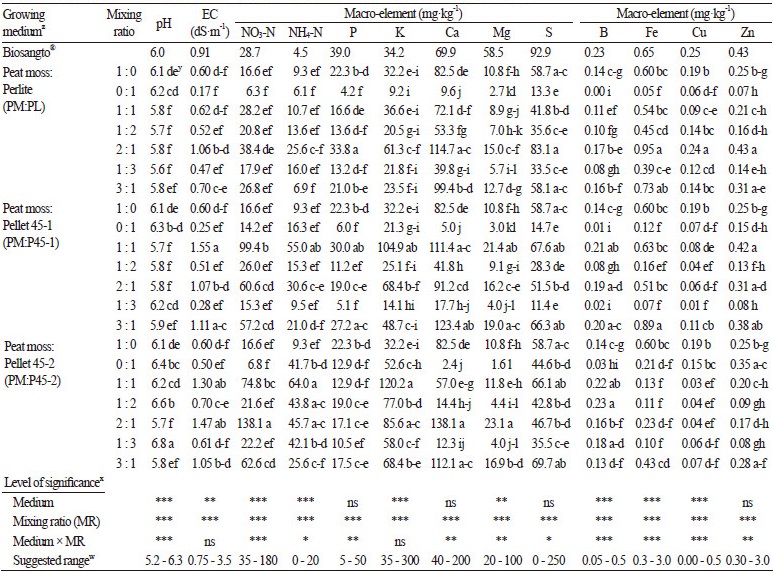
The EC levels of PL (0.17 dS· m-1), P45-1 (0.25 dS· m-1), P45-2 (0.50 dS· m-1), and PM (0.60 dS· m-1) were significantly ( p < 0.05) different from each other (Table 2). The EC levels ranged from 0.47 to 1.06 dS· m-1 for PM:PL at various mixing ratios. In PM: P45-1 or PM:P45-2 media, the EC levels ranged from 0.28 to 1.55 dS· m-1 or from 0.61 to 1.47 dS· m-1, respectively. The EC level of PM:P45-1/1:1 (1.55 dS· m-1) was the highest.
The concentrations of NO3-N varied from 6.3 mg·kg-1 in PL to 14.2 mg·kg-1 P45-1 in individual growing medium (Table 2). The highest NO3-N concentration (138.1 mg·kg-1) in PM:P45-2/2:1. The concentration of NH4-N was the highest (41.7 mg·kg-1) when plants were grown in individual growing medium P45-2, which was significantly higher than the level in P45-1 (16.3 mg·kg-1). The concentrations of phosphorus (P), calcium (Ca), boron (B), iron (Fe), and copper (Cu) in individual growing medium PL, P45-1, or P45-2 medium were significantly ( p < 0.05) lower than those in PM. However, the concentration of potassium (K) was the highest (52.6 mg·kg-1) in individual growing medium P45-2.
The height of plant grown in individual growing medium PM was 23.7 cm, which was significantly taller than when plants were grown in P45-2 (8.0 cm), P45-1 (15.2 cm), PM:P45-1, and PM:P45-2 media of all mixing ratios, ranged from 16.6 cm to 21.3 cm (Table 1). Among the media mixed with PM and pellets, the height of plants grown in PM:P45-2/2:1 or /3:1 was greater (21.3 cm) compared to height of plants grown in other mixing ratios. The number of leaves showed a similar trend to the number of florets. Plant grown in PM:P45-2/3:1 had significantly more leaves than plants grown in the other media (Table 1, Fig. 1).
The concentrations of NO3-N, NH4-N, P, K, Ca, Mg, and S in the growing media mixes PM:PL/2:1, PM:P45-1/2:1, or PM:P45- 2/2:1 were significantly higher than thosein PM, PL, P45-1, or P45-2 (Table 2). Based on the recommended nutrient ranges, the concentration of NH4-N was in the acceptable range of 0 - 20 mg·kg-1, although P concentrationsin P45-1 and PM:P45-1/1:3 were less than 6 mg·kg-1. The concentration of Kwas higher in PM mixed with P45-2 than in PM mixed with PL or P45-1. Potassium concentration in PM:P45-2/1:1 was 120.1 mg·kg-1, which was the highest, followed by 104.9 mg·kg-1 in PM:P45-1/1:1.
The concentrations of Ca, Mg, S, Fe, and Zn were lower when the ratios of PL, P45-1, or P54-2 mixed with PM were higher than that of PM. In particular, Ca concentrations were maintained at the suggested range (40 - 200 mg·kg-1) at 1 : 1, 2 : 1, and 3 : 1 in PM:PL, PM:P45-1, or PM:P45-2 (Table 2). The concentration of B was significantly lower in PL, P45-1, P45-2, and PM:P45- 1/1:3 than that of suggested range (0.05 - 0.5 mg·kg-1).
Nutrient Concentration in Saliva Leaf Tissue
When salvia was grown in different growing media, the concentration of total nitrogen (N) in leaf tissue of plants grown in individual growing medium PM (4.7%) and PL (4.9%) was the lowest, which was significantly lower than that of plants grown in P45-1, P45-2, PM:PL/2:1, PM:PL/3:1, PM:P45-1/3:1, PM:P45-2/1:1, and PM:P45-2/2:1 (Table 3). The N concentration in PM:P45-2/2:1 was 7.5%, which was higher than the suggested upper limit (5.5%). The concentration of P in leaf tissue was the lowest in plants grown in individual growing medium P45-1 or P45-2, and significantly higher in Biosangto®, PM, PM:PL, PM:P45-1/2:1, PM:P45-1/3:1, and PM:P45-1 than other media. The concentration of K was the lowest in leaf tissue grown in P45-2, which was significantly lower ( p < 0.05) than plants grown in other media. The concentration of Ca was the lowest (1.1%) in leaf tissue from plants grown in individual growing medium P45-1 or P45-2, and higher in media with high ratioof PM mixed with PL, P45-1, or P45-2 (Table 3).
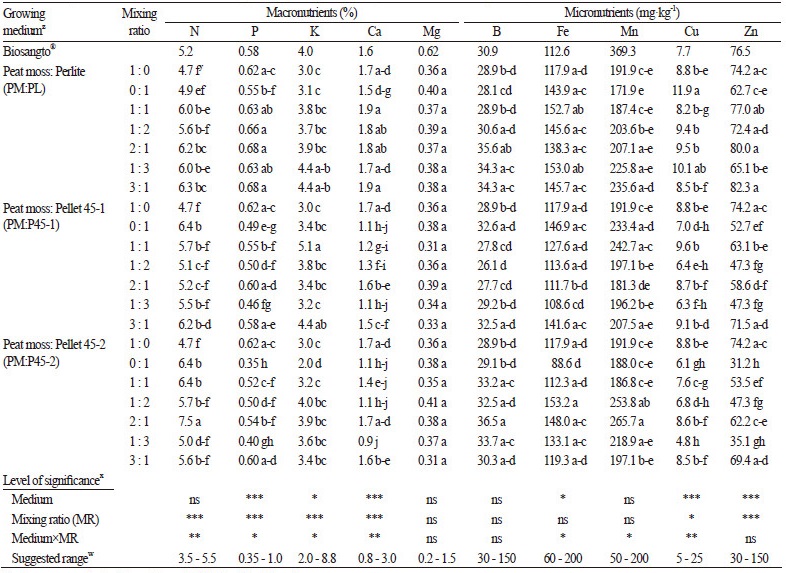
In the leaf tissues, the concentrations of Mg, ranging from 0.31 mg·kg-1 (PM:P45-1/1:1 and PM:P45-3/3:1) to 0.41mg·kg-1 (PM:P45-2/1:2) which were within the suggested ranges (0.2 - 1.5 mg·kg-1 ) and B, ranging from 26.1 mg·kg-1 (PM:P45-1/1:1) to 36.5 mg·kg-1 (PM:P45-2/2:1) which were slightly higher than the lower range of suggested range (30 - 150 mg·kg-1 ) did not differ significantly in all medium, mixing ratio, and medium×mixing ratio (Table 3). The concentrations of Zn, ranging from 65.1 to 82.3 mg·kg-1 in PM:PL, ranging from 47.3 to 71.5 mg·kg-1 in PM:P45-1 or from 35.1 to 69.4 mg·kg-1 in PM:P45-2 were within the suggested ranges. The concentrations of Fe and Mn were the lowest in leaf tissue from plants grown in P45-2 and PL, respectively, and there was no significant difference by mixing ratios (Table 3). For nutrients in leaf tissues, the concentrations of P, K, Ca, Mg, Fe,Cu, and Zn in all media were within the suggested ranges.
Discussion
Although flowering of salvia grown in individual growing medium P45-2 was not different from the flowering of plants in other media, a lower number of florets in individual growing medium P45-2 or P45-1 suggest that these two pellets were not suitable when used alone without mixing with PM to use as a growing medium. When P45, which is similar to the P45-1 used in this study, were mixed with commercial soilless growing medium and supplemented with a slow-release fertilizer, was reported to be suitable for growing floral crops such as Begonia ‘Bonfire’(Roh et al., 2012b), Lilium hybrids (Roh, 2013), and Platycodon hybrid (Kim et al., 2017). However, the length of inflorescence, plant height, number of leaves, and other parameters observed in this study are inhibited, indicating that P45-1 and P45-2 are definitely not suitable to use alone as growing media.
The cause of the poor growth of salvia could be due to an initial high pH (> 8.3) of dry P45-1 and P45-2 (Kim et al., 2017), which can affect early growth after seedlings are transplanted. More than 79% of the tiger lily (Lilium lancifolium Thunb.) does not survive and failed to reach anthesis if they are treated with a buffer adjusted to pH 8 and 9 for eight weeks (Roh, 1979).
However, at the end of this experiment, the pH of P45-1 and P45-2 is 6.4, which is considered an optimum level for most ornamental crops (JR Peters Inc., Allentown, PA, USA), including eustoma (Eustoma grandiflorum Shinn), commonly known as lisianthus (Roh and Lawson, 1984; Harbaugh and Woltz, 1991), Salvia farinacea Benth., ‘Victoria Blue’ salvia (Kelly and Crouse, 2015), tuberous begonia (Begonia boliviensis A. DC.), and hybrid lilies (Roh et al., 2012b; Roh, 2013). Therefore, if these pellets are used, adjusting pH is required, similar to what is reported for PM (Boodley and Sheldrake, 1982) for an optimum growth of seedlings immediately upon transplanting. The inferior growth and high N concentration in leaf tissue is attributed to the initial high pH (8.3 - 8.5) and NH4-N concentration (138 - 178 mg·kg-1) in individual growing medium of P45-1 and P45-2 upon transplanting seedlings. Thus, high concentrations of NH4-N can be corrected by leaching the medium 10 days after transplanting the seedlings (Kim et al., 2017).
Although the initial K concentration in individual growing medium P45-1 was high (315 mg·kg-1) (Kim et al., 2017), K concentration is lower eight weeks after transplanting seedlings as compared to that recommended range for ornamental plants (JR Peters Inc., Allentown, PA, USA). In general, the difference in the concentration of most major and minor elements between individual growing medium PL and P45-1 or P45-2 is not significant; however, the concentration of NO3-N, Ca, Mg, B, and Fe is lower than the suggested low limit ranges eight weeks after transplanting seedlings. In addition, concentrations of NH4-N, K, P, and Zn in P45-2 are maintained higher than the low limit of their suggested range (JR Peters Inc., Allentwon, PA, USA). In Eustoma grandiflorum, Ca concentration in leaf tissue is not affected by pH of the growing medium; however, Ca concentration is increased in plants fertilized with calcium nitrate, which can increase the number of branches and flower buds (Frett et al., 1988). Therefore, individual growing medium such as PL and P45-1 may require additional supplemental macro- and microelements for improved growth and flowering in salvia.
Growth, Flowering Response, and Nutrient Content of Salvia Grown in Peat Moss Media Supplemented with Perlite or Pellets
The P45-1 and P45-2 had low EC, NH4-N and other nutrient concentrations, and are considered as suitable materials to replace PL for young seedlings to grow upon transplanting. Although flowering takes longer for plants grown in PM:P45-1/1:3 or PM:P45-2/1:3 and the number of floretsis reduced in plants grown in PM:P45-2/1:3, flowering acceleration and increased number of florets in plants grown in PM:P45-1/3:1 or PM:P45-2 suggest that P45-1 and P45-2 could replace PL, which is considered as a “nuisance dust” (Maxin et al., 2014). Similar effects on inflorescence length and plant height as well as the number of leaves, and the total weight of florets and leaves are observed in PM media supplemented with PM45 pellets. Therefore, it is clear that P45-1 and P45-2 can be used as substitutes for PL.
The number of flowers and branches in Platycodon grandiflorus was greater in PM mixed with P45-1 and P45-2 than in Biosangto® or other pellets (Kim et al., 2017). Also, the growth and flowering of Begonia boliviens is grown in P45 mixed with Pro Mix BM were more effective compared to other pellets (Roh et al., 2012b). This improved growth is due to maintained pH, EC, and nutrient concentrations that were within the suggested ranges for seedling growth. In this study, based on the pH, EC, and macro- and micro-nutrients concentrations of the media and leaves, mixing three parts PM with 1 part P45-1 (PM:P45- 1/3:1) and P45-2 (PM:P45-2/3:1) is the most suitable ratio for salvia growth and flowering, and is recommended to avoid the reduction of florets, leaves, and plant height in salvia.
If PM:P45-1 or PM:P45-2 media are used as the medium to produce salvia in pots or containers, the use of nitrogen source might be reduced, perhaps at the beginning of the culture. Although Biosangto® has not been tested in floral crops except platycodon (Kim et al., 2017), the effects of PM:P45-1 and PM:45-2 growing media on growth, and flowering can be comparable to that of Biosangto®. Choi and Nelson (1996a, 1996b) have suggested that nitrogen could be released from the feather fibers following hydrolysis or microbial activities, which was shown with P32 pellets (Roh et al., 2012a, 2012b). The N concentration in leaf tissue of plants grown in PM:P45-1/3:1 and PM:P45-2/3:1 was 0.1 - 0.7% higher than the upper limit (5.5%) of the suggested range (JR Peters Inc., Allentown, PA, USA) eight weeks after transplanting seedlings. If nitrogen concentration is maintained at a level higher than this upper limit, liquid fertilizer such as potassium chloride or calcium sulfate could be used instead of potassium nitrate or calcium nitrate. Incorporating calcium sulfate instead of calcium nitrate to prepare mixes before planting (Boodley and Sheldrake,1982) can have a beneficial effect to correct growth reduction in corn (Zea mays L.).
In conclusion, based on the growth and flowering response as well as nutrient analysis, P45-1 and P45-2 are found to be suitable substitutes for PL. Mixing three parts PM with one part P45-1 or P45-2 by volume is recommended to produce salvia.
