

Introduction
Materials and Methods
Experimental site and greenhouse system
Cultivation system and crop management
Growth stage classification
Fertigation and drainage management
Water-based analysis
Nutrient-based analysis
Results
Seasonal Variations in Solar Radiation
System boundary and framework for the analysis
Input: Stage-based fertigation characteristics
Internal transformation: water-based mass balance after crop uptake
Nutrient-based mass balance according to the stage-based standard nutrient solution composition
Biomass-based mass balance and internal allocation
Integrated material balance structure
Discussion
Water interpretation
Nutrient interpretation
Biomass allocation and asymmetry between water and nutrient balances
Limitations and future research directions
Conclusion
Introduction
Hydroponic cultivation has become a core technology in protected horticulture as it minimizes production variability associated with soil conditions while ensuring high productivity and uniform crop quality (Savvas et al. 2024). Among hydroponically grown crops, tomato (Solanum lycopersicum L.) is widely cultivated in greenhouse systems due to its high yield potential and suitability for long-term production (Heuvelink 2005). Recent advances in hydroponic greenhouse system technologies, including automated climate control, fertigation systems, and sensor-based monitoring, have further emphasized the importance of precise water and nutrient management for improving production efficiency and sustainability (Wang et al. 2024).
In Korea, open hydroponic systems using rockwool substrates are commonly adopted for tomato cultivation (Ahn et al. 2022; Yeo et al. 2023). To prevent salt accumulation in the root zone and to maintain stable crop growth, a fixed proportion of drainage relative to irrigation is typically applied. However, drainage is not merely excess water; it contains significant amounts of nutrients such as nitrate, phosphate, and potassium. Excessive drainage can therefore reduce nutrient use efficiency and contribute to environmental pollution through agricultural effluents (Yeo et al. 2023). Consequently, there is increasing interest in quantitatively evaluating water and nutrient flows in hydroponic systems and assessing their relationships with crop production (Savvas et al. 2023).
The analysis, based on the principle of mass conservation, provides a robust framework for quantifying resource flows in hydroponic cultivation systems (Giannothanasis et al. 2025). This approach enables the systematic tracking of water and nutrients supplied through fertigation; their partitioning into drainage, crop uptake, transpiration, and biomass accumulation; and their eventual losses or storage levels within the system. In particular, water taken up by crops is largely lost through transpiration, with only a small fraction retained in the plant biomass (Stanghellini and van Meurs 1992; Jung et al. 2022). Therefore, integrating a water balance analysis with biomass production is essential for understanding the structural characteristics of resource flows in hydroponic systems. Similarly, the nutrient mass balance, defined by nutrient inputs, drainage losses, and crop uptake followed by biomass allocation, provides fundamental information for optimizing fertigation strategies and reducing nutrient discharge (Incrocci et al. 2017).
Previous studies of hydroponic tomato cultivation have examined evapotranspiration, nutrient uptake, or drainage characteristics separately (Cedeño et al. 2023; Cedeño et al. 2024). However, comprehensive analyses that integrate water, nutrients, and biomass under long-term cultivation conditions and explicitly reflect stage-based fertigation strategies remain limited. Given that water and nutrient demands vary substantially across growth stages, a consistent framework applied at the greenhouse scale is required for an accurate characterization of resource flow dynamics (Sanjuan-Delmás et al. 2020; Fathelrahman et al. 2025; Subedi et al. 2026).
Therefore, the objective of this study was to quantify water-, nutrient-, and biomass-based mass balances in a rockwool-based hydroponic tomato greenhouse over a long-term cultivation period of 240 days. By dividing the cropping cycle into five growth stages and incorporating stage-specific fertigation and drainage practices, this study aimed to systematically elucidate resource flow structures in hydroponic tomato cultivation and provide a quantitative basis for improving fertigation management and resource use efficiency in hydroponic tomato greenhouse systems.
Materials and Methods
Experimental site and greenhouse system
This study was conducted in a rockwool-based hydroponic tomato greenhouse located at the AI demonstration farm of the Korea Institute of Science and Technology (KIST) in Gangneung, Republic of Korea. The greenhouse was equipped with automated systems for climate control, including the air temperature, relative humidity, ventilation, and shading, as well as an automated fertigation system that continuously recorded the irrigation volume, drainage volume, and nutrient solution electrical conductivity (EC) and pH. Tomato cultivation was carried out from August of 2024 to April of 2025 for approximately eight months. The entire cropping cycle from transplanting to crop termination was defined as the whole cropping period and set to 240 days for the analysis. All water, nutrient solution, and biomass flows were quantified on a unit ground area basis (m2).
Cultivation system and crop management
Tomato plants were grown using a drip fertigation system with rockwool substrates. In rockwool-based hydroponic cultivation, irrigation inevitably generates drainage, and controlling the drainage ratio is a common management practice to prevent salt accumulation in the root zone (Incrocci et al. 2017; Savvas and Gruda 2018). The effective cultivation area of the greenhouse was 1,344 m2, and the planting density was set to 2.5 plants·m‒2, resulting in a total of 3,360 plants. Crop management practices followed standard commercial hydroponic tomato production protocols commonly applied in Korea. All irrigation, drainage, yield, and results were converted to a unit area basis (1 m2) for consistency and comparability.
Growth stage classification
The cropping period was divided into five growth stages (Establishment stage - Vegetative growth stage - Flowering and fruit set stage - Harvesting stage - Late stage) based on phenological development and management units in Korean hydroponic tomato cultivation (Heuvelink 2005). This stage classification was used as the basic analytical unit for a stage-based analysis, reflecting differences in irrigation demand, nutrient requirements, and biomass accumulation across the growth stages.
Fertigation and drainage management
The nutrient solution used in this study was supplied through an automated drip fertigation system. Daily irrigation volumes were obtained from operational records of the fertigation system and subsequently aggregated by growth stage for the mass-balance analysis. Drainage was not directly controlled as a fixed proportion of irrigation but rather occurred as an outcome of irrigation management aimed at maintaining root-zone EC stability.
For the seasonal mass-balance analysis, cumulative drainage was approximated as 30% of cumulative irrigation, representing a representative whole-cropping-period proportion used for seasonal accounting rather than a fixed operational target. In commercial hydroponic practice, however, the actual drainage ratio varies with the environmental conditions, particularly the light intensity, and may also increase when additional leaching is applied to the lower root-zone EC. This drainage ratio falls within the range commonly applied in open rockwool-based hydroponic tomato cultivation systems to prevent salt accumulation (Ahn et al. 2022; Savvas et al. 2024; Son 2024). Irrigation and drainage volumes were recorded daily using system log data and aggregated for each growth stage.
Water-based analysis
A water-based analysis was performed according to the principle of mass conservation (Stanghellini and van Meurs 1992; Allen et al. 1998). Total water flows during the cropping period were defined as follows:
where is the total irrigation input (L·m‒2), is the drainage volume (L·m‒2), and represents the crop water uptake (L·m‒2). Crop water uptake was calculated as the difference between irrigation input and drainage:
Absorbed water was further partitioned into transpiration () and water retained in the plant biomass ():
Evaporation from the substrate surface was assumed to be negligible due to the surface covering of the rockwool slabs, as commonly assumed in greenhouse water balance studies (van der Salm et al. 2020).
Nutrient-based analysis
A nutrient-based analysis was conducted by defining the rockwool-based hydroponic tomato greenhouse as an open cultivation system at the unit ground area scale (m2), following the principle of mass conservation (Giannothanasis et al. 2025). The nutrients considered in this analysis were limited to the major macronutrients commonly applied in hydroponic tomato cultivation, specifically nitrogen (N), phosphorus (P), potassium (K), calcium (Ca), magnesium (Mg), and sulfur (S) (Incrocci et al. 2017; Savvas and Gruda 2018).
The system boundary was defined from the point of nutrient solution supply through crop uptake, drainage discharge, and biomass accumulation. Gaseous losses or chemical transformations of nutrients were assumed to be negligible and nutrient flows were therefore described using a closed framework consisting of three components: nutrient input through fertigation (INPUT), nutrient discharge via drainage (DRAINAGE), and nutrient uptake by the crop (UPTAKE).
The stage-based nutrient supply was estimated using a standard nutrient solution formulation for hydroponic tomato cultivation and representative supply EC values for different cultivation phases. The standard formulation was used to define the ionic composition of the supplied solution, and the representative EC values were used to approximate the nutrient input concentrations for a seasonal mass-balance analysis. Because continuous root-zone EC data were not available, these EC values were treated as simplified input conditions rather than actual operational targets. In practice, root-zone EC in rockwool-based hydroponic tomato systems is mainly controlled by adjusting the irrigation volume, irrigation frequency, and drainage, while the supply EC is generally maintained within a relatively stable range. Therefore, the EC-based parameterization in this study should be regarded as a practical approximation for estimating nutrient input rather than a detailed description of fertigation control. In commercial hydroponic practice, however, the supply EC is generally maintained within a relatively stable range, whereas the root-zone EC is mainly regulated by adjusting the irrigation volume, irrigation frequency, and drainage ratio. The baseline ionic composition of the nutrient solution was set as follows: NO3‒ 14.0, NH4+ 1.2, H2PO4‒ 1.5, SO42‒ 2.4, K+ 6.0, Ca2+ 5.0, and Mg2+ 2.5 mmol·L‒1, based on widely used standard formulations for drip fertigation systems (Incrocci et al. 2017).
In this equation, is the input of nutrient at growth stage (g·m‒2), is the concentration of nutrient in the nutrient solution at growth stage (g·L‒1), and is the irrigation volume at growth stage (L·m‒2).
Unlike the supplied nutrient solution, nutrient concentrations in the drainage solution were assumed to differ from those of the irrigation solution owing to selective ion uptake by the crop and ion accumulation in the root zone. In rockwool-based hydroponic tomato cultivation, crop uptake rates differ among nutrients, and ions that are absorbed less actively can accumulate in the substrate solution, resulting in drainage concentrations that are higher or lower than the supplied concentrations. Because continuous measurements of drainage nutrient concentrations were not available in the present study, nutrient discharge through drainage was estimated using representative drainage nutrient concentrations reported in previous studies of open hydroponic tomato cultivation systems. These literature-based values were applied as approximate drainage concentrations for the seasonal mass-balance estimation, and the resulting nutrient discharge should therefore be interpreted as an estimated value rather than a directly measured flux.
Here, is the amount of nutrient discharged through drainage at growth stage (g·m‒2), is the nutrient concentration in the drainage solution (g·L‒1), and represents the drainage volume at growth stage (L·m‒2). Crop nutrient uptake (UPTAKE) was calculated according to the principle of mass conservation as the difference between nutrient input and drainage discharge:
,
where represents the amount of nutrient taken up by the crop at growth stage (g·m‒2). Stage-based nutrient uptake values were accumulated over the entire cropping period to obtain the total nutrient uptake. This approach reflects the fact that nutrient concentrations in irrigation and drainage solutions are not identical in practical hydroponic systems and thus provides a more realistic estimation of nutrient flows under open soilless cultivation conditions.
Results
Seasonal Variations in Solar Radiation
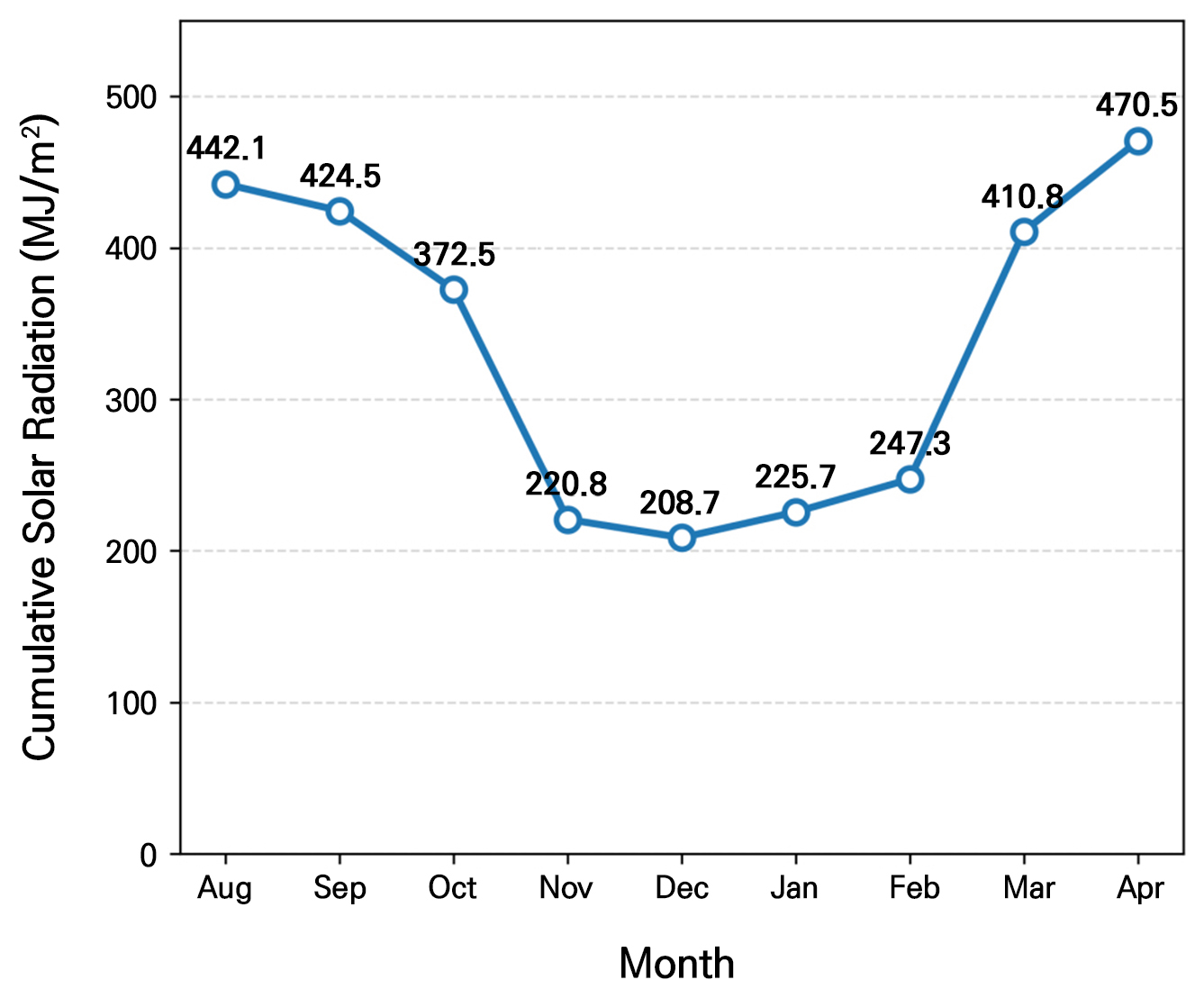
Monthly levels of cumulative solar radiation outside the greenhouse during the cropping period are shown in Fig. 1. Solar radiation gradually decreased from August to December, remained low during winter, and then increased rapidly from February to April. The lowest monthly cumulative radiation was observed in December, whereas the highest value was recorded in April. This seasonal variation in radiation provides the environmental background for interpreting changes in irrigation demand, crop water uptake, and transpiration across the cropping period.
System boundary and framework for the analysis
In this study, the rockwool-based hydroponic tomato greenhouse was defined as an open cultivation system at the unit ground area scale (m2). The mass-balance analysis conducted as part of the study was based on an INPUT–(Internal) TRANSFORMATION–OUTPUT conceptual framework. The primary inputs to the system consisted of water and nutrients supplied in the form of a nutrient solution. Internal transformation occurred through crop uptake and physiological utilization, after which the supplied resources were ultimately partitioned into three output pathways: transpiration, drainage, and biomass accumulation. This framework served as the basis for quantitatively interpreting time-dependent changes in material flows associated with stage-based fertigation strategies.
Input: Stage-based fertigation characteristics
Over the entire cropping period of 240 days, the total irrigation input amounted to 660.0 L·m‒2 on a unit area basis (Table 1). When summarized by cultivation stage, irrigation input was relatively low during the early period and increased during the later stages, with approximately 45% of the cumulative irrigation supplied during the harvesting stage. This increase was primarily associated with the increased canopy size and the seasonal rise in solar radiation toward spring (Fig. 1), rather than being a direct effect of the developmental stage itself. Of the cumulative irrigation input, 198.0 L·m‒2, corresponding to 30% of the total irrigation volume, was estimated as drainage, whereas crop water uptake was estimated at 462.0 L·m‒2 (70%). These values are presented as stage-aggregated seasonal totals for mass-balance accounting and should not be interpreted as indicating that the drainage ratio was determined by the crop growth stage. During actual hydroponic management processes, the drainage ratio varies with the environmental conditions, particularly the light intensity, and with adjustments made to regulate or the lower root-zone EC.
Table 1.
Stage-based irrigation volume, drainage volume, and crop water uptake on a unit area basis and coefficients of stage-specific drainage concentrations
| Growth stage |
Duration (days) | Daily irrigationz (L·m‒2·d‒1) |
Cumulative irrigation (L·m‒2) | Drainage (L·m‒2) | Plant uptake (L·m‒2) | y |
| Establishment | 20 | 1.65 | 33 | 9.9 | 23.1 | 1.20 |
| Vegetative growth | 40 | 2.2 | 88 | 26.4 | 61.6 | 1.25 |
| Flowering & fruit set | 50 | 2.64 | 132 | 39.6 | 92.4 | 1.30 |
| Harvesting stage | 90 | 3.3 | 297 | 89.1 | 207.9 | 1.40 |
| Late stage | 40 | 2.75 | 110 | 33 | 77 | 1.30 |
| Total | 240 | 2.75 | 660 | 198 | 462 | - |
Internal transformation: water-based mass balance after crop uptake
Of the 462.0 L·m‒2 of water taken up by the crop, the majority, 446.6 L·m‒2, was released to the atmosphere through transpiration, while only 15.4 L·m‒2 was retained as water in the plant biomass, corresponding to 3.3% of the absorbed water (Table 2). These results indicate that the hydroponic tomato greenhouse system functioned as a flow-through system with respect to water, where water loss through transpiration was the dominant pathway and water retention in plant biomass represented only a minor component of the overall water balance.
Table 2.
Internal partitioning of crop water uptake over the entire cropping period
| Item | Water amount (L·m‒2) | Proportion of uptake (%) |
| Crop water uptake | 462.0 | 100 |
| Transpiration | 446.6 | 96.7 |
| Water retained in biomass | 15.4 | 3.3 |
Nutrient-based mass balance according to the stage-based standard nutrient solution composition
In this study, the nutrient mass balance was quantified using a standard nutrient solution formulation and representative supply EC values. The formulation defined the ionic composition of the supplied solution, while the EC values were used to approximate nutrient input concentrations for the seasonal mass-balance estimation. These EC values were treated as simplified input conditions rather than precise growth stage-specific operational targets. In practice, supply EC is generally maintained within a relatively stable range, whereas root-zone EC is mainly regulated through irrigation and drainage management.
Although nutrient flows were summarized by growth stage, these values should be interpreted as period-aggregated mass-balance results rather than direct stage-specific effects. Nutrient discharge through drainage was mainly governed by the drainage volume, drainage ratio, and drainage nutrient concentration. Therefore, differences among stages may reflect changes in crop size, irrigation demand, and drainage management rather than the developmental stage itself.
Biomass-based mass balance and internal allocation
Total fresh biomass production amounted to 16.43 kg·m‒2, of which fruits accounted for more than 85% of the total biomass (Table 5). Although the amount of water retained in the plant biomass represented only a minor fraction of the overall water balance, it constitutes the final output of the system from a production perspective and therefore holds critical importance.
Integrated material balance structure
Fig. 2 integrates the quantitative results presented in Tables 1, 2, 3, 4, 5 into a single diagram for the rockwool-based hydroponic tomato greenhouse system. The diagram follows an Input–internal transformation–Output framework: water and nutrients supplied through fertigation (left) enter the system, undergo crop uptake and physiological partitioning (center), and exit via transpiration, drainage, and biomass accumulation (right and bottom). The dominant flux was transpiration, which accounted for 96.7% of absorbed water, whereas drainage removed 30% of the irrigation input along with a disproportionately high fraction of the supplied nutrients (Tables 3 and 4). Biomass accumulation, although a minor component of the water balance, represents the productive output of the system (Table 5). Fig. 2 should be interpreted as a stage-aggregated summary of cumulative material flows rather than as evidence that drainage or water uptake was controlled primarily by the crop growth stage. During the harvesting stage, when irrigation volumes were highest, all material flows reached their maximum values, coinciding with increased solar radiation during the late winter to spring period (Fig. 1).
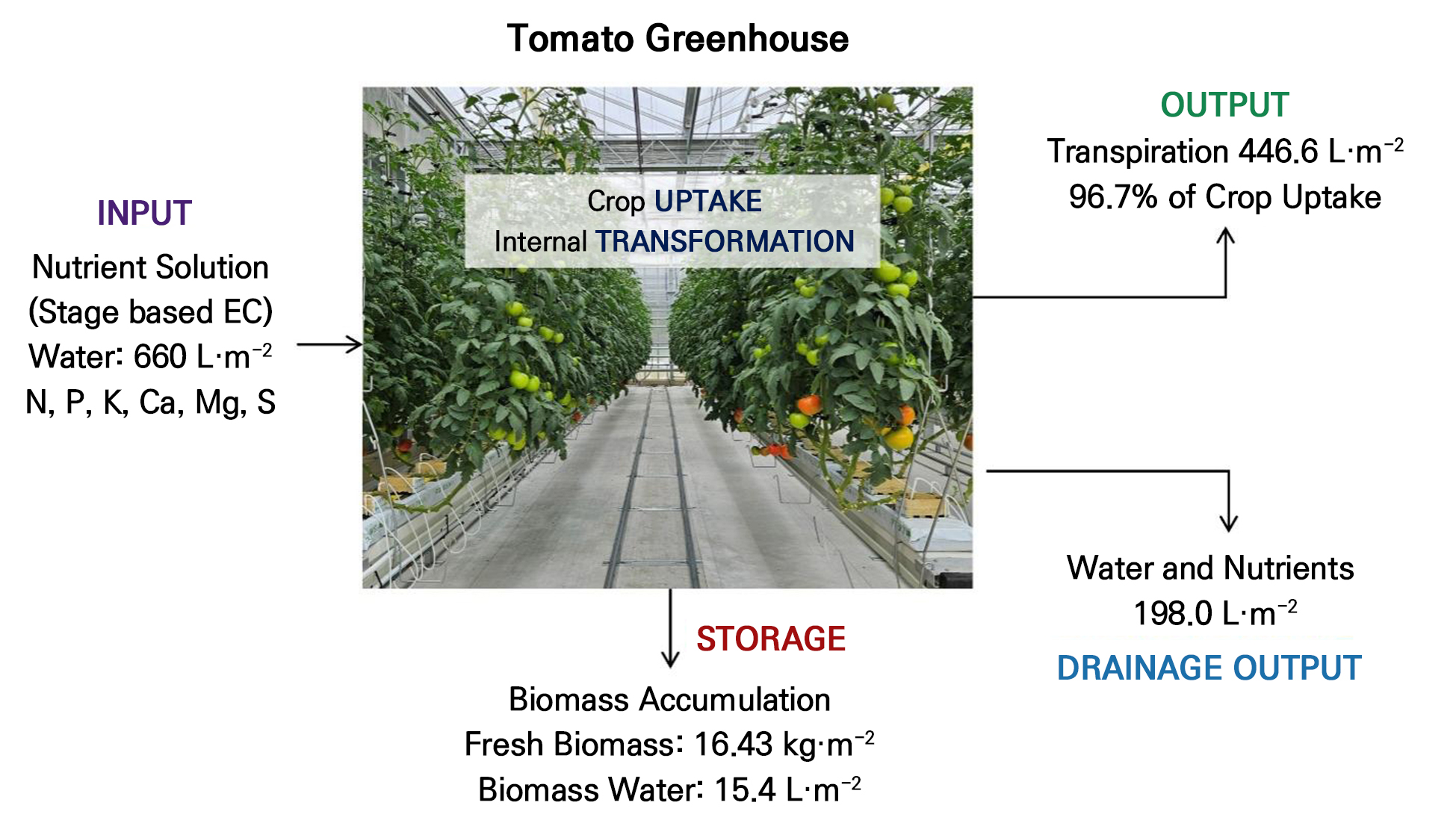
Table 3.
Stage-based Mass Balance of N, P, and K Considering Stage-specific Drainage Concentrations (g·m‒2)
Table 4.
Stage-based Mass Balance of Ca, Mg, and S Considering Stage-specific Drainage Concentrations (g·m‒2)
Discussion
Water interpretation
This study applied a stage-based framework to quantify water, nutrient, and biomass flows in a rockwool-based hydroponic tomato greenhouse over a 240-day cultivation period. The water balance showed that 96.7% of the water absorbed by the crop was released to the atmosphere through transpiration, whereas only 3.3% was retained in the plant biomass (Table 2). This result indicates that transpiration was the dominant water flux in the hydroponic tomato system, while water storage in plant biomass represented only a minor component of the overall water balance. The high proportion of transpired water is consistent with previous findings in greenhouse crop systems (Stanghellini and van Meurs 1992).
Nutrient interpretation
In contrast to water, nutrient flows showed that drainage nutrient losses did not scale directly with the volumetric drainage ratio. Nutrient losses through drainage reached approximately 35–45% depending on the nutrient type and cultivation period (Tables 3 and 4), indicating that the drainage concentration strongly affected nutrient discharge. However, these period-based results should not be interpreted as direct evidence of growth stage-specific physiological uptake patterns. In tomato, ion uptake can vary with the fruit load, canopy development, and environmental conditions, but such mechanisms could not be directly evaluated in this study because organ-level nutrient uptake and continuous drainage nutrient concentrations were not measured. Therefore, the observed differences among the periods are more appropriately interpreted as reflecting changes in the crop size, overall nutrient uptake capacity, irrigation volume, drainage ratio, and drainage nutrient concentration. These results emphasize that nutrient discharge in open hydroponic systems should be evaluated using both the drainage volume and drainage nutrient concentration as opposed to the drainage volume alone.
Biomass allocation and asymmetry between water and nutrient balances
The biomass-based mass balance showed that fruits accounted for more than 85% of the total fresh biomass production (Table 5), confirming that marketable yield was the dominant biomass output of the hydroponic tomato system. Rather than emphasizing the general dominance of transpiration in the plant water balance, this result highlights the importance of linking biomass allocation with nutrient retention and drainage nutrient loss. Therefore, improving nutrient use efficiency in open hydroponic systems should focus on quantifying nutrient accumulation in harvested and non-harvested biomass, reducing nutrient losses through drainage, and evaluating the potential for nutrient recycling.
Limitations and future research directions
Several limitations of the present study should be acknowledged. First, the target root-zone EC was not directly monitored; the EC-related settings used in this analysis were simplified input conditions for a seasonal mass-balance estimation rather than a full representation of contemporary hydroponic fertigation control based on the target root-zone EC. Future studies should include real-time monitoring of the root-zone EC and drainage EC to evaluate the deviation between the target and actual root-zone EC over the cropping cycle and to refine nutrient supply parameterization toward a more operationally representative fertigation model. Second, the 30% drainage ratio adopted here represents a representative whole-cropping-period proportion for seasonal accounting, not a fixed operational target. In commercial practice, the drainage ratio varies dynamically with the light intensity and with leaching adjustments aimed at lowering the root-zone EC. Future research should quantify this dynamic relationship through high-frequency drainage monitoring, which would allow drainage to be modeled as a responsive management variable rather than a fixed seasonal proportion. Third, short-term environmental drivers, particularly the daily light intensity and short-term fluctuations in solar radiation, were not explicitly incorporated into the quantitative analysis, although the seasonal pattern of monthly cumulative solar radiation was presented (Fig. 1). Transpiration and water uptake are governed primarily by the canopy size (leaf area index) and instantaneous radiation rather than by the growth stage per se. Future work should incorporate continuous radiation monitoring to develop transpiration prediction models that account for both canopy development and radiation levels. Fourth, organ-level distributions of mineral nutrients—especially for cationic nutrients such as Ca and K—may vary with light conditions, but the current study did not include organ-specific nutrient concentration measurements under contrasting light environments. Future studies should conduct organ-specific mineral analyses under different radiation regimes to disentangle the relative contributions of developmental- stage and light-driven cation redistribution. Finally, differences in nutrient and water uptake rates across growth stages should not be interpreted as stage-dependent constants, as these processes are strongly influenced by environmental drivers. Future research should integrate short-interval radiation measurements with simultaneous uptake monitoring to establish radiation-use-based uptake coefficients, ultimately supporting radiation-responsive fertigation scheduling in commercial greenhouses.
Conclusion
By incorporating stage-aggregated drainage nutrient concentrations into a mass-balance framework, this study provides a more realistic seasonal quantification of resource flows and nutrient losses in an open rockwool-based hydroponic tomato system. The integrated analysis of water, nutrient, and biomass balances offers a systematic reference for identifying resource loss structures and for improving fertigation management in hydroponic tomato greenhouse systems.
