Introduction
Materials and Methods
Experimental Site and Growing Plants
Breeding Materials and Genealogy
Pathogen Isolate
Growing Seedlings, Inoculation and Disease Scoring
Identification of Fertility Restorer Genotype of F5 Lines
Chemical Composition and Horticultural Characteristics
Results and Discussion
Resistance to P. capsici and Horticultural Characteristics of F5 Lines
Restorer-of-Fertility Genotype for Cytoplasmic Male Sterility
Resistance to P. capsici and Chemical Quality Components of F6 Lines
Total Content of Phenols and Flavonoids
Number of Lactic Acid Bacteria
Introduction
Peppers, Capsicum spp., are an important vegetable crop grown worldwide for fresh immature and mature fruits, dry powder, condiments, and medicinal and ornamental uses. Pepper fruits are a rich source of vitamins, particularly vitamins A and C, and also contain considerable amount of calcium, phosphorus, and iron. It has high economic value as a cash crop for growers and is an integral part of the food and pharmaceutical industries worldwide (Bosland and Votava, 2000).
In Korea, Phytophthora blight caused by the fungus Phytophthora capsici Leonian has been a limiting factor in pepper production, causing root and stem rot, leaf blight, and fruit rot of pepper plants unless properly controlled (Kim et al., 2012; Mo et al., 2014). P. capsici has a wide host range including about 53 species of plant in 24 diverse families, including weed plants (Hausbeck and Lamour, 2004). Asexually produced zoospores of the pathogen have the potential to actively swim toward host plants in water to cause a rapid and destructive outbreak in a relatively short period of time during rainy and humid weather conditions throughout the growing season (Kim et al., 2001, 2009). The oospores of P. capsicihave the ability to overwinter in soil to serve as an inoculum for subsequent growing seasons. Although rotation may be effective to reduce the soil-borne propagules, lack of an alternative cash crop makes adoption of crop rotation difficult. Control measures, including cultural, biological, and chemical strategies are not effective due to the soil-borne nature of the pathogen. Chemical approaches show promise in controlling the disease, but phytotoxicity and residual effects are environmentally hazardous (Bosland and Lindsey, 1991; Rajkumar et al., 2005) and the efficacy of the chemicals can be reduced or overcome by the evolution of new resistant strains of the pathogen. Genetic resistance of the cultivars including rootstocks offers a convenient and worthwhile approach for economic, environmentally friendly, and labor saving control of the disease (Reifschneider et al., 1992; Kim et al., 2001; Abebe et al., 2016).
Many pepper breeding programs in Korea focus on incorporating resistance to P. capsici into existing high yielding varieties producing good dry fruit quality (Kim et al., 2012). Those accessions with well-known sources of resistance, specifically AC2258, PI201234, Criollo de Morelos-334 (CM334), and Mexican pepper Line 29 (Kimble and Grogan, 1960; Choe et al., 1985; Gil Ortega et al., 1990; Hur et al., 1990; Bosland and Lindsey, 1991), have already been exploited in breeding programs. Conversely, in response to host resistance, variability in virulence or pathotype differentiation was observed among different strains of P. capsici (Walker and Bosland, 1999; Oelke and Bosland, 2003; Sy et al., 2005; Glosier et al., 2008; Foster and Hausbeck, 2010; Kim et al., 2010; Lee et al., 2010).
Most of the pepper cultivars grown in Korea are F1 hybrids developed by commercial seed companies for exploitation of hybrid vigor. Male sterility (cytoplasmic or genic or both) found in nature or induced by mutagenesis is used in the hybrid seed production system to reduce the labor involved in hand pollination (Peterson, 1958; Shifriss, 1997; Jo et al., 2016). Cytoplasmic male sterility (CMS) is a maternally inherited trait whereby plants fail to produce functional pollen. It has been identified in more than 150 plant species (Schnable and Wise, 1998). CMS in pepper was first reported by Peterson (1958). Utilization of CMS was more successful during breeding of pungent types of pepper than in sweet peppers, in which instability of male sterility and incomplete restoration of fertility are often observed (Greenleaf, 1986; Shifriss, 1997). Currently CMS is widely used in the F1 hybrid seed production of hot peppers in Korea. CMS lines expressed as Srfrf (with S standing for male sterile cytoplasm and rf for non-functional restorer gene in the nucleus) are maintained by pollination with maintainer lines expressed as Nrfrf with normal cytoplasm but without nuclear restorer. Male fertile F1 hybrid seeds are produced by pollinating the CMS lines with pollen from restorers N(S)RfRf with normal or male sterile cytoplasm, and with a functional restorer gene (Greenleaf, 1986). Any normal genetic resources or breeding lines may, therefore, be classified into maintainer (Nrfrf ) or restorer (N(S)RfRf ) depending on their ability to restore the fertility of CMS lines. Accordingly, the restorer genotype of breeding lines is important information for planning a hybrid breeding program.
Yeongyang is a county located in the mountainous northeastern part of Gyeongbuk Province in Korea. Subi is a district in Yeongyang located 430m above sea level. Local land races of pepper have been kept by farmers as heirlooms in the area and Subicho, the representative land race in Subi, is well known for a good mixture of pungency and sweet taste. These land races are, however, susceptible to fungal, viral, and bacterial diseases. In a breeding program we conducted in the late 1980s to early 1990s, the genetic resistance to Phytophthora blight found in accession PI201234 was introduced into Subicho (Kim and Shon, 1992; Kim et al., 1996). The resultant breeding line 19-1-3-7-1 inherited the flavor of Subicho and resistance to Phytophthora blight but was susceptible to damage from viruses in the fields where CMV predominated. Consequently, in the late 1990s, 19- 1-3-7-1 was crossed with KC406, an introduction from Thailand that showed field resistance to viruses, and later, in 2002, an F7 selection of the cross was backcrossed again into 19-1-3-7-1 to recover Subicho’s flavor. Selection procedures were applied to the cross to breed lines with Subicho flavor and field resistance to viruses in addition to resistance to Phytophthora blight. An F7 selection of the cross (PVR Subi) was crossed with a new version of Subicho, New Subi, which had longer fruits than the original Subicho and strong horticultural characteristics. The PVR Subi was also crossed with KC1522 for its good dry fruit quality. The modified pedigree method of breeding was applied to the crosses PVR Subi x New Subi and PVR Subi × KC1522 to obtain true varieties adapted to the local environments and to identify possible parents for hybrid cultivars. In 2013, we evaluated resistance to P. capsici, recorded horticultural characters, and identified the restorer of fertility (Rf ) genotype of the F5 selections. In 2014, F6 lines of the crosses were evaluated for days to flower and chemical quality components such as capsaicinoids, sugar content, and ASTA color value. The objectives of this study were to breed lines carrying qualities of the original Subicho, in whole or in part, and resistance to P. capsici, and to identify their nuclear restorer genotype with regard to CMS so they could be used as parents in hybrid breeding.
Materials and Methods
Experimental Site and Growing Plants
This study was carried out in the greenhouses of Kyungpook National University’s Agricultural Research Farm, Daegu, Korea. Seeds were sown in commercial growing mix in 200-cell trays and the seedlings were transplanted to 32- or 50-cell trays about 30 d after sowing. The plants were inoculated with a zoosporangial suspension of P. capsici about 45 d after sowing for testing and selection for resistance. The selected plants were transplanted to the greenhouse soil to grow for selection for horticultural characteristics and for seed production in early May. Greenhouse soil beds were prepared (100 cm wide) and mulched with black plastic film for growing the pepper plants. A drip irrigation system was installed under the plastic film. The seedlings were transplanted 40 cm apart in two rows in the beds. Fertilizers were applied following the standard growing manual of hot red peppers (Kim et al., 2001). The plants were supported by staking, with strings connecting the stakes. Sides of the plastic greenhouse were netted to prevent pollinating bees.
Breeding Materials and Genealogy
The genealogy of F5 lines included in the experiment is given in Table 1. The cross PVR Subi x New Subi and PVR Subi x KC01522 were made in 2009 and a modified single seed descent method of breeding (Chahal and Gosal, 2002) was applied to the F2 and F3 populations of the two crosses. Seedlings at about 45 d old were inoculated with a sporangial suspension of P. capsici, and the surviving plants were selected about one month after inoculation. The selected plants were grown in 18-cell trays with growing mix, and seeds were taken from the individual selected plants separately. Certain numbers of seeds taken from each plant seed lot were composited to accumulate about 250 seeds for the next generation. In 2011, promising individual plants were selected in F3 and the resultant 54 F4 lines were grown in the greenhouse and evaluated. From the F4 lines of the two original crosses, 11 and 18 F5 lines were selected, respectively. In 2013, the 29 F5 lines were evaluated for resistance to P. capsici and the resultant selections were grown for recording horticultural characters, selection for the next generation, and for making crosses for identification of restorer-of-fertility genotype for CMS. In 2014, F6 lines (14Y2) of the two crosses were again evaluated for stability and durability of resistance to P. capsici and for chemical quality components.
Table 1. Breeding history up to F5 for the development of pepper cultivars locally adapted to the Subi area of Yeongyang, Gyeongbuk Province in
Korea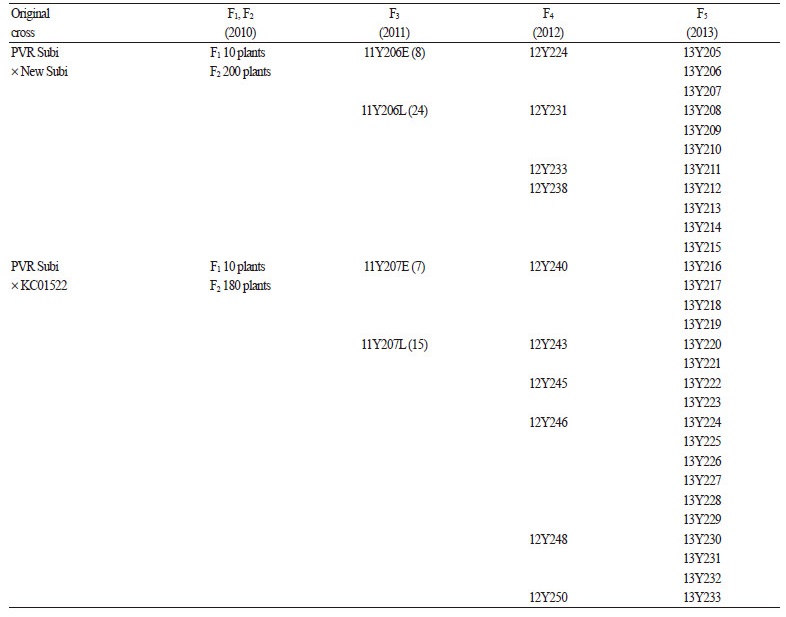 |
Pathogen Isolate
P. capsici isolate Pc018, which was originally collected from the infected plants of Phytophthora resistant commercial F1 hybrids in Yeongyang, Gyeongbuk Province, Korea, was used in inoculation for testing resistance. The pathogen isolates were maintained in potato dextrose agar slants and reactivated every three months according to standard plant pathological methods of fungus management (Dhingra and Sinclair, 1995).
Growing Seedlings, Inoculation and Disease Scoring
F5 and F6 lines were evaluated in 2013 and 2014, respectively. Seeds used in the experiment were treated in hot water at 52°C for 30 min before sowing to control seed-borne bacterial spot pathogen (Xanthomonas euvesicatoria). The treated seeds were sown in 200-cell trays filled with ‘Wonjo Mix’ medium (Nongkyung Co., Ltd., Korea) and seed trays were kept in a moisture chamber at 30°C for 72 h to enhance germination. Thirty days after sowing, seedlings were transplanted to 32-cell trays using the same growing medium, 15 plants per line. Prior to inoculation, P. capsici culture was sub-cultured on V8 agar media (Kuhajek et al., 2003) at 28°C under florescence light. To obtain an abundant mass of sporangia, actively growing mycelial tips were buried in zucchini squash fruit 5-7 d ahead of inoculation and kept at 25°C in light shade. Sporangia that formed on the surface of the zucchini fruits were harvested with a scalpel and mixed with distilled water to make a suspension. This was strained through two layers of muslin cloth to remove the squash tissue. Spore concentration was adjusted to approximately 105 sporangia per mL using a hemocytometer. The plants were inoculated by drenching the soil near the plant stem base with 5 mL of sporangial suspension (Kim et al., 2012). The plants were kept on the greenhouse bench at 25-28°C for disease development. Disease severity on the stem and roots was recorded every week but only the scores taken 4 weeks after inoculation were presented in the results. Disease severity on stem or above ground part was scored on a 1 to 4 scale, where 1 = no disease symptoms observed; 2 = necrotic lesion at base of stem but still surviving; 3 = wilting; 4 = dead and dried. The root infection was measured on a scale of 1 to 5, where 1 = no root rot observed; 2 = about 25% root rot; 3 = about 50% root rot; 4 = about 75% root rot; 5 = complete root rot (Kim et al., 2001). The disease scores and days to bloom of individual plants were considered as a replication or experimental unit and the results were analyzed according to a completely randomized design
Identification of Fertility Restorer Genotype of F5 Lines
Selected F5 plants were crossed with confirmed CMS maternal plants to identify their nuclear restorer-of-fertility (Rf) genotype. F1 plants between the CMS and F5 selections were sown in 200-cell trays and 16 seedlings per cross were transplanted to 32-cell trays and examined for pollen production after flowers bloomed. Observation of pollen was made by the naked eye or a magnifier when necessary. The pollen parents producing male-fertile F1 plants in a cross with the CMS line were classified as restorers with the N(S)RfRf genotype and those producing male-sterile F1 plants were classified as maintainers with the Nrfrf genotype.
For the quantification of pollen on an anther, mature flower buds near to dehisce pollen were taken from the F1 plants and an anther was put into a micro tube. These micro tubes were kept at 30°C for 3-4 h to induce pollen discharge. The tubes were then shaken slightly on a vortex mixer to shed the pollen, 1 mL of acetocarmin solution was dropped into the micro tubes, and shaken moderately to mix the pollen and solution. Five microliters of the suspension were taken by micropipette, dropped onto a glass slide and covered with an 18 × 18 mm cover slip. The solution was exactly covered by the surface area of the cover slip. The number of pollen grains under the cover slip was counted using a microscope. Five cover slip areas were counted and the mean was calculated. The number of pollen grains per anther was obtained by taking average of the five cover slip areas of three anthers of five selected plants per cross, and by multiplying the dilution factor.
Chemical Composition and Horticultural Characteristics
In 2013, five true-to-type plants were selected from each line to record horticultural characteristics, including plant height, length to the 1st branching fork, fruit length and width, pedicel length, and number of locules. In 2014, fruits harvested from the F6 plants were analyzed for chemical quality components. The capsaicinoids and sugar contents were analyzed by HPLC, and ASTA color value by a UV-spectrophotometer at the Yeongyang Pepper Research Institute and the methods used were the same as described in detail by Mo et al. (2015). Each sample was measured twice and the data were analyzed according to a completely randomized design. Statistical analysis was conducted by the Statistical Analysis System (SAS v9.4).
Results and Discussion
Resistance to P. capsici and Horticultural Characteristics of F5 Lines
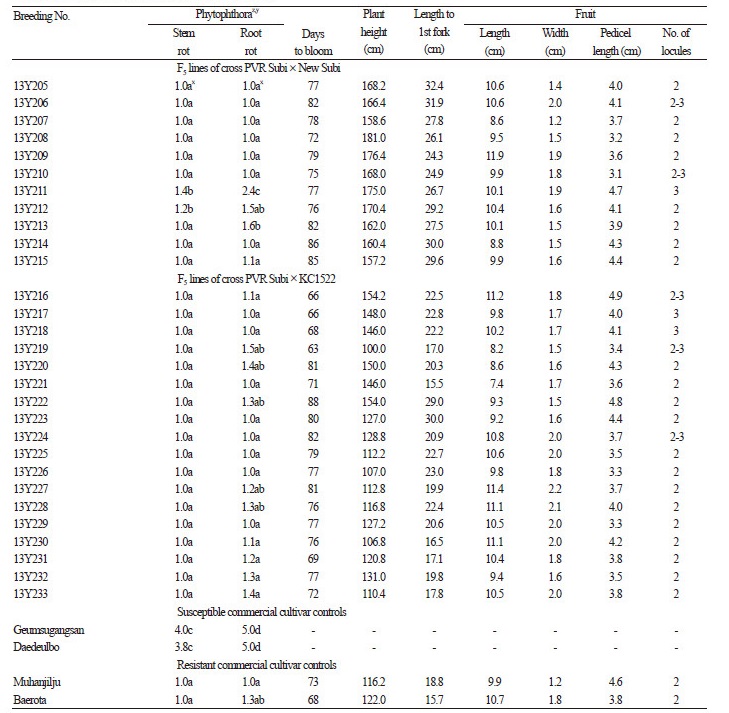
Table 2 presents the disease reaction to P. capsici of 29 F5 lines developed from the PVR Subi × New Subi and PVR Subi × KC01522 crosses. Almost all breeding lines except 13Y211 showed resistance comparable to the commercial resistant cultivars, ‘Muhanjilju’ and ‘Baerota’. The resistant selections showed almost no disease symptom in the above-ground part of the plant and non-existent or minor root rot symptoms in the roots, whereas ‘Geumsukangsan’ and ‘Daedeulbo’, commercial cultivars included as susceptible controls, were diseased to death.
The F5 selections generally grew taller and bloomed later, with a few exceptions, compared to the commercial resistant cultivars and had similar fruit shape and size. Lines developed from the PVR Subi × New Subi cross were later to mature in terms of length to the first bifurcation, and longer and more slender in fruit shape than those of the PVR Subi × KC01522 cross. Days to first bloom ranged from 64-88. Accessions 13Y202, 13Y203, 13Y204, 13Y216, and 13Y217 were earlier in flowering than 13Y214, 13Y215, and 13Y222. Plant height was recorded between 182-106 cm. 13Y201 was the tallest and 13Y219 was the shortest in terms of plant height. Stem hairs were present in 13Y208, 13Y209, 13Y210, and 13Y211. Fruit position was pendent in all accessions. Fruit length ranged from 6.7 to 11.9 cm. 13Y201 had the shortest fruit length while 13Y209 had the longest. Fruits of almost all accessions were 2-loculed except those of 13Y202, 13Y206, 13Y210, and 13Y220, which were 3-loculed.
The natural incidence of bacterial wilt caused by Ralstonia solanacearum was also observed among the breeding lines in the naturally infested greenhouse during the growing season. Only a few lines: 13Y201, 13Y202, 13Y203, 13Y204, 13Y212, 13Y213, and 13Y232, were observed to be infected with the disease. Thus, many of the Subi selections appeared somewhat tolerant to bacterial wilt, however, inoculation testing is necessary for confirmative results.
Restorer-of-Fertility Genotype for Cytoplasmic Male Sterility
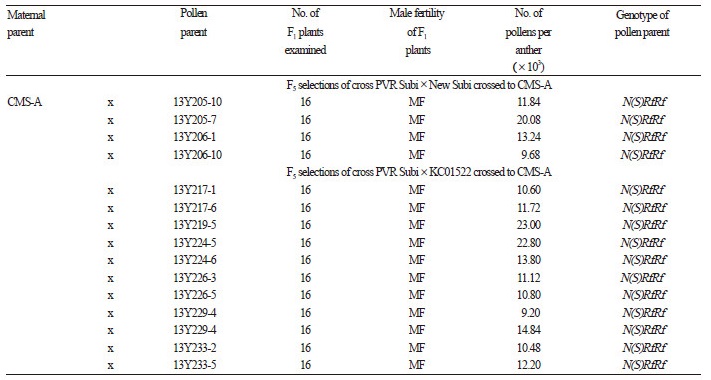
Four and 11 F5 lines developed from the PVR Subi × New Subi and PVR Subi × KC01522 crosses, respectively, produced male fertile F1 plants in crosses with a CMS line, indicating that all of the pollen parents were restorers carrying the N(S)RfRf genotype (Table 3). The F1 plants produced an abundant amount of pollen per anther ranging from 9.20 to 23.00 × 10³. No lineinducing male sterile F1 plants in a cross with CMS was found. Thus, the results agreed with the previous observation that the restorer-of-fertility gene tends to be transmitted together with the gene for resistance to P. capsici (Hwang and Kim, 2002). The number of the breeding lines that were successfully crossed into the CMS line was limited due to labor for crossing and fruit set failure after hand pollination. It has been reported that CMS
It has been reported that CMS is unstable at low temperature (Shifriss, 1997; Lee, 2001), particularly in sweet peppers,resulting in limited use in hybrid seed production. The F1 plants in this study remained male fertile up to the end of growing season with normal fruit set containing an adequate amount of seeds. Many seed industries in Korea rely on the CMS system for hybrid seed production of Korean pungent peppers, and its stability is commonly accepted (Shifriss, 1997; Wai et al., 2013). Molecular markers for the identification of CMS and restorer-of-fertility genes at early stages have also been reported (Zhang et al., 2000; Kim and Kim, 2005; Kumar et al., 2009; Min et al., 2012). Thus, lines developed in this study may be readily used as pollen parents to cross into CMS lines with good combining ability to produce male fertile F1 hybrids and for molecular study.
For DPPH radical-scavenging activity, in vitro experiments were carried out to measure the effects of antioxidant activity (Kim et al., 2013). In a biological system, the protective performance of an antioxidant is determined by examining its free radical-scavenging activity, metal catalyst-chelating ability, antioxidant enzyme activity, and inhibitory effects on oxidizing enzymes. In particular, the DPPH radical is a chemically stable radical whose unique purple color fades when receiving an electron from a certain reaction system (Hyun et al., 2009), a process through which antioxidant activity can be measured. The DPPH radical-scavenging activity was measured in kimchi produced from each type of stored cabbage over various ripening periods (Fig. 2). Prior to fermentation, kimchi made from T2 and T5 cabbage showed significantly high radical scavenging activities of 70.50% and 65.06%, respectively. Following four weeks fermentation, kimchi from T6 cabbage displayed the highest level of radical-scavenging activity (77.52%), which was followed by that from T3 (68.61%) and T1 (68.27%) cabbage. Following eight weeks fermentation, the highest levels of radical-scavenging activity were observed in kimchi made from T4 (70.54%), T3 (68.31%), and T2 (67.58%) cabbage, although there were no significant differences among these values.
Resistance to P. capsici and Chemical Quality Components of F6 Lines
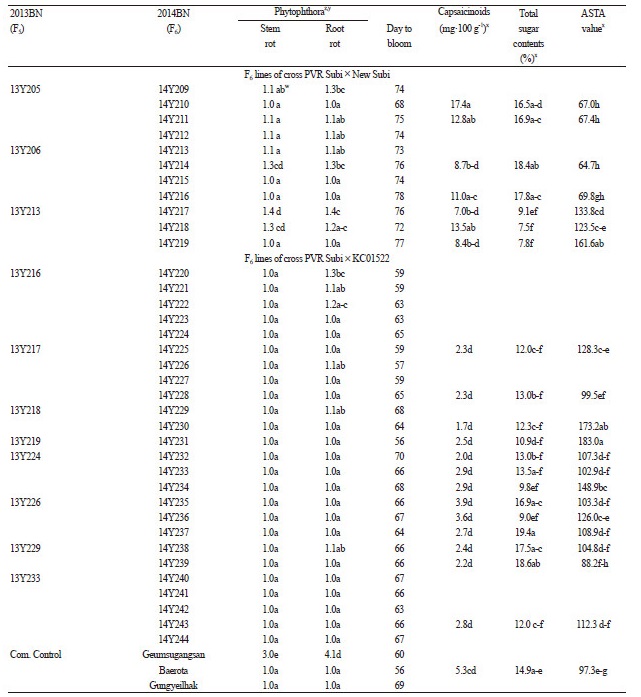
The results of testing of the resistance to P. capsici and the analysis of chemical quality components of F6 lines, carried out in 2014, are given in Table 4. Most of the breeding lines showed high resistance to P. capsici comparable with commercial resistant control cultivars with a few exceptions such as 14Y217 and 14Y218, which developed minor stem infection and root rot. Thus, they seem to be appropriate for use as Phytophthora-resistant, open-pollinated cultivars once horticulturally adapted for growth in the fields of Yeongyang. These breeding lines may also be used as pollen parents to cross with CMS lines to produce F1 hybrids. Quality of fruit is an important factor for adaptability to local growers and consumers. In analysis of capsaicinoids, sugar content, and ASTA color value, lines derived from the PVR Subi × New Subi cross were higher in capsaicinoid content than the commercial cultivar control, ‘Baerota’, whereas lines from the PVR Subi × KC01522 cross were lower. Furthermore, many lines with higher sugar content than ‘Baerota’ were found among the breeding lines. It is generally accepted that sugar content is an important factor contributing to the quality and flavor of pepper products. In terms of ASTA color value, many of the breeding lines were higher than the commercial cultivar control, ‘Baerota’. Many breeding lines with high ASTA color value were found among the breeding lines derived from the PVR Subi × KC01522 cross, as expected, because KC01522 was used in the cross for dry fruit quality, the color and texture of dry fruits. Thus, many of the breeding lines are promising as basic lines for evaluation for adaptability to local growing conditions in view of resistance to P. capsici, tolerance to bacterial wilt and viral complex, chemical quality components, and as paternal parents for making hybrids carrying the taste of Subicho.