

Introduction
Strawberry fruits are known for their plentiful vitamins and inorganic nutrients, as well as their visual appeal and desirable taste (Yang et al., 2010). In this regard, strawberry is notable as a particularly healthy fruit, especially in the winter season in South Korea. Strawberry also takes center stage as an export crop, with around 2.3 million tons exported from Korea to other countries each year (KREI, 2014). Since 2004, ‘Maehyang’ (Fragaria × ananassa Duch.) has been the most popular strawberry cultivar for commercial export to Southeast Asian countries such as Hong Kong, Singapore, and Malaysia.
However, strawberry fruits have high metabolic activity and suffer from a high possibility of microbial contamination. This can result in a short shelf life, fungal decay, color change, and an off-flavor (Van der Steen et al., 2002; Kim et al., 2010). It is therefore important to employ an appropriate preservation method to delay respiration, prevent physical damage, dryness, and maturity, and to restrict pathogen attack in order to extend shelf life. Preservation methods such as precooling, storage at low temperature, carbon dioxide (CO2) and chlorine dioxide (ClO2) treatment or ethylene removal (Jeong et al., 1990; Kim et al., 1999a; Ahn et al., 2000; Jin et al., 2007) can be used for this purpose.
Recently, aqueous ClO2, a well-known bactericidal, viricidal, and fungicidal agent, has been recognized for its use in commercial industries to maintain freshness of fruits, seafood, and poultry. Studies have also revealed that aqueous ClO2 is effective in improving the microbial safety and quality of strawberry fruits during storage (Jin et al., 2007). There have been reported uses of aqueous chloride to preserve edible fruits, vegetables, and seafood in America, Japan, and European countries. However, possible health concerns have been raised because of the presence of trihalomethanes that are generated in the presence of organic materials (Beuchat et al., 1998; Kim et al., 1999b). Moreover, a recent FAO/WHO expert committee meeting suggested an allowed daily intake of 0-30 mg·L-1 ClO2.
The fact that strawberry fruits are soft makes it difficult to administer aqueous ClO2 treatment, since the pressure exerted causes them physical damage. Therefore, it might be appropriate to use a gaseous ClO2 treatment for strawberry fruits. Gaseous ClO2 is usually used in hospitals to remove pathogenic organisms, but has not yet been applied to dietary fruits. If successful, gaseous treatment of strawberries might result in better quality control, which would ensure a more stable supply and pricing – important factors for export.
Compared to air transportation, export by ship is cheaper and can move higher volumes, but it takes 3–10 days longer to transport goods. Transport by ship, therefore, would seem unsuitable for strawberries, a fruit that can easily over ripen, become soft or rot. To deal with this problem, a new processing technology has been developed using gaseous ClO2 either alone or in combination with precooling to retain the freshness and quality of fruits intended for export.
The aim of this study was to assess the effect of precooling and application of gaseous ClO2 on the retention of freshness and quality of ‘Maehyang’ strawberry fruits intended for export, and to investigate the advantages of these treatments in the ‘Maehyang’ strawberry export industry.
Materials and Methods
‘Maehyang’ strawberry fruits were grown and harvested from commercial greenhouses in Jinju (Gyeongnam province, South Korea). Fruits of uniform and medium size and 60% ripeness were selected for use in this study.
A randomized complete block design was used. Strawberry fruits were assigned to one of four treatment groups, with 15 fruits per group, and 3 replicates of each experiment: non-treatment (control), precooling only (PO), gaseous ClO2 only (GCO) or precooling combined with gaseous ClO2 (P + C). Strawberry fruits in the control treatment group were put outside at 15°C (outside air temperature). In the PO treatment group, strawberry fruits were precooled using a forced air cooling storage system set at 2°C to decrease the material temperature of the fruits, as recommended by previous studies (Park et al., 2012; Kim and Hwang, 2013). The average material temperature of the strawberry fruits was 15°C before storage, and 3°C after precooling (1/5 cooling time). Strawberry fruits in the GCO group were treated with gaseous ClO2 (1.0 mg·L-1), generated using a ClO2 gas generating system (Bactericide, Sunseal Co. Ltd., Busan, Korea) at 15°C (outside air temperature) for 1 hour. To ensure the effectiveness of gaseous ClO2 treatment, a high concentration of gaseous ClO2 was used, and the treatment time was long. The amount of gaseous ClO2 applied was measured using a ClO2 gas detector (C16 PortaSens II, Analytical Technology Co. Ltd., PA, USA). In the treatment involving P + C, the strawberry fruits were treated with gaseous ClO2 (1.0 mg·L-1) for 1 hour at the precooling temperature of 2°C. After receiving these treatments, the strawberry fruits were hygienically packed into plastic boxes, put inside cardboard boxes, and wrapped cleanly and completely with plastic film to ensure the boxes were securely packed. The boxes were then put into a climate-controlled container set at 2°C and immediately exported to Hong Kong by ship. Temperature and relative humidity (RH) were recorded inside the container during shipping, and in the laboratory, using an iButton recorder (iButton DS1923L-F5, Maxim Integrated Co. Ltd., San Jose, USA).
To determine the weight loss of strawberry fruits caused by transpiration and respiration, fruits were weighed using a digital balance scale (MW-330, CAS, Yangju Co. Ltd., Korea) just before treatment in South Korea, and again upon their arrival in Hong Kong.
To measure the skin color of strawberry fruits, a color reader (CR-11, Minolta Co. Ltd., Tokyo, Japan) was used at the side of the fruits’ central zone and compared with the Munsell hue circle to determine brightness and chroma.
The soluble solids content of strawberry fruit juice was measured using a digital refractometer (PR-201a, Atago Co. Ltd., Tokyo, Japan) and was expressed as °Brix.
The incidence of gray mold rot affecting the fruit was analyzed by eye and then quantified as a percentage by counting the number of decayed fruits, divided by the total number of fruits in a single plastic box, and multiplying by 100. There were 24 strawberries in each plastic box weighing approximately 250 g.
Analysis of variance and Duncan’s multiple range tests were performed using the SAS program (Statistical Analysis System Co. Ltd., V. 9.1, Cary, NC, USA).
Results and Discussion
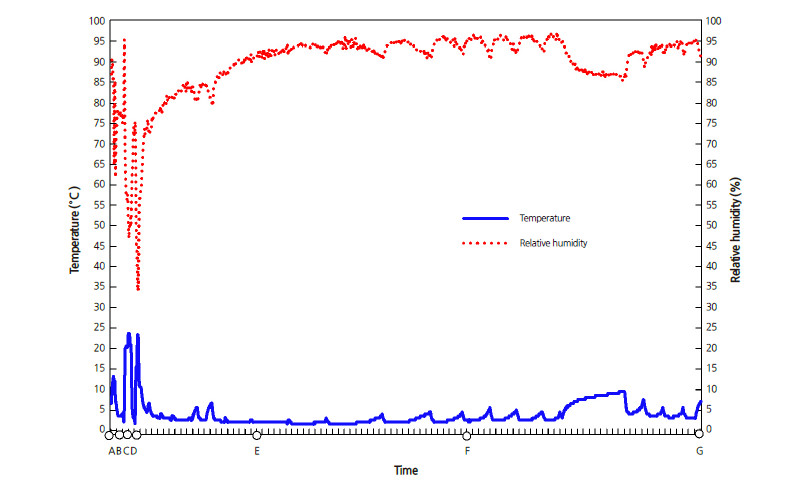
The temperature and RH inside the containers during export from South Korea to Hong Kong by ship are shown in Fig. 1 (time points A-G). The temperature inside the container was controlled at 2°C. From the point of departure in South Korea (E) to the time of port entry in Hong Kong (F), the ranges of temperature and RH were 2-6°C and 87-97%, respectively; the little fluctuation shows that environmental conditions were stable. However, from the entry in Hong Kong (F) to the point of opening the container (G), the temperature rose suddenly by a factor of 5 from 2 to 10ºC and the RH decreased. Fluctuating temperatures during fruit shipping may result in increased loss of quality in terms of weight loss, lower ascorbic acid content, a darker color, evident dryness of the skin, and an unsalable condition (Nunes et al., 2003).
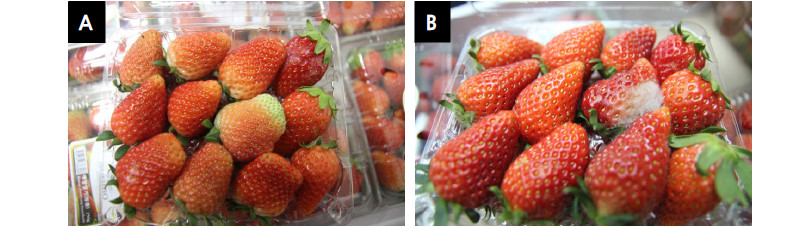
The incidence of gray mold in strawberry fruits before departure and after export is presented in Fig. 2. The sudden rise in temperature may have induced gray mold in strawberry fruits. Park and Hwang (2010) reported that storage temperature is vital for preserving strawberry fruits, and a temperature of less than 4°C is most effective for keeping strawberries fresh. It is well known that environmental conditions, particularly temperature and RH, have a major impact on the appearance, texture, composition and eating quality of strawberry fruits.
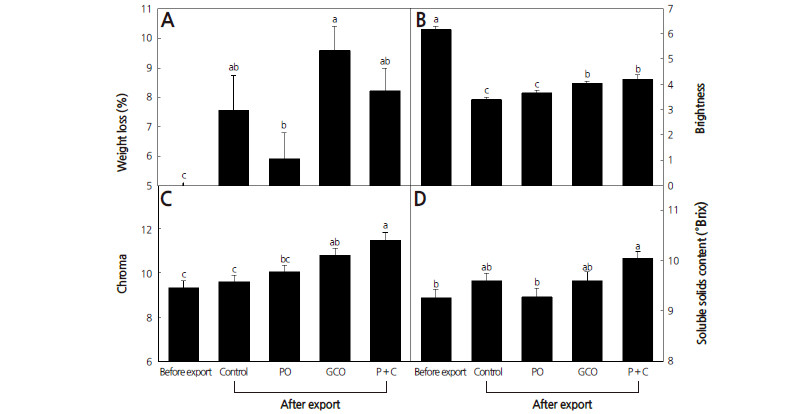
The observed quality of strawberry fruits under each experimental condition is shown in Fig. 3. Harvested fruits continue to respire and lose water to the environment, which cannot be replaced, thus weight loss occurs (Thompson, 2003). In all treatment groups, fruits decreased in weight after export (Fig. 3A). Weight loss was significantly lower with the PO treatment compared to the other treatments, and was highest in the GCO treatment group after export. As previously reported by Robinson et al. (1975), to maintain good fruit quality, the acceptable limit of strawberry weight loss is not more than 6%. Fruits in the PO treatment group remained below this 6% threshold of weight loss, while fruits in the control, GCO and P + C treatment groups lost more than 6% of their weight. It is notable that weight loss is increased by treatment with gaseous ClO2 alone. According to Szczesniak and Smit (1969), the epidermis of strawberry fruits consists of polygonal cells with larger stomata, and strawberry pith consists of thin-walled cells that are often separated during growth, leaving large cavities. The large and thin cell walls in strawberry fruits contribute to their high susceptibility to weight loss. In the present study, gaseous ClO2 might have some direct or indirect effect and/or contribute to opening of the stomatal pores, resulting in weight loss.
The chroma, or ‘colorfulness’ of strawberry fruits is one of the most important visible factors for consumers when selecting for strawberry quality. The higher the chroma, the better the visible quality, so it is important for strawberry fruits to have a vivid red color. In this study, strawberry fruits were 60% ripe, so initially had a high brightness value and low chroma value. The strawberry fruits had a lower chroma value (9.4–11.5) than those in a previous study (25-45) reported by Nunes et al. (2006). In that study, a different strawberry cultivar was used, and the strawberry fruits for export were early harvested. Compared to the fruits before export, post-export fruits had decreased brightness in all treatments (Fig. 3B), and chroma was increased in all groups except for the control (Fig. 3C). Previous research has reported that a controlled atmosphere may affect the color of stored strawberry fruits (Holcroft and Kader, 1999); whereas fresh strawberry fruits have a brilliant red color, processed fruits are characterized by rapid loss and degradation of pigment (Espin et al., 2000).
Lee et al. (2010) found that ‘Sulhyang’ strawberry fruits treated with 0.2 mg·L-1 gaseous ClO2 at 25°C for 20 minutes showed decolorization in the fruit flesh. The concentration of gaseous ClO2 in our experiment was 5 times higher and applied for 3 times longer than in the Lee study, yet we found no decolorization or damage. We considered that the ‘Maehyang’ strawberry fruits used in our experiment, which were treated with gaseous ClO2 at a lower temperature (2 or 15°C), and had lower maturity (60%) and harder fruit flesh than ‘Sulhyang’, were not damaged because the ‘Maehyang’ cultivar was bred for export. In our experiment, strawberry fruits maintained higher brightness and chroma when treated with gaseous ClO2 compared to the control and PO treatment groups. Thus, gaseous ClO2 has a good effect on strawberry fruit color, and is suitable for use in the storage of strawberry fruits.
The soluble solids content of strawberry fruits increased after export (Fig. 3D). Before export, the mean soluble solids content of fruits was 9.27 °Brix. Six days after shipping, the lowest soluble solids content value was observed in the PO treatment group. This might be attributable to the effect of precooling in delaying the breakdown of cell wall polysaccharides (Damodaran, 2007). However, despite also being subjected to precooling, fruits in the P + C group had the highest soluble solids content, with a value as high as 10.05 °Brix. This result suggests that the soluble solids content of fruits is more affected by gaseous ClO2 than by precooling, and as such, P + C treatment seems suitable for ensuring a high soluble solids content in strawberry fruits to maintain good taste quality after export.
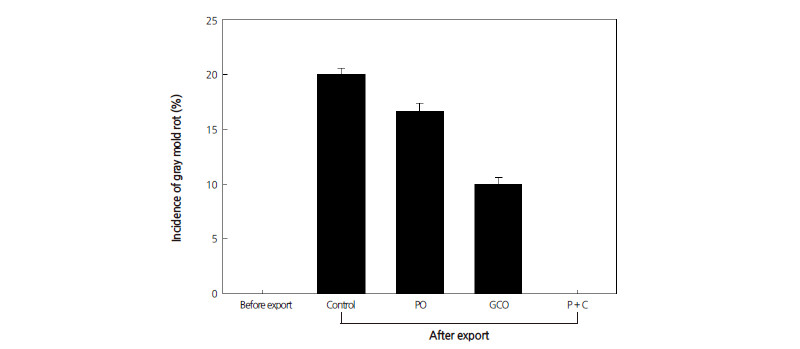
Gray mold may have occurred because of a sudden increase in temperature during the export process; a favourable condition for gray mold growth (Fig. 1). The incidence rate of gray mold of strawberry fruits was 20% and 17% in the control and the PO treatment groups, respectively. Fruits in the GCO treatment group had a gray mold incidence of 10%, and there was no incidence of gray mold in P + C treatment group (Fig. 4). Thus, the results demonstrate that P + C treatment profoundly decreases the incidence of gray mold. Wu and Kim (2007) showed that aqueous ClO2 treatment, a novel sanitization procedure for enhancing food safety, could be used to control foodborne pathogens as well as yeasts and molds on blueberries. Previous studies have also shown that treatment with 10 mg·L-1 gaseous ClO2 for 3 minutes reduced the number of microorganisms on the surface of tomatoes, cantaloupes, and strawberries (Trinetta et. al., 2013). Barakat et al. (2007) reported that gaseous ClO2 reduced the initial microflora (mesophilic and psychrotrophic bacteria, yeasts, and molds) on strawberry. The reduction of gray mold observed in our study shows that gaseous ClO2 is viable for use in fruit export and can be used to prevent gray mold in edible fruits.
The results of our study indicate that gaseous ClO2 treatment combined with precooling (P + C) is effective in maintaining the freshness of ‘Maehyang’ strawberries except for water loss intended for export from South Korea to Hong Kong. This information could be beneficial for importers to obtain good quality and disease-free strawberries. However, further studies should be carried out, specifically with regard to the biochemical and molecular aspects that may identify the enzymes and genes involved in changes in physicochemical parameters and strawberry fruit quality. These results would be useful to integrate into proper handling and postharvest storage techniques for strawberry fruits intended for export from South Korea to other countries.
