

Introduction
Materials and Methods
Plant materials
Experimental treatments
Preparation of cutting-derived seedlings
Nursery management
Field cultivation
Seedling quality measurements
Yield measurements
Statistical analysis
Results and Discussion
Cutting characteristics and survival
Cutting-derived seedling quality by nursery period and node position
Yield performance after transplanting
Introduction
Sweet potato [Ipomoea batatas (L.) Lam] is widely cultivated in Korea and conventionally produced by sprouting seed roots in nursery beds and manually transplanting vine cuttings with approximately 6–8 nodes (RDA 2018). This cultivation system requires substantial labor for nursery management, vine-cutting collection, and transplanting. Among these operations, the transplanting stage accounts for a considerable proportion of the total labor required for sweet potato production (RDA 2014). With the rapid decline and aging of the rural workforce (Ma and Nam 2015), reducing labor requirements through mechanization has become an important challenge with regard to sustainable sweet potato cultivation. Although high levels of mechanization have been achieved in several field operations, including tillage, mulching, pest control, and harvesting, mechanization of the transplanting stage remains limited. This has been recognized as a major bottleneck in labor-saving sweet potato production systems (Kim and Han 2016).
Successful mechanical transplanting largely depends on the availability of uniform and high-quality seedlings that can be continuously supplied and reliably handled by automated feeding systems (Han et al. 2015). Mechanical transplanting technologies using plug seedlings have been widely established for vegetable crops. Uniform plant morphology, including a consistent plant height and well-developed root systems, has been identified as a key factor in the stable operation of mechanical transplanting systems (Shin et al. 2000; Habineza et al. 2025). In contrast, most sweet potato transplanting systems have been developed to handle bundled vine cuttings or require manual feeding by their operators. Consequently, such systems often experience problems such as unstable feeding, irregular transplanting distances, and increased labor requirements (Sharma and Khar 2024). One possible approach to overcoming these limitations involves the use of cutting-derived seedlings.
In sweet potato, cutting-derived seedlings can be produced by excising vine nodes and nursing them to induce root development before transplanting. As these seedlings possess a developed root system and relatively uniform morphology, they have strong potential as transplanting materials suitable for mechanical transplanting. In various horticultural crops, optimizing cutting methods and segment sizes has been a critical approach to maximize multiplication efficiency and improve subsequent seedling quality (Kharrazi et al. 2017). Previous studies have reported that the seedling quality in sweet potato propagation can vary depending on the node position and nursery period, particularly in virus-free seedling production systems (Yoo et al. 2012; Lee and Lee 2019). However, most previous studies focused primarily on improving the propagation efficiency of virus-free seedlings rather than evaluating the field applicability of cutting-derived seedlings for practical cultivation. Consequently, studies investigating the production and field performance of cutting-derived seedlings remain limited. In particular, few studies have simultaneously evaluated seedling quality and subsequent yield performance outcomes according to the nursery period and node position of cutting-derived seedlings, especially under conditions relevant to mechanical transplanting systems.
Sweet potato storage root development is strongly influenced by early root growth after transplanting (Park et al. 2024). Storage root initiation typically begins approximately 20 days after transplanting, and most roots destined to develop into storage roots are determined at approximately 35 days after transplanting (Villordon et al. 2009). Belehu (2005) also reported that storage root initiation begins approximately 45 days after transplanting and is generally completed within eight weeks for most cultivars. These reported differences in initiation timing are attributable to variations in cultivars, environmental conditions, and cultivation methods used in the different studies. Considering these physiological characteristics, cutting-derived seedlings possessing a pre-developed root system may exhibit differences in early rooting and subsequent growth compared to those of conventional vine cuttings that lack roots at the time of transplanting (Islam et al. 2002).
However, despite this potential advantage, the effects that nursery conditions and node positions of cutting-derived seedlings have on field growth and storage root yield have yet to be sufficiently investigated. In particular, experimental evidence linking seedling quality to subsequent yield performance during different nursery periods remains limited, as noted above.
Therefore, the objectives of this study were to evaluate the quality of cutting-derived sweet potato seedlings produced from two-node vine cuttings under different node positions and nursery periods and assess their yield performance after transplanting.
Materials and Methods
Plant materials
The sweet potato cultivar ‘Beniharuka’ was used in this study. Vine cuttings were collected from sprouted seed roots grown in a farmer’s nursery, and only those with intact petioles and fully expanded leaves at all nodes were selected for the experiment. To ensure a uniform transplanting date among the treatments, the cutting dates were adjusted according to the required nursery period for each treatment. Cuttings for the 30-day and 20-day nursery treatments were initiated on April 22 and May 2, 2023, respectively.
Experimental treatments
This study was conducted in two sequential phases: a nursery stage followed by a field performance trial. To evaluate the effects of the node position and nursery period on the quality and yield of cutting-derived seedlings, six treatments were established by combining two nursery periods (20 and 30 days) with three node positions (terminal, second, and basal). The treatments were coded according to the node position and nursery period as follows: T20 (terminal-node cuttings grown for 20 days), S20 (second-node cuttings grown for 20 days), B20 (basal-node cuttings grown for 20 days), T30 (terminal-node cuttings grown for 30 days), S30 (second-node cuttings grown for 30 days), and B30 (basal-node cuttings grown for 30 days). Following the nursery stage, these six cutting-derived seedling treatments were transplanted for the field performance trial, where a control treatment consisting of conventional vine cuttings was included in addition to the six cutting-derived seedling treatments, resulting in a total of seven treatments.
Preparation of cutting-derived seedlings
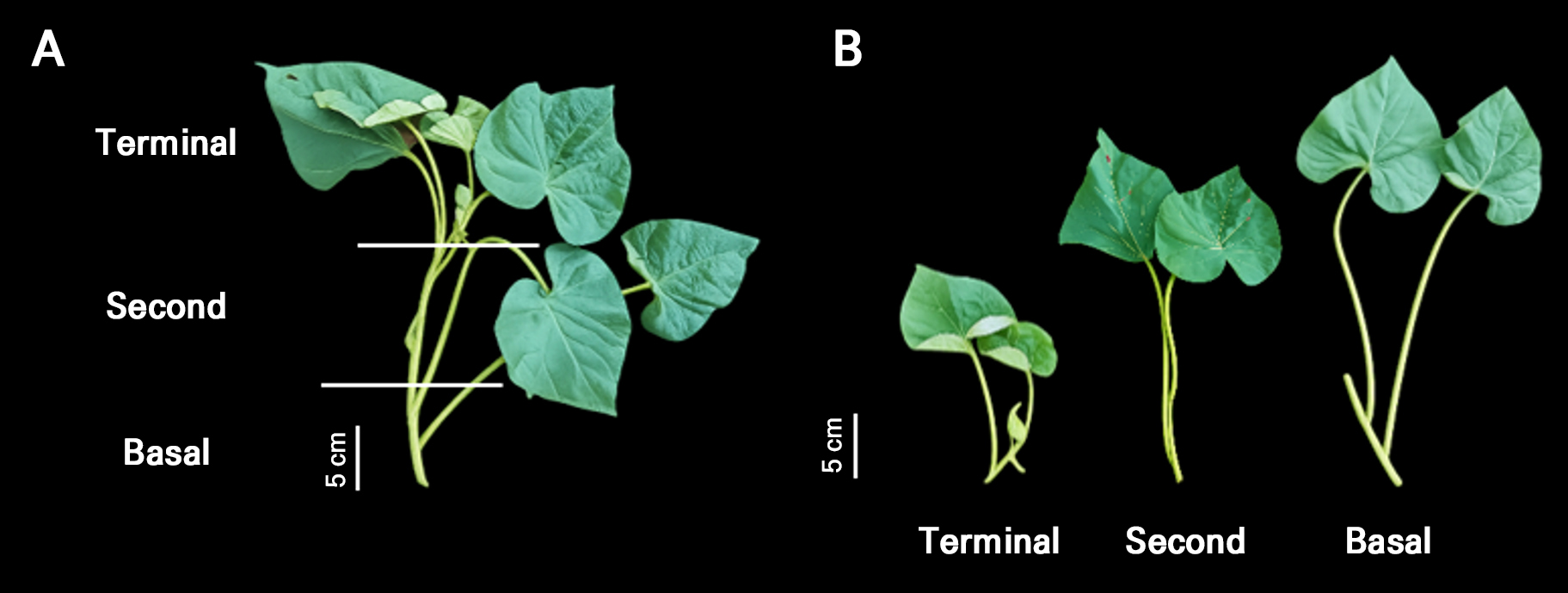
The vine cuttings were initially cut approximately six nodes (6–8 cm) below the apex and then further sectioned into two-node segments to prepare the experimental cuttings (Fig. 1). The treatments based on node position were defined as follows:
• Terminal: two-node cuttings, including the apical meristem, two fully expanded leaves, and unexpanded leaves
• Second: two-node cuttings from the second position below the apex, including two fully expanded leaves
• Basal: two-node cuttings located in the lower portion of the vine cutting, including two fully expanded leaves
Each cutting was prepared by cutting approximately 1 cm below the lower node. The cuttings were planted at a depth of approximately 1.5–2.0 cm into the substrate while maintaining the existing expanded leaves and petioles. For seedling production, 128-cell plug trays (588 × 300 mm) designed for a leafy vegetable transplanter (PW10SA, Yanmar Co., Ltd., Osaka, Japan) were used. A commercial horticultural substrate (Heungnong Bio-substrate, Heungnong Bio Co., Ltd., Suwon, Korea) was used as the growth medium. To minimize damage to the cut surfaces, transplanting holes were created in the center of each cell using a wooden stick with a 5 mm diameter prior to transplanting.
Nursery management
The nursery experiment was conducted in a Venlo-type multi-span greenhouse equipped with a diffused glass roof and 16-mm double-walled, low-iron polycarbonate side walls. After planting, the trays were placed on sub-irrigation benches, thoroughly irrigated, and subsequently managed with sub-irrigation once daily throughout the experimental period. Environmental conditions were monitored using an integrated climate control system (Ridder CX500, Ridder, Netherlands). During the experimental period, the mean temperature was 21.3°C (range, 15.9–32.3°C), and the mean relative humidity was 83.6%. For the cutting-derived seedling experiment, 100 plants per treatment were arranged in a completely randomized design (CRD), with 20 plants allocated to each of the five experimental areas. Four plants were randomly selected from each area and used for the seedling growth measurements.
Field cultivation
After the nursery period, the cutting-derived seedlings were manually transplanted on May 23, 2023. For the control treatment, conventional vine cuttings identical to those used to produce the cutting-derived seedlings were harvested one day before transplanting, stored under shaded room-temperature conditions, and then used for field transplanting. The conventional vine cuttings were approximately 30 cm long with approximately seven nodes and were planted using the horizontal transplanting method. The transplanting density was set to 70 × 18 cm. Each experimental plot consisted of five plants (0.63 m2), and a total of 35 plants per treatment were arranged in a CRD with seven replications. The field trial was conducted at a sweet potato farm in Yongjeong-ri, Hyeongyeong-myeon, Muan-gun, Jeollanam-do, Korea. No artificial irrigation was applied during the cultivation period, and the plants were managed following the farmer’s conventional organic cultivation practices.
Seedling quality measurements
Seedling quality was evaluated on May 22, 2023, at the end of the nursery period. Four plants were randomly selected from each of the five experimental areas, and 20 plants per treatment were used for the seedling quality measurements. Shoots and roots were separated, and the following parameters were measured:
• Shoot length: measured from the point of new shoot emergence to the apical meristem, excluding the existing expanded leaves
• Leaf number: counted as the number of newly formed leaves >1 cm long, excluding existing expanded leaves
• Leaf area: measured for leaves >1 cm long (excluding petioles) using a leaf area meter (LI-3100C Area Meter, LI-COR Inc., Lincoln, NE, USA)
• Fresh and dry weights: separately measured for shoots and roots using an electronic balance; dry weight was measured after drying samples in a convection oven (JSOF-250T, JSR, Gongju, Korea) at 70°C for seven days
• Root length: measured from the point of attachment to the main stem to the tip of the longest root
• Survival rate: calculated as the proportion of surviving plants among the total planted cuttings at the end of the nursery period
Yield measurements
Yield measurements were conducted on September 26, 2023, following harvesting on September 21, 2023 (120 days after transplanting). The following parameters were evaluated:
• Survival rate: proportion of plants surviving from transplanting to harvest
• Number of storage roots per plant: total number of storage roots (diameter ≥2 cm) divided by the number of surviving plants
• Weight of storage roots per plant: total weight of storage roots (diameter ≥2 cm) divided by the number of surviving plants
• Total yield: total weight of storage roots with a diameter ≥2 cm
• Size distribution: classification of the harvested storage roots according to weight (<50, 50–350, and >350 g)
Statistical analysis
Statistical analyses were conducted using SPSS Statistics software (v.29.0, IBM Corp., Armonk, NY, USA). Data were subjected to a one-way analysis of variance (ANOVA), and mean comparisons among treatments were conducted using Duncan’s multiple range test at the p < 0.05 significance level.
Results and Discussion
Cutting characteristics and survival
The initial fresh weights of the two-node cuttings, measured before transplanting them into the trays, varied according to the node position (Table 1). Second-node cuttings showed the highest fresh weight of 5.22 g, whereas terminal and basal cuttings had lower values of 3.47 and 3.32 g, respectively. The morphological characteristics of these cuttings at different node positions are shown in Fig. 1.
The survival rate of the cuttings according to the nursery period and node position ranged from 99 to 100% across all treatments, indicating high survival and rooting success rates (Table 2). The statistical analysis revealed no significant differences in the survival rate among the nursery periods (20 and 30 days) or node positions (terminal, second, and basal positions). These results suggest that two-node cuttings possess sufficient endogenous nutrients and physiological activity to ensure stable rooting after cutting, regardless of the node position or differences in the fresh weight.
Table 1.
Initial fresh weights of two-node sweet potato cuttings before being transplanted into the trays according to the node position
| Node positionz | Fresh weight (g) |
| Terminal | 3.47 ± 0.7 |
| Second | 5.22 ± 1.0 |
| Basal | 3.32 ± 1.3 |
Table 2.
Survival rates of cutting-derived sweet potato seedlings according to the node position and nursery period
| Treatmentz | Seedling survival rate (%) |
| T20 | 100 |
| S20 | 100 |
| B20 | 99 |
| T30 | 100 |
| S30 | 99 |
| B30 | 99 |
zTreatment = 20 days, sweet potato seed vines were cut into two-node cuttings and grown in a nursery for 20 days; 30 days, sweet potato seed vines were cut into two-node cuttings and grown in a nursery for 30 days; Terminal, the apical cutting among the three cuttings; Second, the second node from the top among the three cuttings; Basal, the lowest node among the three cuttings.
Cutting-derived seedling quality by nursery period and node position
Growth characteristics of the cutting-derived seedlings, according to the nursery period and node position, are shown in Table 3 and Fig. 2. Conventional vine cuttings used as the control exhibited significantly higher values than those of all cutting-derived seedling treatments for all seedling quality parameters, with the shoot length reaching 28.18 cm, number of leaves 10.2, leaf area 208.58 cm2, shoot fresh weight 20.18 g and shoot dry weight 1.59 g. Within the cutting-derived seedling treatments, most growth parameters increased as the nursery period was extended from 20 to 30 days. Among the treatments, T30 showed the longest shoot and root lengths of 7.26 and 19.67 cm, respectively, indicating the most vigorous growth.
Table 3.
Quality of cutting-derived sweet potato seedlings according to the node position and nursery period
| Treatmentz |
Shoot length (cm) |
Root length (cm) |
No. of leaves (no·plant-1) |
Leaf area (cm2·plant-1) | Fresh weight (g·plant-1) | Dry weight (g·plant-1) | |||
| Shoot | Root | Shoot | Root | ||||||
| T20 | 4.48 ± 1.5 cy | 14.00 ± 4.2 bc | 5.30 ± 1.3 cd | 78.01 ± 25 b | 5.44 ± 1.5 bc | 2.00 ± 0.5 ab | 0.78 ± 0.3 b | 0.22 ± 0.1 bc | |
| S20 | 2.27 ± 0.8 de | 14.54 ± 3.9 bc | 5.55 ± 1.5 c | 87.80 ± 31 b | 7.18 ± 2.4 b | 2.40 ± 0.8 a | 0.96 ± 0.4 b | 0.27 ± 0.1 ab | |
| B20 | 2.13 ± 0.8 de | 12.50 ± 4.5 c | 4.30 ± 1.5 d | 38.66 ± 24 c | 3.20 ± 1.7 c | 1.13 ± 0.6 c | 0.38 ± 0.2 c | 0.13 ± 0.1 d | |
| Mean | 2.96 | 13.68 | 3.79 | 68.16 | 5.27 | 1.85 | 0.71 | 0.21 | |
| T30 | 7.26 ± 2.3 b | 19.67 ± 7.7 a | 6.65 ± 1.7 b | 91.69 ± 50 b | 7.15 ± 3.0 b | 2.52 ± 1.3 a | 1.02 ± 0.6 b | 0.34 ± 0.2 a | |
| S30 | 3.10 ± 1.7 d | 16.73 ± 5.8 ab | 5.58 ± 2.3 bc | 65.84 ± 39 bc | 5.54 ± 3.2 bc | 1.66 ± 0.9 bc | 0.74 ± 0.4 b | 0.22 ± 0.1 bc | |
| B30 | 1.78 ± 0.7 e | 14.15 ± 5.3 bc | 5.30 ± 1.7 cd | 36.09 ± 20 c | 3.26 ± 1.9 c | 1.34 ± 0.5 c | 0.41 ± 0.2 c | 0.15 ± 0.1 cd | |
| Mean | 4.04 | 16.85 | 5.93 | 64.54 | 5.31 | 1.84 | 0.72 | 0.24 | |
| Conventional | 28.18 ± 2.8 a | -x | 10.20 ± 2.4 a | 208.58 ± 125 a | 20.18 ± 7.9 a | - | 1.59 ± 0.8 a | - | |
zTreatment = 20 days, sweet potato seed vines were cut into two-node cuttings and grown in a nursery for 20 days; 30 days, sweet potato seed vines were cut into two-node cuttings and grown in a nursery for 30 days; Terminal, the apical cutting among the three cuttings; Second, the second node from the top among the three cuttings; Basal, the lowest node among the three cuttings; Conventional, harvested seed vine from seed sweet potatoes.
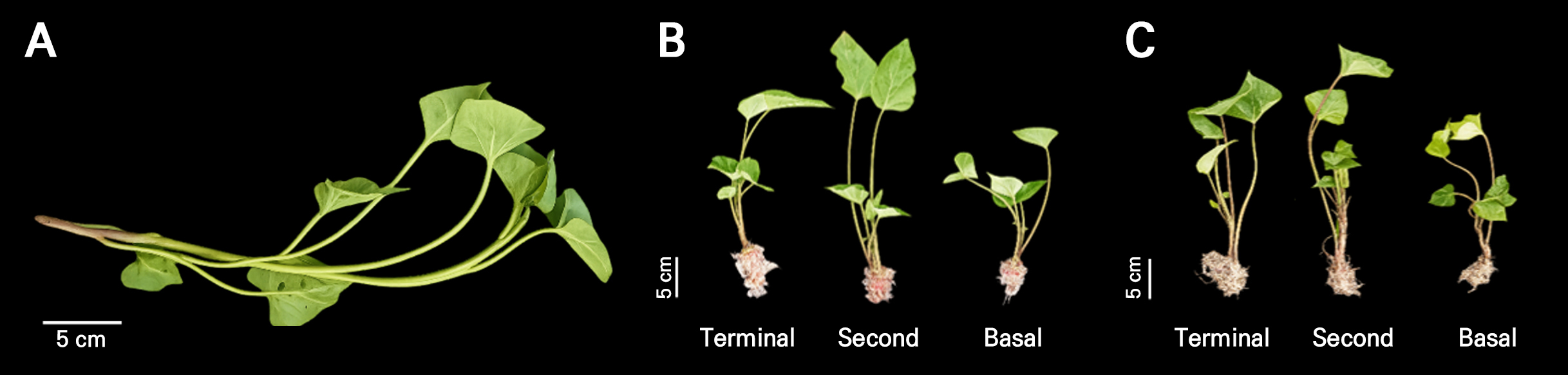
Root lengths, number of leaves, and shoot fresh weights of the second-node cutting-derived seedlings did not significantly differ from those of the terminal treatment, indicating comparable seedling quality. In contrast, the shoot length of the basal-node cutting-derived seedlings was significantly shorter than that of the other node positions, while no significant differences were observed in the other parameters. Although the second-node cuttings had the highest initial fresh weight (Table 1), the seedling quality after the 30-day nursery period was highest in the terminal-node cutting-derived seedlings (Table 3). This result is attributable to the apical dominance and high physiological activity of terminal tissues (Müller and Leyser 2011). Terminal tissues possess a high cell division capacity and elevated activity of plant growth regulators, which promote rapid growth after cutting (Lee 2014). In the present study, although the initial fresh weight of cuttings differed among the node positions, these differences did not affect the survival rate. However, the node position significantly influenced the seedling quality. Terminal cuttings exhibited superior growth in major seedling quality parameters, in This case the shoot and root lengths and fresh weight. Specifically, a sufficient shoot length is essential for mechanized handling, while longer roots enhance the water uptake capacity. Furthermore, seedlings with higher fresh weights likely provide an advantage with regard to stable early-stage establishment due to their greater overall biomass (Comas et al. 2013; Kim et al. 2015). Superior growth of terminal cuttings has also been reported in several crops. Previous studies have shown that terminal cuttings exhibit better rooting and growth compared to basal cuttings in virus-free sweet potato (Yoo et al. 2012) and potato (Ku et al. 2000), consistent with the results of the present study. The enhanced growth of terminal cuttings is attributable to the higher auxin activity and greater cell division capacity in terminal tissues (Ma et al. 2025). These physiological characteristics likely contribute to the improved early rooting and subsequent growth of cutting-derived seedlings.
Yield performance after transplanting
Yield performances of the conventional vine cuttings and two-node cutting-derived seedlings measured at 120 days after transplanting are presented in Table 4 and Fig. 3. Survival rates ranged from 94.3 to 100%, and all node positions in the 30-day nursery treatments showed 100% survival. This trend can be attributed to the improved seedling quality and vigor associated with the longer nursery period. The number of storage roots per plant was highest in the conventional vine cuttings at 4.2 roots per plant. Among the cutting-derived seedling treatments, no significant differences were observed in the number of storage roots per plant among the T20, S20, B20, and T30 treatments, with values ranging from 3.2 to 3.6. Regarding the storage root weight per plant, T30 showed the highest numerical storage root weight per plant value at 307 g, which was numerically higher than the value of 297 g recorded for the conventional vine cuttings, whereas S30 recorded the lowest value of 231 g. Except for S20 and S30, the storage root weight per plant of the cutting-derived seedling treatments did not differ significantly from those of the conventional vine cuttings (Table 4). These results indicate that T30 showed the highest numerical storage root weight per plant, while several cutting-derived seedling treatments maintained a storage root weight comparable to that of conventional vine cuttings. A similar trend was observed for the total yield (Table 4). T30 showed the highest numerical total yield of 1,536 g, which was numerically higher than that of the conventional vine cuttings (1,471 g), whereas S30 recorded the lowest value (1,153 g). Although the total yield of S30 was significantly lower than that of T30, it did not differ significantly from that of the conventional vine cuttings, indicating statistically comparable yield performance. Moreover, most cutting-derived seedling treatments, except for B20, produced a greater proportion of storage roots within the highly marketable range of 50–350 g relative to the conventional vine cuttings. In particular, B30 showed the highest value of 129.7 g, followed by S30 (124.8 g) and T30 (120.4 g). No significant differences were observed among the 30-day nursery treatments, indicating that stable production of marketable storage roots can be achieved when a sufficient nursery period is secured, regardless of the node position. Although the basal-node cutting-derived seedlings exhibited relatively low growth indicators in the seedling quality assessment (Table 3), no reduction in yield was observed. This may have arisen because the cutting-derived seedlings were transplanted with a pre-developed root system. In contrast, conventional vine cuttings are transplanted without formed roots and, therefore, require rooting after transplanting. These physiological advantages of the cutting-derived seedlings likely contributed to their improved early rooting and assimilated accumulation, ultimately maintaining yield performance comparable to that of conventional vine cuttings (Yu et al. 1999; Ma et al. 2015; Lee 2023).
Table 4.
Yield and storage root size distribution of sweet potato at 120 days after transplanting according to the seedling type and nursery period
| Treatmentz |
Survival rate (%) |
No. of storage roots (no·plant-1) |
Weight of storage roots (g·plant-1) |
Total yield (g/4.4 m2) | Distribution of storage roots per plant | |||||||
| Less than 50 g | 50-350 g | Over 350 g | ||||||||||
| Number | Weight (g) | Number | Weight (g) | Number | Weight (g) | |||||||
| T20 | 94.3 | 3.6 ± 1.0 by | 288 ± 65 abc | 1,358 ± 60 ab | 7 | 28.7 ± 2.2 a | 10 | 113.4 ± 5.0 abc | -x | - | ||
| S20 | 100 | 3.2 ± 0.9 b | 252 ± 73 cd | 1,253 ± 104 ab | 6 | 31.0 ± 12 a | 9 | 105.0 ± 4.7 bc | 1 | 361 | ||
| B20 | 94.3 | 3.6 ± 1.1 b | 262 ± 59 bcd | 1,234 ± 75 ab | 6 | 31.5 ± 22 a | 11 | 99.5 ± 6.7 d | - | - | ||
| Mean | 96.2 | 3.4 | 267 | 1,282 | 6 | 30.4 | 10 | 106.0 | 0 | 120 | ||
| T30 | 100 | 3.4 ±1.0 b | 307 ±102 a | 1,536 ± 136 a | 7 | 30.5 ± 1.2 a | 10 | 120.4 ± 9.9 abc | 2 | 1020 | ||
| S30 | 100 | 2.2 ± 0.8 c | 231 ± 82 d | 1,153 ±117 b | 3 | 33.4 ± 18 a | 7 | 124.8 ± 9.3 ab | 2 | 744 | ||
| B30 | 100 | 2.6 ± 0.8 c | 265 ± 86 bcd | 1,323 ±133 ab | 4 | 33.6 ± 21 a | 9 | 129.7 ± 8.3 a | 1 | 402 | ||
| Mean | 100 | 2.7 | 267 | 1,337 | 5 | 32.5 | 9 | 125.0 | 2 | 722 | ||
| Conventional | 100 | 4.2 ± 1.4 a | 297 ± 87 ab | 1,471 ±120 ab | 9 | 29.4 ± 13 a | 12 | 98.8 ± 45 d | - | - | ||
zTreatment = 20 days, sweet potato seed vines were cut into two-node cuttings and grown in a nursery for 20 days; 30 days, sweet potato seed vines were cut into two-node cuttings and grown in a nursery for 30 days; Terminal, the apical cutting among the three cuttings; Second, the second node from the top among the three cuttings; Basal, the lowest node among the three cuttings.
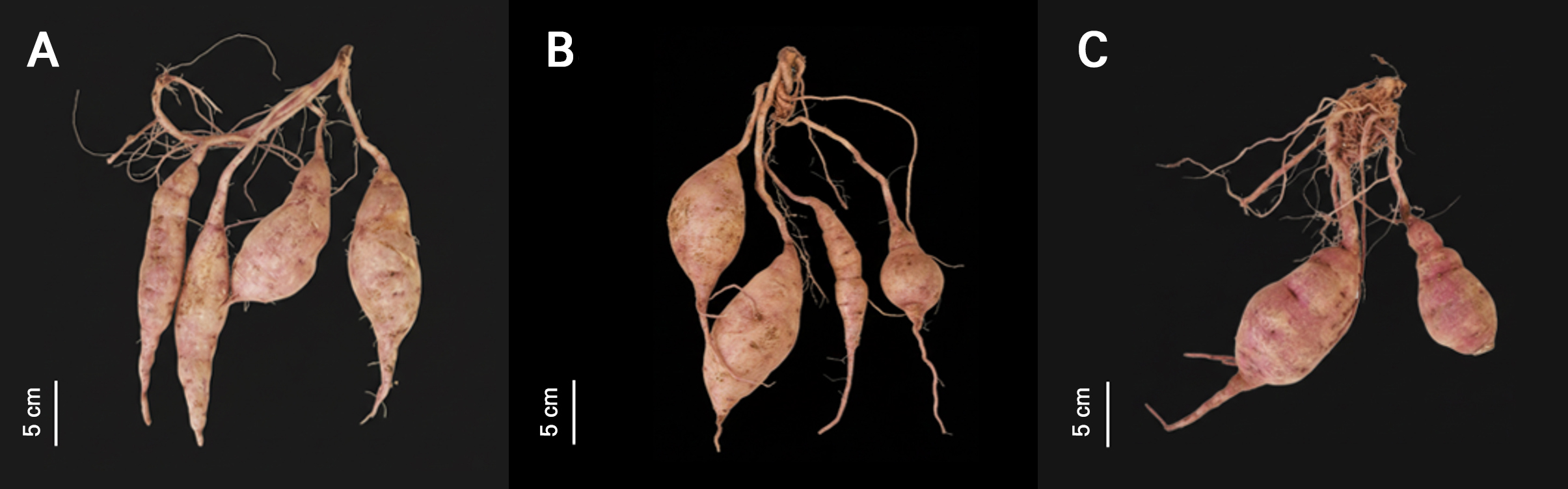
Fig. 3.
Storage root morphology at harvest according to the seedling type and nursery period: (A) storage roots harvested from conventional seedlings without a nursery treatment, (B) storage roots harvested from two-node cuttings after 20 days in the nursery, and (C) storage roots harvested from two-node cuttings after 30 days in the nursery.
In conventional vine-transplanting systems, unrooted vine cuttings are directly transplanted into the field, making early rooting highly susceptible to environmental conditions. In contrast, cutting-derived seedlings are transplanted with a well-developed root system formed during the nursery stage, which enhances early growth stability and promotes uniform growth after transplanting (You et al. 2022). In the present study, although the two-node cutting-derived seedlings showed lower values for the shoot length, leaf number, leaf area, and fresh weight than conventional vine cuttings, they met the essential quality criteria for mechanized transplanting, including morphological uniformity and a well-developed root system within the plug cell. These characteristics are important for stable handling by automated transplanting systems and contributed to storage root yield performance comparable to that of conventional vine planting after transplanting. This is likely due to the rooted cultivation system, which enables stable adaptation to environmental conditions after transplanting via the pre-developed root system. In particular, T30 showed the most stable performance as assessed by seedling quality, survival rate, yield per plant, and total yield. This is directly attributed to the well-developed root system resulting from the sufficient nursery period and high physiological activity of terminal tissues (Ma et al. 2025). Therefore, the production of cutting-derived seedlings and management of the nursery period can be considered key factors for ensuring stable productivity in sweet potato cultivation systems.
Collectively, these findings demonstrate that two-node cutting-derived seedlings, particularly terminal cuttings grown for 30 days, can maintain a yield and marketable storage root production comparable to that of conventional vine transplanting, thus supporting their suitability as transplanting materials for mechanized sweet potato cultivation.
