Horticultural Science and Technology. 31 August 2015. 470-478
https://doi.org/10.7235/hort.2015.15029

ABSTRACT


MAIN

  • 서 언

  • 재료 및 방법

  • 결과 및 고찰

서  언

Anthocyanin은 포도를 비롯한 다양한 식물에서 과실, 꽃, 종자 등의 여러 기관에 존재하는 붉은 빛을 내는 색소이다. 포도의 색은 품종에 따라 연녹색에서 진한 검정색까지 다양하며, 과피의 색을 결정하는 anthocyanin은 과피에 주로 존재하지만 일부 품종에서는 과육에 존재하기도 한다(Castillo- Muñoz et al., 2009). Anthocyanin의 함량은 수확 시기, 성숙기의 온도, 일교차, ABA 처리 유무에 따라 다르지만 anthocyanin 조성은 날씨나 재배 조건 등의 영향을 받지 않고 성숙하는 과정에서도 큰 변화가 없다(Mattivi et al., 2006). 따라서 과피색의 특징을 표현함에 있어 anthocyanin의 함량보다는 조성을 이용하는 것이 보다 적합하다(Núñez et al., 2004; Wu et al., 2004).

대부분의 고등 식물에 존재하는 anthocyanin은 결합되어 있는 작용기에 따라 구분되고, 그 중에서 cyanidin, delphinidin, malvidin, pelargonidin, peonidin, petunidin의 6가지의 antho-cyanidin이 가장 빈번하게 발생된다(Mazza and Miniati, 1993). 작용기로는 수산기(-OH)와 메틸기(-OCH3)가 있으며, cyanidin과 peonidin은 B링의 3’번 탄소 위치에 결합되고, delphinidin, petunidin, malvidin은 3’번과 5’번 위치에 결합된다(Gómez- Alonso et al., 2007). 일반적으로 포도에서는 delphinidin, cyanidin, petunidin, peonidin, malvidin이 만들어지는 것으로 알려져 있으나(Baldi et al., 1995), 최근에는 포도에서도 pelargonidin이 극소량 존재하는 것으로 보고되었다(He et al., 2010).

Anthocyanin은 anthocyanidin과 당이 결합한 형태로 대부분 존재하여 당의 개수와 결합 위치가 다양하고 glucose, galactose, rhamnose, arabinose 등이 대표적이다(Yonekura- Sakakibara et al., 2009). 그 중에서 일부는 acetic acid, p-coumaric acid, caffeic acid, ferulic acid 등의 organic acid와 acylation된 형태를 갖는다(García-Beneytez et al., 2003; Yonekura-Sakakibara et al., 2009).

Anthocyanin의 조성을 이용해 포도 품종을 구분하는 것이 가능하고(Huang et al., 2009) 포도와 와인의 품종을 구분하는데 있어 지표로 사용되고 있다(Núñez et al., 2004; Yokotsuka et al., 1988). Vitis vinifera의 anthocyanin은 당이 한 개 결합되어 있는 형태와 acylation된 형태이지만(Liang et al., 2008), V. rotundifolia의 anthocyanin에는 2개의 당과 결합된 형태만 존재하고, V. riparia와 V. rupestris에서는 당이 1개만 결합되어 있다(Mazza, 1995; Ribéreau-Gayon, 1982; Stobiecki, 2000; Yokotsuka et al., 1988). Anthocyanin의 조성에 관해 나타나는 특성들은 이용해서 종이나 교잡종간의 구분이 가능하다(Mazza, 1995; Zhao et al., 2010). 그러나 이와 관련된 대부분의 연구는 V. vinifera에 집중되었으며 V. amurensis와 그 교잡종에 대해서는 거의 연구되지 못하였다.

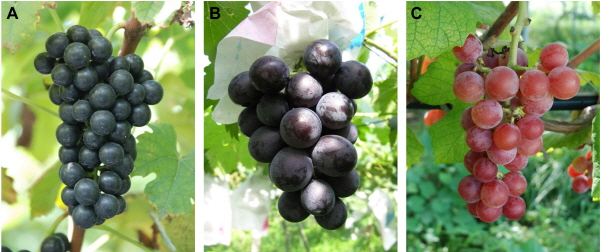
본 연구에 이용된 ‘개량머루’는 흑포도 품종으로 변색기 고온이나 지속적인 강우일수와 같은 포도 착색에 불량한 기상조건에서도 착색이 우수하다(Yamane and Shibayama, 2006, Kwon et al., 2011). ‘거봉’은 대표적인 교잡종인 흑포도로 기상조건이나 착과량 등에 의해 착색이 불량해지기 쉽고(Shim et al., 2007) ‘홍이슬’은 분홍색 과피를 갖고 있는 국내 육성 품종이다(Fig. 1).

http://static.apub.kr/journalsite/sites/kshs/2015-033-04/N0130330402/images/KSHS_33_04_02_F1.jpg

Fig. 1. Matured clusters of (A) ‘Gaeryangmeoru’, (B) ‘Kyoho’, and (C) ‘Hongisul’ grapes cultivated in Korea.

본 연구에서는 포도의 anthocyanin 조성을 ultra-performance liquid chromatography(UPLC)를 mass spectrometer(MS)를 이용해서 분석하였으며, 품종 고유의 anthocyanin 특성을 구명하고 포도 착색에 관한 기초 데이터를 구축하고자 하였다.

재료 및 방법

표준 물질로 Cyanidin glucoside, delphinidin glucoside, malvidin glucoside, pelargonidin glucoside, petunidin glucoside (Polyphenols Laboratories AS, Sadness, Norway), peonidin glucoside(Extrasynthèse, Genay, France)를 구입하였다. 시약은 HPLC용 Methanol(J.T. Baker, Center Valley, PA), formic acid와 hydrochloric acid(Sigma Aldrich, St. Louis, MO)를 사용하였다. 초순수 증류수는 Direct-Q3 purification system (Millipore Milford, MA, USA)을 사용해 얻었다.

‘개량머루’는 파주, ‘거봉’, ‘홍이슬’ 포도는 안성 인근 농가에서 품종별 성숙기에 수확하였으며 수확 직후 과피는 과육으로부터 분리하여 -80°C에서 보관하였다. 과방당 10개 과립을 무작위로 사용하였으며, 1개 과방을 1반복으로 하여 품종당 6반복 하였다.

과피 1g을 1% HCl-methanol 20mL에 넣고 30분간 초음파 처리 후 상온에서 2시간동안 추출하고, 1% HCl-methanol 20mL를 추가하여 잔여 추출물을 수집하였다. 추출물 10mL를 45°C에서 rotary evaporating하고 침전물을 0.01% HCl-증류수 10mL에 녹였다. C18 SPE cartridge는 5mL의 methanol과 0.01% HCl-증류수의 순서로 활성화시켜 준비하였다. 최종 추출물을 cartridge에 주입한 다음, 0.01% HCl-증류수 5mL로 세척 후 5mL methanol을 통과시켜 anthocyanin을 최종적으로 용출하였다. UPLC에 분석하기 직전 0.45μm syringe filter로 여과하여 사용하였다..

Anthocyanin의 분석은 UPLC-ESI-MS/MS를 이용해 분석하였다. 600 pump, autosampler, PDA detector로 구성 된 UPLC system(Accela, Thermo, US)과 mass spectrometry (LTQ velos, Thermo, US)를 연결하였으며 hypersil gold 컬럼(100 × 2.1mm, particle size 3μm)을 이용하여 물질을 분리하였다.

이동상 A와 B는 각각 1% formic acid 수용액과 100% methanol을 사용했으며 유속은 200μL・min-1으로 흘려주었다. 이동상의 조성은 gradient를 설정하여 100% methanol(이동상 B)을 기준으로 5%에서 시작해서 20분(24%), 38분(45%), 40분(100%), 44분(100%), 46분(13%), 56분(13%)이 되도록 하였다. PDA는 520nm에서 검출하였고, 컬럼 30°C, 트레이 10°C로 온도를 설정하고, 시료는 10μL를 주입하였다.

ESI source를 결합하여 collision-induced dissociation(CID) mode로 collision energy를 35%로 설정하였으며 positive mode로 scan range 10-1000m/z에서 기록하였다. Capillary 275.0°C, source heater 250.0°C, sheath gas flow 35.0, aux gas flow rate 5.0, sweep gas flow 5.0로 설정하였다.

결과 및 고찰

‘개량머루’, ‘거봉’, ‘홍이슬’ 과피의 anthocyanin 조성을 UPLC-ESI-MS/MS를 이용하여 조사하였다. 먼저 anthocyanin 표준물질의 fragment pattern을 확인하였고, 추출액에서 검출된 물질은 검출시간, MS에서 분자량, MS/MS에 의한 ion fragment pattern을 표준물질과 비교하였다. 또한 기존 문헌에서 보고된 검출순서와 일치하는지 확인하였다.

Anthocyanin 표준물질과 과피 추출물에서의 MS/MS의 결과에서 mono glucoside는 M+-162의 fragment ion(m/z 287, 301, 303, 317, 331)이 검출되었고, di glucoside는 M+-162, M+-324의 fragment ion이 검출되었다(Fig. 2A). 이러한 패턴은 anthocyanin에서 glucose 분자(m/z 162)가 떨어지기 때문에 발생되는 것으로 확인되었다. Acylated form에서는 acylated organic acid의 종류에 따라 acetic acid(M+-162, -204, -366), caffeic acid(M+-162, -324, -486), p-coumaric acid(M+-162, -308, -470), ferulic acid(M+-338)의 공통적인 fragment pattern을 확인했다(Fig. 2B).

http://static.apub.kr/journalsite/sites/kshs/2015-033-04/N0130330402/images/KSHS_33_04_01_F2.jpg

Fig. 2. MS/MS spectra of malvidin 3-glucoside (MW 493) (A) and malvidin 3-coumaroyl glucoside 5-glucoside (MW 801) (B) within ‘Gaeryangmeoru’ grape skin extract. MW, molecular weight.

위의 과정을 통해 3개 품종에서 추출된 anthocyanin을 검출된 순서로 비교하였다(Table 1). Cyanidin, delphinidin, petunidin, peonidin, malvidin의 anthocyanidin과 mono-glucoside, di- glucoside, non-acylated, acylated form(acetyl, caffeoyl, coumaroyl, feruloyl)으로 구분되어 총 29종의 anthocyanin이 확인되었다.

검출되는 anthocyanidin의 순서는 delphinidin, cyanidin, petunidin, peonidin, malvidin이었고 di-glucoside는 mono- glucoside보다 먼저 검출되었다. Acylation 중에서는 acetic acid, caffeic acid, p-coumaric acid의 순서로 확인되어 기존에 보고된 organic acid에 따른 검출 순서와 일치하였다(García-Beneytez et al., 2003; Wu and Prior, 2005). 즉 검출되는 순서는 di-glucoside, mono-glucoside, acetyl di-glucoside, caffeoyl di-glucoside, coumaroyl di-glucoside, acetyl mono- glucoside, caffeoyl mono-glucoside, coumaroyl mono-glucoside이었다.

각 품종에서 확인된 anthocyanin은 ‘개량머루’와 ‘거봉’이 25종, ‘홍이슬’이 21종이었다(Table 2). ‘개량머루’와 ‘거봉’에서는 malvidin mono-glucoside가 가장 많이 검출되었고 ‘홍이슬’에서는 cyanidin mono-glucoside였다. 각 품종에서 상대적으로 검출량이 많았던 anthocyanin은 ‘개량머루’ 8종, ‘거봉’ 14종 및 ‘홍이슬’ 5종이었다. 결과적으로 ‘홍이슬’의 anthocyanin 조성이 가장 수가 적고 단순하였고, cyanidin 이외의 anthocyanin은 소량 존재하는 특징을 확인하였다. Cyanidin feruloyl glucoside는 ‘홍이슬’에서만 검출되었고 다른 품종에서는 전혀 검출되지 않았다.

검출된 anthocyanin을 anthocyanidin을 기준으로 분류한 결과(Fig. 3) malvidin은 ‘개량머루’와 ‘거봉’에서 각각 44.1%와 56.5%로 가장 풍부했다. Cyanidin은 6.4%와 4.1%로 ‘개량머루’와 ‘거봉’에서는 가장 적었던 반면 ‘홍이슬’에서는 96.8%로 가장 많았다. ‘홍이슬’의 anthocyanin은 cyanidin이 대부분이고 나머지 anthocyanidin이 0.1-2.0%로 매우 적은 품종 특성이 관찰되었다.

Anthocyanin에 결합된 당의 개수를 기준으로 분류한 결과(Fig. 4), 세 품종에서 공통적으로 mono-glucoside가 di- glucoside보다 많아 2.3-5.9배 차이를 보였으며, 특히 홍이슬은 85.5%로 mono-glucoside가 다른 품종에 비해 많았다.
http://static.apub.kr/journalsite/sites/kshs/2015-033-04/N0130330402/images/KSHS_33_04_01_F3.jpg

Fig. 3. Classification of anthocyanin according to the types of anthocyanidin. Mean ± SD.

http://static.apub.kr/journalsite/sites/kshs/2015-033-04/N0130330402/images/KSHS_33_04_01_F4.jpg

Fig. 4. Classification of anthocyanin according to the number of substituted glucoses. Mean ± SD.

Anthocyanin의 acylation된 organic acid를 기준으로 antho-cyanin을 분류한 결과, non-acylation은 ‘홍이슬’(25.7%), ‘거봉’(58.6%), ‘개량머루’(98.0%)의 순이었다(Fig. 5). Acylation을 형성하는 4종의 organic acid가 확인되었으며 p-coumaric acid, acetic acid, caffeic acid, ferulic acid였다. 세 품종에서 모두 coumaric acid와 결합된 형태가 가장 많았고, 특히 ‘홍이슬’(70.7%)에서 가장 많았다. 다른 organic acid는 소량 존재했으며 ferulic acid는 홍이슬에서만 발견되었다. 따라서 본 연구에서의 품종별 anthocyanin의 분류는 acylation의 유무와 organic acid의 종류에 따른 차이가 가장 큰 것을 확인하였다.
http://static.apub.kr/journalsite/sites/kshs/2015-033-04/N0130330402/images/KSHS_33_04_01_F5.jpg

Fig. 5. Classification of anthocyanin according to the types of acylated organic acid. Mean ± SD.

본 연구의 결과에 의하면 mono-glucoside와 di-glucoside는 ‘개량머루’, ‘거봉’, ‘홍이슬’에서 모두 검출되었고, acylation은 거봉과 홍이슬에서만 확인되었다. 기존의 보고에 의하면 V. vinifera의 anthocyanin은 di-glucoside가 존재하지 않고 mono-glucoside와 그 유도체인 acylation만으로 되어 있다(Boss et al., 1996; Mazzuca et al., 2005; Núñez et al., 2004). 이는 교잡종 포도는 anthocyanin 조성이 복잡하고 분광 특성이 유사하다는 (Ribéreau-Gayon(2001)과 García-Beneytez et al.(2003)의 보고와 같이 교잡종 품종에서는 상대적으로 다양한 anthocyanin으로 구성되어 있는 것을 확인할 수 있었으며, 특히 ‘거봉’에는 mono-, di-glucoside 및 acylation 형태가 다양하고 고르게 존재하는 것이 확인되었고, 따라서 교잡종 포도의 anthocyanin 조성은 LC-MS를 이용해서 분석하는 것이 가장 적합한 것으로 판단되었다.

현재까지 보고된 연구결과에 의하면 anthocyanin의 종류 및 조성, 특정 anthocyanin을 이용해 포도의 종류를 구분하는 것이 가능하여 와인 제조에 이용된 품종을 구분하거나 재배중인 포도의 종이나 품종을 구분하는데 이용되고 있다(Castillo-Muñoz et al., 2009; Gómez-Alonso et al., 2007; Núñez et al., 2004) 본 연구에서의 ‘개량머루’ anthocyanin은 acylation의 형태가 거의 존재하지 않는 특징을 보여 다른 품종이나 기존에 보고된 포도의 anthocyanin 조성과는 뚜렷한 차이를 보였다.

‘개량머루’는 양친과 기원이 불분명한 품종이며, 분자생물학적 방법으로도 국내 재배 품종뿐만 아니라 V. vinifera 품종과도 유전적 관계가 전혀 없는 것으로 확인되어 양친을 확인할 수 없었다(Park et al., 2003; Park and Lee, 2007). 따라서 ‘개량머루’의 기원을 추적하기 위해서는 품종 특성을 구명하고 기존에 보고된 문헌과 비교하는 방법을 통해 여러 가능성을 검토하는 과정이 필요하다. Zhao et al.(2010)이 V. amurensis와 그 교잡종에서 acylation이 존재하지 않는 anthocyanin 조성이 관찰되었다고 보고하였고 이러한 anthocyanin 조성은 다른 포도 속에서는 전혀 보고되지 못하였으므로, 본 연구 결과에서 acylated anthocyanin이 존재하지 않았던 ‘개량머루’는 중국 등지에서 자생하고 있는 V. amurensis 혹은 그 교잡종일 것으로 판단되었다. 이를 증명하기 위해서는 자생하고 있는 V. amurensis의 다양한 변종 수집과 분자 수준에서의 검증이 반드시 필요할 것으로 판단된다.

‘홍이슬’에서 검출된 cyanidin feruloyl glucoside은 다른 포도 품종에서는 거의 보고되지 않았고, anthocyanidin중에서 cyanidin이 풍부하고 p-coumaric acid의 acylation 비율이 월등히 높은 특징을 갖고 있다. ‘Koshu’ 포도에는 peonidin fumaryl mono-glucoside가 존재하기 때문에 다른 품종과 구분이 가능하다는 Yokotsuka et al.(1988)의 보고와 같이 cyanidin feruloyl glucoside는 ‘홍이슬’의 품종 구분의 기준으로 사용할 수 있을 것으로 판단된다.

‘Pinot noir’ 포도는 acylated form과 di-glucoside가 존재하지 않고 mono-glucoside의 형태로만 존재하여 anthocyanin 조성이 단순하기 때문에 anthocyanin 연구에 적극적으로 활용되고 있다(Cortell et al., 2007; Mori et al., 2005). ‘개량머루’는 acylation이 진행되지 않았고, ‘홍이슬’은 cyanidin으로 구성된 단순한 조성이므로 이 품종들을 이용해서 anthocyanin의 생합성 과정의 flavonoid 3’, 5’ hydroxylase, methyltransferase, acyltransferase와 관련된 연구에 활용될 것으로 기대된다

Table 1. Anthocyanins detected by MS analysis of the extracts from ‘Gaeryangmeoru’, ‘Kyoho’, and ‘Hongisul’ grapes.

No.

Identity

tR

(min)

Molecular ion (M+)

(m/z)

Fragment ions

(m/z)

1

delphinidin-3,5-diglucoside

 8.81

627

303, 465

2

cyanidin-3,5-diglucoside

10.84

611

287, 449

3

petunidin-3,5-diglucoside

12.26

641

317, 479

4

delphinidin-3-glucoside

14.10

465

303

5

peonidin-3,5-diglucoside

14.62

625

301, 463

6

malvidin-3,5-diglucoside

15.61

655

331, 493

7

cyanidin-3-glucoside

16.62

449

287

8

petunidin-3-glucoside

18.41

479

317

9

petunidin-3-acetyl glucoside-5-glucoside

20.11

683

317, 521

10

peonidin-3-glucoside

21.34

463

301

11

malvidin-3-glucoside

22.42

493

331

12

malvidin-3-acetyl glucoside-5-glucoside

23.14

697

331, 493, 535

13

delphinidin-3-acetyl glucoside

26.31

507

303

14

delphinidin-3-coumaroyl glucoside-5-glucoside

28.39

773

303, 465, 661

15

malvidin-3-caffeoyl glucoside-5-glucoside

28.91

817

331, 493, 655

16

delphinidin-3-caffeoyl glucoside

29.10

627

303

17

cyanidin-3-acetyl glucoside

29.03

491

287

18

cyanidin-3-coumaroyl glucoside-5-glucoside

29.93

757

287, 449, 595

19

petunidin-3-coumaroyl glucoside-5-glucoside

30.26

787

317, 479, 625

20

malvidin-3-coumaroyl glucoside-5-glucoside

31.49

801

331, 493, 639

21

peonidin-3-coumaroyl glucoside-5-glucoside

32.09

771

301, 463, 609

22

malvidin-3-acetyl glucoside

32.11

535

331

23

delphinidin-3-coumaroyl glucoside

32.96

611

303

24

malvidin-3-caffeoyl glucoside

33.77

655

331

25

cyanidin-3-coumaroyl glucoside

35.01

595

287

26

cyanidin-3-feruloyl glucoside

35.04

625

287

27

petunidin-3-coumaroyl glucoside

35.31

625

317

28

malvidin-3-coumaroyl glucoside

37.22

639

331

29

peonidin-3-coumaroyl glucoside

37.37

609

301

The data were obtained using UPLC-ESI-MS/MS. tR, retention time

Table 2. Anthocyanin profiles of the skin in ‘Gaeryangmeoru’, ‘Kyoho’, and ‘Hongisul’ grapes.

Identity

Gaeryangmeoru

(area %)

Kyoho

(area %)

Hongisul

(area %)

cyanidin-3-glucoside

 5.70

 2.53

23.35

cyanidin-3-glucoside-5-glucoside

 0.61

 0.06

 1.50

cyanidin-3-acetyl glucoside

nd

nd

 3.22

cyanidin-3-coumaroyl glucoside

 0.08

 1.28

56.58

cyanidin-3-coumaroyl glucoside-5-glucoside

nd

 0.20

12.01

cyanidin-3-feruloyl glucoside

nd

nd

 0.16

delphinidin-3-glucoside

16.14 

 4.08

 0.41

delphinidin-3-glucoside-5-glucoside

 0.13

nd

 0.04

delphinidin-3-acetyl glucoside

 0.02

 0.03

 0.19

delphinidin-3-caffeoyl glucoside

 0.06

 0.01

 0.06

delphinidin-3-coumaroyl glucoside

 0.40

 2.44

 0.98

delphinidin-3-coumaroyl glucoside-5-glucoside

 0.04

 0.15

 0.27

peonidin-3-glucoside

 4.35

11.32 

 0.22

peonidin-3-glucoside-5-glucoside

 6.39

 4.36

 0.08

peonidin-3-coumaroyl glucoside

 0.07

 3.67

 0.28

peonidin-3-coumaroyl glucoside-5-glucoside

 0.01

 3.34

 0.45

petunidin-3-glucoside

16.93 

 5.10

nd

petunidin-3-glucoside-5-glucoside

 4.66

 0.23

 0.04

petunidin-3-acetyl glucoside-5-glucoside

 0.01

nd

nd

petunidin-3-coumaroyl glucoside

 0.26

 4.31

nd

petunidin-3-coumaroyl glucoside-5-glucoside

 0.03

 0.44

 0.04

malvidin-3-glucoside

25.01 

23.24 

nd

malvidin-3-glucoside-5-glucoside

18.10 

 7.69

 0.05

malvidin-3-acetyl glucoside

 0.04

 0.23

nd

malvidin-3-acetyl glucoside-5-glucoside

nd

 0.02

nd

malvidin-3-caffeoyl glucoside

 0.23

 0.13

nd

malvidin-3-caffeoyl glucoside-5-glucoside

 0.04

 0.05

nd

malvidin-3-coumaroyl glucoside

 0.60

16.04 

 0.06

malvidin-3-coumaroyl glucoside-5-glucoside

 0.07

 9.06

 0.02

The data were obtained using UPLC-ESI-MS/MS. nd, not detected.

Acknowledgements

본 연구는 농촌진흥청 공동연구사업의 지원(PJ008224082014)에 의해 수행되었음.

References

1
Baldi, A., A. Romani, N. Mulinacci, F.F. Vincieri, and B. Casetta. 1995. HPLC/MS application to anthocyanins of Vitis vinifera L. J. Agric. Food Chem. 43:2104-2109.
2
Boss, P.K., C. avies, and S.P. Robinson. 1996. Anthocyanin com-position and anthocyanin pathway gene expression in grapevine sports differing in berry skin colour. Aust. J. Grape Wine Res. 2:163-170.
3
Castillo-Muñoz, N., M. Fernández-González, S. Gómez-Alonso, E. García-Romero, and I. Hermonsín-Gutiérrez. 2009. Red-color related phenolic composition of Garnacha Tintorera (Vitis vinifera L.) grapes and red wines. J. Agric. Food Chem. 57:7883-7891.
4
Cortell, J.M., M. Halbleib, A.V. Gallagher, T.L. Righetti, and J.A. Kennedy. 2007. Influence of vine vigor on grape (Vitis vinifera L. cv. Pinot Noir) anthocyanins. 1. Anthocyanin concentration and composition in fruit. J. Agric. Food Chem. 55:6575-6584.
5
García-Beneytez, E., F. Cabello, and E. Revillia. 2003. Analysis of grape and wine anthocyanins by HPLC-MS. J. Agric. Food Chem. 51:5622-5629.
6
Gómez-Alonso, S., M. Fernández-Gonzalez, A. Mena, J. Martínez, and E. García-Romero. 2007. Anthocyanin profile of Spanish Vitis vinifera L. red grape varieties in danger of extinction. Aust. J. Grape Wine Res. 13:150-156.
7
Huang, Z., B. Wang, P. Williams, and R.D. Pace. 2009. Identifi-cation of anthocyanins in muscadine grapes with HPLC-ESI-MS. LWT-Food Sci. Technol. 42:819-824.
8
Kwon, Y.H., B.H.N. Lee, S.B. Shim, K.H. Shin, I.M. Choi, and H.S. Park. 2011. Fruit quality and freezing damage of ‘Kyoho’ grapes by girdling. Kor. J. Hort. Sci. Technol. 29:81-86.
9
Liang, Z.C., B.H. Wu, P.G. Fan, C.X. Yang, W. Duan, X.B. Zheng, C.Y. Liu, and S.H. Li. 2008. Anthocyanin composition and content in grape berry skin in Vitis germplasm. Food Chem. 111:837-844.
10
Mattivi, F., R. Guzzon, U. Vrhovsek, M. Stefanini, and R. Velasco. 2006. Metabolite profiling of grape: Flavonols and anthocyanins J. Agric. Food Chem. 54:7692-7702.
11
Mazza, G. 1995. Anthocyanins in grapes and grape products. Crit. Rev. Food. Sci. Nutr. 35:341-371.
12
Mazzuca, P., P. Ferranti, G. Picariello, I. Chianese, and F. Addeo. 2005. Mass spectrometry in the study of anthocyanins and their derivatives: differentiation of Vitis vinifera and hybrid grapes by liquid chromatography/ electrospray ionization mass spectrometry and tandem mass spectrometry. J. Mass Spectrom. 40:83-90.
13
Mori, K., H. Saito, N. Goto-Yamamoto, M. Kitayama, S. Kobayashi, S. Sugaya, H. Gemma, and K. Hashizme. 2005. Effects of abscisic acid treatment and night temperatures on anthocyanin composition in Pinot noir grapes. Vitis 44:161-165.
14
Núñez, V., M. Monagas, M.C. Gomez-Cordovés, and B. Bartolomé. 2004. Vitis vinifera L. cv. Graciano grapes characterized bits anthocyanin profile. Postharvest Biol. Technol. 31:69-79.
15
Park, Y.S, I.J. Kim, B.C. Jung, S.M. Park, J.H. Kim, and C.S. Jeong. 2003. The origin of gailiangmeru (Vitis spp.) for isozyme analysis, leaf and seed character. Kor. J. Hort. Sci. Technol. 21 (SUPPL. I) (Abstr.).
16
Park, H.S. and G.P. Lee. 2007. The study of functional materials, classification, identification and cultivation techniques for ‘Gaer-yangmeoru’ grape. Rural Development Administration (in Korean).
17
Ramazzotti, S., I. Filippetti, and C. Intrieri. 2008. Expression of genes associated with anthocyanin synthesis in red-purplish, pink, pinkish-green and green grape berries from mutated ‘Sangioveses’ biotypes: A case study. Vitis 47:147-151.
18
Ribéreau-Gayon, P. 1982. The anthocyanins of grapes and wines, p. 209-244. In: Markakis, P. (ed.). Anthocyanins as food colors. New York, Academic Press.
19
Stobiecki, M. 2000. Application of mass spectrometry for iden-tification and structural studies of flavonoid glycosides. Phytochemistry 54:237-256.
20
Wu, X., L. Gu, R.L. Prior, and S. McKay. 2004. Characterization of anthocyanins and proanthocyanidins in some cultivars of Ribes, Aronia, and Sambucus and their antioxidant capacity. J. Agric. Food Chem. 52:7846-7856.
21
Wu, X. and R.L., Prior. 2005. Systematic identification and cha-racterization of anthocyanins by HPLC-ESI-MS/MS in common foods in the United States: Fruits and berries. J. Agric. Food Chem. 53:2589-2599.
22
Yamane, T. and K. Shibayama. 2006. Effects of truck girdling and crop load levels on fruit quality and root elongation in ‘Aki Queen’ grapevines. J. Jpn. Soc. Hortic. Sci. 75:439-444.
23
Yokotsuka, K., N. Nishino, and V.L. Singleton. 1988. Unusual Koshu grape skin anthocyanins. Amer. J. Enol. Vitic. 39: 288-292.
24
Yonekura-Sakakibara, K., T. Nakayama, M. Yamazaki, and K. Saito. 2009. Modification and stabilization of anthocyanins. p. 169-190. In: K. Gould, K. Davies; and C. Winefield (eds.). Anthocyanins: Biosynthesis, functions, and applications. Springer, New York.
25
Zhao, Q, C.Q. Duan, and J. Wang. 2010. Anthocyanins profile of grape berries of Vitis amurensis, its hybrids and their wines. Int. J. Mol. Sci. 11:2212-2228.
페이지 상단으로 이동하기