

Introduction
Materials and Methods
Fruit source for the validation experiment
Experimental instruments and tools
Survey of APCs regarding storage conditions and packinghouse environments
Prediction of water condensation based on psychrometric approaches
Validation experiment and a supplementary treatment for a correlation analysis Experimental treatments
Investigation of water condensation and related fruit attributes
Statistical analysis
Results
Packinghouse operations in apple APCs related to water condensation
Prediction of water condensation on cold-stored apples
Validation of water condensation on cold-stored apples: evaluation of water condensates
Temperature increases
Regression model between VPD and water condensation
Discussion
Conclusions
Introduction
Temperature fluctuations during the breakdown of postharvest cold chains bring out water vapor condensation in cold-stored fruits and vegetables (Bovi et al. 2016; Joyce and Patterson 1994). Substantial condensation occurs when the fruit temperature is low and when the temperature and relative humidity (RH) are high in the surrounding air (Ben-Yehoshua et al. 2005). Condensation diminishes operational efficiency in the packinghouse and disturbs non-destructive measurements, thereby reducing the accuracy when grading the fruit (Yun et al. 2007). Moreover, water condensation s on fresh commodities and within packaging films elevates the risk of microbial contamination throughout the distribution chain (Yun et al. 2007; Linke et al. 2021; Shrivastava et al. 2023). Park et al. (2016) reported that condensation droplets inside packaging films advance quality deterioration during the long-distance distribution and export of tomatoes using modified atmosphere packaging technology.
The first temperature break causing water condensation occurs in the packinghouse when refrigerated fruits and vegetables are on standby in the sorting area after immediate delivery from cold storage. In particular, fruits stored near 0°C, such as apples (Park et al. 2005; Kim et al. 2014), are prone to water condensation when exposed to the warm atmosphere of the packing lines. Although new large-scale agricultural processing centers (APCs) operate in enclosed environments with air conditioning, the packinghouse atmosphere is still affected by weather conditions because doors are frequently open to facilitate vehicle and worker movement. Furthermore, in open-style small-scale APCs, fruits in sorting areas are partially exposed to the ambient atmosphere without air-conditioner systems. The risk of water condensation increases as the outer air temperature rises up to approximately 20°C after March. High RH levels can also aggravate the situation on cloudy and rainy days.
Water condensation can be predicted using theoretical psychrometric approaches (Lee et al. 2007) and can be observed through real-time measurements (Linke et al. 2023). Thermodynamically, condensation on fruits occurs when water vapor moves from the surrounding air under high vapor pressure towards the internal air space of the fruit at low vapor pressure. Vapor pressure, the determinant of water condensation, is a dependent variable affected by the temperature and RH. With regard to the vapor pressure inside fresh fruits, the internal relative humidity remains constant at 97–100% RH, indicating that vapor pressure varies only with the temperature. In contrast, the vapor pressure around the packing lines varies depending on the temperature and RH of the surrounding air (Harvey 1988; Park 2016). From these viewpoints, the first step in avoiding water condensation is to estimate the vapor pressure deficit (VPD) between the fruit and the surrounding atmosphere under various weather conditions. Second, the discussion on the validation of water condensation suggests a practical application of vapor pressure data to prevent water condensation.
This study focuses on water condensation in apples transferred from refrigerated storage to packing lines under various atmospheric conditions. VPDs between the fruit and surrounding atmosphere were theoretically estimated, and water condensation was validated through a laboratory experiment to develop guidelines for packinghouse management to prevent water condensation on apples.
Materials and Methods
Fruit source for the validation experiment
‘Fuji’ apples were harvested in early November of 2024 and cold-stored at 0°C for three months before the experiment. Healthy fruits without surface defects were selected, with an average weight of 352 ± 17 g.
Experimental instruments and tools
The packinghouse atmosphere in the validation experiment was simulated using an incubator (MIR-253; Sanyo Electric Co., Ora-Gun, Gunma, Japan) modified to supplement the RH control function. The temperature and RH inside the incubator were measured using a data logger (TR-72wf; T&D Corp., Matsumoto, Japan). The initial and final fruit temperatures were monitored using a two-channel data logger (TR-71U; T&D Corp.) attached to a probe temperature sensor.
Photographs of the apples were taken using a digital camera (Sony DSC-WX7, Tokyo, Japan) initially 30 min after incubation.
Survey of APCs regarding storage conditions and packinghouse environments
A survey of the packinghouse operations of apple APCs of different sizes was conducted in 2023. The eight APCs involved in this study were grouped into three categories according to the total facility area of the storage, packinghouse, and administration buildings. The indications were as follows: L, large scale (>10,000 m2); M, medium scale (5,000–9,999 m2); and S, small scale (<5,000 m2). The survey questions included those pertaining to storage practices, temperatures, and humidity control in the packinghouse, and the timing of air-conditioner operations.
Prediction of water condensation based on psychrometric approaches
The vapor pressures inside the apples and packinghouses were estimated at specific fruit temperatures and hygrothermal conditions based on the saturation pressure of water vapor (Harvey 1988; Park 2016). VPD was determined by comparing the vapor pressure of the fruit with that of the surrounding air and is expressed in mmHg, a typical unit in the field of postharvest technology. The internal vapor pressure of the fruit was evaluated by applying Raoult’s law, which involves lowering the saturated vapor pressure of the solution (Schmitz 2017). The water activity of the fruit juice in mature ‘Fuji’ apples was estimated to be 0.97 by analyzing sugar concentrations (Choi et al. 1997). The internal vapor pressure was calculated based on this information, multiplying 0.97 by the saturated vapor pressure of water at a particular temperature. The temperature of the fruit required to avoid water condensation in a specific atmosphere was defined by determining the temperature of the vapor pressure equilibrium (VPE), which is the dew point at which the vapor pressure inside the fruit equals that of the surrounding air.
Validation experiment and a supplementary treatment for a correlation analysis Experimental treatments
The experiments were conducted through simulated incubation, considering seasonal variations in packinghouse environments under which potential water condensation on cold-stored apples could occur.
Six treatments were applied at two fruit temperatures in combination with different packinghouse environments, reflecting seasonal weather data from major production areas (KMA 2025). Treatments 1 and 2 were combinations of 0°C fruit temperature with incubation at 10°C and 50% RH and 10°C and 80% RH, respectively, simulating packinghouse operations under weather conditions from December to February. Treatments 3 and 4 were combinations of 0°C fruit temperature with incubation at 20°C and 50% RH and 20°C and 80% RH, respectively, simulating packinghouse operations under weather conditions from late March. Treatments 5 and 6 were 12°C fruit temperature paring incubations at 20°C with 60% or 80% RH, respectively, considering the practice of raising the fruit temperature before their transfer to packing lines.
In addition, a supplementary treatment was performed separately to reinforce the regression model between water condensation and VPD. The complementary data positions were determined along the first regression curve obtained from the six main treatments, indicating the need for water condensation data corresponding to a VPD of approximately 7.0 mmHg. The treatment was performed by incubating refrigerated apples at 3.7°C in an atmosphere maintained at 19.5°C with 75% RH.
Investigation of water condensation and related fruit attributes
Fruit at 0°C (treatments 1–4) and 12°C (treatments 5 and 6) were put into a Styrofoam box according to their respective treatments and moved to an incubator. Individual apples were placed on paper trays, followed by initial weight measurements and incubation for 30 min. The incubation duration was determined based on the retention time of water condensation in fruits after exposure to the target environment (Linke and Gottschalk 2005; Yun et al. 2007).
The increase in fruit weight due to water condensation was estimated by measuring the fruit weight before and after incubation on an analytical scale (MH-999; Boboscale Co., Yiwu, China). The weight of the paper tray holding each apple in a set was measured to ensure the potential loss of water condensate running down the fruit surface. Water condensation per fruit was then converted to weight gain per surface area, as represented in mg·cm-2 of surface area. Fruit surface area was determined using the corrected formula suggested by Clayton et al. (1995): surface area (in cm2) = 5.30 volume0.659 (in cm3). Fruit volume was measured using the water displacement method described by Hryniewicz et al. (2008) to complete the equation.
Statistical analysis
A validation experiment was conducted using a completely randomized design with four replicates. Analysis of variance (ANOVA) and treatment mean separations were determined by Duncan's multiple range test at a significant level of p < 0.05 (SAS 1998). The EXEL program was used to develop a regression model correlating water condensation with VPD.
Results
Packinghouse operations in apple APCs related to water condensation
The survey of eight APCs in 2023 indicated that ‘Fuji’ apples were stored at 0–1°C at high RH levels. The target atmospheric conditions inside the packinghouses were 15–20°C with 60% RH according to the use of air-conditioner operations in large APCs. In contrast, apples were exposed to ambient temperatures with varying RH levels in small-scale APCs (Table 1). After March, when the temperature exceeds 20°C (KMA 2025), two types of temperature control strategies were applied to reduce or prevent water condensation on apples after their removal from the store rooms. The first is the cooling of the packinghouse atmosphere in large-scale APCs. The air-conditioner operation generally started in April and continued until the end of the storage period. The second strategy is to increase the fruit temperature. Post-storage temperature increases in mid- and small-scale APCs were conducted at 10–12°C in store rooms before the transfer of the apples to the packing lines (Table 1).
Table 1.
Survey of apple APCs on temperature and humidity control inside cold storage and around packing lines in 2023
| Apple packinghouse | Inside storage |
Target atmosphere around packing lines |
Air conditioning /temperature-rise operation (°C)w | |||||
| Group by sizez | Namingy | Temp.x (°C) | RHx (%) | Temp. (°C) | RH (%) | |||
| L | A1 | 0.0 | 90 | 15 | 60 | Seasonal/none | ||
| B2 | 0.0 | 90 | 20 | 60 | Seasonal/none | |||
| E5 | 0.0 | 90 | 20 | 60 | Seasonal/none | |||
| H8 | 0.0 | 90 | 20 | 60 | Seasonal/none | |||
| M | C3 | 0.0 | 90 | 20 | 60 | Seasonal/none | ||
| G7 | 0.0 | 95 | 20 | Varied | Seasonal/10‒12 | |||
| S | D4 | 0.0 | 70 | Ambient | Varied | None/10‒12 | ||
| F6 | 0.0 | 90 | Ambient | Varied | None/10‒12 | |||
Prediction of water condensation on cold-stored apples
The fruit temperatures for the VPE (dew points) were theoretically investigated under various packinghouse environments reflecting seasonal weather conditions (Table 2).
Table 2.
Predictions of fruit temperatures for vapor pressure equilibrium to avoid condensation under various temperature and relative humidity conditions in the packinghouse
| Exemplified packinghouse environmentz |
Dew point (fruit temperature to reach vapor pressure equilibriumy) (°C) | |||
| Management |
Temperature (°C) |
Relative humidity (%) |
Vapor pressure (mmHg) | |
|
Under ambient conditions without air-conditioning | 10 | 30 | 2.76 | < 0.0x |
| 50 | 4.60 | 0.5 | ||
| 80 | 7.37 | 7.2 | ||
| 15 | 30 | 3.84 | < 0.0x | |
| 50 | 6.39 | 5.1 | ||
| 80 | 10.23 | 12.1 | ||
| 20 | 30 | 5.26 | 2.4 | |
| 50 | 8.77 | 9.7 | ||
| 80 | 14.03 | 17.0 | ||
| Target of large APCs | 20 | 60 | 10.52 | 12.5 |
The vapor pressure estimation indicated that the dew points were low in environments at low temperatures with low RH levels and increased with an increase in the temperature and RH in the packinghouse atmospheres (Table 2). The dew points estimated under the atmospheric conditions tested here ranged from >0.0 to 17.0°C. The vapor pressure of the atmosphere in the 10°C environments with 30% RH was 2.76 mmHg, which was lower than that in apples at 0°C (4.46 mmHg), indicating that the dew point was below 0°C. With regard to the atmosphere at 10°C with 50% RH, the vapor pressure of the air (4.60 mmHg) was slightly higher than that in apples of 0°C, indicating water vapor movement from the atmosphere towards the apples. The estimated dew point was 0.5°C and was 7.2°C when the atmospheric RH increased to 80%, while the dew points were below 0°C, 5.1°C, and 12.1°C in 15°C atmospheres with different RH conditions of 30%, 50%, and 80%, respectively. The dew points increased under the 20°C environments, with outcomes of 2.4, 9.7, and 17.0 mmHg with the same corresponding RH intervals, respectively. The dew point temperature to prevent water condensation was 12.5°C under the target packinghouse condition of 20°C with 60% RH.
Validation of water condensation on cold-stored apples: evaluation of water condensates
The validation experiment comprised six treatments, combining two fruit temperatures and three atmospheric conditions.
Water condensation on apples after 30 min of incubation differed significantly with the VPD among the fruits and the atmospheres (Table 3). Weight increases by water condensates were slight in treatments with low VPD levels below 1.0 mmHg (treatment 1: 0°C apples in the atmosphere of 10°C, 50% RH; treatment 5: 12°C apples in the atmosphere 20°C, 60% RH). In treatments 1 and 5, the amounts of water condensate were <0.16 mg·cm-2. In comparison, the water condensates increased remarkably to 5.46 mg·cm-2, with the largest VPD in treatment 4 (0°C apples in the atmosphere of 20°C with 80% RH). In treatments 2, 3, and 6 with VPDs of 2.9, 4.3, and 3.8 mmHg, respectively, the water condensates ranged from 0.47 to 0.83 mg·cm-2, with these values being statistically insignificant.
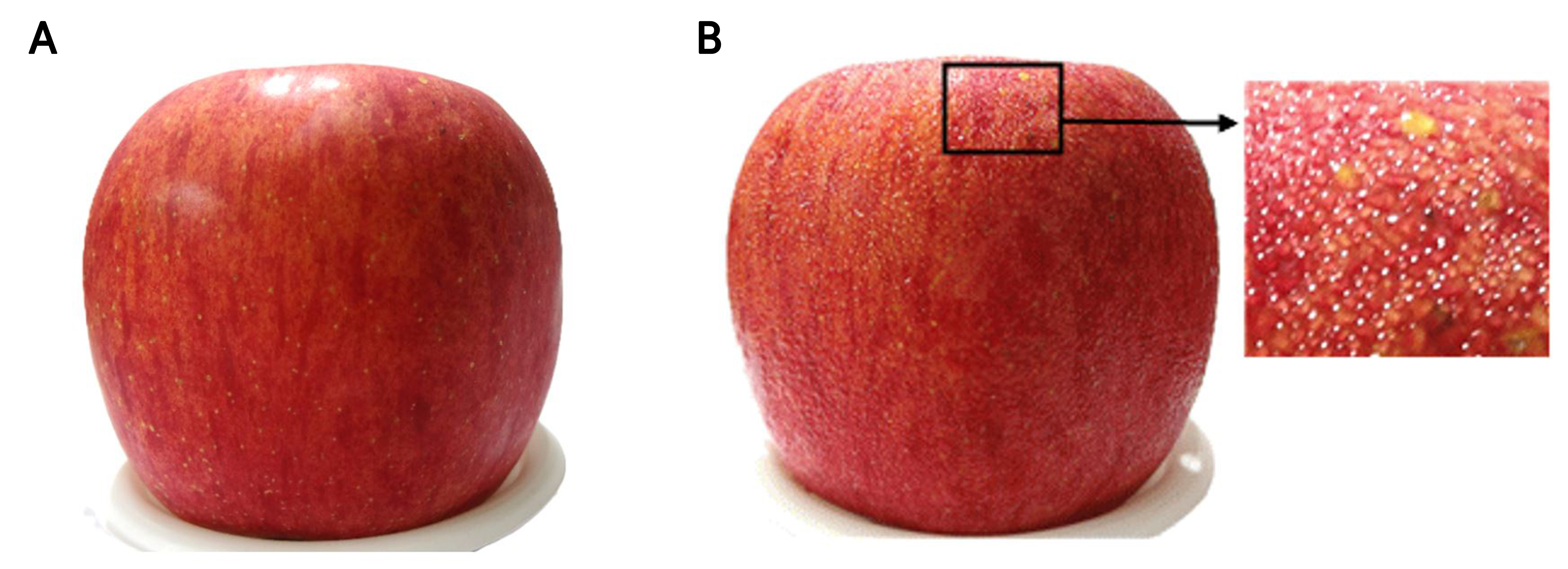
The apples in treatment 4 showed distinguishable water condensate on the surface (Fig. 1).
Table 3.
Estimation of water condensation on apples by measuring weight changes during 30-min incubation under various temperature and humidity conditions
| Packing line operation and environmental simulation |
Initial VPDz (mmHg) |
Weight increase per surface area (mg·cm-2) |
Temperature rise during 30 min of incubation (°C) | |||
| Treatment |
Initial fruit temp. (°C) | Incubating atmosphere | ||||
|
Temp.y (°C) |
RHy (%) | |||||
| 1 | 0 | 10 | 50 | 0.163 | 0.16 ± 0.01 cdx | 1.8 ± 0.1 d |
| 2 | 0 | 10 | 80 | 2.925 | 0.47 ± 0.06 bcd | 2.7 ± 0.2 c |
| 3 | 0 | 20 | 50 | 4.326 | 0.72 ± 0.14 bc | 3.6 ± 0.1 b |
| 4 | 0 | 20 | 80 | 9.586 | 5.47 ± 0.80 a | 4.5 ± 0.1 a |
| 5 | 12 | 20 | 60 | 0.309 | 0.06 ± 0.01 d | 1.3 ± 0.2 e |
| 6 | 12 | 20 | 80 | 3.816 | 0.83 ± 0.17 b | 2.0 ± 0.3 d |
Temperature increases
Increases in the fruit temperature during 30 min of incubation were influenced by the initial temperature difference (TD) between the fruit temperature and the incubator atmosphere and by the RH inside the incubator (Table 3). When 0°C apples were placed in the incubator set to 10°C (TD = 10°C), the increases were 1.8°C and 2.7°C under environments with 50% and 80% RH, respectively. In comparison, they were more noticeable at 3.6°C and 4.5°C under the 20°C environments (TD = 20°C) with 50% and 80% RH, respectively. The transfer of apples warmed at 12–20°C (TD = 8°C) resulted in lower increases in the fruit temperature under similar RH conditions.
Regression model between VPD and water condensation
When using data from the six treatments, a significant regression developed between VPD and water condensation, showing a quadratic curve pattern (Fig. 2A). The model was also highly significant after supplementary data input, corresponding to a VPD of 7 mmHg (Fig. 2B), maintaining the curved pattern. The coefficients of determination (R2) for the initial and revised models after data supplementation were similar (0.9648 and 0.9602, respectively).
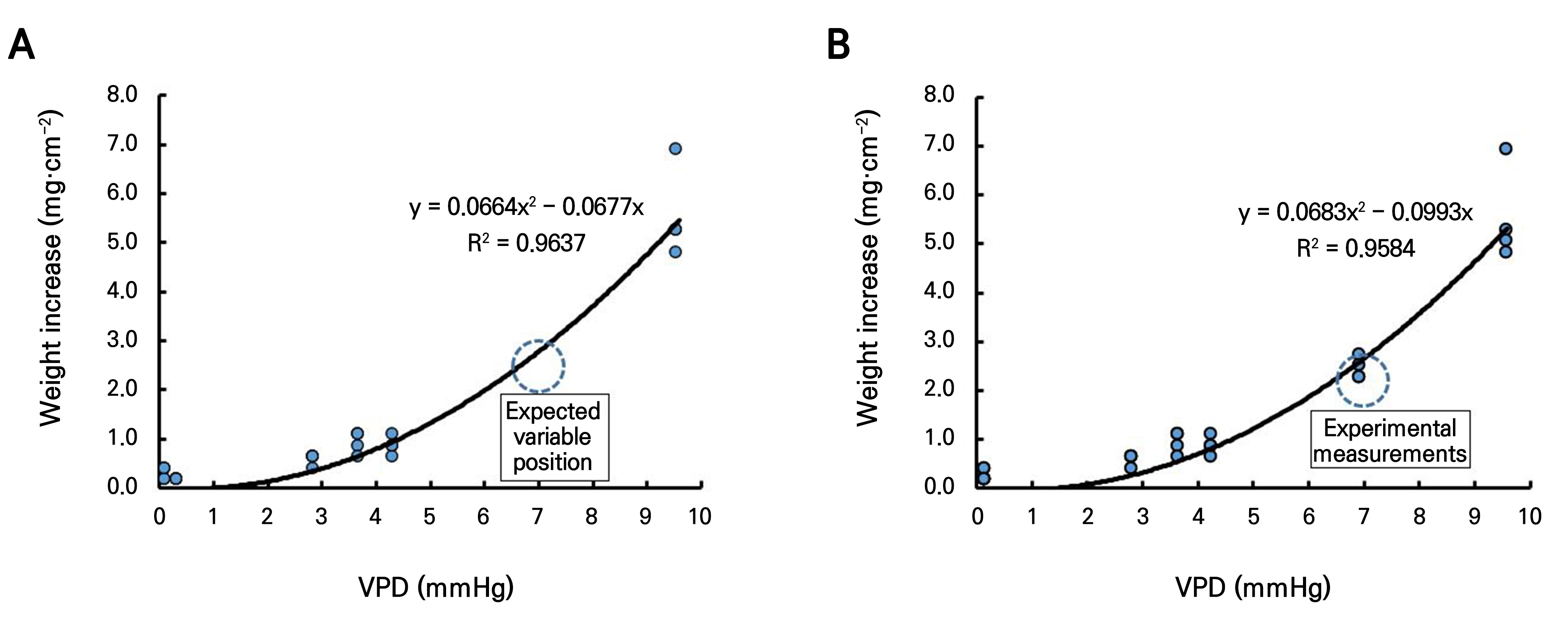
Fig. 2.
Regression model between the vapor pressure deficit (VPD) and weight increase by condensation on apples, based on the surface area in cm2. The first regression line was established using data from the initial six treatments (A) and was then refined by incorporating additional observations (B).
Discussion
Because apples are stored at temperatures close to 0°C to maintain their quality for an extended period (Park et al. 2010; Park and Yoon 2012; Yoo et al. 2023), the fruits are exposed to the risk of water condensation when transferred to the warm atmosphere of the packinghouse. Vapor pressure data and dew points are theoretical indicators for predicting water condensation in specific environments where cold-stored apples are transferred for grading and packaging operations (Table 2).
The validation experiment demonstrated that water vapor condensation occurred, consistent with the theoretical evaluation. Water condensation on apples was slight in environments with low dew points and a smaller VPD between the fruit and atmosphere, as in treatments 1 and 5. In contrast, noticeable condensation was observed in the atmosphere characterized by a high dew point and a larger VPD, as in treatment 4 (Table 3 and Fig. 1). Previous observations focusing on cold-stored peaches (Yun et al. 2007) support the validity of the present study. The amount of water condensate on 0°C apples after incubation in the 20°C atmosphere with 80% RH, 1.63 g/fruit, was similar to that observed in cold-stored peaches exposed to a similar atmosphere, 1.5 g/fruit.
The regression model developed in the present study is a unique model for predicting the numerical amounts of condensation based on changes in the VPD, showing a close relationship between the theoretical VPD and the virtual incidence of water condensation on apples (Fig. 2). The similarity of the quadratic curves and the coefficients of determination before and after the addition of supplementary data indicated that the regression model could be a practical tool for estimating the severity of water condensation, at least in the range of 0 to 10 mmHg VPD. A prediction model with detailed VPD data under environmental variations can provide guidelines for fruit temperature control, preventing water condensation during packinghouse operations and along distribution chains (Yun et al. 2007), as well as strategies for optimizing air ventilation in packaging boxes (Shrivastava et al. 2023).
Apple APCs employ two practical means of mitigating water condensation in packinghouses. The first is to increase the fruit temperature before transfer to the packing lines, as recommended for cold-stored melons (Lee et al. 2007) and shipping tomatoes (Park et al. 2022). From a psychrometric viewpoint, treatments that increase the temperature contribute to an increase in the vapor pressure inside fruits, diminishing the VPD and water vapor movement from the surrounding air towards the fruit and consequently reducing water condensation. A temperature increase to 10–12°C before delivery to packing lines, as simulated in treatments 5 and 6 (Table 3), appears to be a simple and inexpensive solution to prevent water condensation in apple APCs.
The extent of fruit temperature management depends on variations in the packinghouse environments owing to seasonal weather conditions. The packinghouse environment could remain around 10°C with 50% or lower RH from December to February, even without heating operations under ambient conditions on winter days (KMA 2025). Water condensation on apples stored at 0°C occurs slightly under such environments given that the fruit temperature, 0°C, is very close to the VPE temperature for the atmosphere at 10°C with 50% RH, 0.5°C (Table 2). Condensation did not proceed under lower RH conditions. As an exception, water condensation is unavoidable on cloudy and rainy days with a high RH of > 50%. Theoretical estimates of VPE temperatures under spring and early summer weather conditions, as summarized in Table 2, suggest that increases in fruit temperatures to 2.4–17.0°C are required to avoid water condensation depending on the weather conditions.
The problem with methods that rely on temperature increases is the difficulty in precisely controlling the fruit temperatures. The stacking pattern on the pallets disturbs the airflow to the fruits positioned in the center of the load. Supplementary spaces and ventilation systems are prerequisites.
The second practice to prevent water condensation is to cool the surrounding air in the packinghouse down to the dew point (Table 2) while holding the fruit temperature similar to the storage temperature, as reported for stored strawberries (Kim et al. 2017). This practice is a convenient operation that can be performed simply by turning on the air conditioner. Higher utility costs during spring and summer are the primary hurdles when cooling the entire packinghouse atmosphere. Secondary problems could arise owing to occasional warm weather. Although air conditioning is not necessary during the winter, the risk of water condensation always exists on intermittently warm and humid days. Water condensation could occur when the temperature exceeds 10°C with RH levels higher than 50% during the packinghouse operations. These considerations suggest that predictive estimations of the VPD are also necessary as a preparatory step, even in APCs equipped with air-conditioner systems.
Conclusions
Postharvest manuals for domestic fresh commodities have proposed general recommendations for controlling water condensation during packinghouse operations and along cold-chain distribution chains. However, APCs require specific details for practical applications to cope with environmental variations. The overall results of the present study prove the effectiveness of psychrometric approaches in preventing water condensation on apples during packinghouse operations. In this study, the regression model between water condensation and VPD demonstrates that theoretical estimates of the vapor pressure can be used practically without further validation. Visible condensation occurred in the packinghouse environments where the VPD reached approximately 4.0 mmHg. Regarding cold-stored apples, the atmospheric conditions were either over 50% RH with a 20°C difference between the fruit and the surrounding air, or around 80% RH with an 8°C difference. Warming apples to 12°C before delivery to the sorting line could reduce the risk of condensation during packinghouse operations in spring. Starting in May, when the surrounding air temperature begins to exceed 20°C, an air-conditioning facility can help to prevent the condensation on apples while mitigating the quality deterioration issue.
