

Introduction
Description and Performance
Origin
Description
Notes for Production
Plant Breeder’s Right and Availability
Introductio
In ornamentals, interspecific breeding is considered to be the most important source of genetic variation. The introgression of genes may be part of a breeding program towards disease resistance, better growth vigor, winter hardiness or morphological alteration in general. Both sexual and asexual hybridization, by pollination and protoplast fusion respectively, are fit to induce the desired introgression into the acceptor species. However, the number of possible genetic barriers is very high (Eeckhaut et al., 2006). The creation of interspecific hybrids, along with chromosome doubling technology, offers extended opportunities for orna-mental breeders (Van Tuyl and Kim, 2003), as demonstrated in many genera (Sujatha and Prabakaran, 2003, Kobayashi et al, 2004, Van Huylenbroeck et al., 2004).
Geographically, Hibiscus is mainly distributedin tropical and subtropical zones, with some species extending into the temperate regions of the world like; Hibiscus syriacus L. (althea or rose of Sharon) and Hibiscus sinosyriacus Bailey (Bates, 1965). The similarity in natural distribution pattern of these species is an indication of a similar tolerance to environmental factors (Bates, 1965). Hibiscus syriacus is the most popular species and about 40 different cultivars, with varying flower color and shape, are commonly in culture in Europe and a lot more genotypes are present in different collections (Van De Laar, 1997). Furthermore, large collections exist in Korea, where Hibiscus is the national flower (Yu and Yeam, 1987; Van de Laar, 1997).
Interspecific and even intersubgeneric hybridizations are highly interesting to combine desired traits from genetically distinct genotypes (Van Tuyl and De Jeu, 1997; Van Huy-lenbroeck and Van Laere, 2008). In an attempt to introgress an increased growth vigor and improved flowering into H. syriacus two different breeding strategies were followed. A first approach focused on creating hexaploid H. syriacus plants. The second strategy emphasized on the interspecific hybridization between H. syriacus and H. paramutabilis. When used as a seed parent, H. paramutabilis failed to set fruits (Van Laere et al., 2006). Also some interspecific breeding work involving more tropical species of Hibiscus is published (Tachibana, 1958; Kuwada, 1964). Attempts to create interspecific hybrids between H. syriacus and H. rosa-sinensis, especially to introduce new flower colors and forms, were not successful so far (Yu, et al., 1976; Paek et al., 1989).
A Hibiscus breeding program was initiated in 2005 to develop new Hibiscus cultivars with tall vigorous growth, upright, compact branches, and unique flower with long red eye through interspecific hybridization between H. syriacus and H. sinosyriacus.
Description and Performance
Origin
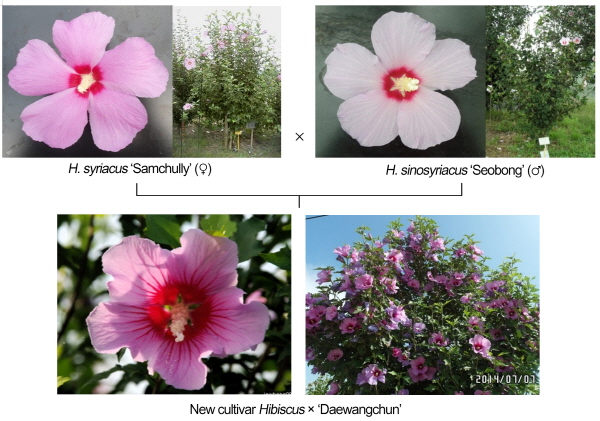
The breeding program which produced Hibiscus hybrid ‘Daewangchun’ extended over a period of some 7 years. The objective of the breeding program was to develop new Hibiscus cultivars with tall vigorous growth and upright branches interspecific hybridization between Hibiscus syriacus and H. sinosyriacus. The new Hibiscus plant developed after cross-pollination between H. syriacus ‘Samchully’ (Plant patent number 1481), as the female, seed parent and H. sinosyriacus ‘Seobong’ introduced from Belgium as the male, or pollen parent.
For the cross H. syriacus ‘Samchully’ × H. sinosyriacus ‘Seobong’, in total 55 syriacus flowers were pollinated. The crosses resulted in 47 fruits (85.5% successful pollinations) which contained on average 5.3 seeds. Of the obtained seedlings 250 could be planted in the greenhouse. 230 F1 seedlings of H. syriacus ‘Samchully’ × H. sinosyriacus ‘Seobong’ transplanted in the field and then flowered in 2007. The new Hibiscus hybrid ‘05-R-204’ was discovered and selected in August, 2008 as a vigorous plant with in the progeny of the stated cross-pollination in anoutdoor nursery environment in the Research Institute of Rose of Sharon and Tiger Lily, Chonan, Korea. Asexual reproduction of the new Hibiscus hybrid ‘05-R-204’ by hardwood grafting and softwood cuttings in a controlled greenhouse environment since the spring of 2010 has shown that the unique features of this new Hibiscus plant are stable and reproduced true to type in successive generations of asexual reproduction (Fig. 1). After the plant characteristics evaluation such as growth characteristics, leaf shape, leaf size, flower charac-teristics, and flowering for 3 years (2010-2012), it was named as ‘Daewangchun’ in 2013.
Asexual propagation of the selected ‘05-R-204’ by grafting had shown that the unique and distinguishing features of the plant are faithfully transmitted from generation to generation and appear to be fixed. The characteristics were evaluated based on the manual for agricultural investigation and guidelines for the conduct of tests for distinctness, uniformity and stability for Hibiscus (UPOV, 2005).
Description
Plants of ‘Daewangchun’ had vigorous growth, and upright branches with abundant production of violet-purple (N80C) (Royal Horticultural Society Flower Council of Holland, 2001) flowers of moderate size (11-13 cm) with red eye spot.
The ‘Daewangchun’ was a vigorous and tall sized plant with upright branches. 4-year-old plant of ‘Daewangchun’ was 370 cm in height and 180 cm in crown width, and 1-year-old grafted plant was 115 cm in height and 30 cm in crown width. Plant height of new cultivar was taller than the parent plants and control (Table 1). ‘Daewangchun’ was more vigorous compared to H. syriacus ‘Daeil’. Fig. 2 showed the overall appearance of the new Hibiscus, showing the colors as true as it was reasonably possible to obtain in colored reproductions of this type. Colors in the photographs might differ slightly from the color values cited in the detailed botanical description which accurately described the colors of the new Hibiscus × ‘Daewangchun’ (Fig. 2). This cultivar was very fertile with abundant seed pods produced from insect pollination.
Leaves were alternate and oval shape. The leaf apex was acute, the base shallowly acute. Leaf margins were irregularly dentate. The leaves were 8.7 cm long and 4.7 cm wide. They were medium to dark-green in color. The intensity of the green coloring depended upon the nitrogen nutrition of the plant. The new ‘Daewangchun’ in well grown plants attained a diameter of leaf shoulder of 3.5 cm and a petiole of 2.5 cm (Table 2). The flower diameter of Hibiscus × ‘Daewangchun’ was 12.0 cm and very large as compared with contrastive cultivar, ‘Daeil’ with 11.47 cm. The corolla was composed of five slightly fantype of petals, 7.2 cm long by 5.5 cm at the widest point. The petals were violet purple (N80C) (Table 3, 4). The red eye spotwas slightly darker red (59A) in color for 3.0 cm (Table 3, 4). ‘Daewangchun’ had longer red eye than other species of Hibiscus. Upon anthesis in the early morning the flower petals reflexed, then gradually returned to nearly right angles to the central axis and remained thus for the life of the flower (Table 4). Hibiscus ‘Daewangchun’ started to flower each year in early July and continued for about four months, depending upon environmental conditions. The flowering of ‘Daewangchun’ initiated on July 5 and then total blooming duration was 102 days in Chonan, Korea. The plants then produced sporadic flowering until frost (Table 5).
The stiff, upright main stems of H. × ‘Daewangchun’ apparently were derived from H. syriacus. It seemed to be increased vigorous growth into H. syriacus by interspecific hybridization with H. sinosyriacus. The flower color in Hibiscus × ‘Daewangchun’ was darker pink than those of H. syriacus ‘Samchully’ and H. sinosyriacus ‘Seobong’. In size, the flowers of H. × ‘Daewangchun’ were larger than in any of its parent cultivars. In pose, the flowers of H. × ‘Daewangchun’ somewhat resembled those of the species H. syriacus in that the flowers expanded their petals widely. Meanwhile, the oval three-lobed leaves of ‘Daewangchun’ also resembled those of H. sinosyriacus in shape and also resembled those of H. sinosyriacus in shape. H. sinosyriacus was allied to H. syriacus, but had broader leaves, with three short triangular lobes (Bates, 1965; Bean, 1973).
Plants of the new Hibiscus were more vigorous than parents and plants of the control ‘Daeil’. Hibiscus × ‘Daewangchun’ differed primarily from parent plants in growth habit, flower size, and length of red eye spot as plants of the new Hibiscus were more vigorous growth and had larger flowers than plants of ‘Daeil’. ‘Daewangchun’ differed from plants of the female and male parents in flower size and color as plants of the parents had smaller and lighter pink-colored flowers.
Notes for Production
The new Hibiscus × ‘Daewangchun’ plant grows in well- drained soil. It easily grows in average and medium moisture in full sun to part shade. Best flowering occurs in full sun. It prefers moist, organically rich soils, but tolerates poor soils and some drought. It is very tolerant of summer heat and humidity. Prune to shape in spring. Pruning back to 2-3 buds in late winter may produce larger blooms. It is easily propagated by stem cuttings. May be grown from seed, but seedlings may not have the exact same flower color as the parent. Larger flowers may be obtained by pruning back hard to 2-3 buds in early spring. Otherwise, prune to shape (Table 6).
Plant Breeder’s Right and Availability
An application was filed for variety protection of ‘Dae-wangchun’ at the Korea Seed and Variety Service (Application no. 2013-210) and the plant variety protection rights have been registered as grant number 4731 on April15, 2013. Additional information or a list of nurseries propagating ‘Daewangchun’ is available on written request to Research Institute of Rose of Sharon and Tiger Lily (RIRS & TL), Chonan, Korea (e-mail: shimkk@chol.com). In addition, specimens of the releases have been deposited in the Research Institute of Rose of Sharon and Tiger Lily where it will be available for research purposes. The cultivar had been already released by RIRS & TL, Chonan, Korea and has been selling as commercial variety for domestic market. It is requested that appropriate recognition be made if this germplasm contributes to the development of a new breeding lines or cultivars.
