

Introduction
Materials and Methods
Participants
Experimental Set-up
Instruments and Measurements
Experimental Procedure
Horticultural Activities
Data Analysis
Results
Discussion
Introduction
Daily life events can act as various stressors. Effective stress management is important because it is closely associated with physical and mental wellness. However, improper stress management disrupts the homeostasis of the autonomic nervous system (ANS) and eventually causes physical illness, because repetitive stress reduces disease resistance (Lipowski, 1985).
High degrees of stress and stress-related diseases, especially in industrial settings, deteriorate job performance capability and increase medical expenses (Cooper, 1996; Manning et al., 1996). Stress clearly increases social and economic losses, which may decrease a country’s competitiveness in the world marketplace (Driskell and Salas, 1996; Quick, 1998).
In 2005, there were 1,095 job-related deaths in South Korea. Among them, there were 608 deaths from cerebrovascular and cardiac diseases caused by overwork, accounting for 55.5% of the total deaths (MOEL, 2005). Further, 75% of the causes of cerebrovascular and cardiac diseases are stress related (Belkic et al., 2004).
According to the National Institute for Occupational Safety and Health (NIOSH, 1999), approximately 40% of the US working population suffered from job stress and 75% recognized that they had more job stress compared to previous generations. Besides, the medical expenses of the workers who reported more stress from their jobs were 50% higher than those who did not report so (Goetzel et al., 1998).
When exposed to stress, the human body activates the sympathetic nervous system and simultaneously suppresses the parasympathetic nervous system, to resist stress and acquire energy. This causes various physiological changes, such as increased heart rate (HR) and blood pressure (BP), sweating, muscle stiffness, decreased gastro-intestinal activity, and suppression of immune response (Hancock and Desmond, 2011).
To prevent these diverse deleterious phenomena, effective stress management programs are required. Researchers have reported that horticultural therapy (HT) and plants are effective in reducing physical and psychological stress. Doxon et al. (1987) reported that after people with mental illnesses performed horticultural work in a greenhouse, their blood pressure dropped, response to electric stimuli decreased, and skin temperature increased more than when they performed other simple activities.
In addition, Coleman and Mattson (1995) reported a considerable reduction in stress after being surrounded by foliage plants during the biofeedback training process. Shoemarker et al. (1992) and Larsen et al. (1998) also reported that the introduction of plants into the office brought positive effects on the workers’ attitudes. Although there have been numerous reports on the positive effects of HT, few studies have been conducted on lighting as an environmental factor in treatment spaces.
Recently, the accelerated development of the light-emitting diode (LED) has attracted attention as an alternative light source because it is eco-friendly and more energy efficient than other sources, such as fluorescent lights, incandescent light bulbs, and halogen lamps (Jang et al., 2009). Furthermore, unlike other lights, LEDs are also widely used in creative activities since it is easy to control their color and shape (Gi et al., 2009).
Gerard (1958) studied the physiological and psychological effects of various colored lights and observed that blue and white light relax the body, while red light markedly raises tension and arousal. Additionally, Birren (1961) stated that light had been shown to affect feelings, such as happiness and emotional stability, demonstrating its vast potential to affect overall psychology. These studies have confirmed that lights with specific colors can have unique effects on human psychology and physiology (Park, 2003).
Although there have been many reports on the effect of horticultural activities or plants, there are few studies on the spatial environments where HTs are conducted. Therefore, we explored the effects of conducting flower arrangement activities under various lighting conditions on stress-related physiological changes in the human body.
Materials and Methods
Participants
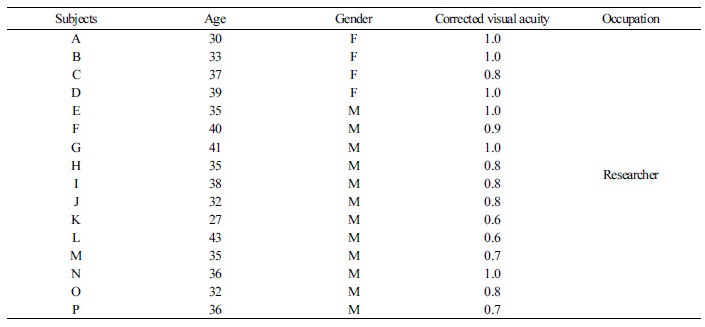
The study participants consisted of 16 office workers (12 men and 4 women) with an average age of 35.5 years. Their age ranged from 27 to 43 years and all were members of the LED-IT Fusion Technology Research Center in Gyeongsan, South Korea. We excluded participants with chronic disease, heart and lung disease, mental illness, physical injuries, and color-blindness with corrected visual acuity of more than 0.8 (Table 1). Alcohol was strictly prohibited the day before the experiment, and smoking and caffeine were prohibited 2 h prior to the study. The participants were fully aware of the plan and description of the experimental procedure and agreed with this experiment. After the end of the experiment, the research group provided compensation to all participants.
Experimental Set-up
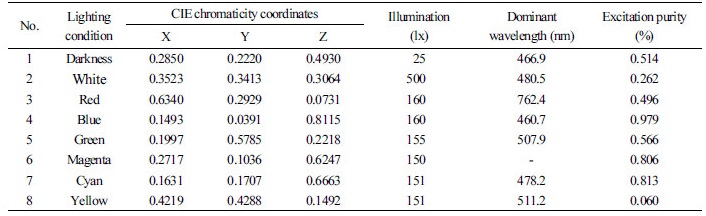
The experiment was conducted in a room with an LED-lighted ceiling installed by LND Inc. (Daegu, South Korea). The size of the room was a 3.0 m (L) × 5.0 m (W) × 2.5 m (H). The room contained a Max Pulse (Medicore Co., Ltd., Korea) for measuring and controlling HR variability (HRV), CL-200A (Konica-Minolta, Japan) for measuring illumination, HR-400 (Ocean Optics, USA) for measuring spectrum analysis, and DMX-512 (Entos, Korea) for controlling lighting conditions (darkness, white (4500K), red, blue, green, magenta, cyan, and yellow). In addition, there was one round table (1 m diameter) and four chairs placed 1 m behind the square table intended for flower arrangement (FA). Table 2 summarizes the experimental lighting conditions: illumination, color coordinates, dominant wavelength, and purity.
Instruments and Measurements
Heart rate variability (HRV): A Max Pulse (Medicore Co., Ltd., USA) was used to measure HRV, with tweezers attached to a sensor. We measured participant HRV for 5 min by connecting the machine to their left forefinger. HRV was measured twice, before and after FA. Generally, HRV is sensitive to the time of measurement, i.e., morning or evening, due to the time-specific response of the sympathetic nervous system. Therefore, we measured HRV in the morning from 09:30 to 11:30, and participants were not allowed to talk or move during measurement. Standard deviation of the normal-normal intervals (SDNN), total power (TP), and ratio of low frequency to high frequency (LF/HF) were employed as sub-parameters.
SDNN is an index of stress-coping skills that is associated with four important states: good, ≥ 50; normal, 30-50; required, 20-30; and dysfunction (or disease), < 20. TP (i.e., LF + HF) reflects the activity of the ANS: high values reflect a healthy condition. Further, TP is a powerful index of stress-coping skills.
The ratio of LF/HF reflects the balance between the sympathetic and parasympathetic nervous systems. The ratio of LF/HF, rather than LF or HF alone, has been widely used as a control function of the ANS (Jeong, 2004).
Blood pressure (BP): We used a UA-772C (A&D Co., Ltd., Japan) digital manometer with a precision of ± 3 mm Hg and ± 5% HR to measure BP and pulse. The precision accuracy of a manometer is higher than that of others, such as mercury and meta-sphygmomanometer. We measured BP twice each time, both before and after FA.
Quantitative analysis of salivary cortisol: For the quantitative analysis of salivary cortisol, saliva was collected from the participants immediately after FA for each of the eight sessions at 11:00. The participants were guided to not consume any food including gum, snacks, or coffee for 1 h prior to sampling, to ensure that nothing induced salivation. After gargling, they bit cotton enclosed in salivary containers (for 10 min before sampling) until their saliva was completely absorbed. The participants were requested to stay calm and comfortable without talking because unwanted excitation can induce a change in cortisol concentration during sampling. As soon as the saliva was collected in the container, it was frozen using liquid nitrogen and sent to a certified institution (Green Cross Reference Lab, Yongin, Korea) for analysis. Using high-sensitivity salivary cortisol enzyme immunoassay kit reagents (Salimetrics Inc., State College, PA, USA), the salivary cortisol was quantified using a microplate reader, VERSA Max (Molecular Devices, Sunnyvale, CA, USA). A reduction in salivary cortisol concentration represents a decrease in stress.
Experimental Procedure
Experimental procedures consisted of pre-testing and testing with individual participants. For pre-testing, the participants spent approximately 5 min inside the experimental room, on a comfortable chair, for acclimatization to the testing conditions. For testing, HRV and BP were measured before and after performing 25 min of FA. Salivary cortisol was collected immediately after FA.
Horticultural Activities
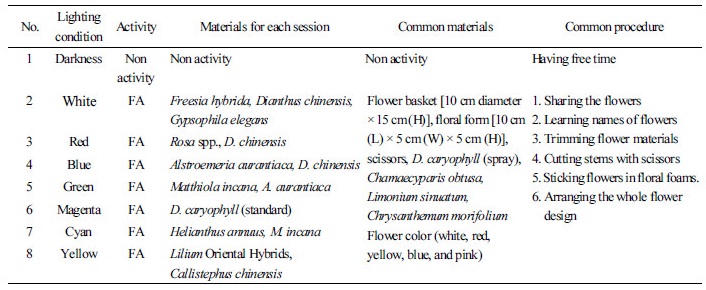
FA was performed using floral foam [10 cm (L) × 5 cm (W) × 5 cm (H)] inside a flower basket [10 cm diameter × 5 cm (H)], and each participant performed seven FAs, except during the darkness condition. The darkness condition was the control condition and participants simply spent time in a dark room. Common flower materials were used in all sessions, and unique materials were provided for each session to avoid tedium (Table 3). Flower materials of the same colors (white, red, yellow, blue, pink, and green) were used to avoid LED light-color interaction effects. In addition, the participants were guided to design the flowers freely, without any fixed form. Table 3 shows the summary for procedures, common flower materials, and specific flower materials for each session.
Data Analysis
Data were analyzed with SPSS version 14.0 (SPSS Institute Inc., Chicago, IL, USA). We used the Wilcoxon signed-rank test to analyze changes in HRV and BP, before and after FA under various lighting conditions. Following this, one-way analysis of variance (ANOVA) and Duncan’s multiple range test (p < 0.05) were conducted to analyze the differences.
Results
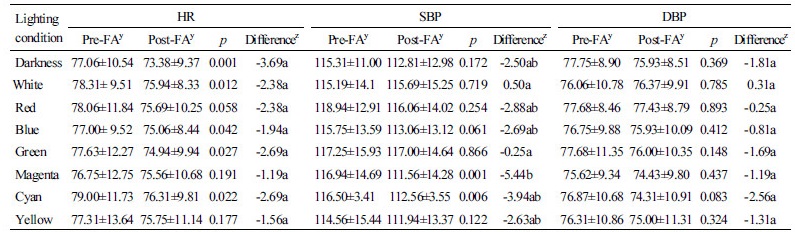
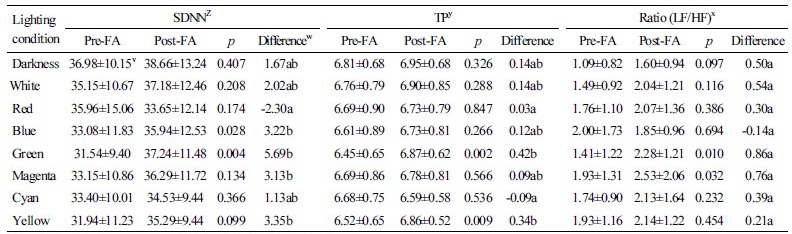
Based on the Wilcoxon-test, HR significantly decreased from 77.06 to 73.37 in the darkness condition (p < 0.05), from 78.31 to 75.93 in white light (4500K) (p < 0.05), from 77.00 to 75.06 in blue light (p < 0.01), from 77.62 to 74.93 in green light (p < 0.01), and from 79.00 to 76.31 in cyan light (p < 0.01). Systolic BP (SBP) decreased from 116.93 to 111.50 in magenta light (p = 0.001) and from 116.50 to 112.56 in cyan light (p = 0.006) (Table 4). SDNN significantly increased from 33.08 to 35.94 in blue light (p < 0.05) and from 31.54 to 37.24 in green light (p < 0.01). TP distinctly increased from 6.45 to 6.87 in green light (p < 0.01) and from 6.52 to 6.86 in yellow light (p < 0.01). The ratio of LF/HF considerably increased from 1.41 to 2.28 in green light (p < 0.05) and from 1.93 to 2.53 in magenta light (p < 0.05). The data for SDNN, TP, and LF/HF are listed in Table 4.
The one-way ANOVA revealed differences in HR, BP (systolic and diastolic), and HRV (SDNN, TP, and LF/HF) before and after FAs. There were significant differences in SBP, SDNN, and TP (p < 0.05). The results of Duncan’s multiple range test are shown in Tables 4 and 5. The test results show that SBP in 4500 K and green light was much higher than in magenta light. SDNN in red light was significantly lower than that in blue, green, magenta, and yellow lights. On the other hand, TP in red and cyan lights was significantly lower than that in green and yellow lights.
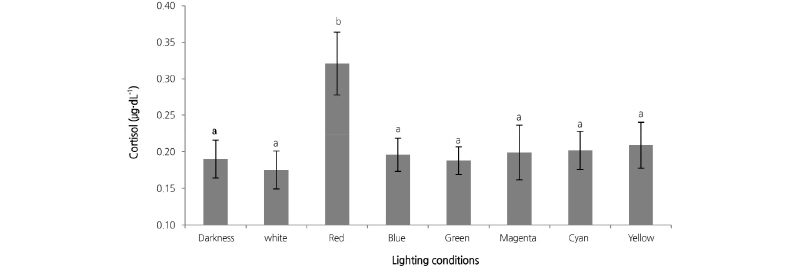
The one-way ANOVA results for salivary cortisol showed a significant difference (p < 0.05) after the FAs (Table 6). The results of Duncan’s multiple range test demonstrate that the test value in red light was higher than that in the other lighting conditions (Fig. 1).

Discussion
To explore the effect of LED-colored lights on the physiological changes related to worker stress using HT, we analyzed changes in the HR, BP, HRV, and salivary cortisol levels in 16 workers while engaging in FA under various lighting conditions: darkness, white (4500K), red, blue, green, magenta, cyan, and yellow. After the FA, all stress-related responses were more negative in the red light compared to the other colors. Jacobs and Suess (1975) reported that the anxiety scores of university students were significantly higher in red and yellow light, than in green and blue light. In other studies (Gerard, 1958; Jacobs and Hustmyer, 1974), the galvanic skin response of university students was higher in red light than in blue light. Since FA reduced the cortisol level in the blood of adolescents, we concluded that red light in this study had a negative effect on physiological stress-related response, regardless of the cortisol-reducing effect of FA (Kim, 2008).
Red is generally associated with discord, arousal, confusion, and attention and has expanding effect on body organs (Goldstein, 1942). Our results showed that the red light accelerated blood circulation, stimulated the sympathetic nervous system, and activated liver and muscle tissues; this is similar to the results of previous studies (Birren, 1961; Sun and Sun, 1998). Red, magenta, and yellow tend to be regarded as similar warm colors, which cause emotions such as dysphoria and arousal (Jacobs and Suess, 1975; Park et al., 2011). In this study, the stress response in magenta and yellow lights showed contrary results to red light, for SDNN and cortisol level. Although reports have shown negative results in color preference and anxiety scores with yellow light (Baek et al., 2011; Lewinski, 1938; Jacobs and Suess, 1975), the physiological responses to yellow light in this study were positive. These results suggest that secondary colors, such as magenta and yellow, may be used for psychological therapeutic purposes.
For cool colors, stress responses (SDNN and TP) were most effectively reduced by green, blue, and cyan light (in descending order) (Jacobs and Suess, 1975). Cortisol levels were the lowest after performing FA in green light. Green represents balance, harmony, and compassion; it encourages relaxation, while stabilizing the mind and body, lowering BP, and preventing blood clots (Birren, 1961; Sun and Sun, 1998). Goldstein (1942) stated that when people with hand tremors or convulsions wore green optical glasses, their symptoms alleviated because the green light prevented the negative effect of red light and soothed the nerves. In Japan, the suicide rate was reduced by installing blue lights in train platforms, and blue street lights have been used to lower the crime rate and soothe people’s moods (Suya, 2008; New York Times, 2009; Matsubayashi et al., 2013)
Blue has opposing characteristics to that of red, and promotes oxidation in biological tissues, while suppressing hormonal activities.
For blue light, the LF/HF ratio diminished after FA. The LF/HF ratio is an index of sympathovagal balance and represents the regulatory control ability of the ANS. It is especially known as an index that indicates the activation level of the sympathetic nervous system (Choi et al., 2005). In this study, both green and blue lights had the same stress-reducing effects, but showed opposing results in the LF/HF ratio. The parasympathetic nervous system is activated in relaxed conditions without stress, keeping BP, HR, and respiration rate lower than normal and increasing gastro-intestinal activity, which helps to digest food and maintain warm skin (Dwight, 1983).
Finally, the darkness condition was the state of total darkness and resting, without any activity. Considering the positive physiological responses related to stress irrespective of FA, the state of darkness worked positively on psychological stability. The result concurred with Lee (2011). However, there was no significant difference before and after FA. Considering that it is difficult to conduct activities in darkness, further studies are required regarding its usage as localized lighting during HT.
In conclusion, we found that colors closer to darkness were more suitable for relaxation and sound sleep. Moreover, red and cyan lights were inadequate for psychological treatment during HT. The most effective responses were observed in green and blue lights. Yellow light also had a positive effect on the spaces for treatment activities.
Finally, our results show that combining HT with color treatment using LED lights helps to reduce worker stress. Thus, our study provides a novel contribution to the field of HT.
