Introduction
Origin
Brief History of Selection
Cultural Conditions for Phenotypic Characteristic Evaluations
Storability Test and Quality Investigation of Fruits
Description and Performance
Plant Phenotypic Characteristics of ‘Mansu’
Fruit Characteristics at Harvest
Quality Changes during Cold Storage and Storability
Availability
Introduction
Hardy kiwifruit (Actinidia arguta Planch.et Miq.) is widely distributed from Southwest China, Korea, and Japan to Siberia (Cui et al., 2002). In the Korean peninsula, A. arguta vines are commonly found in the mountains and valleys from Gangwondo to Jejudo below an altitude of approximately 1,000 m above sea level (Lee, 1982; Cho et al., 2011). The fruits of A. arguta have long been collected and consumed by local people due to their sweetness (Lee, 1982). Trial cultivation to utilize A. arguta fruits for commercial production has recently begun (unpublished data from the Korean Arguta Workshop). However, a profitable arguta industry has not yet been established due to various barriers (Williams et al., 2003), such as low consumer awareness, the short marketing period for this fruit, anddifficulties in vine management, pest management, and deciding when to harvest the fruits (Strik and Cahn, 1998). Among these, the short marketing period is said to be the most important structural problem in the arguta industry. Several approaches can be taken to overcome the short marketing period. The first approach is to develop better storage techniques for arguta kiwifruits. These techniques may include precisely determining the optimum harvest time for each cultivar (Fisk et al., 2006), establishing the best storage conditions, proper packing methods, and fruit handling procedures, as well as developing new cultivars with better storability. Most arguta kiwifruits have short storability (roughly 1 month) (Strik and Cahn, 1998; Fisk et al., 2008). Although 12 arguta cultivars have been released in Korea to date (Cho et al., 2011; Cho et al., 2014), most of these cultivars also have short storability, even in cold storage.
Origin
Brief History of Selection
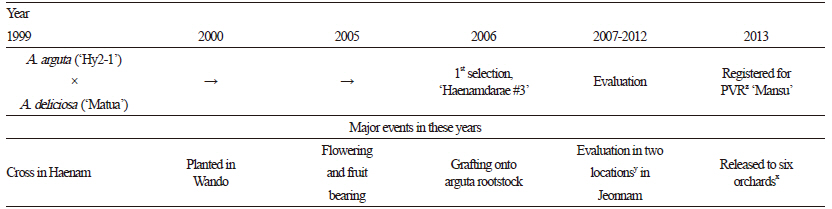
An interspecific cross was made between A. arguta and A. deliciosa at Haenam experimental station in May 1999, and the resulting seeds were planted at Wando experimental station in April 2000. The first selection was made in November 2006. The major events in the selection process are presented in Table 1. Experimental orchards were established to further evaluate the selected accession in Gwangyang (latitude 35.01119 and longitude 127.58675) and in Haenam (latitude 34.61381 and longitude 126.52826) by grafting the plants onto another arguta rootstock in March 2007. Final selection was performed between 2011 and 2012, and the cultivar was registered for plant variety protection (Registration number 2013-10) from the National Forest Seed Variety Center in 2013.
Cultural Conditions for Phenotypic Characteristic Evaluations
All vines were planted at a density of 6 × 6 m and were grown in sandy loam soil for 7 years until 2012. The vines were trained on a pergola system. Experimental blocks of vines were managed organically following general cultural practices such as pruning, thinning, and pest control. No synthetic chemicals or soluble fertilizers were applied, and only organic fertilizer was applied (40 kg per vine during the winter season). In the absence of rain, sprinkler irrigation was performed every 4 days.
Investigations of each phenotypic characteristic were carried out in Gwangyang following the standards for agricultural experiments, research, and investigation issued by the Korean Rural Development Administration (RDA, 1995). Each investigation on flower organs was performed with 30 replicates during the flowering period. At harvest, each group of 60 fruits was investigated for fruit characteristics in three replicates. All flowers and fruits investigated were obtained from the central flower of a flower cluster.
Storability Test and Quality Investigation of Fruits
Fruits were randomly picked from six vines within the experimental blocks and stored at room temperature for one night for precooling and to remove surface moisture. Soft fruits were removed prior to storage, and fruit stalks were also removed. Fruits were stored at 0 ± 0.5°C, 1 ± 0.5°C, or 2 ± 0.5°C for 2.5 months at 95% relative humidity in plastic bags. For dry matter weight (DM, %) measurements, a 2 mm thick slice was cut from the equatorial part of the fruit and dried at 65°C for 24 h;the DM was expressed as dry weight divided by raw weight. All data are the average values from three replicates (20 fruits/replicate).
Description and Performance
Plant Phenotypic Characteristics of ‘Mansu’
The characteristics of flowers and floral organs of ‘Mansu’ are quite similar to those of ‘Chiak’ (Table 2), a typical A. arguta cultivar. The vine vigor and growth characteristics of these varieties are nearly identical (data not presented). However, many severe vertical cracks were observed on the trunk surface of ‘Mansu’ (Table 3). Therefore, the trunk of ‘Mansu’ is clearly distinguishable from that of ‘Chiak’. On the other hand, the overall leaf shape of ‘Mansu’ is the same as that of ‘Chiak’. However, ‘Mansu’ leaves do not curl in the summer, but ‘Chiak’ leaves curl severely (Table 3). Therefore, ‘Mansu’ is considered to be more tolerant to hot temperatures than ‘Chiak’.

Table 3. Characteristics of leaves and bark of ‘Mansu’ (2011–12, Gwangyang).
| |
zSame letters within columns indicate no significant difference by Duncan’s multiple range test at p ≤ 0.05. | |

Fruit Characteristics at Harvest
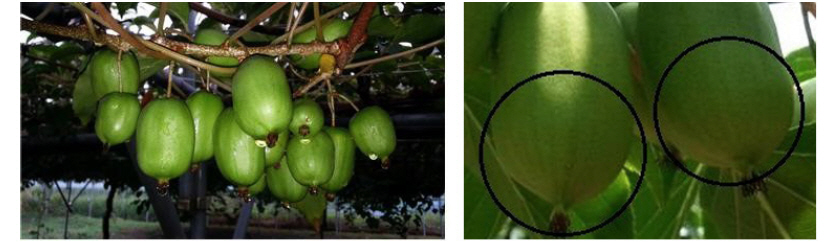
The fruit appearance of ‘Mansu’ is similar to that of ‘Chiak’. The average fruit size of ‘Mansu’ is approximately 15 to 17g at harvest. ‘Mansu’ has typical vertical stripes at the fruit end (Fig. 1). On October 15, the fruit firmness of ‘Mansu’ was 2.9 kg/5 mmØ, whereas that of ‘Chiak’ was over 2.6 kg/5 mmØ on October 5 (Table 4). Therefore, ‘Mansu’ is a late maturing fruit, which should be harvested at least approximately 10 days later than ‘Chiak’. The soluble solid content of ‘Mansu’ appeared to be a bit lower than that of ‘Chiak’ when compared on the same date in autumn. Dry matter weight (used as a taste index after ripening in kiwifruit) increased in both cultivars at a similar rate when they approached harvest maturity (Table 4).
| |
Fig. 1. Fruiting ‘Mansu’ (left); vertical stripes on the ends of fruits are shown in black circles (right). | |

Quality Changes during Cold Storage and Storability
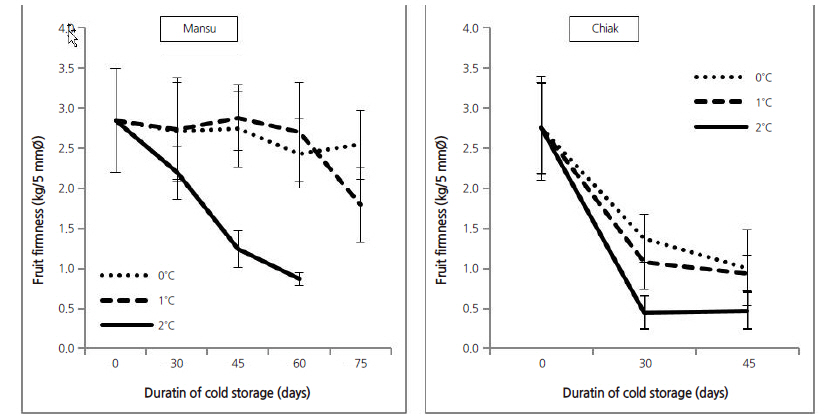
The fruit firmness of ‘Mansu’ was higher than that of ‘Chiak’ at all storage temperatures (0, 1, and 2°C) during storage (Fig. 2). The firmness of ‘Mansu’ fruits was maintained at over 1.5 kg/5 mmØ until 75 days of storage at 0°C, 60 days at 1°C, and 30 days at 2°C. By contrast, the firmness of ‘Chiak’ fruits decreased to below 1.5 kg/5 mmØ after 15 to 30 days of storage at all temperatures. The dry matter weight of ‘Mansu’ was well-maintained throughout the cold storage period (data not presented).
Availability
‘Mansu’ can be harvested approximately 10 days later than the control (‘Chiak’). Although ‘Mansu’ has very similarphenotypic characteristics to those of the typical A. arguta vine (‘Chiak’, which was derived from pure A. arguta seedlings) (Jo et al., 2007), the vertical cracks in ‘Mansu’ trunks are clearly distinctive compared to ‘Chiak’. Another feature of ‘Mansu’ vines is that they appear to be tolerant to drought during hot summers, because the leaves of ‘Mansu’ did not curl under strong sunlight. Such morphological features imply better photosynthetic ability of ‘Mansu’ vines. In terms of fruit firmness, ‘Mansu’ exhibited approximately two times longer storability in cold storage than ‘Chiak’ (Fig. 2). At present, the rapid softening of A. arguta fruits after harvest and even in cold storage is one of the limiting factors in the arguta industry. However, the introduction of later maturing cultivars with longer storage lives such as ‘Mansu’ may represent a breakthrough in the arguta industry in the future. At the same time, further studies are urgently needed to explore marketing technology and postharvest quality management, as well as cultural practices for high quality fruit production, to facilitate the establishment of the arguta industry.