Horticultural Science and Technology. 31 August 2014. 571-575
https://doi.org/10.7235/hort.2014.13155

ABSTRACT


MAIN

  • 서 언

  • 육성 경위

  • 주요 특성

  • 재배상 유의점

  • 유용성

서  언

안개초는 1978년 국내에 도입된 이후 1995년까지 재배면적이 증가하여 국화에 이어 2대 절화작목으로 성장하였으나, IMF 이후 꽃 소비패턴 변화와 안개꽃을 대신할 수 있는 다양한 화종들의 재배가 늘어나면서 2012년 현재 51.6ha로 6번째 절화작목에 위치하고 있다(MIAFRA, 2013). 도입 때부터 2000년 중반까지 유일한 재배품종이었던 ‘Bristol Fairy’는 시장 선호도가 떨어졌을 뿐만 아니라 역병 등 병해 발생이 심각하여 농업인의 재배 기피로(Park et al., 2003) 2009년 이후 급격하게 면적이 감소하여 현재는 재배가 전무하다. 그 사이 주산단지인 경남 창원과 김해, 전북 남원 및 전남 여수를 중심으로 ‘Inbal’이 재배되기 시작하였고 ‘Casiopeia’ 및 ‘Mirabella’ 등이 시장에서도 높은 평가를 받고 있다. 또한 최근에 ‘Over Time’, ‘Jeus’ 및 ‘Ginza’ 등 다양한 신품종들이 도입되어 치열한 경쟁을 하고 있다. 안개초는 2004년 국제신품종보호연맹(UPOV)의 신품종 보호작목으로 지정되어 도입품종 재배 시 불가피하게 로열티를 지불해야 하기 때문에 농가의 종묘비 부담으로 작용하고 있을 뿐만 아니라 신품종 갱신주기가 매우 짧아지고 있어 소비자 선호도가 높고 재배자의 요구에 맞는 국내 육성품종 개발 및 보급이 시급한 실정이다. 그러나 안개초 원예종은 단성(unisexual)이고, 5개 수술 원기의 꽃잎화로 겹꽃이 되는 과정에서 수술이 퇴화, 화분립이 형성되지 못하거나 화분의 임성이 없어 결실되지 않아 전통적인 교잡 육종이 불가능하다(Doi et al., 1991; Shillo, 1985; Zuker et al., 1997). 전라북도농업기술원에서는 1998년부터 신품종 개발을 위해 유식물체 돌연변이원 처리, 캘러스 통한 재분화 및 재배포장에서의 아조변이주 선발 등의 유용한 변이체를 선발 육성하는 방법을 이용하였다(Cheong et al., 2004). 그러던 중 1999년 ‘Bristol Fairy’로부터 결실되는 아조변이체 ‘Gyp99’ 계통을 선발하였는데 화분의 acetocarmine 염색 결과 수정 능력이 있음을 확인하였으며(Cheong, 2005), 이 계통으로부터 여러 세대를 진전시켜 선발육종법을 통해 국내 최초로 내서성이 강하고 기형화 발생이 없는 안개초 신품종 ‘Yeowon’을 육성하였고, 이후로 일시개화성이 우수하고 흰가루병에 강한 ‘Shine’(Cheong et al., 2010)을, 이후 ‘Double Shine’과 ‘Happy Dream’을 육성하였고(Cheong et al., 2012), 분홍색 겹꽃으로 흰가루병에 강한 ‘Dream Pink’(Cheong et al., 2011)를 등록하였다. 국내 안개꽃에 대한 소비자 기호도는 밝은 백색 겹꽃에 소화가 크고 일시개화성이 우수하고, 줄기는 단단하고 측지 발생 각도가 작은 직립형태이며 절화수명이 긴 품종을 선호한다. 전라북도농업기술원에서는 2010년 백색 겹꽃으로 소화가 크며, 측지 분지각이 작고 일시개화성이 우수한 신품종 ‘Dream Song’을 육성한 바 있으며, 본 논문을 통하여 육성 경위와 주요 특성을 보고하고자 한다.

육성 경위
http://static.apub.kr/journalsite/sites/kshs/2014-032-04/N0130320419/images/PIC7DDA.gifhttp://static.apub.kr/journalsite/sites/kshs/2014-032-04/N0130320419/images/PIC7E78.gifhttp://static.apub.kr/journalsite/sites/kshs/2014-032-04/N0130320419/images/PIC7F82.gif

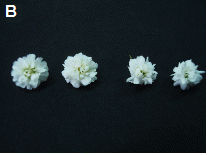
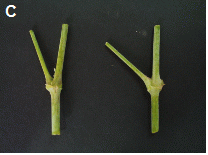
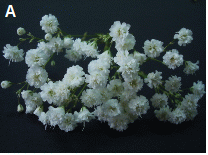
Fig. 1. Inflorescence (A) of Gypsophila paniculata ‘Dream Song’, and the comparison of florets (B), and branching angle (C) between ‘Dream Song’ (left) and ‘Bristol Fairy’ (right, the control cultivar).

Table 1. Pedigree diagram of Gypsophila paniculata ‘Dream Song’.

Year

2006

2007-2008

2009

2010

   1

Gyp06-11

OP

   2

Gyp08-2

‘Dream Song’

 121

Pedigree

Seed harvesting after

an open pollination

Line separation and

clonal selection

Proliferation and

field trial

Field trial

‘Bristol Fairy’의 결실되는 아조변이체 ‘Gyp99’의 계통으로부터 2006년 선발된 ‘Gyp06-11’ 계통의 방임수분을 통하여 121개의 실생계통을 획득하였으며, 이들 중 백색 겹꽃으로 소화가 크고 측지 분지각이 작은 08-2계통을 선발하여 ‘Gyp08-2’로 계통명을 부여하였다. 2009년 영양번식 후 특성평가와 검정을 실시하였고, 2010년 ‘Bristol Fairy’를 대조품종으로 하여 5월 15일 삽아묘를 정식하고 6월 15일에 적심한 후 식물체 고유특성과 개화 및 소화특성 등을 국립 종자원의 신품종 심사를 위한 안개초 특성조사 요령에 의거하여 조사하였다. 특성검정을 실시한 결과 우수성이 인정되어 농촌진흥청 농작물 직무육성 신품종 선정 위원회의 심의를 거쳐 ‘Dream Song’으로 명명하였다(Table 1).

주요 특성

‘Dream Song’의 개화습성은 중생종으로 조생종인 대조품종 ‘Bristol Fairy’보다 만생성을 보였으며, 초형은 직립형, 소화는 크고 백색 겹꽃(RHS, NN155-D)이었다(Fig. 1A). 줄기의 색은 연녹색(RHS, YG144-C)을 띠고 잎 모양은 피침형이며, 꽃잎 모양은 도란형, 꽃잎 끝 모양은 약간 둥근형, 꽃받침 모양은 컵형이었다(Table 2). ‘Dream Song’과 대조품종인 ‘Bristol Fairy’ 삽아묘를 2010년 5월 15일 전라북도농업기술원 허브시험장(구 화훼자원연구소, 해발 500m) 시험포장에 정식하여 특성검정을 실시한 결과, ‘Dream Song’의 개화는 ‘Bristol Fairy’보다 17일 정도 늦었으며, 절간장 8.4cm, 화경장 88.6cm로 대조품종보다 각각 2.2cm, 8cm 더 길었다. 분화된 마디수는 22개 정도로 두 품종이 유사하였으나 측지수는 ‘Dream Song’이 본당 14.4개로 1.6개 더 많았다. 줄기 역시 대조품종보다 약간 굵었으며, 1차 측지 발생 각도가 47도(°)의 대조품종보다 11도(°) 작은 직립적인 형태를 보여(Table 3 and Fig. 1C) 소비자 선호도가 높은 특성을 가진다. ‘Dream Song’의 엽장은 대조품종보다 약간 짧은 반면, 엽폭은 0.6cm 더 넓었으며, 소화가 크고 꽃잎수도 11.5개 더 많았다(Fig. 1B). 특히 안개초는 화아분화기에 야간기온 22°C 이상의 고온조건이 7일 이상 지속되면 수술의 꽃잎화가 이상적으로 진행되어 연한 황색의 작은 꽃잎괴가 형성되는 기형소화가 발생되는데(Doi et al., 1991; Sakamoto, 1994; Shillo, 1985; Suto et al., 1987), ‘Bristol Fairy’는 꽃잎괴가 소화당 7.0개가 생긴 반면, ‘Dream Song’은 기형소화가 전혀 발생되지 않아 고온 적응성이 우수하였다. 암술수는 2개로 일정하였고 수술수는 대조품종보다 많았으며, 암술과 수술 길이도 더 길었다(Table 4). ‘Bristol Fairy’는 역병, 흰가루병 및 충해에 약한 반면, ‘Dream Song’은 흰가루병에 매우 강하고, 역병과 총체벌레, 잎굴파리 등 충해도 상당히 강한 경향이었으나, 응애에는 대체로 약했다.

Table 2. Morphological characteristics of Gypsophila paniculata ‘Dream Song’ as compared to ‘Bristol Fairy’.

Cultivars

Flowering

habit

Plant

type

Stem

color

Leaf

shape

Petal

color

Petal

shape

Petal

tip shape

Dream Song

Mid-

flowering

Upright

Pale green

(YG144-C)z

Lanceolate

White

(NN155-D)

Obovate

Truncate

Bristol Fairy

(Control)

Early-

flowering

Intermediate

Light green

(G137-B)

Lanceolate

White

(NN155-C)

Spatulate

Emarginate

zThe colors of stem and petal were measured on the basis of the Royal Horticultural Society (RHS) color chart.

Table 3. Phenotypic characteristics of Gypsophila paniculata ‘Dream Song’ examined on the flowering date in a summer cultivation after transplanting rooted cutting on May 15.

Cultivars

Flowering date

Flower stalk length (cm)

No of

node

Stem diameterz

(mm)

No of primary branchesy

Branching angle (°)

Internodal lengthz (cm)

Dream Song

Aug. 21

88.6 ± 1.0x

21.8 ± 0.2

2.8 ± 0.1

14.4 ± 0.4

36.0 ± 0.8

8.4 ± 0.2

Bristol Fairy (Control)

Aug. 4

80.6 ± 1.5

21.6 ± 0.4

2.5 ± 0.1

12.8 ± 0.7

47.0 ± 1.5

6.2 ± 0.1

Significance

*

ns

*

ns

**

***

zDetermined from the middle internode of the tallest main stem.

yCounted on the main stem from apex to base.

xValues represent mean ± standard error (n = 10).

ns,*,**,***Nonsignificant or significant at p = 0.05, 0.01, or 0.001, respectively.

Table 4. Characteristics of leaf growth and floret of Gypsophila paniculata ‘Dream Song’ examined on the date of flowering in a summer cultivation after transplanting rooted cutting on May 15.

Cultivars

Leaf length

(cm)

Leaf width

(cm)

Floret width

(mm)

No. of

petals

Calyx Height

(mm)

No. of

pistils

No. of

stamens

Dream Song

6.6 ± 0.2z

1.4 ± 0.1

8.2 ± 0.2

70.8 ± 1.6

(0 ± 0)y

3.7 ± 0.1

2.0 ± 0.0

(5.4 ± 0.4)x

10.4 ± 0.7

(4.2 ± 0.3)w

Bristol Fairy

(Control)

6.9 ± 0.1

0.8 ± 0.1

7.9 ± 0.1

59.3 ± 3.0

(7.0 ± 0.2)y

3.4 ± 0.1

3.3 ± 0.4

(2.7 ± 0.2)x

 2.6 ± 0.6

(2.8 ± 0.4)w

Significance

ns

***

*

**

(***)

**

ns

(*)

**

(**)

zValues represent mean ± standard error (n = 10).

yPetal clusters formed in the floret through excessive petaloidy of stamens by high temperature.

xLength of pistil.

wLength of stamens.

ns,*,**,***Nonsignificant or significant at p = 0.05, 0.01, or 0.001, respectively.

Table 5. Diseases and pests incidence of Gypsophila paniculata ‘Dream Song’.

Cultivars

Diseases (0-9)z

Pestsy

Powdery mildew

Phytophthora rot

Fusarium wilt

Mites

Thrips

Leaf-miners

Dream Song

1.6

4.1

2.0

++

+

+

Bristol Fairy (Control)

5.1

5.8

3.5

++

+

+++

Significance

**

*

*

zEvaluated subjectively on a scale of 0 (Healthy) to 9 (Severe).

yIncidence level: +, slight; ++, moderate; and +++, very severe.

*,**Significant at p = 0.05 or 0.01, respectively.

Table 6. Cultivative characteristics of Gypsophila paniculata ‘Dream Song’, ‘Casiopeia’, and ‘Mirabella’ examined in summer cultivation at Namwon city (Unbong, 500 m over the sea level) after transplanting rooted cutting on June 14.

Cultivars

Flowering date

Flower 

stalk length

(cm)

No. of

node

Stem 

diameterz

(mm)

No. of

primary branchesy

No. of

axillary 

stemx

Yield

(bundles/10 a)

Dream Song

Aug. 30

104.5 ± 2.3w

24.6 ± 0.5

7.0 ± 0.3

18.4 ± 0.6

6.0 ± 0.4

3,250 ± 13.4

Casiopeia (Control)

Aug. 26

 95.4 ± 2.0

25.7 ± 0.9

7.3 ± 0.3

19.4 ± 0.5

4.8 ± 0.3

3,201 ± 15.6

Mirabella (Control)

Sept. 10

117.8 ± 3.5

26.6 ± 1.4

7.5 ± 0.5

19.8 ± 0.7

4.0 ± 0.4

3,130 ± 22.4

Significance

*

*

ns

ns

**

*

zDetermined in 10 cm above ground level of the tallest main stem.

yCounted on the main stem from apex to base.

xCounted the number of axillary stem differentiated at the base

wValues represent mean ± standard error (n = 10).

ns,*,**,***Nonsignificant or significant at p = 0.05, 0.01, or 0.001, respectively.

재배상 유의점

숙근 안개초의 화아분화는 일장이 길고 일사량이 많을수록 촉진되어 최종 적심에서 출뢰까지 적산 일사량이 500-550 M・m-2 이상 필요한 작목이다(Hicklenton, 1987; Suto et al., 1987). 따라서 중생종인 ‘Dream Song’은 일사량을 충분히 확보할 수 있도록 재배포장 선정과 재배관리가 중요하고(Sakamoto, 1994), 겨울철 재배는 화형과 일시개화성 등의 고유한 특성 발현을 위해서는 최저온도 10°C 이상 유지 관리해야 된다. 역병에 강하지 못하기 때문에 토양수분 조건은 대조품종인 ‘Bristol Fairy’의 영양생장기 관수 개시점 -10.0kPa, 출뢰기 후 -79.4kPa과 동일하게 관리하여(Cheong et al., 2001; Hosoya and Miura, 1995) 과습되지 않도록 한다. 또한 대기가 건조하면 응애 발생이 쉽기 때문에 예방과 초기 방제를 철저히 해야 한다. 이 밖에 번식, 재배작형, 비배 관리 및 병해충 방제는 일반적인 안개초 재배관리에 준한다.

유용성

종자산업법에 의거 2011년 1월 3일에 본 품종에 대한 품종 보호권을 출원(품종보호출원번호: 출원2011-19, 품종명칭출원번호: 명칭2011-22)하였고, 2011년 1년 동안 재배심사를 실시하여 종자산업법 제55조에 의해 2012년 2월 7일 신품종 ‘Dream Song’이 최종등록(품종번호: 제3851호)되었다. 2011년부터 농가 보급을 시작하여 2013년 현재 남원, 무주 및 강릉 등 고랭지와 창원, 김해 및 고성 등 평난지에서 재배되고 있다. ‘Dream Song’은 밝은 백색 겹꽃으로 소화가 크고 소화수가 많으며 줄기가 직립이어서 시장 선호도가 우수하며, 특히 고온 경과 작형(6월-10월)에서 절화수명이 길어 시장 경쟁력이 높다. Table 6은 2012년 6월 14일 남원 운봉(해발 500m)에서 ‘Mirabella’, ‘Casiopeia’ 및 ‘Dream Song’ 삽아묘를 정식하여 실증 재배한 결과로, ‘Dream Song’의 개화가 ‘Mirabella’보다 10일 빨랐고 ‘Casiopeia’보다는 4일 늦었으며, 분지 발생수는 두 품종보다 많아 절화량이 높은 경향이었다. ‘Dream Song’의 4-11월 시장성은 ‘Mirabella’와 대등하거나 유사하고 ‘Casiopeia’보다는 높고 종묘비가 저렴하기 때문에 농가 소득 향상에 도움이 될 것으로 생각된다. 본 품종은 2012년 통상실시권을 실시하여 유한회사 서해농산(전북 부안군 소재)에서 종묘를 구입할 수 있다.

References

1
Cheong, D.C. 2005. Physio-morphological characteristics and inhibition of flower malformation and rosette formation in Gypsophila paniculata. Ph.D. Thesis. Chonbuk Natl. Univ., Jeonju, Korea p. 20.
2
Cheong, D.C., C.H. Choi, Y.J. Song, H.C. Lim, J.M. Kim, J.J. Lee, and J.S. Lee. 2012. A new cultivar of Gypsophila paniculata ‘Happy Dream’ with white colored double petals and strong stem for cut flower. Flower Res. J. 20:124-127.
3
Cheong, D.C., H.C. Lim, C.H. Choi, K.C. Kim, Y.J. Song, and J. M. Kim. 2010. Simultaneous blooming ‘Shine’, a new cultivar of Gypsophila paniculata. Kor. J. Hort. Sci. Technol. 28:159-161.
4
Cheong, D.C., H.C. Lim, C.H. Choi, Y.J. Song, and J.M. Kim. 2011. A new cultivar of Gypsophila paniculata with powdery mildew resistance and double florets of pink color, ‘Dream Pink’. Kor. J. Hort. Sci. Technol. 29:500-502.
5
Cheong, D.C., J.S. Jeong, C.J. Chang, E.J. Lee, E.G. Choi, and H.B. Park. 2004. Shoot regeneration of callus from shoot tip and node culture of Gypsophila paniculata ‘Bristol Fairy’. Kor. J. Hort. Sci. Technol. 22:100-106.
6
Cheong, D.C., J.S. Jeong, and H.B. Park. 2001. Optimum irrigation point to produce high quality cut flowers of Gypsophila paniculata ‘Bristol Fairy’. Kor. J. Hort. Sci. Technol. 19:579-584.
7
Doi, M., T. Morita, Y. Takeda, and T. Asahira. 1991. Effects of exposure to high temperature at different developmental stages of shoots on rosette formation and flower malformation of Gypsophila paniculata. J. Japan. Soc. Hort. Sci. 59:795-801.
8
Hicklenton, P.R. 1987. Flowering of Gypsophila paniculata cv. Bristol Fairy in relation to irradiance. Acta Hortic. 205:103-111.
9
Hosoya, M. and H. Miura. 1995. Nutrition physiology and fertilization of flower. Society of Farming and Fishing Communities, Tokyo, Japan. p. 183-192.
10
Ministry of Agriculture, Food and Rural Affairs (MIAFRA). 2013. Statistics for floricultural industry in 2012. MIAFRA, Gwacheon, Korea.
11
Park, H.B., D.C. Cheong, J.S. Jeong, Y.G. Choi, and Y.J. Kim. 2003. Development of long-term cold storage method for root clumps and crowns of Gypsophila paniculata ‘Bristol Fairy’. J. Kor. Soc. Hort. Sci. 44:367-372.
12
Royal Horticultural Society (RHS). 2001. Royal Horticultural Society color chart. RHS, London.
13
Sakamoto, H. 1994. An outline of agricultural technology, floriculture. Vol. IX, Perennial. Society of Farming and Fishing Communities, Tokyo, Japan. p. 163-217.
14
Shillo, R. 1985. Gypsophila paniculata, p. 83-87. In: A.H. Halevy (ed.). Handbook of flowering. Vol. III. CRC Press, Boca Raton.
15
Suto, K., M. Kunishige, and K. Nishio. 1987. Effects of the temperature, photoperiod and light intensity on the growth Gypsophila paniculata L. Bul. Natl. Res. Inst. Veg. Ornamental Plants Tea. A.1:235-247.
16
Zuker, A., A. Ahroni, H. Shejtman, and A. Vainstein. 1997. Adventitious shoot regeneration from leaf explants of Gypsophila paniculata Plant Cell Rep. 16:775-778.
페이지 상단으로 이동하기