

Introduction
Pathogen Diversity
Taxonomy
Disease symptoms and identification of Colletotrichum species in Korea
Colletotrichum gloeosporioides
Colletotrichum acutatum
Colletotrichum horii
Colletotrichum siamense
Colletotrichum nymphaeae
Colletotrichum fructicola
Colletotrichum fioriniae
Disease Cycles
Environmental Conditions
Management Approach
Cultural Control
Biological Control
Chemical Control
Conclusions and Future Perspectives
Introduction
Persimmon (Diospyros kaki Thunb.) is a globally important fruit crop that originated in China and was subsequently diversified through extensive cultivation and selection in Japan and Korea (Kwon et al. 2013; Mir et al. 2025). It is widely cultivated in warm-temperate and subtropical regions of Asia, the Americas, and Europe (Yonemori et al. 2000; Mir et al. 2025). Global sweet persimmon production reached approximately 5.03 million tonnes in 2024, with China producing 3.9 million tonnes (77.53% of total production), followed by Korea with 0.23 million tonnes (4.57%) (FAO 2024). Anthracnose, caused by Colletotrichum species, is one of the most destructive diseases affecting persimmon and many other crops worldwide, including in Korea (Kwon et al. 2013; Jeon et al. 2017). In Korea, anthracnose affects both sweet and astringent persimmon (Kwon and Park 2004). Korean farmers have consistently identified anthracnose as the most serious disease in persimmon during the growing season (Lee et al. 2001; Lim et al. 2008). The persimmon cultivation area in Korea has expanded rapidly in the major production regions of Sangju (Gyeongsangbuk-do), Yeongdong (Chungcheongbuk-do), and Sancheong (Gyeongsangnam-do) (Yu et al. 2017; Chang et al. 2018). Consequently, orchards have become increasingly concentrated within a relatively short period, and cultivars highly susceptible to anthracnose are predominantly grown in these regions.
This disease causes significantly fruit yield and quality losses during preharvest production and postharvest storage (Kwon et al. 2013; Jeon et al. 2017; Hassan et al. 2018; Guan et al. 2022). Severe outbreaks may result in substantial fruit losses and reduced marketable yields under environmental conditions favorable for disease development (Kwon et al. 2013). For instance, disease incidence has been reported to exceed 40–60% in sweet persimmon orchards, highlighting the considerable economic impact on persimmon production in Korea (Kwon et al. 2013; Hassan et al. 2019). Many studies have reported that multiple species of Colletotrichum can infect the same host plant, contributing to the complexity of disease diagnosis and management (Huang et al. 2013; Wang et al. 2016).
Traditionally, Colletotrichum species were identified based on their morphological characteristics and host associations. However, current species identification primarily relies on multilocus phylogenetic analyses conducted using DNA sequence data (Damm et al. 2012; Weir et al. 2012; Liu et al. 2014). With advances in molecular taxonomy, multilocus phylogenetic analyses have increasingly been used for accurate species-level identification, with pathogenicity tests applied to confirm the causal relationship between identified isolates and disease symptoms. This distinction is important because isolation of a Colletotrichum species from symptomatic tissue alone does not establish its role as the causal pathogen.
With the integration of morphological characteristics and molecular phylogenetic analyses approaches, diverse Colletotrichum species have been found to infect persimmon worldwide, including Korea. For instance, C. gloeosporioides, C. horii, C. siamense, and C. fructicola, and the C. acutatum species complex, including C. acutatum, C. nymphaeae, and C. fioriniae have been identified in Korea (Kwon and Kim 2011; Kwon et al. 2013; Jeon et al. 2017; Chang et al. 2018; Hassan et al. 2018; Hassan et al. 2019; Yoo et al. 2026; Choi et al. 2026); C. gloeosporioides, C. horii, and C. karstii have been found in China (Zhang 2008; Xie et al. 2010; Wang et al. 2016); C. acutatum is present in the United States (Williamson and Sutton 2010); C. gloeosporioides in Spain (Palou et al. 2013; Palou et al. 2015); C. horii has been found in Japan and New Zealand (Xie et al. 2010), and C. horii, C. fructicola, C. nymphaeae, C. asianum, and C. melonis have been found in Brazil (May De Mio et al. 2015; Carraro et al. 2019). Notably, the species C. horii is one of the most widely distributed and frequently reported as a causal agent of persimmon anthracnose worldwide (Carraro et al. 2022). Species identification across the aforementioned studies has employed combinations of loci, including the internal transcribed spacer (ITS), actin (ACT), glyceraldehyde-3-phosphate dehydrogenase (GAPDH), calmodulin (CAL), β-tubulin 2 (TUB2), chitin synthase 1 (CHS-1), histone H3 (HIS3), and the Apn2–Mat1-2 intergenic spacer and partial mating-type gene (ApMat) regions, substantially improving the taxonomic resolution of Colletotrichum associated with persimmon anthracnose.
Colletotrichum species also have a broad host range and infect numerous economically important crops, including apple (González et al. 2006; Oo et al. 2018), strawberry (Nam et al. 2013), pepper (Kim et al. 2008; Liu et al. 2016), citrus (Peres et al. 2008), peach (Kim and Hong 2008; Lee et al. 2020; Tan et al. 2022), mango and avocado (Sanders and Korsten 2003), banana (Weir et al. 2012), coffee (Nguyen et al. 2010), and even cereals (Crouch and Beirn 2009), among many other fruit and vegetable crops.
The disease symptoms of Colletotrichum species observed under natural and artificial inoculations were generally found to produce similar anthracnose lesions on susceptible persimmon tissues. Typical symptoms can develop on multiple plant tissues, including shoots, twigs, leaves, flowers, and fruits, although symptom expression and severity may vary depending on the Colletotrichum species or isolate, host tissue and developmental stage and environmental conditions (Xie et al. 2010; Hassan et al. 2018; Hassan et al. 2019; Guan et al. 2022). Many studies have reported that Colletotrichum species affect persimmon in the field by infecting leaves, shoots, twigs, flowers and fruits (Kwon and Park 2004; Kwon et al. 2007; Cannon et al. 2012; Kwon et al. 2013; Moreira et al. 2023). On young shoots and twigs, anthracnose typically appears as dark necrotic lesions that can coalesce and develop into extensive cankers (Kwon and Park 2004; Kwon et al. 2013; Jeon et al. 2017; Guan et al. 2022). Leaf symptoms typically appear as brown to black spots on veins and petioles, often leading to premature defoliation (Kwon and Park 2004; Zhang et al. 2005; Kwon et al. 2013; Jeon et al. 2017; Guan et al. 2022; Fan et al. 2024a). Fruit symptoms are characterized by sunken, dark lesions that progressively expand into the underlying tissue, leading to fruit softening tissue, decay, and premature fruit drop (Kwon and Park 2004; Xie et al. 2010; Kwon and Kim 2011; Kwon et al. 2013; An et al. 2017; Jeon et al. 2017; Chang et al. 2018; Hassan et al. 2019; Guan et al. 2022). Similarly, artificial inoculation with pathogenic Colletotrichum isolates reproduce typical anthracnose lesions on persimmon fruits, leaves, and shoots, resembling those observed during natural field infections (Xie et al. 2010; Kwon and Kim 2011; Hassan et al. 2018; Choi et al. 2026).
Persimmon anthracnose is characterized as a polycyclic disease cycle, with repeated infections throughout the growing season (Kwon and Park 2004; Hassan et al. 2018). The pathogen overwinters in infected tissues and debris, producing primary inoculum in spring, while warm, humid, and rainy conditions promote conidial dispersal and secondary infections. Infected debris contributes to pathogen persistence between seasons, whereas fruit infections may remain latent until ripening, storage, or distribution, resulting in postharvest decay and reduced fruit quality (Kwon and Park 2004). Colletotrichum infection and disease development are favored by warm, humid conditions, with temperature, rainfall, relative humidity, and tissue wetness strongly influencing disease progression (Kwon et al. 2000; Kwon and Park 2004; Kwon et al. 2013; Jeon et al. 2017; An et al. 2018; Hassan et al. 2018; Moreira et al. 2023).
Management of persimmon anthracnose can be challenging once severe disease outbreaks occur in the orchard. Therefore, effective management of persimmon anthracnose requires an integrated approach combining cultural, biological, and chemical control strategies to reduce inoculum and disease development (Dowling et al. 2020; Salotti et al. 2023). Cultural practices, including the removal of infected debris, pruning, and appropriate orchard management, can reduce overwintering inoculum, tissue wetness, and pathogen dispersal (Kwon et al. 2013; Hassan et al. 2018). Biological control techniques that rely on Bacillus, Trichoderma, and plant-derived products offer potential alternatives to synthetic fungicides (Damasceno et al. 2019; Heo et al. 2024), although persimmon-specific evidence remains limited. When these management approaches provide insufficient control, fungicide applications are most effective when used preventively, particularly from early shoot development through fruit development and during the summer rainy season, when warm and wet conditions promote conidial production, dispersal, and repeated infection. Early protection of emerging shoots is particularly important because infected shoots can serve as secondary inoculum sources for subsequent infections of leaves and developing fruits (Kwon and Park 2004; Kwon et al. 2013).
The understanding of persimmon anthracnose etiology in Korea has evolved substantially over the past two decades. Earlier studies, based on morphological characteristics for species identification, recognized only a limited species of causal agents. However, multilocus phylogenetic analyses have shown that persimmon anthracnose is caused by a complex of genetically distinct Colletotrichum species rather than a single pathogen (Jeon et al. 2017; Chang et al. 2018; Hassan et al. 2018; Hassan et al. 2019). This taxonomic resolution is critical for accurate disease diagnosis, epidemiological studies, and the development of effective disease management strategies. Therefore, as noted above, this review aims to provide a comprehensive synthesis of the current understanding of persimmon anthracnose in Korea by integrating published studies pertaining to Colletotrichum diversity, taxonomy and identification, disease cycles and epidemiology, disease management, and future research directions. Evidence from other Colletotrichum pathosystems is incorporated selectively where persimmon-specific information is limited to highlight potentially transferable approaches and research priorities.
Pathogen Diversity
Taxonomy
The genus Colletotrichum is a taxonomically complex group comprising numerous plant pathogens that cause anthracnose disease across a wide range of host plants (Cannon et al. 2012; Thao et al. 2024). Early classifications were based on cultural and morphological attributes; however, advances in molecular identification have indicated that morphological evidence alone cannot reliably distinguish Colletotrichum species due to a lack of molecular data (Cai et al. 2011; Damm et al. 2012; Weir et al. 2012; Liu et al. 2014). Modern multilocus phylogenetic studies have recognized approximately 280 accepted Colletotrichum species, classified into 16 species complexes and 15 singleton species (Liu et al. 2022). The nuclear ribosomal internal transcribed spacer (ITS) region is broadly used to assign Colletotrichum isolates to species complexes (Cannon et al. 2012). Because ITS alone often lacks a sufficient phylogenetic resolution to distinguish closely related species, multilocus phylogenetic analyses incorporating loci such as TUB2, HIS3, GAPDH, CHS-1, and ACT are conducted (Damm et al. 2012; Damm et al. 2014; Jayawardena et al. 2016; Damm et al. 2019; Liu et al. 2022).
The genus Colletotrichum is a taxonomically complex group of fungal pathogens with several plant hosts. For instance, the C. gloeosporioides complex alone comprises over 20 closely related species within different hosts (Table 1) (Weir et al. 2012). Distinguishing species within this complex based only on morphological characteristics is difficult because many taxa exhibit overlapping colony morphologies, conidial dimensions, and appressorial characteristics (Hu et al. 2015).
Table 1.
List of Colletotrichum gloeosporioides species complexes
The C. acutatum species complex is recognized as consisting of destructive plant pathogens worldwide and has been found in Korea as well (Lee et al. 2007; Peres et al. 2008; Kwon and Kim 2011; Cho et al. 2021; Kim et al. 2022). To date, this complex is known to be one of the largest groups in the genus Colletotrichum, with 43 accepted species with either broad or narrow host ranges (Jayawardena et al. 2016; Liu et al. 2022). Variations in conidial morphologies among the species within this complex have often resulted in cases of misidentification when species identification relies solely on morphological characteristics. For instance, Damm et al. (2012) re-identified 39 isolates, previously identified morphologically as C. gloeosporioides, as 14 species within or closely related to the C. acutatum species complex based on a multilocus phylogenetic analysis.
Disease symptoms and identification of Colletotrichum species in Korea
Colletotrichum species are well-known causal agents of anthracnose in persimmon and a range of other host plants in Korea. The previously reported Colletotrichum species associated with persimmon anthracnose in Korea are presented in Table 2. Although disease symptoms are generally similar among species, their severity and appearance can vary depending on the pathogen, infected tissue, and environmental conditions. The characteristic disease symptoms associated with the major Colletotrichum species that reportedly affect Korean persimmon are summarized in Table 3. For species identification, isolates obtained from symptomatic persimmon tissues were cultured on potato dextrose agar (PDA) and characterized based on morphological features. Species identity was subsequently conducted using molecular approaches, particularly multilocus sequence and phylogenetic analyses, while pathogenicity tests and pathogen re-isolation were used to confirm their causal association with anthracnose symptoms.
Table 2.
Chronology of published reports of Colletotrichum species causing persimmon anthracnose in Korea
| Species identification | Species name | Location | References |
| Morphological characteristic | C. gloeosporioides | Jinju | Kwon et al. 2000; Kwon and Park 2004; Kwon et al. 2007 |
| Morphological characteristic + ITS | C. acutatum | Changwon | Kwon and Kim 2011 |
|
Morphological characteristics and multilocus phylogenetic analysis (ITS, ACT, GAPDH, CAL, TUB2, CHS-1, HIS3, ApMat) | C. horii | Jinju, Sangju, Yeongdong | Kwon et al. 2013; Jeon et al. 2017; Hassan et al. 2018 |
| C. siamense | Sangju | Chang et al. 2018; Hassan et al. 2018 | |
| C. nymphaeae | Sangju | Hassan et al. 2019 | |
| C. fructicola | Naju | Yoo et al. 2026 | |
| C. fioriniae | Suncheon | Choi et al. 2026 | |
| Species-complex assignments | C. gloeosporioides species complex (C. gloeosporioides, C. horii, C. siamense, C. fructicola) | Weir et al. 2012 | |
| C. acutatum species complex (C. acutatum, C. nymphaeae, C. fioriniae) | Damm et al. 2012 | ||
Colletotrichum gloeosporioides
Early identification of persimmon anthracnose in Korea has primarily relied on morphological characteristics. C. gloeosporioides was initially identified from diseased sweet persimmon fruits based on morphological characters of the pathogen and was subsequently reported as the predominant pathogen affecting sweet persimmon in Korean orchards (Kwon et al. 2000). The sweet persimmon anthracnose, C. gloeosporioides, causes premature fruit drop and when branches are infected, and the disease weakens tree vigor and causes dieback of affected branches (Kwon et al. 2000). Kwon et al. (2000) inoculated sweet persimmon fruits at the maturing stage with a conidial suspension (1 × 10⁵ conidia mL-1) using a spraying method. After observation for many hours, symptoms initially appeared as numerous small black spots on the fruit surface which later became enlarged sunken anthracnose lesions resembling those observed in cases of natural field infection. However, as the study did not report pathogen re-isolation, Koch's postulates were not fully verified. In addition, molecular identification or phylogenetic confirmation of the isolated inoculant was not described.
Kwon and Park (2004) investigated the development of anthracnose in a sweet persimmon orchard and found that symptoms appeared initially on current-season shoots, followed by rapid infection of young fruits during the peak conidial dispersal period. Infected shoots, including secondary shoots and water sprouts, developed dark brown lesions and served as the primary secondary inoculum source for fruit infection. Infected young fruits developed circular dark brown lesions that grew into sunken black lesions on mature fruits, leading to fruit softening, premature fruit drop and severe yield losses under warm, humid, and rainy conditions. During the growing season, the infection continued to develop on newly emerged shoots and young fruits, while small lesions were also observed on flower stalks and leaves. Kwon et al. (2007) further reported that twigs and buds were the most important overwintering inoculum sources of sweet persimmon anthracnose. In subsequent work, Kwon et al. (2007) investigated the anthracnose disease symptoms and identified overwintering inoculum sources of sweet persimmon anthracnose by collecting samples from infected twigs, buds, dead twigs, petioles, leaves, and fallen fruits. The pathogen was then isolated, cultured on PDA, and incubated at 25°C for eight days to determine its distribution among the different plant tissues. However, the morphological observation of fungal colonies from the recovered isolates was not described in the study. A subsequent taxonomic revision demonstrated however that isolates previously identified as C. gloeosporioides from persimmon were in fact C. horii based on multilocus sequence analyses (Weir and Johnston 2010). According to Weir et al. (2012), colonies of C. gloeosporioides were typically white to gray with abundant cottony aerial mycelia. Conidia were hyaline, cylindrical to fusiform with rounded or obtuse ends, whereas appressoria were brown and clavate to irregular in shape.
Table 3.
Comparative symptoms and morphological characteristics of Colletotrichum species causing persimmon anthracnose in host tissues and on potato dextrose agar (PDA) media
| Characteristic | C. gloeosporioides | C. acutatum | C. horii | C. siamense | C. nymphaeae | C. fructicola | C. fioriniae |
| Natural field infection |
Dark brown lesions on shoots, circular dark brown to sunken black lesions on fruits; twigs, buds, leaves, and flower stalks (Kwon and Park 2004; Kwon et al. 2007) |
Small black specks/spots
(black sesame seeds) on fruits only (Kwon and Kim 2011) |
Circular, sunken, brown and dark black spots lesions on fruits, twigs, branches, and leaves (Kwon et al. 2013; Jeon et al. 2017) |
Single, small, circular, dark black, and sunken lesions on fruits (Chang et al. 2018; Hassan et al. 2018) |
Circular, brown, sunken lesions on fruits (Hassan et al. 2019) |
Anthracnose lesions on fruits (Yoo et al. 2026) |
Water-soaked lesions on leaves, sunken necrotic lesions on shoots and fruits (Choi et al. 2026) |
| Artificial inoculation |
Small black spots, sunken anthracnose lesions on fruits (Kwon et al. 2000) |
Small black spots similar to sesame seeds on fruit (Kwon and Kim 2011) |
Black pinhead-size spots, small, circular, dark brown to black, slightly sunken lesions on fruits, (Jeon et al. 2017; Hassan et al. 2018) |
Tiny black pin-head spots, circular, dark brown to black, and sunken lesions on fruits (Chang et al. 2018; Hassan et al. 2018) |
Anthracnose symptoms, necrotic lesions on fruits (Hassan et al. 2019) |
Gray to brown sunken necrotic lesions, with orange conidial masses on fruits (Yoo et al. 2026) |
Typical anthracnose symptoms (Choi et al. 2026) |
| Colony |
White to gray, cottony aerial mycelia (Weir et al. 2012) |
Whitish to dark gray, later to salmon-colored conidial masses (Kwon and Kim 2011) |
White to grayish, cottony; reverse dark concentric zones, regular margins (Jeon et al. 2017; Hassan et al. 2018) |
Dense, white to off-white, olivaceous gray; reverse creamy yellow or white (Hassan et al. 2018; Chang et al. 2018) |
Gray on the upper side; creamy white on the reverse side (Hassan et al. 2019) |
White , dense aerial mycelia; reverse gray to dark gray, and yellow (Yoo et al. 2026) |
Cottony mycelia, and pale orange conidial masses (Choi et al. 2026) |
| Conidia |
Hyaline, cylindrical, fusiform with rounded, obtuse ends (Weir et al. 2012) |
Fusiform shape, constricted medially (Kwon and Kim 2011) |
Cylindrical, straight, single celled, a few curved, non-septate, obtuse apices (Jeon et al. 2017; Hassan et al. 2018) |
Hyaline, cylindrical to fusiform, straight or slightly curved, nonseptate, and guttulate (Hassan et al. 2018; Chang et al. 2018) |
Hyaline, fusiform, and pointed ends (Hassan et al. 2019) |
Hyaline, aseptate, cylindrical to oblong, and round ends (Yoo et al. 2026) |
Hyaline, and fusiform to cylindrical (Choi et al. 2026) |
| Appressoria |
Brown, clavate to irregular shape (Weir et al. 2012) |
Pale to dark brown, clavate/slightly irregular, no setae (Kwon and Kim 2011) |
Short and cylindrical, light brown, smooth uniform outline, a few irregularly lobed (Jeon et al. 2017; Hassan et al. 2018) |
Dark brown, various shapes, irregularly complex lobes (Hassan et al. 2018; Chang et al. 2018) | Oval, cylindrical, lobed, medium brown, and often formed in chains (Hassan et al. 2019) |
Dark brown, clavate, and solitary (Yoo et al. 2026) |
Dark brown, and ovoid to irregular shape (Choi et al. 2026) |
Colletotrichum acutatum
At present, multilocus phylogenetic analysis has been a reliable approach for the identification of Colletotrichum species complexes in Korean studies. Kwon and Kim (2011) observed symptoms in a sweet persimmon orchard and found that C. acutatum infected only fruit, whereas it has not been reported on twigs or suckers. Infected fruit symptoms initially appeared as small black specks resembling black sesame seeds on the fruit surface. Adjacent lesions occasionally coalesced but rarely developed into the large, expanding sunken lesions characteristic of C. gloeosporioides. Subsequently, Kwon and Kim (2011) collected fruits diseased due to natural field infection and cultured them on PDA. The initially developed colonies were white, gradually turned dark gray, and later produced orange to salmon-colored conidial masses. Conidia were fusiform and occasionally constricted at the center. The appressoria were pale to dark brown and clavate to slightly irregular in shape, and no setae were found. To confirm the species identity, pathogenicity tests of sweet persimmon fruits were conducted using a wounding method with a conidial suspension (2 × 10⁴ conidia mL-1) from 10-day-old PDA cultures incubated at 25°C. The inoculated fruits developed symptoms identical to those observed on naturally infected fruits, and the pathogen was successfully re-isolated based on these symptoms. Molecular identification based on a 584-bp ITS sequence and a phylogenetic analysis further supported the identification, showing 100% sequence similarity to C. acutatum sequences deposited at GenBank. C. acutatum was then identified as the causal agent of fruit black spots in sweet persimmon in Korea based on the identification method described above.
Colletotrichum horii
Anthracnose symptoms caused by C. horii mainly affected young twigs and fruits, causing brown lesions, circular dark black spots, and sunken lesions (Kwon et al. 2013; Jeon et al. 2017). Jeon et al. (2017) isolated C. horii from naturally infected astringent persimmon fruits and cultured the isolates on PDA at 25°C. Seven-day-old colonies were white to gray, producing abundant conidia across the colony surface. The mycelia were hyaline and septate. Conidia were cylindrical, straight or slightly curved with round ends, and single-celled, whereas appressoria were short, cylindrical and brown. To confirm the pathogen species, genomic DNA was extracted from re-isolated cultures and the ITS, ACT, and GAPDH loci were amplified and sequenced. A BLAST analysis showed 100% sequence identity with reference C. horii isolates in GenBank. A phylogenetic analysis based on the combined ITS–ACT–GAPDH dataset using the neighbor-joining method in MEGA6 clustered the isolates with authentic C. horii strains with 100% bootstrap support, confirming the pathogen as C. horii. To fulfill Koch's postulates, a pathogenicity test was used to evaluate Colletotrichum isolates by spray-inoculating mature persimmon fruits with a conidial suspension (1 × 10⁵ conidia mL-1). Black pinhead-sized spots developed on the fruit surface three to five days after inoculation, and the pathogen was successfully re-isolated from symptomatic tissues with the isolates confirmed as C. horii based on a molecular phylogenetic analysis.
Hassan et al. (2018) further identified morphological characteristics of C. horii similar to those reported by Jeon et al. (2017); colonies were cottony, white to gray, with dark concentric zonation and regular margins on the reverse side. Conidia were hyaline, one-celled, cylindrical and mostly straight with a few slightly curved, and with obtuse apices. Appressoria were short, cylindrical, light brown to brown, smooth and generally uniform in outline, with a few irregularly lobed.
To confirm C. horii as the causal agent of persimmon anthracnose, pathogenicity tests were conducted by inoculating green and mature astringent persimmon fruits with a conidial suspension (1 × 10⁵ conidia mL-1) using a wounding method. Ten days after inoculation, anthracnose symptoms developed as small, circular, dark brown to black, slightly sunken lesions surrounded by a yellow chlorotic halo. The lesions remained well defined and localized, with no visible conidial masses, consistent with symptoms observed on naturally infected fruits described by Jeon et al. (2017). The pathogen was subsequently re-isolated from symptomatic fruits, fulfilling Koch's postulates. Molecular identification based on ITS, ACT, and GAPDH loci showed 100% sequence identity with C. horii isolates reported by Jeon et al. (2017) and other reference isolates in GenBank. Furthermore, a phylogenetic analysis of the combined ITS–ACT–GAPDH dataset using the neighbor-joining method in MEGA6 clustered the isolates with authentic C. horii strains, confirming their taxonomic identity.
Colletotrichum siamense
Field infection symptoms initially appeared as small, circular, dark black lesions with a distinct margin visible on immature fruit. The lesions are localized and represent an early stage of symptom development (Hassan et al. 2018). On mature fruits, symptoms developed into single, circular, dark black, slightly sunken lesions with well-defined margins (Chang et al. 2018; Hassan et al. 2018).
Chang et al. (2018) collected persimmon fruits showing anthracnose necrotic lesions from orchards and conducted PDA isolation assessments. Seven days after incubation at 25°C, the colonies developed white aerial mycelium with olivaceous gray mycelium below, while the reverse side was creamy white. Hyphae were multinucleated and septate. Conidia were hyaline, nonseptate, cylindrical, straight or slightly curved, and obtuse at both ends. Appressoria were dark brown, ovate, globose, or ellipsoidal. The isolates exhibited cultural characteristics consistent with those of other species within the C. gloeosporioides complex, including C. siamense. To identify the species accurately, genomic DNA from the isolates was subjected to a multilocus sequence analysis using the ITS, GAPDH, CAL, and ApMat (Apn2–Mat1-2) loci. A BLAST search of the GAPDH, CAL, and ApMat sequences showed 100% similarity with reference C. siamense isolates in GenBank. However, the ITS region alone could not reliably distinguish C. siamense from closely related Colletotrichum species. A phylogenetic analysis based on the combined GAPDH, CAL, and ApMat dataset was performed using the neighbor-joining method in MEGA6. The isolates clustered with C. siamense strains, with high bootstrap support (>75%), confirming its taxonomic identity. Chang et al. (2018) also undertook a pathogenicity test by spraying ripe persimmon fruits with a conidial suspension (1 × 10⁵ conidia mL-1). Three to five days after inoculation, tiny (pin headed) black spots developed on the fruit surfaces. The pathogen was successfully re-isolated on PDA, fulfilling Koch's postulates. Thus, the isolates were successfully re-isolated and identified as C. siamense according to the methods described above.
Hassan et al. (2018) further identified C. siamense from diseased fruits collected from orchards and described similar morphological characters. Colonies on PDA were dense and white to off-white, with the reverse side appearing creamy to dull yellow. Conidia were hyaline, cylindrical to fusiform, and frequently guttulate. Appressoria were dark brown and highly variable in shape, often featuring complex irregular lobes. Species identification was further validated by a multilocus sequences analysis of the ITS, ACT, GAPDH, CAL, and ApMat (Apn2–Mat1-2) loci. A BLAST analysis indicated 100% similarity with sequence C. siamense isolates deposited in GenBank. Furthermore, a neighbor-joining phylogenetic analysis of the combined multilocus dataset, performed using MEGA6, grouped the isolates within the C. siamense clade with 99% bootstrap support. The pathogenicity test was verified by wounding-inoculating mature and green persimmon fruits with a conidial suspension (1 × 10⁵ conidia mL-1). Symptoms developed as circular, dark brown to black, slightly sunken lesions with a distinct dark center surrounded by a diffuse brown necrotic area. The lesions remained localized, with no visible conidial masses. To confirm the causal agents, the pathogen was subsequently re-isolated from necrotic tissue, thereby fulfilling Koch’s postulates. The isolates were then identified as C. siamense based on a multilocus analysis and morphological characteristics.
Colletotrichum nymphaeae
Under natural field infection, Hassan et al. (2019) reported that green fruits of the sweet persimmon ‘Jiro’ were most severely affected, developing circular, brown, sunken lesions, though no infections were reported on the twigs or leaves. The infected fruits were isolated on PDA culture and after seven days of culturing, and colonies were grey on the upper side and creamy white on the bottom side. Conidia were hyaline, fusiform, and pointed at both ends, and were produced by the entire colony. Appressoria were oval, cylindrical, lobed, medium brown, and often formed in chains. These morphological characteristics are consistent with several Colletotrichum species within the C. acutatum species complex, including C. nymphaeae (Damm et al. 2012). Species identification was verified by a multilocus sequence analysis of the ITS, TUB2, GAPDH, CHS-1, and ACT loci. BLAST results using each locus revealed 100% similarity with reference sequences of C. nymphaeae in the GenBank database. In addition, phylogenetic and neighbor-joining analyses performed using MEGA6 based on the five multi-loci samples mentioned above further showed that the isolates were clustered within the C. nymphaeae strain with high bootstrap support (>98%). To fulfill Koch’s postulates, pathogenicity was subsequently verified by inoculating green sweet persimmon fruits with a conidial suspension (1 × 10⁵ conidia mL-1). After one week of investigation, typical anthracnose symptoms arose, with necrotic lesions that closely resembled those observed on naturally infected fruits in the field. The pathogen was then successfully re-isolated and identified as C. nymphaeae based on the analysis described above.
Colletotrichum fructicola
Yoo et al. (2026) reported that symptoms appeared as anthracnose lesions on naturally infected sweet persimmon fruits. During the early stage of disease development, fruits showed small black lesions that grew over time, and orange conidial masses subsequently developed in the center of the lesions. Fungal isolates recovered from symptomatic tissues were cultured on PDA at 25°C in the dark to examine their morphological characteristics. Colonies produced white mycelia after seven days of incubation. Colonies were circular, with dense aerial mycelia at the center that gradually became less dense toward the margins. The reverse side exhibited a gray to dark gray center surrounded by yellow pigmentation. Conidia were hyaline, aseptate, cylindrical to oblong, with rounded ends. Appressoria were dark brown, clavate, and formed singly; their dimensions were not reported. The morphological characteristics of the isolates were consistent with species in the C. gloeosporioides species complex. To identify the isolates accurately, seven loci (ITS, TUB2, ACT, CHS-1, CAL, GAPDH, and ApMat) were sequenced. A BLAST analysis revealed >90% sequence similarity with reference C. fructicola sequences deposited in GenBank. Furthermore, a maximum likelihood phylogenetic analysis based on the combined seven-locus dataset, performed using MEGA12, demonstrated that the isolates recovered from symptomatic sweet persimmon fruits belonged to the C. gloeosporioides species complex; these were identified as C. fructicola. Pathogenicity testing was subsequently performed using wounding and non-wounding methods, and mature sweet persimmon fruits ‘Fuyu’ were inoculated with a conidial suspension (1 × 10⁶ conidia mL-1). The inoculated fruits showed well-developed anthracnose lesions after seven days of inoculation. The symptoms were gray to brown sunken necrotic lesions, accompanied by orange conidial masses developing at the centers of the lesions. The pathogen was successfully re-isolated from symptomatic tissues, thereby fulfilling Koch's postulates. Morphological and molecular identification of the re-isolated fungi was consistent with that of the inoculated isolates, confirming C. fructicola. This study reported that C. fructicola was the first species affecting sweet persimmon fruit in Korea. Previously, this species had been reported only in relation to other fruit crops, including apple, pear, pepper, and kiwifruit (Park et al. 2018; Choi and Park 2021).
Colletotrichum fioriniae
Choi et al. (2026) observed the typical anthracnose symptoms on sweet persimmon trees under field infection and found that the initial symptoms appeared as water-soaked lesions on leaves, followed by sunken necrotic lesions on shoots and fruits. Fungal isolates obtained from symptomatic tissues were cultured on PDA at 25°C. Colonies developed cottony mycelia with pale orange conidial masses. Conidia were hyaline and fusiform to cylindrical, whereas appressoria were dark brown and ovoid to irregular in shape. The morphological characteristics were similar to those of C. fioriniae reported by Damm et al. (2012). To confirm the species identity, the isolates were selected for a molecular phylogenetic analysis. Multilocus sequence analyses were performed using six gene loci (ITS, ACT, CHS-1, GAPDH, HIS3, and TUB2). A BLAST analysis revealed 99-100% identity with reference sequences of C. fioriniae in GenBank. In addition, a phylogenetic analysis using MEGA X combined with a sequencing dataset from the six loci confirmed that all isolates were clustered within the C. fioriniae strains with high bootstrap support. A pathogenicity test was further verified by inoculating leaves, shoots, and fruits of the persimmon cultivar ‘Fuyu’ by a wounding method with a conidial suspension (1 × 10⁶ conidia mL-1), which was maintained at 25°C under high humidity. Developing typical anthracnose symptoms were observed within five to seven days after inoculation. Subsequently, the pathogen was re-isolated and confirmed as C. fioriniae based on morphological and molecular characteristics, fulfilling Koch’s postulates. Notably, C. fioriniae has previously been reported to cause anthracnose on persimmon in China (Fan et al. 2024a) and on peach in Korea (Lee et al. 2018); however, no previous reports exist of C. fioriniae on persimmon in Korea. Thus, this is the first report of anthracnose caused by C. fioriniae on sweet persimmon in Korea.
Based on integrated morphological and multilocus molecular analyses, current Korean studies of persimmon anthracnose are well aligned with global taxonomic revisions. It has been confirmed that Colletotrichum species previously identified through morphological characteristics belong to distinct phylogenetic species within the C. gloeosporioides species and C. acutatum species complexes.
Disease Cycles
At least one Colletotrichum species has been reported to infect nearly every crop cultivated worldwide (Dean et al. 2012). Colletotrichum species reported differ in terms of their infection strategies depending the pathogen species, host, or infected tissue (De Silva et al. 2017). Although persimmon-associated Colletotrichum species may share general features of the anthracnose disease cycle, species-specific epidemiological patterns remain insufficiently characterized.
In Korean persimmon orchards, the disease cycle has been most extensively characterized for C. gloeosporioides, whereas disease cycles of other persimmon-associated Colletotrichum species remain insufficiently resolved. Therefore, the following description and the disease cycle illustrated in Fig. 1 are based on C. gloeosporioides, as reported by Kwon and Park (2004). C. gloeosporioides exhibits a polycyclic disease cycle characterized by primary and secondary infection phases that are strongly influenced by seasonal temperature and rainfall patterns (Kwon and Park 2004). The pathogen typically overwinters as dormant mycelia or acervuli within infected plant debris, including dead twigs, fallen leaves and mummified fruits from the previous growing season, which serve as sources of the primary inoculum for the following spring. Conidia from the overwintering anthracnose pathogen begin to disperse in early spring and infect newly emerging shoots; however, disease symptoms generally develop later. The conidia are then dispersed rapidly during periods of frequent rainfall in June and July by wind or rain splashes and subsequent infections of susceptible young tissues, including shoots, water sprouts, leaves, flowers and young fruits. As environmental conditions become favorable, repeated secondary infections contribute to increasing levels of disease incidence during the growing season (Kwon and Park 2004).
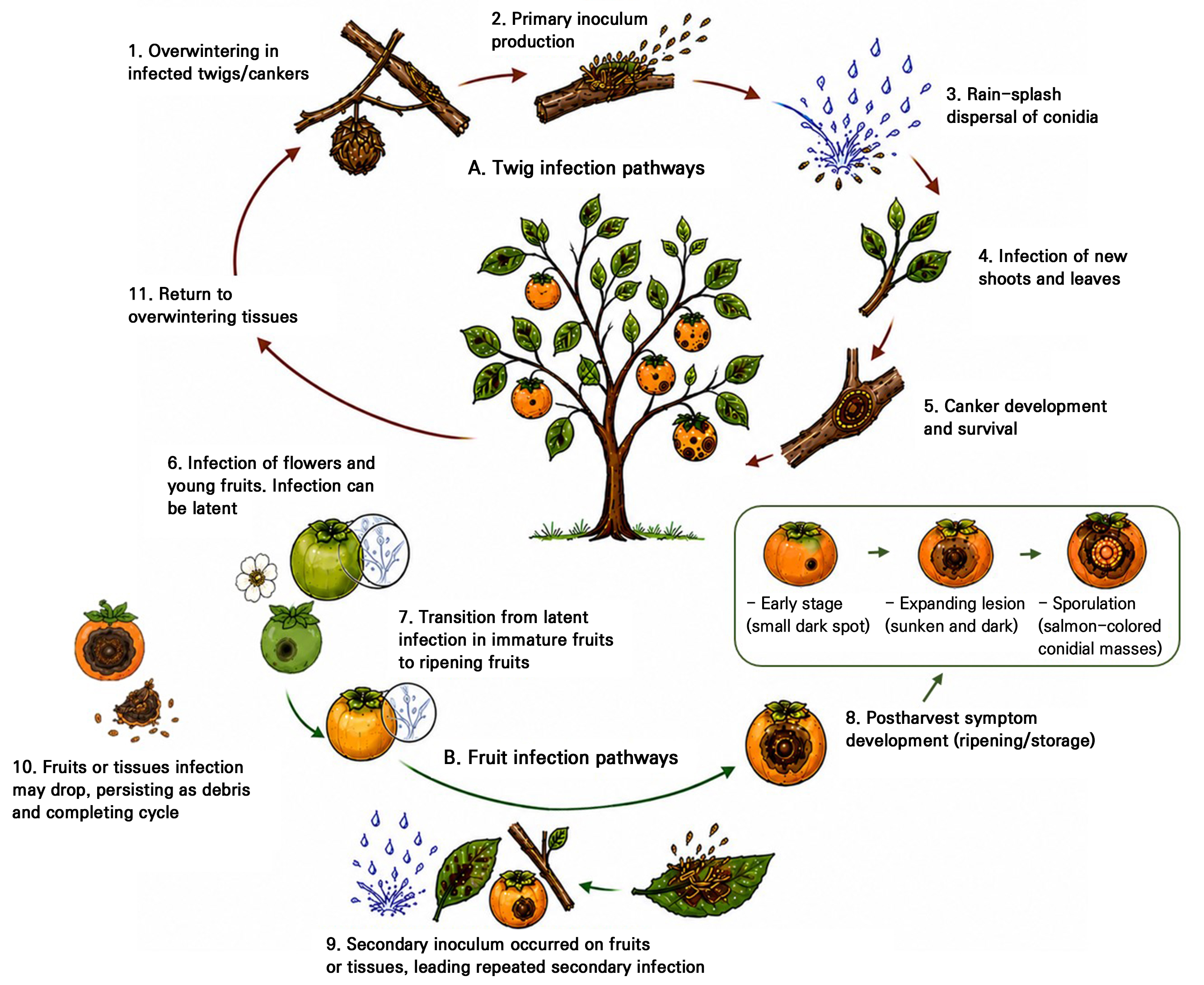
Fig. 1.
Polycyclic life cycle of persimmon anthracnose caused by Colletotrichum gloeosporioides in a Korean orchard. The pathogen overwinters in infected twigs/cankers (1), where the primary inoculum is produced (2). Conidia are dispersed by rain splashes (3) and infect newly emerging shoots and leaves (4), resulting in the development of lesions and cankers on the shoots and twigs (5). Conidia continue to develop on flowers and young fruits, and infection can be latent without visible symptoms (6). Latent infection became active during ripening or storage (7), leading to the development of postharvest symptoms (8). Secondary inoculum produced on infected fruits and tissues for repeated secondary infections (9). Infected fruits and tissues may fall and persist as plant debris (10), contributing to the overwintering of inoculum for the following season (11). This figure was generated using artificial intelligence (ChatGPT, OpenAI) and subsequently reviewed and edited by the authors.
The infection process may complete within a short period; however, the pathogen may remain latent infections in developing leaves and immature fruits, which show no visible symptoms when eventually harvested. Disease symptoms can subsequently develop during fruit ripening, storage, or distribution stages, resulting in typical sunken anthracnose lesions with salmon-colored spore masses (Kwon and Park 2004). At the end of the season, infected fruits or plant tissues may drop prematurely or manifest in the orchard as latent infections transition to an active state. These infected tissues eventually return to the orchard ground as debris, completing the cycle and ensuring inoculum persistence for the next year (Kwon and Park 2004).
Overall, Fig. 1 summarizes the most commonly characterized disease cycle of persimmon anthracnose caused by C. gloeosporioides in Korean orchards. Although other persimmon-associated Colletotrichum species may share general features such as conidial dispersal, repeated infection, and latent fruit infection, their species-specific epidemiological cycles have not been characterized to the same extent. Further studies are therefore needed to determine whether overwintering, infection timing, latency, and seasonal disease development differ among the Colletotrichum species associated with persimmon anthracnose in Korea.
Environmental Conditions
Environmental conditions strongly influence infection and symptom development of Colletotrichum species associated with persimmon anthracnose. Pathogenicity studies have generally demonstrated successful infection under warm and high-humidity conditions, with symptoms developing within approximately three to ten days after inoculation at 25°C under high humidity, depending on the pathogen species, host tissue, fruit developmental stage, and inoculation method (Kwon et al. 2007; Kwon and Kim 2011; Jeon et al. 2017; Chang et al. 2018; Hassan et al. 2018; Hassan et al. 2019; Choi et al. 2026; Yoo et al. 2026). Kwon et al. (2000) studied the cultural characteristics of C. gloeosporioides and found that this pathogen requires an optimal temperature for mycelial growth on PDA of approximately 30°C at eight days after incubation, whereas for conidial germination it was 25°C after 24 h of incubation. Fruit infection was initiated after 1 h of surface wetness, and disease incidence increased rapidly with longer wetness periods after 5 h. These findings demonstrate that warm temperatures and extended wetness are key environmental factors driving the epidemiology of persimmon anthracnose caused by C. gloeosporioides. However, specific infection temperature and wetness duration requirements were generally not reported in other species-specific studies, and more commonly reported is the 25°C condition for fungal culture or experimental incubation as opposed to an optimum temperature for infection.
Therefore, the development of persimmon anthracnose is favored by the temperate monsoon climate, characterized by warm temperatures (20–30°C), high relative humidity (>80%), and prolonged rainfall during the warmer months. The summer monsoon, occurring from June to August, is a critical epidemiological driver. Intensive rainfall during this period induces profuse sporulation and facilitates the rain-splash dispersal of conidia from overwintering inoculum sources to susceptible host tissues (Kwon and Park 2004; An et al. 2018; Moreira et al. 2023). Infections initiated under favorable conditions often transition into a latent state in immature fruits. These quiescent infections typically become symptomatic as the fruit matures or enters postharvest storage, driving the polycyclic development of the disease and complicating long-term management (Kwon and Park 2004; Hassan et al. 2018). These environmental parameters are optimal for key stages of the fungal life cycle, including conidial germination, appressorium formation, and successful host penetration.
Beyond macro-climatic conditions, the canopy microclimate also plays a significant role in disease dynamics. A dense canopy structure can impede air circulation, thereby extending the duration of leaf wetness and increasing disease intensity within the orchard (Kwon et al. 2013; Jeon et al. 2017).
Management Approach
Integrated pest management (IPM) strategies, which encompass cultural, biological, and chemical controls, are essential for the effective management of anthracnose in persimmon and related fruit crops (Dowling et al. 2020; Salotti et al. 2023). The results of a comparison of the advantages and limitations of each management method are summarized in Table 4.
Table 4.
Comparative evaluation of management strategies for persimmon anthracnose caused by Colletotrichum species
| Control methods | Typical practices | Advantages | Disadvantages | Key references |
| Cultural control |
Sanitation by removing diseased twigs, fallen leaves, mummified and dropped fruits Winter pruning of dormant trees Disease-free planting materials Using drip irrigation instead of overhead irrigation Ground mulching and weed control Optimal tree spacing and pruning to reduce for canopy ventilation Removing all infected fruits during harvest and postharvest |
Minimizes primary inoculum and early disease pressure Environmentally friendly with no chemical residue Cost-effective for long-term orchard management Essential foundation of integrated disease management programs |
Labor-intensive and time-consuming Requires consistent implementation to be effective Insufficient alone under high disease pressure or favorable weather conditions | Coelho et al. 2008; Yang et al. 2008; Hassan et al. 2018; Chang et al. 2018 |
| Biological control |
Using antagonistic microorganisms (Trichoderma spp., Bacillus spp.) Plant extracts and essential oils (ginger, turmeric, neem, eucalyptus) Application during dormancy, early infections, or postharvest stage Combined with cultural practices and reduced fungicide programs |
Economical sustainable and suitable for organic production Minimal toxicity to humans and beneficial organisms Multiple modes of action (competition, antibiosis, mycoparasitism, systemic resistance induction) Useful for postharvest disease management and reducing residues Reduce dependency on conventional synthetic fungicides |
Field efficacy can be inconsistent due to environmental variability Generally slower acting than chemical fungicides Typically achieves partial rather than complete disease suppression Limited commercial formulations and registration in Korea Requires an optimized formulation and strategic integration for efficacy | Dowling et al. 2020; Hassan et al. 2018; Peralta-Ruiz et al. 2023; Jang et al. 2019; Chang et al. 2023 |
| Chemical control |
Protective and systemic fungicides (DMI, QoI, SDHI, benzimidazoles, anilines) Targeted sprays during flowering, fruit set, and rainy seasons Rotation and mixture of fungicides with different modes of action |
Rapid and highly effective disease suppression Crucial during severe epidemics and favorable weather conditions Provides reliable control of both twig and fruit anthracnose Supported by extensive efficacy data and established grower experience Ensures commercial yield protection in production orchards |
Risk of fungicide resistance with repeated applications Environmental contamination and human health safety concerns Residue persistence impacting export markets and consumer acceptance Higher production costs with frequent spray programs Time-consuming and spray coverage | Hassan et al. 2018; Jeon et al. 2015; Kwon et al. 2013; Gang et al. 2015 |
Cultural Control
Cultural practices are fundamental in Korean orchards because they directly reduce overwintering inoculum levels and suppress the humid canopy conditions that favor conidial production, dispersal, and repeated infection cycles.
Sanitation is a critical component of cultural management. The removal of diseased twigs, fallen leaves, mummified fruits, and other infected debris is especially important because these tissues serve as major overwintering reservoirs of the Colletotrichum inoculum (Kwon et al. 2013; Hassan et al. 2018). Additional practices, such as the use of disease-free planting materials, weed control, mulching, pruning, and appropriate tree spacing, can further reduce rain-splash dispersal and shorten the leaf-wetness duration (Coelho et al. 2008; Yang et al. 2008; Saxena et al. 2016). These practices are environmentally safe, residue-free, and compatible with all other management approaches (Saxena et al. 2016). However, their main limitation is that they are labor-intensive and often insufficient as stand-alone methods under warm, rainy conditions, particularly because persimmon anthracnose is polycyclic and latent infections established before symptom appearance may continue to contribute to disease after fruit development or during storage (Chang et al. 2018). Kwon et al. (2000) reported that conidia can infect fruits and initiate disease within a short period; fruits should be harvested promptly during the growing season and stored at low temperatures to prevent disease development. Therefore, cultural control methods should be presented as an essential baseline strategy, but not as a replacement for complementary biological or chemical interventions under high disease pressure.
Biological Control
Biological control is a promising component of sustainable anthracnose management because it can reduce fungicide reliance and fits well within organic or low-residue production systems. However, the practical field adoption of biological control strategies in Korean orchards remains constrained.
Biological control agents (BCAs), such as Trichoderma spp. and Bacillus spp., inhibit pathogens through multiple mechanisms, including competition for nutrients and infection sites, antibiosis, the secretion of antifungal metabolites and cell-wall-degrading enzymes, mycoparasitism in the case of Trichoderma, and the induction of host defenses (Kim and Hwang 2007; Dowling et al. 2020; Shi et al. 2021). In general, Bacillus spp. are particularly attractive for product development owing to their stable endospores and broad spectrum of metabolites, including lipopeptides such as iturins, fengycins, surfactins, and bacillomycin-like compounds; in contrast, Trichoderma spp. are mechanistically strong colonizers and mycoparasites, but field efficacy often depends heavily on the formulation quality, environmental conditions, and the timing of application (Shi et al. 2021).
A recent review of biocontrol strategies for the in vivo management of Colletotrichum species in postharvest fruits - but not persimmon - reported strategies that showed high inhibitory activity and, in some cases, completely suppressed disease symptoms, improving the efficacy of commercial biocontrol agents (Shi et al. 2021). For instance, Bacillus velezensis strains have been shown strongly to suppress postharvest banana anthracnose caused by Colletotrichum spp. by inhibiting mycelial growth and pathogen sporulation and positive for cellulase and xylanase activity (Damasceno et al. 2019). On the other hand, Trichoderma spp. can also reduce postharvest anthracnose severity through mycoparasitism, colonization, and competition with Colletotrichum spp. (Shi et al. 2021).
Korean evidence is promising but still incomplete for orchard-scale integrated programs. Heo et al. (2024) reported that Bacillus subtilis GYUN-2311 can control anthracnose caused by C. siamense on apples with 75% and 70% control efficacy in wounded and unwounded fruit assays, and their study recommended that a combined application with a chemical fungicide such as pyraclostrobin or TK® can suppress anthracnose more than a chemical treatment alone.
Beyond microbial BCAs, plant-derived products, including essential oils and natural plant extracts from ginger, turmeric, neem, and eucalyptus, have shown significant inhibition of the mycelial growth of C. gloeosporioides in other fruit pathosystems by 50% to 90% (Peralta-Ruiz et al. 2023). In Korea, plant-extract-based approaches have already shown field relevance in persimmon, and formulation improvements with food-grade emulsifiers have increased stability and disease suppression. Field-based evidence is strongest for plant-derived products, particularly within organic or low-input production systems. However, botanical products still face major limitations, including variability of their active compositions, volatility, photodegradation, short residual activity, and the need for standardized formulations and registration pathways. For instance, Jang et al. (2019) studied the antifungal activity of optimized plant extracts in vitro and subsequently reported reductions in persimmon anthracnose incidence of 63% and 51% in organic orchards. Their study also demonstrated that incorporating food-grade emulsifiers enhanced formulation stability and field efficacy, suggesting that biopesticides should be developed as standardized formulations rather than unstandardized, farm-made preparations. However, considering that the study specifically evaluated C. coccodes, the effectiveness of such formulations against other major persimmon-associated Colletotrichum species requires further laboratory and orchard validation.
The potential of Bacillus and Trichoderma species has been studied in relation to fruit crops such as apple, peach or strawberry; however, persimmon-specific studies are conducted less frequently (Conway et al. 2004; Freeman et al. 2004; Kim and Hwang 2007; Chang et al. 2023).
The aforementioned management agents are particularly effective during the dormant period or at the earliest stages of disease onset (Hassan et al. 2018). Despite these advantages, most growers continue to rely on synthetic fungicides because the performance of BCAs can be inconsistent under fluctuating field conditions (Dowling et al. 2020). To achieve durable anthracnose management, it is recommended to integrate sanitation, compatible microbial BCAs, and reduced-risk fungicide programs to control infections caused by Colletotrichum species in persimmon and other fruit crops in Korea and worldwide (Kwon et al. 2013; Dowling et al. 2020; Chang et al. 2023; Kang et al. 2023; Heo et al. 2024).
Chemical Control
During severe anthracnose outbreaks, chemical control remains indispensable, particularly from the development of new shoots through fruit set and during the summer rainy season, when favorable conditions promote repeated infection cycles and rapidly increased levels of disease incidence. In particular, during the early period of conidial dispersal, fungicides effective against anthracnose should be applied simultaneously. Effective control of early infections on newly emerging shoots is important to prevent subsequent disease development on secondary shoots, water sprouts, young fruits, and mature fruits. Thus, preventive fungicide applications should be thoroughly implemented before anthracnose develops on shoots and conidial dispersal increases (Kwon and Park 2004).
Fungicides provide the most rapid and reliable suppression, and several fungicides have been reported as possessing high inhibitory activity in vitro and in field trials for anthracnose management in sweet persimmon, including astringent persimmon, caused by Colletotrichum species in Korea (Kwon et al. 2013; Gang et al. 2015; Jeon et al. 2015; An et al. 2017).
For instance, Kwon et al. (2013) reported that well-timed fungicide spray programs can substantially reduce disease incidence when combined with sanitation. They demonstrated the efficacy of intensive fungicide management against sweet persimmon anthracnose caused by C. horii in affected twigs and fruits of the ‘Fuyu’ cultivar under field conditions. Two to three fungicide applications achieved 89.4–93% disease control, whereas four or more applications resulted in 100% control. The effectiveness of these chemical treatments was further enhanced when combined with sanitation practices, such as the removal of infected plant debris before spraying, and when fungicides were applied before conidial dispersal.
The principal advantage of chemical control is therefore its dependable short-term efficacy under commercial orchard conditions. However, chemical control has several important limitations, as repeated fungicide applications increase production costs, raise concerns about pesticide residues, and impose selection pressure with regard to fungicide resistance, particularly when single-site fungicides are repeatedly applied against genetically diverse Colletotrichum populations (Dowling et al. 2020). For instance, quinone outside inhibitors (QoI; FRAC Code 11) fungicides, including azoxystrobin, pyraclostrobin, and trifloxystrobin, share the same mode of action and therefore exhibit a high risk of cross-resistance within this fungicide group. To delay resistance development, QoI fungicides should be used preventively, with limited and non-consecutive applications, and should be rotated or mixed with fungicides from different FRAC groups (FRAC 2024). Similarly, demethylation inhibitor (DMI; FRAC Code 3) fungicides should not be used continuously throughout the growing season but should be alternated or mixed with fungicides having different modes of action (FRAC 2024). Therefore, persimmon anthracnose management should avoid the repeated use of the same single-site fungicide. Instead, effective fungicides from different FRAC groups should be rotated and combined with multi-site fungicides or premixes, where registered, to reduce selection pressure and delay resistance development.
Korean studies of persimmon have reported variability in the sensitivity of C. horii to benzimidazole and DMI fungicides. In addition, studies of persimmon anthracnose in Korea have shown that EC50 values vary significantly among Colletotrichum species and among host-associated populations of the same species (Table 5). Jeon et al. (2015) evaluated 16 fungicides for the management of sweet persimmon anthracnose caused by C. gloeosporioides, and three fungicides among the 16 were selected as effective fungicides for disease control. The three fungicides selected, metconazole, dithianon and propineb, showed reliable control under field conditions. Particularly, metconazole exhibited the greatest antifungal activity, with the lowest EC50 value (0.051 µg·mL-1), indicating high sensitivity of the pathogen population (Table 5). This was followed by propineb, a dithiocarbamate fungicide with multi-site contact activity, which also showed strong antifungal efficacy, with an EC50 value of 1.402 µg·mL-1. Although dithianon exhibited a substantially higher EC50 value (114.920 µg·mL-1) than metconazole and propineb, it was selected as an effective fungicide based on its satisfactory disease control performance in field evaluations (Table 5). These findings suggest that fungicide selection for anthracnose management should consider both in vitro sensitivity and field efficacy when developing integrated disease-management programs.
Table 5.
Fungicides evaluated for the management of persimmon anthracnose in Korea
| Fungicides | FRAC code |
Group (mode of action) | Pathogen species/number of isolates |
EC50 (µg·mL-1) | Field efficacy | In vitro efficacy | Reference |
| (Azoxystrobin + Difenoconazole)* | 11 + 3 | QoI + DMI (respiration and sterol biosynthesis in membranes) | C. horii from sweet persimmon/NR | 250 | Significantly reduced infection on twig and fruits | Reduced mycelial growth | Kwon et al. 2013 |
| 335 | |||||||
| Pyraclostrobin* | 11 | QoI (C3-cytochrome bc1, respiration) | |||||
| 500 | |||||||
| Difenoconazole | 3 | DMI (C14-demethylase inhibitor) | |||||
| 125 | |||||||
| Trifloxystrobin* | 11 | QoI (C3-cytochrome bc1, respiration) | |||||
| Metconazole* | 3 | DMI (C14-demethylase inhibitor) | C. gloeosporioides from sweet persimmon / NR | 0.051 | Efficient control for infected twigs and fruit with four fungicide applications | NR | Jeon et al. 2015 |
| Dithianon* | M09 | Quinone (multi-site contact activity) | 114.920 | ||||
| Propineb* | M03 | Dithiocarbamates (multi-site contact activity) | 1.402 | ||||
| Thiophanate-methyl* | 1 | MBC (β-tubulin assembly inhibitor) | C. gloeosporioides from sweet persimmon / 150 | 3.2 | NR | Effective for suppressing mycelial pathogen growth against many isolates | Gang et al. 2015 |
| Fluazinam* | 29 | Uncoupler of oxidative phosphorylation | |||||
| 1.8 | |||||||
| Carbendazim | 1 | MBC (β-tubulin assembly inhibitor) | C. horii from astringent persimmon /282 | 0.022 | NR | High efficacy for mycelial growth inhibition | An et al. 2017 |
| Thiophanate-methyl* | 0.753 | ||||||
| (Fluquinconazole + Prochloraz)* | 3 | DMI (C14-demethylase inhibitor) | C. horii from astringent persimmon /275 | 0.052 | NR | Reliable for mycelial growth inhibition | An et al. 2018 |
Note: All fungicides listed are registered for persimmon, including sweet persimmon in Korea, in the Pesticide Safety Information System (PSIS), Rural Development Administration, Jeonju, Korea (RDA 2026). ‘*’, current pesticide registration: Azoxystrobin + Difenoconazole (2026.05.14); Pyraclostrobin (2026.04.22); Trifloxystrobin (2026.07.29); Metconazole (2026.05.12); Dithianon (2026.05.20); Propineb (2026.05.08); Thiophanate-methyl (2026.04.22); Fluazinam (2026.06.09); Fluquinconazole + Prochloraz (2026.05.28.).
The use of pre-mixed formulations, such as azoxystrobin + difenoconazole, has been supported for its dual mode of action, which increases overall efficacy and reduces the risk of fungicide resistance management caused by C. horii (Kwon et al. 2013). While strobilurins such as trifloxystrobin and pyraclostrobin have been reported as effective fungicides under high rainfall conditions, the variability in EC50 values (125 and 335 µg·mL-1) suggests shifting sensitivities (Table 5). Furthermore, although benzimidazoles (e.g., carbendazim and thiophanate-methyl) have shown potent antifungal activity, their repeated use is cautioned due to the high risk of resistance (An et al. 2017). Fluazinam, an aniline fungicide that inhibits mitochondrial respiration, has demonstrated strong activity, and there are currently no reports of fungicide resistance, highlighting its value in fungicide rotation programs (Gang et al. 2015). Collectively, these findings underscore the necessity of implementing strategies with diverse modes of action for the sustainable management of persimmon anthracnose in Korea.
Thus, disease management programs should emphasize rotating fungicides with different modes of action and using appropriate premixed formulations rather than relying repeatedly on single-active-ingredient products. Rational fungicide selection and application, supported by growers' understanding of fungicide active ingredients and resistance-management principles, are essential for the sustainable management of persimmon anthracnose (Brent and Hollomon 1998; Lim et al. 2008; Lim et al. 2015).
Conclusions and Future Perspectives
Anthracnose, caused by Colletotrichum species, remains the most destructive disease affecting persimmon production in Korea, leading to substantial pre- and postharvest losses that threaten both domestic stability and international export markets. Over the past two decades, Korean research has significantly advanced our understanding of persimmon anthracnose by revealing its pathogen diversity, disease epidemiology, and the environmental factors associated with disease development. Early studies based primarily on morphological characteristics and ITS sequence analysis reported C. gloeosporioides and C. acutatum in association with persimmon anthracnose. Subsequent multilocus phylogenetic analyses have refined this taxonomic framework and confirmed additional species within the C. gloeosporioides and C. acutatum species complexes, including C. horii, C. siamense, C. fructicola, C. nymphaeae, and C. fioriniae. These findings demonstrate that persimmon anthracnose in Korea is associated with a taxonomically diverse Colletotrichum complex rather than a single pathogen species. These species may differ in terms of their aggressiveness, tissue specificity, and fungicide sensitivity, highlighting the need for species-specific evaluations of management strategies. Importantly, effective fungicide control has been demonstrated primarily against C. gloeosporioides and C. horii, whereas in vitro and field efficacy against other persimmon-associated Colletotrichum species remains insufficiently characterized. Despite advances in IPM, control methods focusing on persimmon anthracnose continue to rely on synthetic fungicides. The polycyclic disease cycle and the persistence of latent infections, pathogen diversity, and the risk of fungicide resistance further complicate long-term control, emphasizing the need to integrate improved disease management with the development of durable and broad-spectrum host resistance methods.
Future research should therefore focus on advancing genomics-assisted breeding to accelerate the identification and development of anthracnose-resistant persimmon cultivars. However, progress remains limited because most Korean cultivars have not been thoroughly evaluated for quantitative resistance, and major resistance genes or quantitative trait loci (QTLs) remain largely unidentified. Given the diversity of the Colletotrichum species complex associated with persimmon, breeding programs should prioritize stable, quantitative, and broad-spectrum resistance rather than resistance to a single pathogen species or isolate.
A critical requirement for genomic-assisted breeding is the development of standardization and reproducible resistance phenotyping protocols. Anthracnose severity can vary according to the pathogen species and isolate aggressiveness, host tissue and development stage, inoculation method, and environmental conditions, potentially reducing the reproducibility of resistance classifications and genotype-phenotype associations. Future screening should therefore include multiple representative Colletotrichum species and isolates from major persimmon-growing regions, including C. horii, C. gloeosporioides, and members of the C. acutatum species complex where epidemiologically relevant. Isolates of each species should be accurately identified using morphological and molecular approaches, preferably multilocus sequence analysis. Multi-isolate screening would allow broadly resistant genotypes to be distinguished from those exhibiting species- or isolate-specific resistance.
Phenotyping should also reflect the target tissue and disease phase. Fruit resistance can be evaluated using detached-fruit or attached-fruit assays under standardized inoculation and environmental conditions. Wound inoculation can facilitate uniform infection and assessments of post-penetration resistance, whereas non-wounded inoculation may better represent natural infection and resistance to initial penetration. Spray inoculation with a standardized conidial suspension may more closely simulate natural pathogen exposure and would be particularly useful for evaluating overall host susceptibility under conditions favorable for infection. Importantly, because Colletotrichum infection may remain latent in immature fruit and become symptomatic during ripening or postharvest storage, resistance evaluations should consider both initial lesion development and subsequent disease expression during fruit maturation. Young shoots, twigs, or leaves should similarly be evaluated when resistance to vegetative infection, shoot blight, or canker development is targeted.
Disease responses should preferably be quantified using objective and reproducible parameters, including lesion diameters or areas, percentages of necrotic tissue, disease incidence and severity levels, incubation periods, and areas under the disease progress curve. Standardized disease-rating scales may facilitate the rapid screening of large populations, whereas direct lesion measurements or image-based quantification can provide greater precision for genetic analyses. Initial screening should use randomized and replicated genotype–isolate combinations under controlled conditions, followed by validation across seasons and orchard environments. Such an approach would also enable assessments of genotype–isolate and genotype–environment interactions. Genotypes consistently exhibiting low disease severity across multiple isolates and environments would represent valuable sources of stable, broad-spectrum resistance.
Once reliable resistance phenotypes are established, they can be integrated with genomic approaches to identify the genetic basis of anthracnose resistance. Recent transcriptomic and functional studies have identified lignin biosynthesis as an important defense mechanism in persimmon. In particular, DkCAD1 and its transcriptional regulators DkWRKY8 and DkWRKY10 promote lignin accumulation, strengthen cell walls, and restrict pathogen development (Fan et al. 2024b). These findings provide candidate genes for further validation and potential applications in marker-assisted selection or genome editing.
In addition, genome-wide association studies (GWAS), QTL mapping, genotyping-by-sequencing (GBS), and genomic selection could further identify resistance-associated loci, candidate genes, and molecular markers underlying quantitative resistance. A GBS analysis of 93 sweet persimmon cultivars has already characterized genetic diversity and population structures (Park et al. 2023), providing a valuable genomic resource for future resistance studies.
Thus, sustainable management of persimmon anthracnose in Korea will require the integration of standardized multi-isolate phenotyping with genomic and functional approaches. Such an integrated strategy will provide a stronger framework for developing persimmon cultivars with durable and broad-spectrum anthracnose resistance while reducing long-term reliance on chemical control methods.
