

Introduction
Materials and Methods
Measurement of Moisture Content
Measurement of Free Soluble Carbohydrate Contents
Measurement of Organic Acid Content
Measurement of β-Carotene Content
Statistical Analysis
Results
Moisture Content
Free Soluble Carbohydrates Contents
Citric Acid and β-Carotene Content
Discussion
Introduction
Oriental melon (Cucumis melo) is an annual plant of the Cucurbitaceae family. It has a high sugar content, is rich in calcium, phosphorus, minerals, and vitamins A and C, and is one of the summer fruit vegetables with a crispy texture (RDA, 1993). However, oriental melons are vulnerable to powdery mildew, which routinely infects Cucurbitaceae plants (Lee et al., 2010).
Melon (Cucumis melo), an annual vine, is one of the top grade fruit vegetables with a unique aroma and flavor. Cho et al. (2009) reported that melon is rich in β-carotene and sugar. It is known
to decrease blood viscosity and has an anticoagulant effect that prevents heart disease and stroke. Additionally, it has been investigated in the prevention of cancer. The quality of melon is judged by its appearance, flavor, and sugar content. Among these factors, the flavor and sugar content are the most important. In recent years, its antioxidant components, such as β-carotene, with important health functions, have attracted as much attention as the fruit quality (Choi et al., 2007; Bhandari et al., 2016).
To strengthen the tolerance of the oriental melon to powdery mildew, a highly functional new cultivar ‘Chammel’ was developed through crossing with a strong melon line to powdery mildew. This cultivar has orange flesh, increased disease tolerance, and high β-carotene and citric acid content. The mated cultivars were isolated from the F2 generation and selected for resistance to powdery mildew disease as seedlings. In the crossed F2 vine, the maternal line selected was an oriental melon with orange flesh, and the paternal line had the fruit shape of oriental melon with orange flesh, high sugar content, and a crispy texture. The application of ‘Saekomchammel’ (application number: 2017-493) and ‘Dalkomchammel’ (application number: 2017-494) was made by the Korea Seed and Variety Service after evolution, and the selected maternal and paternal generations were carried out to fix the characteristics. ‘Chammel’ has a larger fruit size than usual oriental melons, a uniform shape, orange flesh with a crispy texture, high sugar content, and a strong resistance to powdery mildew. In this study, we evaluated β-carotene and citric acid content, which are the antioxidative components of ‘Saekomchammel’ and ‘Dalkomchammel’, in order to investigate the possibility of their use as functional food.
Materials and Methods
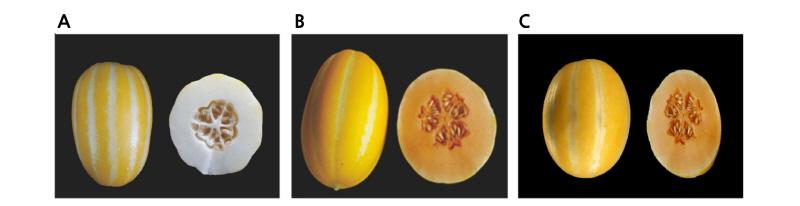
Oriental melon ‘Kkulstar’, ‘Saekomchammel’, and ‘Dalkomchammel’ fruits were harvested from the 12th to ~15th node section on May 22, 2017, at Spring Seed Co., Ltd, located in Wolhang-myeon, Seongju-gun, Gyeongsangbuk-do. The oriental melons ‘Kkulstar’ and ‘Chammel’ were sliced to measure the moisture content. Others were frozen at -80°C for lyophilization. The lyophilized sample was used to measure free sugar, citric acid, and β-carotene contents. All experiments were performed in five replicates. The characteristics of the oriental melons ‘Kkulstar’, ‘Saekomchammel’, and ‘Dalkomchammel’ are shown in Fig. 1 and Table 1. ‘Chammel’ was found to be bigger than the oriental melon ‘Kkulstar’, round, and heavy (Table 1). The skin color of ‘Chammel’ was similar to the oriental melon. In terms of the flesh, that of the oriental melon was thin and white, while in ‘Chammel’, the flesh was thick and orange (Fig. 1).

Measurement of Moisture Content
The moisture content was measured in five replicates using an infrared moisture analyzer (FD-720, Kett, Tokyo, Japan).
Measurement of Free Soluble Carbohydrate Contents
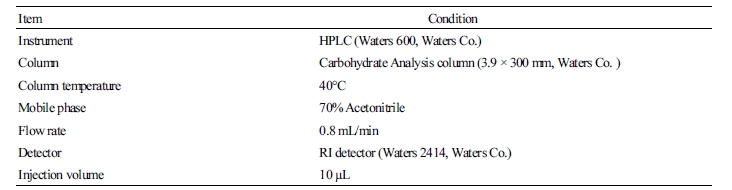
To measure the free soluble carbohydrate contents, 5 g of lyophilized flesh powder was diluted with distilled water thrice to a concentration of 10 mg·mL-1. It was subsequently treated in a water bath at 80°C for 1 h. The solution was passed through filter paper (Whatman No. 2) and then through C18 Sep-Pak®. Next, it was filtered through a 0.45-µm membrane filter. The free sugar content was finally measured by a high-performance liquid chromatography (HPLC) system (Waters 600, Waters Co., MA, USA) equipped with a RI detector (Waters 2414, Waters Co.) and a carbohydrate analysis column (3.9 × 300 mm; Waters Co.). Elution was performed with 70% acetonitrile at a flow rate 0.8 mL/min (Table 2).
Measurement of Organic Acid Content
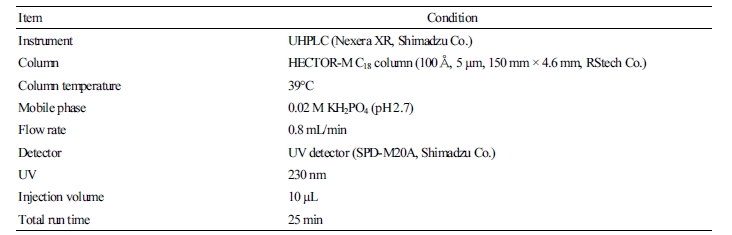
To measure the organic acid content, 5 g of lyophilized flesh powder was diluted with distilled water thrice to a concentration of 1 mg·mL-1. It was subsequently filtered through a 0.45-µm membrane syringe filter. Table 3 shows the analytical conditions for the measurement of organic acid. The organic acid content was measured by ultra-high-performance liquid chromatography (UHPLC, Nexera XR, Shimadzu Co., Kyoto, Japan) equipped with a UV detector (SPD-M20A, Shimadzu Co.) and a HECTOR-M C18 column (100 Å, 5 µm, 150 mm × 4.6 mm, RStech Co., Cheongju, Korea). Organic acid was detected at 230 nm. The solvent used was 0.02 M KH2PO4 (pH 2.7), and flow rate was set at 0.8 mL/min.
Measurement of β-Carotene Content
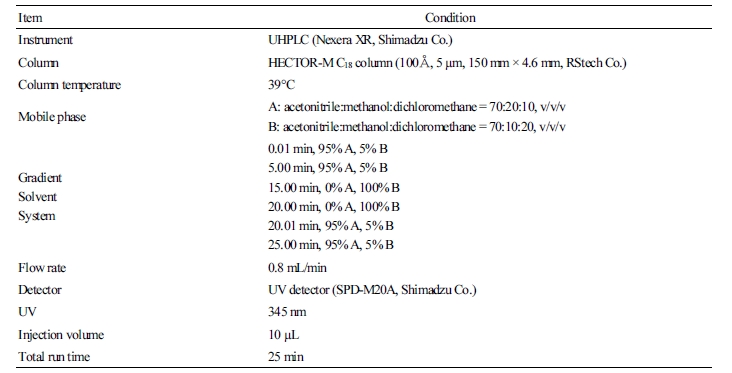
To measure the β-carotene content, 5 g of the lyophilized sample was extracted in 100 mL of an acetone and petroleum ether (1:1) solvent. After the petroleum ether layer was collected and vacuum evaporated with a rotary evaporator, the extract was dissolved in 10 mL of hexane, filtered through a 0.45-µm membrane filter, and analyzed according to the UHPLC analytical conditions (Table 4). The filtered solution (10 µL) was injected in to UHPLC system (Nexera XR, Shimadzu Co.) equipped with a UV detector (SPD-M20A, Shimadzu Co.) and a HECTOR-M C18 column (100 Å, 5 µm, 150 mm × 4.6 mm, Rstech Co.). The elution was detected at 345 nm. The mobile solvent A was acetonitrile/methanol/ dichloromethane (70:20:10, v/v/v), and solvent B was acetonitrile/methanol/dichloromethane (70:10:20, v/v/v). For the analysis of samples, gradient elution was performed as follows: 0 min, 95% eluent A; 5 min, 95% eluent A; 15 min 0% eluent A; 20 min 0% eluent A; 20.01 min 95% eluent A; 25 min 95% eluent A.
Statistical Analysis
Statistical analysis was performed with SPSS ver. 23.0 software (SPSS Inc., Chicago, IL, ISA) using ANOVA analysis, and Duncan’s multiple range test comparisons at p < 0.05 were run to determine significant differences.
Results
Moisture Content
The moisture content of the oriental melons ‘Kkulstar’ and ‘Chammel’ is shown in Table 5. The moisture content of oriental melon ‘Kkulstar’ was found to be 81.8%. On the other hand, it was observed as 80.2% and 81.5% for ‘Saekomchammel’ and ‘Dalkomchammel’, respectively. There was no statistically significant difference obtained in the moisture content between the oriental melons ‘Kkulstar’ and ‘Chammel’.
Table 5. Comparison of the moisture content of the oriental melons ‘Kkulstar’, ‘Dalkomchammel’, and ‘Saekomchammel’  | |
zValues with different letters are significantly different at p < 0.05 by DMRT. | |
Free Soluble Carbohydrates Contents
The analyzed free soluble carbohydrate contents of the oriental melons ‘Kkulstar’, ‘Saekomchammel’, and ‘Dalkomchammel’ are shown in Table 6. The results revealed that there were quantitative differences among them. However, all three cultivars were higher in the order of maltose, sucrose, and glucose. The sucrose content, one of the major factors determining sweetness, was 23.4 mg·g-1 FW for the oriental melon ‘Kkulstar’. In the case of ‘Saekomchammel’ and ‘Dalkomchammel’, it was found to be 34.3 mg·g-1 FW and 36.3 mg·g-1 FW, respectively. These results revealed that these melons had a sugar content about 10 mg·g-1 FW higher than the oriental melon ‘Kkulstar’. The glucose content was 15.9 mg·g-1 FW for the oriental melon. On the other hand, it was 23.3 mg·g-1 FW and 26.8 mg·g-1 FW for ‘Saekomchammel’ and ‘Dalkomchammel’, respectively. The ‘Chammel’ glucose content was significantly higher than that in the oriental melon ‘Kkulstar’. However, the maltose content of the oriental melon was higher than that of ‘Chammel’. As a result, the concentration of sucrose and glucose, which determined the sweetness of the new cultivar ‘Chammel’, was higher than in the oriental melon ‘Kkulstar’.
Table 6. Comparison of the sugar content of the oriental melons ‘Kkulstar’, ‘Dalkomchammel’, and ‘Saekomchammel’  | |
zValues with different letters are significantly different at p < 0.05 by DMRT. | |
Citric Acid and β-Carotene Content
The results of the analysis of the citric acid and β-carotene content of oriental melons ‘Kkulstar’, ‘Saekomchammel’, and ‘Dalkomchammel’ are shown in Table 7. The citric acid content of the oriental melon ‘Kkulstar’ was 6.4 mg·g-1 FW. On the other hand, that of ‘Saekomchammel’ was 11.5 mg·g-1 FW and that of ‘Dalkomchammel’ was 12.2 mg·g-1 FW, which was twofold higher than the oriental melon ‘Kkulstar’. The β-carotene content of the oriental melon ‘Kkulstar’ was 1.3 mg·kg-1 FW. In the case of ‘Saekomchammel’, the 54.7 mg·kg-1 FW was 42 times higher than the oriental melon ‘Kkulstar’. Moreover, the β-carotene content of the ‘Dalkomchammel’ (107.0 mg·kg-1 FW) was twice as much as ‘Saekomchammel’ and 82.3 times more than the oriental melon ‘Kkulstar’. Thus, the content of β-carotene was found to be the highest in the ‘Dalkomchammel’ fruit.

Discussion
The present study was conducted to investigate the functional properties of the new cultivars ‘Saekomchammel’ and ‘Dalkomchammel’, which are interspecific hybrids between oriental melon and melon.
In case of the free soluble carbohydrate contents, ‘Chammel’ showed a higher result than the oriental melon ‘Kkulstar’ by 10 mg·g-1 FW in both glucose and sucrose, which determined the sweetness of the fruit. Albuquerque et al. (2006) reported that in melon, the free soluble carbohydrate contents, i.e. sucrose, ranged from 22.9 to 65.3 mg·g-1 FW depending on the variety. In other words, the sucrose content of ‘Chammel’ in this experiment was close to 35.3 mg·g-1 FW. In the case of glucose, ‘Chammel’ showed a result higher than melon by 10 mg·g-1 FW. The sucrose and glucose content in both varieties, ‘Saekomchammel’ and ‘Dalkomchammel’, were similar to melon and were higher than the oriental melon ‘Kkulstar’. The sugar content is a basic parameter used in evaluating the market quality of fruit (Villanueva et al., 2004). ‘Chammel’, with a high content of sucrose and glucose, is expected to be a highly valued fruit. The citric acid content of the ‘Chammel’ was about twofold higher than the oriental melon ‘Kkulstar’. The average concentration of citric acid in the three varieties of melon used in the Albuquerque et al. (2006) experiment was 1.69 mg·g-1 FW. In addition, the content in ‘Chammel’ was about 6.7 times higher than in melon. From these results, it was confirmed that the citric acid content of ‘Chammel’ was higher than the citric acid content of the oriental melon ‘Kkulstar’ and melon. Lemons and oranges are rich in citric acid and are widely used as a sour ingredient in the food industry. They dissolve well in water and have a refreshing acidity. Consumption of fruits or drinks with high citric acid has been reported to relieve fatigue (Kim et al., 2010; Barnes and Weitzman, 1986).
Previous studies have reported that β-carotene content in oriental melons is about 1 mg·kg-1 FW (Korean Nutritional Society, 2000). The content of β-carotene in oriental melons used in this study was observed to be 1.3 mg·kg-1 FW, similar to that reported previously. However, ‘Dalkomchammel’ β-carotene content is about 42 times higher than that of ‘Saekomchammel’ and 82.3 times higher than that of the oriental melon ‘Kkulstar’. β-carotene enhances immune function in the treatment of cancer, prevents heart disease, inhibits the progression of diabetes, and is an important antioxidant that affects fruit quality (Ha et al., 2003). Deficiency of vitamin A can cause night blindness, anemia, dry eye syndrome, and delayed infant growth (Sommer et al., 1996). Therefore, ‘Chammel’ containing a large amount of β-carotene, a vitamin A precursor, is used in nutritional supplements. Currently, oriental melon is used in the making of wine (Hwang et al., 2015), oriental melon juice (Jang et al., 2014), and oriental melon makgeolli (Kim et al., 2015). In the present study, it was found that ‘Chammel’ contains a higher level of sugar, citric acid, β-carotene, and other substances than the oriental melon ‘Kkulstar’. Thus, these results will encourage its use as a functional food material in the future.
