

Introduction
The food production worldwide has become increasingly important with the explosion in human population. To provide everyone with enough food, the agricultural area needs to expand or the yield needs to increase by 60 - 110% before 2050 (Alexandratos and Bruinsma, 2012; Tilman et al., 2011). Therefore, yield gap analyses are ongoing to determine the limiting factors, in an effort to improve the cultivation and increase the yield (Hochman et al., 2013; Hochman et al., 2012). Although yield gap analysis is more common in the agricultural area, yield improvements are also possible in the
horticultural sector. Yield is determined by cultivar, temperature, radiation, CO2, and water and nutrient availability (Van Ittersum et al., 2013). In protected cultivation, the climate conditions can be manipulated to enhance the productivity of plants. However, insight into the favorable conditions is needed before the plants can be manipulated accurately. Many environmental factors, such as temperature patterns, light, shading, and cooling play a role in plant growth (Cockshull, 1985; Heuvelink, 1989; Montero, 2006). The Korean government is working with farmers to try to improve the production of vegetables by building Dutch greenhouses and using Dutch knowledge to cultivate the vegetables. However, a huge yield gap in the production of the most important vegetable crops, such as tomato and sweet pepper, exists between Korea and The Netherlands. For example, Koreans harvest 8.3 times less tomatoes, 10.7 times fewer sweet peppers, and 7.7 times fewer cucumbers compared with The Netherlands (CBS, 2018; MAFRA, 2018).
The yield of sweet pepper depends on the fruit set and abortion rate, and approximately 70% to 80% of the reproductive organs abort (Wubs et al., 2009a). Fruit set is determined by the source-to-sink ratio, as it is reduced by a shortage in energy supply. Wubs et al. (2009b) showed that the threshold value to fruit set varies with cultivar, and large-fruited cultivars exhibit a threshold value of 1. High light intensities decrease abortion (Aloni et al.., 1996). Temperature affects abortion rates, as an increase in average daily temperature from 16°C to 24°C increased abortion from 59% to 83% (Bakker, 1988). Moreover, water, nutrient, and CO2 supply influence the abortion of the reproductive organs (Nederhoff and van Uffelen, 1988; Wubs et al., 2009a). A reduction in the abortion rates improves the sweet pepper yield. Therefore, it is necessary to determine the limiting factor, which triggers abortion to reduce the yield gap.
Computer-based control systems have been used to measure the equipment and indicate the environmental conditions in the greenhouse. The environmental data available during the cultivation period play a possible role in determining the limiting factors contributing to the high abortion rates. In this study, a comparison between Dutch and Korean sweet pepper yield was made to find a way to improve the productivity of the crop. Fruit set, number of fruit, harvested fruit, weekly production, and climate data obtained at similar Venlo-type glasshouses with the same cultivar from a grower in The Netherlands and Korea.
Materials and Methods
The yield gap analysis was conducted between a Korean (34.62°N, 126.77°E, Gangjin County) and a Dutch (51.99N, 4.52E, Hoekenindseweg, Bleiswijk) commercial sweet pepper farm. Both growers cultivated yellow sweet pepper ‘Derby’ in a Venlo-type greenhouse (5 ha in The Netherlands and 2 ha in Korea) and used a V-system with three stems per plant. The plant density was almost similar: 6.9 for the Korean grower and 6.8 stems/m2 for the Dutch grower. The data from the 2014/2015 growing season were used, including outside greenhouse weather data, inside greenhouse climate data, and fruit set and yield data. Different crop factors were compared to determine the limiting factors, such as radiation use efficiency, the yield distribution over the season, and fruit set. In addition, the fruit load and source-to-sink ratio were calculated to determine their role in yield gap.
Fruit load may be used to analyze the pattern of increase in yield. Fruit load refers to the number of current fruits [Fruit load (tw)], which is calculated from previous number of fruit load  , currently harvested fruits
  , and fruit set
  as follows:
 (1)
(1)
The source strength is calculated as the biomass produced by photosynthesis:
 (2)
(2)
where I denotes the radiation (MJ·m-2), Y is the transmissivity of the greenhouse, f PAR is the fraction of PAR at all wavelengths (0.47), and k is the light extinction coefficient (0.72) (Kim et al., 2013). Kim et al. (2013) measured the light use efficiency (LUE) in sweet pepper crops during winter in Korea and obtained a value of 3.8 g DM/MJPAR, which was used, although it changes during the growing season (Heuvelink et al., 2002). The transmissivity of the Korean greenhouse was set at 0.65 (Jeong et al., 2009a). LAI increases linearly and is calculated as follows:
 (3)
(3)
where t is the time in days after planting. Eq. (3) was based on different experiments in sweet pepper, where LAI was measured (data not shown).
The sink strength of a fruit at any given time is calculated according to Wubs (2010):
 (4)
(4)
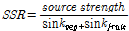
where wmax is the potential fruit size (18 g dm), k is the rate parameter of Gompertz function (0.095 d-1), tfi is fruit age, and tm is the time of maximum growth (20 d). The fruit growth duration as a large-fruited cultivar was set at 70 days after anthesis (Wubs et al., 2009b). Using this equation, only the sink strength of a fruit can be calculated. Therefore, the weekly data of fruit set per square meter were used to calculate the sink strength per square meter. The source-to-sink ratio was calculated as follows:
 (5)
(5)
where the sink strength of the vegetative parts is 1.6 g DM/plant/day, which was determined in large-fruited cultivars by Wubs et al. (2009b) and Jeong et al. (2009). The threshold value of the fruit set was calculated using normal distribution. The point starting with the 5% lowest values was used as an indicator of the threshold value.
Results
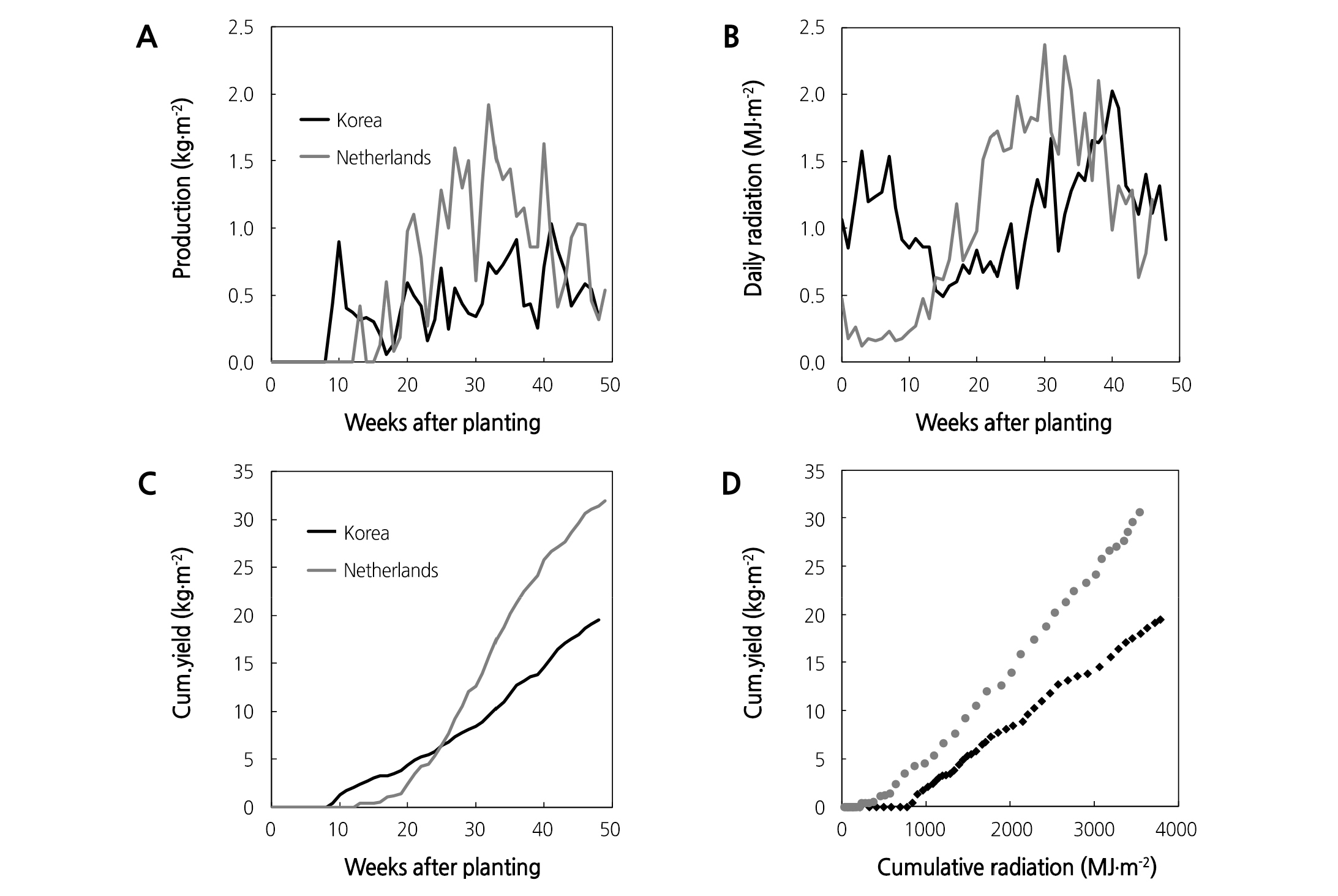
The sweet pepper crop fluctuates with time and the trend varies with the growing season. The fruit weights increased for the grower in The Netherlands, while the Korean crop showed a peak at the start and a much slower increase during the growing season (Fig. 1A). The Korean grower produced 10 kg·m-2 less sweet peppers compared with the grower in The Netherlands. The first sweet peppers were harvested earlier in Korea than in The Netherlands (Fig. 1C). The increased yield in both Korea and The Netherlands was linear; however, the weekly increase was larger for the grower in The Netherlands. The comparison between yield and radiation showed a similar trend with a linear increase in both countries. However, the grower in The Netherlands produced more sweet pepper than the Korean under a similar amount of light exposure (Fig. 1B, D).
The fruit set showed a similar pattern in both greenhouses in both countries, where periods of high fruit set alternated with periods of low fruit set. The Korean grower had one crop more than the grower in The Netherlands, but the fruit set was not counted at the start and end of the growing season (Fig. 2A). The time between the crops differs, although, overall, the grower in The Netherlands showed a more frequent fruit set (4 to 6 weeks) compared with the Korean grower (3 to 8 weeks). The fruit load was higher during the first weeks after planting by the Korean grower, whereas the fruit load was higher 13 weeks after plantation by the grower in The Netherlands (Fig. 2B).

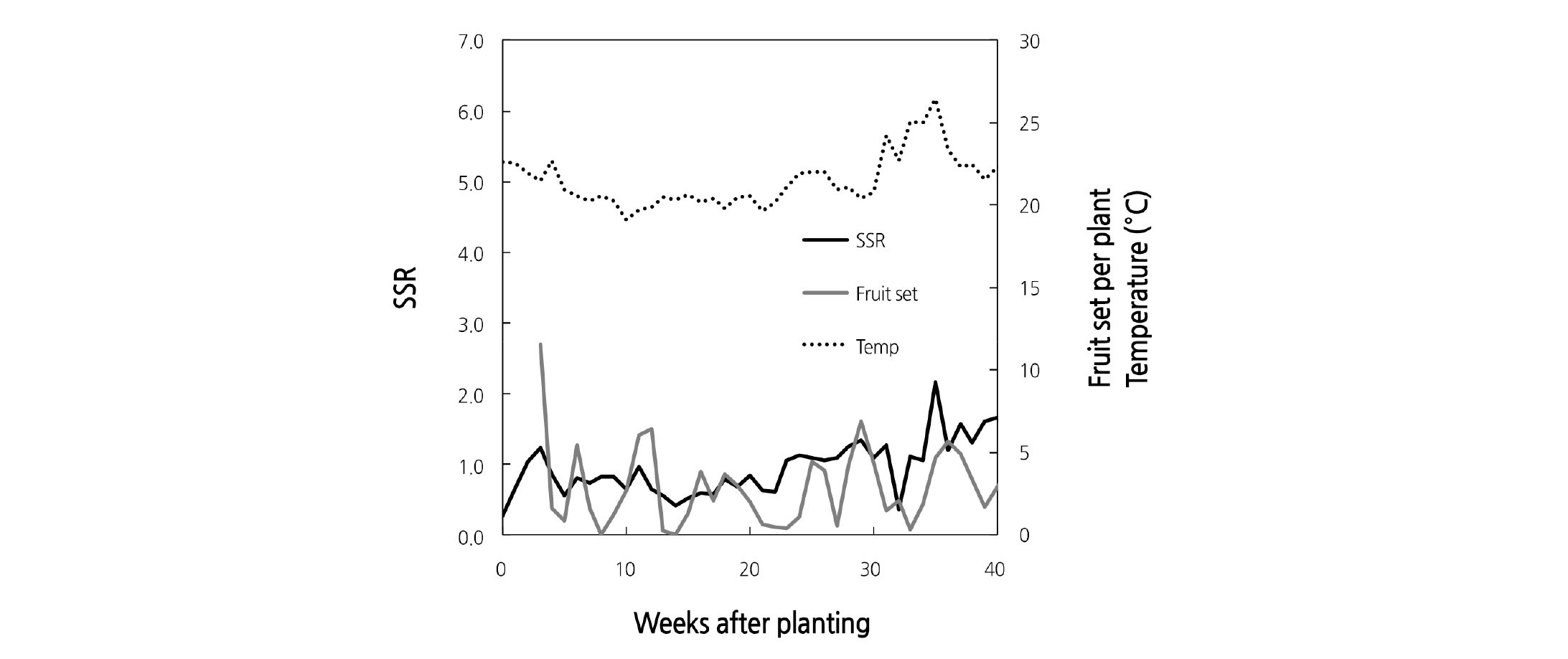
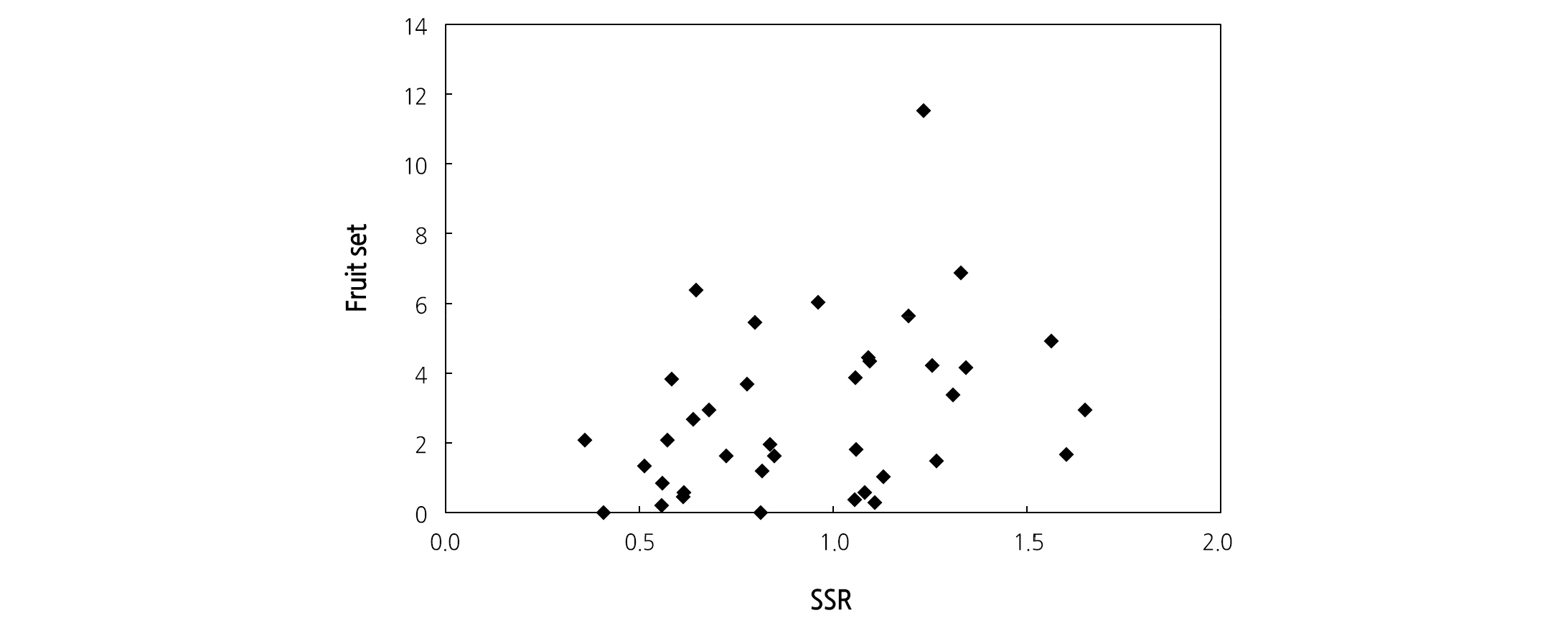
An increase in SSR resulted in a higher fruit set per plant for the Korean grower (Fig. 3). The SSR started low and increased with time, after the first fruit set periods of high SSR alternated with periods of low SSR. Due to the large differences in radiation in Korea, SSR fluctuated daily. The average air temperature was 21.8°C, which varied during the season. The air temperature was higher than the average temperature, especially at the start and end of the season in the Korean greenhouse. The average SSR during fruit set was 1.1; however, the threshold value required for fruit set was 0.49. The number of fruit set is not affected by the SSR value (Fig. 4).
Discussion
The comparison between The Netherlands and Korea showed a clear difference in yield, which cannot be explained by the differences in total amount of light. The grower in The Netherlands harvested more sweet peppers under the same amount of light as the Korean grower, which does not indicate directly the differences in total biomass, since the dry matter partitioning varied (Higashide and Heuvelink, 2009). However, a difference of 10 kg/m2 is large and other factors influence the yield. The pattern of increase in yield during the season may have an effect on the yield. The first production after planting in Korea was high, which ensures that almost all the energy is channelled into the fruits, since the sink strength for fruits is larger than for the other organs. The high sink strength from the fruits inhibits the plant growth, resulting in no new bud or flower formation (Nederhoff and Houter, 2009), which delays the next crop of fruits.
Korea produces higher levels of fruit early in the season, although the increase in the number of fruits was less abrupt compared with the sweet pepper grown in The Netherlands. A high fruit load indicates abundance of fruits in the plant; however, a high fruit load results in lower fruit weight (Heuvelink, 1996; Marcelis, 1993). No scale or indicator is available to measure high or low fruit loads. Moreover, fruit load is affected by light (Abdel-Mawgoud et al., 2008): in a sunny season, a fruit load of 25 is totally different from a cloudy season. The fruit load needs to be compared with the plant load to indicate possible periods of yield increase during the growing season. The SSR showed the current energy status, which depends on the LAI, amount of light for photosynthesis, and energy demand. These parameters ensure a fair degree of comparison based on plant and environmental factors. Moreover, as Marcelis et al. (2004) reported, almost all the abortion was related to the source and sink strength of the plant. Wubs et al. (2009b) showed that the average SSR for large-fruited sweet peppers for fruit set was 1.03 - 1.06, wherease the average SSR in Korea gower was 1.13. The difference could explained by the less fruit set and high vegetative growth. Moreover, the source of strength varied enormously, due to the fluctuating weather in Korea (Jeong et al., 2009b).
When the SSR is below the threshold value, the light quantity or interception is the limiting factor because the source strength is too small to produce enough assimilate for the reproductive organs. In most cases, fruiting is prevented by the low SSR in Korea. At the end of the growing season, fruit set is prevented while the SSR remained above the threshold, suggesting that factors such as temperature and assimilate availability were the limiting factors. An increase in temperature increases the total sink strength, due to higher rates of plant development (De Koning, 1994). Moreover, the plants were large with many old leaves at the end of the growing season, and the old leaves intercept much less light compared with the leaves on the top layer of the crop, which resulted in vegetative sink strength, as shown by Dueck et al. (2006). The lowest leaf layers in the sweet pepper showed a negative assimilation rate, suggesting relatively high energy demand from the old leaves. The negative assimilation rate was larger during the warm conditions, since the respiration was increased by temperature. Moreover, the sweet pepper plants in Korea exhibited a higher leaf area and growth rate compared with The Netherlands (Jeong et al., 2009a). Thus, the low fruit set at the end of the season can possibly be explained by a combination of temperature and leaf area with high SSR values. Regulating the temperature during summer is difficult, whereas manipulating the leaf area by removing the unnecessary leaves will reduce the vegetative sink strength. The LAI of a sweet pepper plant can be 8 at the end of the growing season, while the light interception will barely increase above 4 (Grashoff et al., 2014). Removing the leaves one time from an LAI of 6 to one of 3 increases the yield 1% in The Netherlands (Grashoff et al., 2014). Comparing this information to the Korean study, where the LAI and temperature were higher, removal of leaves could help improve yield to regulate SSR value.
