

Introduction
Materials and Methods
Plant material
Establishment of cell suspension cultures
Establishment of cell suspension cultures in balloon type bubble bioreactors
Determination of cell biomass
Determination of total phenolic content
Determination of total flavonoid content
Establishment of extraction method
Scavenging effect of 1,1-diphenyl-2-picrylhydrazyl (DPPH)
Statistical analysis
Results
Optimization of medium parameters in flask-scale cell suspension cultures
Optimization of bioprocess parameters in balloon type bubble bioreactors
Optimization of extraction of bioactive compounds from cell biomass
Discussion
Optimization of medium parameters in flask-scale cell suspension cultures
Optimization of bioprocess parameters in balloon type bubble bioreactors
Optimization of extraction of bioactive compounds from cell biomass
Introduction
Eurycoma longifolia (family Simaroubaceae) is popularly known as ‘Tongkat Ali’ is an important medicinal plant in Southeast Asia which is used for its antipyretic, anti-malarial, anti-ageing and restorative activities (Perry, 1980). Major chemical constituents of E. longifolia are phenolics, alkaloids and triterpenoids (Bhat and Karim, 2010). Phenolics which are isolated from E. longifolia show profound antioxidant activities and are considered responsible for anti-ageing effect (Purwantiningsih et al., 2011). Various E. longifolia based health supplements are available in the market. Due to its increased demand and overexploitation, this plant has been declared as endangered in Malaysia.
Cell and organ cultures are promising alternatives for the production of valuable bioactive compounds in plants which are rare and difficult to cultivate (Ramachandra Rao and Ravishankar, 2002; Murthy et al., 2014). Production of biomass and bioactive compounds through cell cultures can meet the demand of pharmaceutical industry and also accounts for little ease on natural stand. Therefore, major objective of present study was to establish cell suspension cultures using bioreactor system. Initially we established cell suspension cultures in Erlenmeyer flasks and optimized the various chemical parameters such as growth regulators, medium salt strength, sucrose and nitrogen concentration for accumulation biomass. After establishing the medium parameters at flask-scale cultures, cell suspension cultures were initiated in balloon type bubble bioreactors and bioprocess parameters such as inoculum density and aeration volume were worked out for the accumulation of both biomass and bioactive compounds.
Materials and Methods
Plant material
In vitro grown plant material of E. longifolia was supplied by Dr. Ibrahim Rusli, Malaysian Nuclear Agency, Bangi, Kajang, Selangor, Malaysia.
Establishment of cell suspension cultures
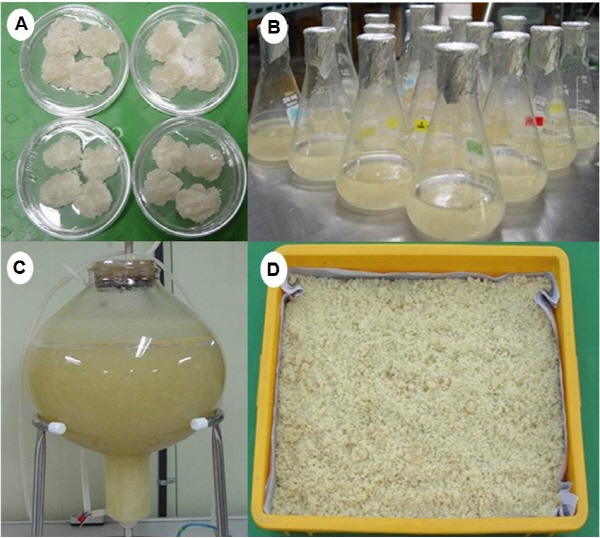
Callus cultures were raised from root segments of E. longifolia on Murashige and Skoog (MS, 1962) medium gelled with 0.8% (w/v) agar and supplemented with 1.0 mg・L-1 2, 4-dichloroacetic acid (2, 4-D) and 3% (w/v) sucrose. Cultures were incubated in the growth chambers at 25 ± 1oC, with a 16 h light (40 µmol・m-2・s-1) and 8 h dark photoperiod cycle provided by 40-W white fluorescent tubes. The calli masses were subcultured once in four weeks to fresh medium to make the callus friable (Fig. 1A). Cell suspension cultures were initiated by taking 5 g cells as inoculum in 100 mL MS liquid medium with 30 g・L-1 sucrose in 400 mL Erlenmeyer flasks (Fig. 1B). The cultures were kept for continuous agitation at 110 rpm on the orbital shaker and incubated at 25 ± 1oC, with a 16 h (40 µmol・m-2・s-1) light and 8 h dark photoperiod cycle provided by 40-W white fluorescent tubes.
In the first set of experiments, the effect of indole-3-butyric acid (IBA) and naphthalene acetic acid (NAA) in the range of 0.5, 1.0, 3.0, 5.0 and 7.0 mg・L-1 were tested on biomass accumulation. In another set of experiments, the effects of MS salt strength ranging 0.5, 1.0, 1.5 and 2.0 concentrations were tested on biomass growth. In the third set, the effect of sucrose concentrations [0, 1, 3, 5 and 7% (w/v)] was assessed on the production of biomass. The effect of nitrogen concentration [NH4+:NO3; 0:30, 5:25, 10:20, 15:15, 20:10, 25:5 and 30:0 mM] was tested for the production of biomass in the fourth set of experiments. The concentration of ammonium (NH4+) nitrogen and nitrate nitrogen (NO3-) were maintained by using NH4Cl (20 M) and KNO3 (40 M) solutions. Cell suspension cultures were initiated by taking 5 g of inoculum in 100 mL MS liquid medium supplemented in 400 mL Erlenmeyer flasks. The pH of the medium was adjusted to 5.6 ± 0.2 before sterilization using 0.1 N sodium hydroxide (NaOH) and 0.1 N hydrochloric acid (HCl). The cultures were kept for continuous agitation at 110 rpm on the orbital shaker and incubated at 25 ± 1oC, with a 16 h light (40 µmol・m-2・s-1) and 8 h dark photoperiod cycle provided by 40-W white fluorescent light for 30 days.
Establishment of cell suspension cultures in balloon type bubble bioreactors
After optimization of growth regulator, salt strength (MS medium), sucrose and nitrogen concentration of medium, suspension cultures were established in the 5 L balloon type bubble bioreactors containing 3 L of full strength modified MS medium supplemented with 3.0 mg・L-1 NAA, 3% (w/v) sucrose, 60 mM KNO3 for accumulation of biomass and bioactive compounds. As inoculum, 50 g・L-1 cells (fresh biomass) was used, the aeration rate in bioreactors was automatically adjusted to 0.1 vvm (air volume per culture volume) using air flow meters (RMA series; Dwyer Instruments Inc., Michigan, USA) and cultures were maintained for 30 days. The effect of inoculum density viz. 40, 50, 60, 70 and 80 g・L-1 was verified in one set of experiments. In another set of experiments, bioreactor cultures were established as described above, but here the cultures were aerated at a rate of 0.05, 0.1, 0.2, and 0.3 vvm constant air supply throughout the culture period, or with an increased rate of air supply from 0.05 to 0.3 vvm every 7-days to verify the most appropriate aeration rate for the accumulation of biomass and phenolics. All the bioreactors were maintained for 30 days at 25 ± 1oC, with a 16 h (40 µmol・m-2・s-1) light and 8 h dark photoperiod cycle provided by 40-W white fluorescent tubes. After 30 days, growth parameters such as fresh weight, dry weight and growth ratio and the content of bioactive compounds polyphenolics and flavonoids were assessed.
Determination of cell biomass
After 30 days of culture, the cells were separated from the medium through a stainless steel sieve. The fresh biomass measured after blotting away the surface water. The dry weight was recorded after drying the cells at 60oC for 24 h. The growth ratio was calculated as follows: [harvested dry weight (g) – inoculated dry weight (g)/inoculated dry weight].
Determination of total phenolic content
The total phenolic content in the methanolic cell extract was determined as described by Slinkard and Singleton (1977). Methanolic extract (0.05 mL) was added with 2.25 mL distilled water and 0.1 mL (2N) Folin-Ciocalteu reagent and solution was allowed to stand for 6 min at room tem-perature. The absorbance was measured at 760 nm with a UV visible spectrophotometer (UV-1650PC; Shimadzu, Kyoto, Japan). The amount of phenolic content was calculated with reference to standard curve of gallic acid solution (Sigma Chemical Co., St. Louis, MO, USA).
Determination of total flavonoid content
The total flavonoid content in the methanolic cell extract was determined by following the method of Zhuang et al. (1992). The methanolic extract (0.25 mL) or a (+)-catechin standard solution (Sigma Chemical Co., St. Louis, MO, USA; 0.25 mL) was added with 1.25 mL distilled water and 0.075 mL 5% (w/v) aluminum chloride solution, and the mixture was allowed to stand for 5 min and then 0.5 mL of 1 M sodium hydroxide solution was added. The absorbance was measured at 510 nm with a UV-visible spectrophotometer (UV-1650PC; Shimadzu, Kyoto, Japan). The absorbance measurements were integrated by comparison with an external standard calibration curve.
Establishment of extraction method
Heat reflex method was followed and extraction was carried out in 100 mL round bottom flask fitted with a cooling condenser (Buchi extraction unit E-812, Flawil, Switzerland). 0.5 g powdered material was placed in a round bottom flask and extraction was carried out at 80 ± 1oC for 1 h using 50 mL of distilled water, 40, 60, 80 and 100% of methanol and ethanol to find out the suitability of solvent for extraction of total phenolics and flavonoids. In all the above experiments, when the extraction was complete, the extract after cooling was filtered using two layers of Whatmann no. 1 filter paper. The residue obtained was re-extracted one more time using fresh solvent under the conditions mentioned above. The condenser was washed with 20 mL of solvent. The washings were added to the extract, and then the flask was filled up to volume. The combined extract (100 mL) was used for total phenols and flavonoids.
Scavenging effect of 1,1-diphenyl-2-picrylhydrazyl (DPPH)
Free radical scavenging capacity was evaluated according to the previously reported procedure using 1, 1-diphenyl-2- picrylhydrazyl (DPPH) (Brand-William et al., 1995). The initial concentration of DPPH radicals was 100 µM for all antioxidant-radical reactions. The antioxidant-radical reactions were conducted for 5 min in the dark at an ambient tem-perature. The decrease in absorbance at 517 nm was measured against a blank of pure ethanol to estimate the radical scavenging capacity of each antioxidant sample.
Statistical analysis
All experiments were set up in a completely randomized design and the data were collected from three replicates. Mean values were subjected to Duncan’s multiple range test using SPSS software (version 9.0).
Results
Optimization of medium parameters in flask-scale cell suspension cultures
To understand the growth characteristics of suspended cells of E. longifolia in shake flasks, the effect of NAA and IBA was tested and the results revealed that supplementation of NAA was superior in terms of biomass accumulation and the medium supplemented with 3.0 mg・L-1 NAA yielded optimum results (Table 1). In this medium, 131.8 g・L-1 fresh biomass and 7.6 g・L-1 of dry biomass was recorded and growth ratio (2.68) was also optimum with this treatment.
Depending on MS salt strength, it was observed that full strength MS medium was found suitable for both fresh (124.6 g・L-1) and dry (6.0 g・L-1) biomass accumulation and growth rate was also optimum (1.91) with this treatment. Lower (0.5) and higher salt strength (1.5 and 2.0) did not favor the biomass accumulation (Table 2).
Several concentrations of sucrose were supplemented in MS medium and it was observed that 3% sucrose was suitable for biomass accumulation (Table 3). Optimum of 130.0 g・L-1 fresh biomass and 6.9 g・L-1 dry biomass was accumulated and growth ratio of cells was also optimum (2.34). MS medium was supplemented with varied concent-ration of NH4+:NO3- 0:30, 5:25, 10:20, 15:15, 20:10, 25:5 and 30:0 mM were tested and results are presented in Table 4. It is evident that increase in the concentration of ammonium nitrogen decreases the biomass accumulation, whereas increase in nitrate nitrogen was responsible for the increase in biomass growth. The maximum biomass accumulation was with 0:60 mM NH4:NO3 and 115.4 g・L-1 fresh biomass and 6.5 g・L-1 dry biomass was recorded.
Optimization of bioprocess parameters in balloon type bubble bioreactors
After optimization of medium parameters for biomass accumulation in flask-scale cultures, cell suspension cultures were established using 5 L capacity airlift bioreactors containing 3 L of modified MS medium supplemented with 3.0 mg・L-1 NAA and 3% (w/v) sucrose (Fig. 1C). Plant cell suspensions are initiated using relatively high cell concentrations, as there is a minimum inoculation density below which growth does not occur or is preceded by a lag phase. The effect of different inoculum density were tested, and the results are presented in Table 5. The maximum cell fresh (356.60 g・L-1; Fig. 1D) and dry biomass (7.53 g・L-1) were measured at an inoculum density of 50 g・L-1. The higher concentration of phenolics (7.72 mg・g-1 DW) and flavonoids (1.74 mg・g-1 DW) were also obtained at an inoculum density of 50 g・L-1 (Table 5).
The cultures were aerated with various rate of constant air supply throughout the culture period, or with an increased rate of air supply every 7-days to verify the most appropriate aeration rate for the accumulation of biomass and phenolics (Table 6). Root fresh and dry biomass decreased with the increasing aeration rate throughout culture period (Table 6). The maximum cell growth was measured with increment of air supply at every 7 days i.e., the aeration rate was controlled at 0.05 vvm and increased to 0.1, 0.2, and 0.3 vvm after 7, 14, and 21 days, respectively. Accumulation of phenolics and flavonoids in the cultured cells were also maximum with increment in air supply and an optimum of 10.33 mg・g-1 DW of phenolics and 3.89 mg・g-1 DW of flavonoids were recorded (Table 6).
Optimization of extraction of bioactive compounds from cell biomass
Among various concentrations of methanol and ethanol as solvent for extraction of bioactive compounds, optimal phenolics (11.8 mg・g-1 DW) and flavonoids (3.2 mg・g-1 DW) were obtained when 60% ethanol was used as extraction solvent (Fig. 2A). Free radical scavenging activity on DPPH was also high in this treatment (Fig. 2B). Other solvents, 40, 60, 80 and 100% methanol and 40, 80 and 100% ethanol were not efficient for the extraction of bioactive compounds from cell biomass of E. longifolia as the yield of bioactive compounds was lower when they are used as solvents for extraction.
Discussion
Optimization of medium parameters in flask-scale cell suspension cultures
It was reported that type and concentration of auxin alters dramatically the growth of cells and accumulation of biomass in cell suspensions (Murthy et al., 2014; Ramachandra Rao and Ravishankar, 2002). The E. longifolia cells suspension cultures were supplemented with NAA and IBA (0.5, 1.0, 3.0, 5.0 and 7.0 mg・L-1) and the results showed that IBA supplemented medium was superior biomass accumulation (Table 1). Medium supplemented with 3.0 mg・L-1 NAA yielded optimum biomass (131.8 g・L-1 fresh biomass and 7.6 g・L-1 of dry biomass) cultured cells and it was also responsible for highest growth rate (2.68). In contrast to the current results, supplementation of IBA was found superior for proliferation of adventitious roots in ginseng when compared to NAA and on the medium supplemented with IBA roots were involved in profuse branching and multiplication of additional roots which accounted for over-all biomass accumulation (Jeong et al., 2009). Impact of growth regulators on induction of cell or organ proliferation and biomass accumulation is species specific event and therefore, type and concentration of growth regulator supplementation should be assessed individually.
The optimum nutrient concentration is a critical determinant in controlling growth of the cells/organ and biomass accumulation (Paek et al., 2009) and it should be assessed and fixed in the initial stages of cultures. Half strength MS medium was reported to be suitable for biomass accumulation in adventitious root cultures of Echinacea angustifolia (Wu et al., 2006), whereas, full strength MS medium was suitable for biomass accumulation in Withania somnifera cell cultures (Praveen and Murthy, 2010). In the present experiments, it was observed that full strength MS medium was found suitable for biomass accumulation (Table 2).
Plant cell cultures are usually grown heterotrophically using simple sugars and carbon sources and the levels of sucrose has been shown to affect the biomass accumulation during suspension cultures (Ramachandra Rao and Ravishankar, 2002). The results of present work showed that 3% sucrose (w/v) was found suitable for biomass accumulation in cell suspension cultures of E. longifolia (Table 3). Similar to the current results, 3% sucrose was found suitable for biomass accumulation in cell suspension cultures of Gymnema sylvestre (Nagella et al., 2011), whereas, 2% sucrose was found suitable for biomass accumulation in shoot cultures of Bacopa monnieri (Naik et al., 2010). These results suggest that initial sucrose concentration in the culture media is important for the growth of suspended cells and its effect is specific for a particular plant species. Macro-elements especially nitrogen play an important role in biomass accumulation in cultured cells and organs (Paek et al., 2009). It was reported that NH4:NO3 ratio affected the biomass accumulation in shoot cultures of Bacopa monnieri (Naik et al., 2011), adventitious root cultures of Withania somnifera (Murthy and Praveen, 2012) and cell suspension cultures of Gymnema sylvestre (Praveen et al., 2011). The results of current studies showed that 0:60 mM NH4:NO3 was responsible for highest biomass accumulation (115.4 g・L-1 fresh biomass and 6.5 g・L-1 dry biomass) among the varied concentration of NH4:NO3 tested (Table 4).
Optimization of bioprocess parameters in balloon type bubble bioreactors
Inoculum density is an important factor affecting the growth and the production of bioactive compounds in a number of culture systems. For instance, high inoculum density stimulated root growth but inhibited biosynthesis of phenolics and flavonoids in Echinacea purpurea (Wu et al., 2006) and eleutherosides in Eleutherococcus koreanum (Lee et al., 2011). In addition, the anthocyanin composition can be changed by cell inoculum size in strawberry suspension culture (Sakurai et al., 1996). In Dendrobium candidum protocorom suspension cultures, protocrom growth and biosynthesis of phenolics, flavonoids, and polysaccharides were affected by inoculum size (Cui et al., 2014). In the present study, Inoculum density of 50 g・L-1 was found suitable for both biomass accumulation and metabolites production (Table 5). Lower (40 g・L-1) and higher (60-80 g・L-1) inocula have reduced both biomass and metabolite accumulation.
Aeration rate in the bioreactors is an important factor which controls the accumulation of biomass and the production of metabolites, because it is meant for biomass circulation and also it provides essential gaseous composition of the medium (Thanh et al., 2006 a,b; Jeong et al., 2009). The accumulation of cell biomass and secondary metabolites varies with the plant species and the type of explant used. For instance, in Echinacea purpurea, a constant aeration rate of 0.1 vvm was optimal for adventitious root growth compared at high aeration rate (Jeong et al., 2009). In contrast, in suspension cultures of Morinda citrifola, constant aeration of 0.3 vvm resulted in the most cell growth (Ahmed et al., 2008). In bioreactor culture, a gradual increase in aeration rate is often favorable for optimal cell growth because of the high inflow of air agitating the cell, thereby elevating the oxygen concentration in the culture, resulting in accelerated cell growth (Cui et al., 2014; Lee et al., 2011). The increment in aeration rate from 0.05 vvm to 0.1, 0.2, and 0.3 vvm after 7, 14, and 21 days was good enough for increasing the production of both cell biomass and bioactive compounds in the present study (Table 6).
Optimization of extraction of bioactive compounds from cell biomass
The extraction of bioactive compounds from the medicinal plant raw material is very important to obtain better yield for qualitative and quantitative studies (Azmir et al., 2013). The most common factors affecting the extraction process are matrix properties of plant part, solvent and temperature (Hernandez et al., 2009). In the current studies, among the various solvents (distilled water, ethanol and methanol) tested, 60% ethanol was found suitable for extraction of phenolics and flavonoids from cell biomass of E. longifolia (Fig. 2A) and the free radical scavenging activity on DPPH was also high with this treatment (Fig. 2B). Various solvents are used for extraction of bioactive solvents from medicinal plant raw material and a solvent which is economical, environmentally friendly and effective in mass transfer is selected as suitable solvent for extraction (Azmir et al., 2013). For instance, Kim et al. (2007) reported that 70% ethanol found superior for ginsenosides extraction from Panax ginseng adventitious roots, whereas, 60% ethanol was found superior for the extraction of caffeic acid derivatives from adventitious roots of Echinacea purpurea (Wu et al., 2008). However, treatment with 80% methanol was found suitable for extraction of phenolics and flavonoids from protocorm biomass of Dendrobium candidum (Cui et al., 2014).
Bioreactor culture system provides better advantages than traditional tissue culture system for large scale production of biomass, and bioreactor-based systems have been developed for the production ginsenosides (Paek et al., 2009) and phenolics (Wu et al., 2007). In the present study, various medium parameters such as suitability of medium, salt strength, type and concentration of auxin, sucrose and nitrogen concentration which affect biomass accumulation were established at flask-scale. Subsequently, bioreactor cultures were established and inoculum density and aeration rate were standardized for biomass and accumulation of phenolics and flavonoids. Suitable extraction method which was also achieved to be a heat reflux method. The procedure developed here is simple and it can be used for the pro-duction of bioactive phenolics from cell suspension cultures of E. longifolia.
