

Introduction
Materials and Methods
Experimental Site and Covering Materials
Environmental Conditions in Experimental Greenhouses
Plant Materials and Growth Conditions
Gas Exchange Parameters
Fruit Color Analysis
Experimental Design and Statistical Analysis
Results
Discussion
Introduction
It is important to select an appropriate covering material for greenhouse applications as this directly affects microclimatic factors, and consequently crop growth and yield. Modern greenhouse covering materials must be sufficiently strong to withstand different climatic conditions, allow good transmittance of solar photosynthetically active radiation (PAR),maintain this performance over a long time period ( > 10 years), and must have good heat insulation properties.
A diverse range of covering materials with various properties is presently available for greenhouse applications. Glass has been widely used as a greenhouse covering due to its good mechanical and optical characteristics. It displays good transmittance of solar radiation and retains this ability over long periods, with a lifespan of more than 20 years if properly utilized. This combination of properties makes glass a near-optimal choice as a greenhouse covering. However, glass has several disadvantages:due to its high rigidity, it can only be applied to specific types of greenhouses (e.g. even - span greenhouses) utilizing a specific type of frame. Glass panes are very heavy compared to polymer materials and require a massive support frame (Giacomelli and Roberts, 1993) which can significantly increase capital costs. Moreover, the use of these massive frames in combination with plant - support and screening equipment can negatively affect light transmission and distribution within the cultivation area, which may reduce crop productivity in low natural light conditions.
Rigid or semi-rigid polymers such as acrylic, fiber-reinforced plastic (fiberglass), polyvinylchloride (PVC), and polycarbonate are also widely used as greenhouse covering materials. In particular, double-wall polycarbonate is currently one of the most common rigid polymer material, and has become popular for covering sidewalls and the ends of large greenhouses with double-poly roofs. (Giacomelli and Roberts, 1993). However, the usefulness of such materials for roofing is restricted by their lower transmittance (10% less) compared to glass or other single-wall polymer coverings.
Polycarbonates are a group of thermoplastic polymers that are mostly manufactured from bisphenol A (BPA). Because of their unique molecular structure, BPA - based polycarbonates have high light transmittance and impact strength, and good thermal resistance (Serini, 2001). Previously, the application of polycarbonate sheets as a greenhouse covering was restricted by its comparatively premature weathering under exposure to various atmospheric conditions; they displayed yellowing and discoloration when exposed to solar ultra violet (UV) radiation in combination with high temperatures (Laski and Chipalkatti, 1995). In recent years, polycarbonate properties have improved significantly through the use of UV - stabilizers and condensation - preventing coatings. Polycarbonate - based covering materials are usually manufactured in multi-wall or corrugated single - wall configurations for energy savings or improved light transmission, respectively (Papadakis et al., 2000). A literature review showed that there is little information available on the optical and spectral characteristics of polycarbonate-based greenhouse covering materials (especially single-wall, flat - surface sheets) and their effect on the light environment and plant growth. Consequently, the objectives of the present experiment were to analyze and compare the spectral and optical characteristics of solid polycarbonate sheets to conventional greenhouse glass and to study the growth responses of tomato and cucumber plants under greenhouses covered by the two materials.
Materials and Methods
Experimental Site and Covering Materials
The study was conducted in two stand - alone, even - span, north - south oriented experimental greenhouses located at the Protected Horticulture Research Institute, near Busan (35 °N, 128 °E), Korea, during the spring - summer growing season. The dimensions of each greenhouse were as follows: eave height 3.5 m, ridge height 5.0 m, width 6.0 m, and length 9.0 m. One of the greenhouses was covered with glass (4 mm thick) and the frame of the other greenhouse was retrofitted with a newly developed polycarbonate sheet (3 mm thick) (Tae Kwang New Tec. Co., Ltd., Seoul, Korea). This sheet is solid, single - layer, colorless (clear), and flat. Air temperature in the greenhouses was controlled by ventilation through automatic roof and side windows with opening and closing set points of 23°C and 18°C, respectively.
Environmental Conditions in Experimental Greenhouses
Both air temperature and soil temperatures were recorded using Hobo Pro v2 dataloggers with embedded temperaturesensors (Onset Computer Corp., Bourne, ME, USA) which were placed at a height of 1.5 m in each greenhouse. Solar radiation spectral distributions in the two greenhouses were scanned and analyzed at solar noon (12 : 00 - 13 : 00)with an LI - 1800 spectroradiometer (Licor, Lincoln, NE, USA) equipped with a standard cosine diffuser in the wavelength range 300 - 1100 nm. The spectral and optical characteristics of the glass and polycarbonate sheets were analyzed with this spectroradiometer coupled with an external integrating sphere, according to the manufacturer’s instructions (Licor, 1989).
Plant Materials and Growth Conditions
Young tomato (Solanum lycopersicum L. cv. Superdoterang) and cucumber (Cucumis sativus L. cv. Joeunbaegdadagi) plants were transplanted into a silt - loam soil with green plastic mulch. Prior to covering the beds with mulch film, an automatic drip irrigation system was installed. Plants were periodically irrigated with commercial nutrient solution (Daeyu Co., Ltd., Seoul, Korea) according to standard growing recommendations (RDA, 2014). Plants were trained to a single stem and tied to the strings, supported by overhead wires. The growth point of tomato plants was pinched after the appearance of the fifth cluster. Cucumber plants were periodically lowered to stimulate their growth. At the end of the cultivation period, four plants from each greenhouse were subjected to destructive sampling to determine plant growth characteristics, including plant height, stem diameter, number and area of leaves, and total fresh and dry weights. Tomato and cucumber plants were harvested twice weekly and yields were recorded.
Gas Exchange Parameters
Measurements were taken on a clear day, between 11 : 00 and 13 : 00. An LI - 6400 portable photosynthesis system (Licor, Lincoln, NE, USA) with a standard clear top leaf chamber was utilized to measure instantaneous leaf gas exchange parameters. Measurements were taken on fully expanded, mature, sunlit leaves with four replicates. Environmental conditions inside the leaf cuvette during measurements were: flow rate 400 μmol·s-1, CO2 concentration 400 μmol·mol-1, humidity 70 ± 2% and temperature was kept at 25 ± 2°C. Light intensity inside the leaf cuvette during measurements was 1000 ± 50 μmol·s-1·m-2.
Fruit Color Analysis
To analyze the effect of greenhouse covering materials on the fruit surface-color characteristics, a CR - 400 chroma meter (Konica Minolta, Osaka, Japan) was utilized. Color measurements were performed on three points of the fruit skin at the equatorial region using CIE L* a* b* color space, where L* represents lightness (range 0 / dark to 100 / light), a* is the degree of redness (where negative values represent more green and positive values indicate more red) and b* is the degree of yellowness (where negative values represent more blue and positive values indicate more yellow). The ratio of a* to b* was used to estimate tomato color index (Jarquin - Enriquez et al., 2013). The chroma parameter, which indicates color saturation, was also calculated via the instrument software.
Experimental Design and Statistical Analysis
Experiments were arranged in a completely randomized design with four replicas. Experimental data were analyzed with Student’s t - test at p ≤ 0.05 to determine significant differences between means, using RStudio statistical software (RStudio,Inc., Boston, MA, USA) with the “agricolae” package (Mendiburu, 2014).
Results
The visual appearance of the glass and polycarbonate sheets was very similar; both materials were clear and transparent. However, laboratory and field spectroradiometric measurements showed significant differences in their optical and spectral characteristics. The spectral distribution of solar radiation in greenhouses covered by glass or polycarbonate is shown in Fig.1. Field spectroradiometric data showed that polycarbonate strongly restricted penetration of photon flux in both the UV-B (300 - 320 nm) and UV - A (320 - 400 nm) ranges, whereas glass was transparent in the UV - A region. It was also observed that interception of photon flux in the near infrared (NIR) range (700 - 1100 nm) was higher in glass than polycarbonate. The laboratory results were consistent with those measured outside. The spectral transmittance curve (Fig. 2) of polycarbonate was relatively flat within the 400 - 1100 nm range, and had a sharp decline in the UV range. Glass showed a flat transmittance line across the 400 - 600 nm range, but inflection started at 620 nm (orange - red region) and continued to 1100 nm (NIR). Table 1 shows the transmittance, reflectance, and absorptance values of glass and polycarbonate for the UV, PAR, and NIR ranges. The two materials showed more prominent differences in their transmittance and absorptance values. Transmittance for both PAR and NIR ranges was higher for the polycarbonate sheet, whereas transmittance for the UV range was highest in glass. The low UV - transmittance observed for the polycarbonate covering was attributed to its strong absorption in that spectral region.
Fig. 1.
Spectral distribution of solar radiation outside or in greenhouses covered with glass or polycarbonate sheets.

Fig. 2.
Transmittance spectra of glass and polycarbonate sheets, analyzed with a spectroradiometer coupled to an external integrated sphere.
The typical daily course of indoor air and soil temperature are shown in Fig. 3A and Fig. 3B, respectively. We found no difference in either air or soil temperatures between glass and polycarbonate greenhouses. This can be attributed to the experimental conditions; during the spring-summer season the roof and side vents were open both day and night due to high air temperatures.
Fig. 3.
Daily course of air (A) and soil (B) temperatures outside and in greenhouses covered with glass or polycarbonate sheets (May 15, 2014).
Gas exchange parameters of tomato and cucumber plants are presented in Table 2. Instantaneous gas exchange measurements showed no significant differences in the net assimilation rate (An), stomatal conductance (gs), or transpirationrate (Tr ) in tomato plants grown in the two different greenhouses. A slightly higher stomatal conductance rate was observed for cucumber plants grown under glass, but An and Tr were not affected.

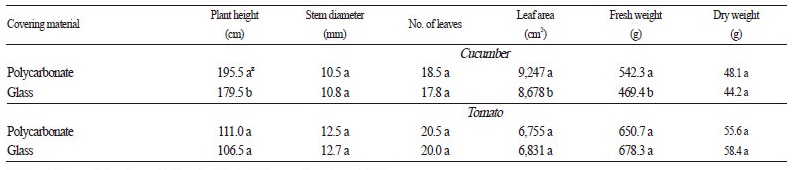
Plant growth parameters such as height, stem diameter, number of leaves, total leaf area, and fresh and dry weights are given in Table 3. Cucumber plants grown under polycarbonate were taller, produced a larger total leaf area, and had more fresh biomass than those grown under glass. In contrast, the growth and development of tomato plants were not significantly affected by covering materials.
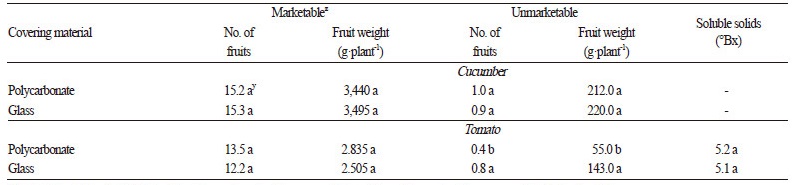
Crop yield was expressed as the number of fruits and fruit weight per plant (Table 4). Marketable and unmarketable fruits were weighed separately. Neither tomato nor cucumber plants showed a significantly different yield between glass or polycarbonate greenhouses, but it should be noted that the unmarketable yield fraction (predominantly composed of cracked fruits) was slightly higher in tomato plants grown under glass. The soluble solids content, indicated by Brix value, was unaffected by the different materials.
The coloration of cucumber fruits was not affected by the covering material (data not shown); however, there were significant differences in some color parameters of tomato fruits (Table 5). Tomato fruits harvested from the glass covered greenhouses showed smaller values for lightness (L*) and yellowness (b*) than those from polycarbonate greenhouses, butthere were no differences in fruit color characteristics such as the degree of redness (a*), tomato color index (a* / b*), and chroma.

Discussion
The light environment in greenhouses can be significantly altered by various covering materials, thereby changing the growth habits of greenhouse plants. In this experiment, we studied the effects of a newly developed single - layer, solid polycarbonate covering material on the light environment, growth, and yield of tomato and cucumber plants. Hollow (double - or multi - layer) polycarbonate panels are typical greenhouse coverings (Giacomelli and Roberts, 1993), and in most cases are used for glazing the sidewalls and endwalls of greenhouses due to their improved insulation properties. However, their use as a roof covering is restricted because the structure of double - or multi - wall polycarbonate panels usually reduces light transmission. Compared with multi - wall rigid panels, one of the main advantages of single - layer, flat - surface polycarbonate sheets is their high transparency for light. Our analysis showed that polycarbonate sheet transmittance in the PAR region was about 2% more than glass transmittance (Table 1, Fig. 2). High transparency to solar radiation is a very important attribute of any greenhouse covering material (Max et al., 2012), especially in the PAR region (400 - 700 nm) because it is an essential component of solar radiation for photosynthesis and normal plant growth. According to a rough “rule of thumb,” decreasing PAR transmittance of a greenhouse cover by 1% results in respective yield reduction of 1% (Papadakis et al., 2000). From this perspective, single - layer, solid polycarbonate sheets can be considered a good alternative to common roof - glazing materials such as glass. The experimental results revealed that polycarbonate sheets almost completely blocked UV radiation in the 300 - 400 nm range, whereas greenhouse glass was opaque only to UV - B (300 - 320 nm) radiation (Table 1, Figs. 1 and 2). In an extensive review of greenhouse covering systems by Max et al. (2012), it was reported that polycarbonate effectively blocks UV, and, regardless of the structure and thickness of the sheets, the transmittance of UV radiation (280 - 400 nm) is usually less than 3%, which is consistent with our results (Table 1).
The effect of UV radiation (both from natural and artificial sources) on the growth and development of various crops were studied by several research groups (for a review, refer to Lamnatou and Chemisana, 2013). Our findings showed that cucumber plants grown in a polycarbonate greenhouse (UV - A free environment) produced higher stem, more leaf area, and a higher fresh weight compared to those grown under glass, where substantial amounts of solar UV - A radiation were present. These results support the findings of Krizek et al. (1997), who reported that cucumber plants grown in UV - A free chambers showed increased biomass accumulation, stem elongation and leaf area expansion compared to those grown under environments that included UV - A. Similar experimental results were also reported for hydroponic eggplant grown under UV - blocking and UV - transmitting plastic films (Kittas et al., 2006). The effect of UV - A on the growth and development of young cucumber plants was found to be positive rather than negative in UV experiments conducted by Mitani - Sano and Tezuka (2013). The authors reported that, despite suppression of stem (hypocotyl) elongation and leaf area in young plants under UV radiation from black - light fluorescent lamps (with a peak at 352 nm), the plants developedthick stems (stubby hypocotyls) and leaves. Based on those results, the authors concluded that near - UV radiation reaching the Earth’s surface is beneficial for plant growth. The experimental results on the effects of UV - A on the growth and development of various crops remain disputable. More studies are necessary to examine plant growth responses to solar UV radiation, using covering materials with various UV transmittance levels. In this context, polycarbonate based coverings are suitable for UV exclusion experiments, as the material entirely blocks UV transmission. In our experiments, the covering materials induced morphological changes primarily in cucumber plants; however, in both cucumber and tomato plants, the total yield was not affected by covering materials (Table 3), meaning that these crops can be grown successfully under glass and polycarbonate covering.
Tomato coloration is an important quality both for the fresh market and the processing sector (Saltveit, 2005), and is a useful criterion for estimating the maturity of tomato fruits (Salunkhe, 1974). Visually, we found that tomato fruits grown under glass had a slightly darker appearance than those harvested from polycarbonate greenhouses; this was supported by the lower L* and b* values obtained by color measurements (Table 5). In general, lightness (L* value) and yellowness (b*) values decline as tomato fruits ripen (Saltveit, 2005). Lopez Camelo and Gomez (2004) reported that the L* value did not change significantly until the turning stages; however, when red color pigments began to be synthesized, the L* value started to decrease. The higher L* and b* values obtained in our measurements may indicate that fruit ripening was slightly delayed in tomato plants grown under polycarbonate (a UV - free environment) compared to those cultivated under glass that were exposed to UV - A radiation. Contrasting results were obtained by Papaioannou et al. (2012), who reported that color values, including the L* value, measured in tomato fruits were similar in both UV - absorbing and common, low - density polyethylene covered greenhouses. Similar results for fruit coloration were reported for hydroponic eggplant cultivated under plastic films with differing UV transmittance values (Kittas et al. 2006). Such discrepancies in the results on fruit coloration can be explained by the specific sensitivity of various plants, or even various cultivars, to the differing levels of ambient UV radiation. For example, in the red lettuce Lollo Rosso, levels of total phenolics, anthocyanin, luteolin, and quercetin were increased when cultivated under UV - transparent film; however, green lettuce Lollo Biondo showed virtually no phytochemical responses to the varying levels of ambient UV radiation transmitted through the plastic films (Ordidge et al., 2010). Shioshita et al. (2007) observed that the coloration of various red lettuce cultivars was significantly affected (all were mostly green) when plants were cultivated under a non - UV transmitting acrylic polycarbonate cover, whereas those grown under F clean film, with high UV transmittance, showed normal coloration. The authors concluded that UV radiation appears to be the most important factor for the coloration of red lettuce cultivars.
We suggest that polycarbonate sheets can be considered an appropriate alternative to glass and other conventional plastic films for applications requiring high light transmittance in combination with UV protection, light weight, and long - term stability. The results of this experiment show that the growth of tomato and cucumber plants under the newly developed polycarbonate material were comparable or better than those grown under glass. However, care should be taken when growing crops in greenhouses covered by materials that entirely block UV radiation (such as polycarbonates), especially crops for which the fruit or leaf coloration can be affected by the level of solar UV.
