

Introduction
The nutrients added to a root medium facilitate the early growth of seedlings after germination (Argo, 1998; Choi et al., 2015; Nelson, 2003). Because pre-planting fertilizers are only needed to facilitate early growth, they are supplied in small amounts compared with the total amount of mineral nutrients needed for the plant to reach maturity (Jones, 2005). In addition, the concentrations of mineral nutrients in root media could be reduced by the watering method used to raise seedlings, especially under watering conditions with a high leaching potential (Handreck, 1996; Huett, 1997). If the nutrient concentrations in the root media drop below the optimal level during seedling growth, post-planting fertilizers are needed.
Due to the inconvenience and difficulties of post-planting fertilization, many growers prefer root media that contain a high level of pre-planting fertilizers. Generally, the fertility of these root media is sustained for a longer period of time compared to media with lower levels of fertilizers. However, excessively high levels of soluble salts in a root medium could retard the early growth of seedlings as well as cause various nutrient disorders (Jones, 2005; Raviv and Lieth, 2008; Sonneveld and Voogt, 2009; Vu et al., 2015). In Korea, damage to seedlings caused by high levels of pre-planting fertilizers is common.
Among the various formulations of pre-planting fertilizers, most contain nitrogen (N) (Sung et al., 2016). While excessively high N concentrations can damage seedlings, the level at which damage occurs has not been sufficiently investigated. The objective of this study was to investigate the effect of different levels of N added to an inert medium as a pre-planting fertilizer on the growth of tomato plug seedlings.
Materials and Methods
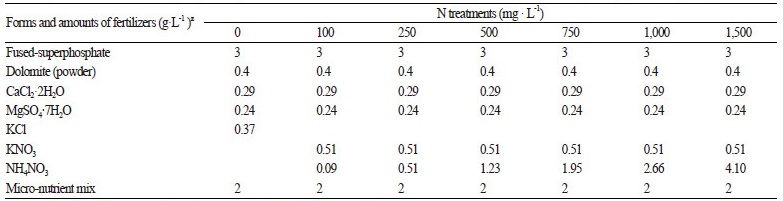
The root medium as well as the levels of N and other essential nutrients added as pre-planting fertilizers were formulated according to Sung et al. (2016). Briefly, the root medium was prepared by mixing perlite, coir dust, and peat moss at volumetric ratios of 30%, 35%, and 35%, respectively. The treatments contained different levels of N: 0, 100, 250, 500, 750, 1,000, or 1,500 mg·L-1 (Table 1). The air-filled porosity, container capacity, and total porosity of the root medium was measured by the method by Park and Choi (2013) and were 19.7%, 62.7%, and 82.4%, respectively. The ratio of easily available water (with a water tension of 4.9 kPa or lower) was about 46% and that of buffering water (with a water tension of 4.9 to 9.8 kPa) was about 36%.
Seeds of ‘Dotaerang Dia’ tomato (Takii Co. Ltd., Kyoto, Japan) were sown in 50-cell plug trays packed with the root medium supplemented with the different pre-planting fertilizer treatments. The plug trays were placed in a germination room under dark conditions at 28-29°C for three days. To prevent overgrowth, the plug trays were moved to a glass greenhouse just before germination. Post-planting fertilization was done at an interval of seven to ten days starting from 20 days after sowing. Two formulations of fertilizers with a N-P2O5-K2O ratio of 13-2-13 and 20-9-20 (SunGro Horticulture, Agawam, MA, USA) were applied alternately. The concentrations and application of the two fertilizers followed the methods by Sung et al. (2016). The leaching percentages were controlled to around 30%.
The growth of the plug seedlings was measured at six weeks after sowing, at which point the shoots were large enough for commercial distribution. Shoots of fifteen individual seedlings were collected randomly from each treatment and measured according to the method by Choi et al. (2015).
The root media surrounding the roots of the seedlings were sampled each week and then air-dried. A paste was prepared by mixing the air-dried root media and distilled water at a ratio of 1:10 (w/w). One or two drops of a soil wetting agent (AquaPro; Shinsung Mineral, Jincheon, Korea) were added to overcome the hydrophobic property of the root media. After two hours at room temperature, the solution was extracted by squeezing the root media. The pH, electrical conductivity (EC), and the concentration of the mineral nutrients in the solution was measured. Six-week-old shoots were harvested for analysis of the nutrient contents in the tissues. The harvested plants were dried at 75°C in a drying oven and then, were ground to pass through a 20-mesh screen.
The preparation, oxidation, and analysis of the mineral nutrient concentration in the plant tissues and root media were performed according to the standard method of the National Institute of Agricultural Sciences and Technology (NAIST, 2000). The concentrations of total N, NH4, and NO3 were analyzed with a N analyzer (Model DE/QUAATRO; BRAN+LUEBBE Gmbh, Norderstedt, Germany), and the concentrations of other essential nutrients were analyzed with an inductively coupled plasma (ICP) instrument (Intergra XL, GBC, Scientific Equipment, Braeside, Australia).
The statistical analysis of the results from the plant growth measurements and the soil analysis were performed with the CoStat program (CoHort Statistical Software Version 6.310; Monterey, California, USA). The means for the seedling growth measurements were compared among the treatments at a significance level of p ≤ 0.05. The trends in seedling growth were investigated by performing a linear and quadratic regression analysis.
Results and Discussion
Figs. 1 and 2 show the changes in the pH and EC of the root media each week from the initial sowing to week six. The initial pH of the root media containing the pre-planting fertilizer was in the range of 5.87 to 6.23 in all treatments. The pH rose slowly in all treatments as the seedlings grew. However, the pH was not significantly different among the treatments at any time during the six-week experimental period. In contrast, the EC notably increased in the root media solution after the pre-planting fertilizer was added with the increasing level of N. The EC slowly decreased, with significant differences among the treatments, until week three; thereafter, this decrease accelerated in all treatments. No differences in the EC was found among the treatments on weeks five and six.
The optimal pH of soilless media for tomato growth is in the range of 5.6 to 6.2 (Argo, 1998; Jones, 2005; Nelson, 2003). Because the pH at week four and later was slightly higher than the optimal range, the amount of limestone added as pre-planting fertilizers during the preparation of the root media would need to be decreased. Soilless media have a lower cation exchange capacity than that of mineral soils (Argo, 1988; Nelson, 2003), and the amount of cations adsorbed at the cation exchange site of the root media is limited. If a large amount of alkaline fertilizer, such as potassium (K), calcium (Ca), and magnesium (Mg), is added as pre-planting fertilizers, it is easily leached through the drainage holes during irrigation or fertigation (Nelson et al., 1996). In the present study, the number of irrigation events was low until week three as the early-stage seedlings do not require much water. Therefore, only a small amount of mineral nutrients might have been leached during this time, thus the EC of the root media was maintained at a high level. However, from week three to week six, the EC of the root media drastically decreased regardless of the treatment. This is likely due to the increased absorption of mineral nutrients by the seedlings as they grew, and the increased leaching due to an increase in the frequency of irrigation. This result is similar to the results reported by Handreck (1996) and Huett (1977).
Fig.1.
Changes in pH of the root media solution (medium 1:water 10, w/w) during the growth of the ̒Dotaerang Dia ̓ tomato seedlings as influenced by the different amounts of N (mg·L-1) added as pre-planting fertilizer in the peat moss:coir dust:perlite (3.5:3.5:3.0, v/v/v) medium.
Fig. 2.
Changes in EC of the root media solution (medium 1:water 10, w/w) during the growth of the ̒Dotaerang Dia ̓ tomato seedlings as influenced by the different amounts of N (mg·L-1) added as pre-planting fertilizer in the peat moss:coir dust:perlite (3.5:3.5:3.0, v/v/v) medium.
Fig. 3 shows the concentrations of the two forms of N in the root medium samples collected each week. The initial NH4-N and NO3-N concentrations in the control treatment (0 mg·L-1) were the lowest among all the treatments at 20.0 mg·kg-1 and 26.9 mg·kg-1, respectively. The NH4-N and NO3-N concentrations were the highest in the 1,500 mg·L-1 treatment at 384.6 mg·kg-1 and 583.2 mg·kg-1, respectively. The differences in the concentrations of the two forms of N were significant among the various N treatments and this is why the incorporation rates of N as pre-planting fertilizers were different. As the seedlings grew, the trend for the NH4-N and NO3-N concentrations in the root media was similar to that of the EC. The drastic decrease in the concentration of NO3- at three weeks after sowing likely occurred because the negatively charged ions could not be adsorbed on the cation exchange sites of the root media. These results indicate that post-planting fertilization with N would be required if the EC of the root media falls below 2.5 dS·m-1 (1:10 w/w method).
Fig. 3.
Changes in the concentrations of NH4-N and NO3-N in the root media solution (medium 1:water 10, w/w) during the growth of D̒ otaerang Dia ̓ tomato seedlings as influenced by the different amounts of N (mg·L-1) added as pre-planting fertilizer in the peat moss:coir dust:perlite (3.5:3.5:3.0, v/v/v) medium.
The initial concentration of K, Ca, and Mg in the root medium ranged from 362.0 to 404.5 mg·kg-1, 104.7 to 202.1 mg·kg-1, and 96.9 to 154.1 mg·kg-1, respectively (Fig. 4). The concentrations of Ca and Mg were highest in the 1,500 mg·L-1 N treatment. The concentrations of Ca and Mg increased as the level of N increased. This is probably due to the antagonism among NH4-N, Ca, and Mg at the cation exchange sites of the root media. The NH4-N might preferably occupy the cation exchange sites, thus the concentrations of Ca and Mg were high in the root medium because they failed to be adsorbed. However, the concentrations of all macro-elements continued to decrease in the root media during seedling growth, which may be due to leaching during fertigation and irrigation.
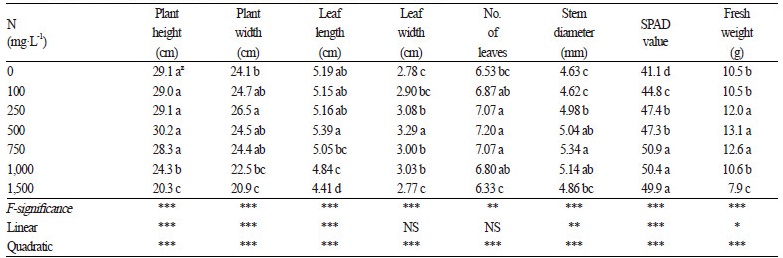
Table 2 and Fig. 5 show how the different concentrations of N influenced the seedling growth at six weeks after sowing. The growth of the seedlings was highest in the 500 mg·L-1 N treatment (Table 2). From the 0 mg·L-1 treatment to the 500 mg·L-1 N treatment, seedling growth increased as the level of N increased. However, seedling growth decreased as the level of N increased above 750 mg·L-1, and seedling growth was lowest in 1,500 mg·L-1 N treatment. The trends were significant in most of the growth indexes as indicated by the quadratic regression with p ≤ 0.001 or p ≤ 0.01. The fresh weight was 67% heavier in the 500 mg·L-1 N treatment compared to the 1,500 mg·L-1 N treatment. Early growth was poor in the treatments with a high-N concentration (data not shown), which might affect the growth at later stages.
Marschner (2012) reported that adjusting the fertilization level to promote growth to over 90% of the maximum growth is appropriate for lowering production costs and preventing damage due to high soluble salts in the root zone. Considering this report, it may be appropriate to adjust the concentration of N in the pre-planting fertilizer to a level lower than 500 mg·L-1. Although not presented in this article, the growth of the seedlings (observed visually) at three weeks was highest in the 250 mg·L-1 N treatment. Therefore, it may be more appropriate to limit the pre-planting fertilizer level to below 250 mg·L-1 to prevent the fertilizer-induced inhibition of early growth, and after three weeks, the post-planting fertilization levels should be elevated when the EC is decreased.
Table 3 shows the contents of the mineral nutrients in the seedling tissues harvested at six weeks after sowing, which were analyzed based on the dry weight of the shoot. The total N content was lowest in the control treatment (0 mg·L-1) at 2.36% and highest in the 1,000 mg·L-1 N treatment at 4.77%. The total N content in the plants linearly increased as the N fertilization levels increased (linear regression: p ≤ 0.01). Considering that the heaviest dry weight was 1.08 g/plant (Fig. 5) and that 90% of maximum growth is acceptable as Marschner (2012) reported, the optimum range of dry weight should be 0.97 to 1.19 g/plant and the optimum range of tissue N content should be 3.21 to 4.60%. The post-planting fertilizer concentrations should also be adjusted to maintain the total N content between 3.21 to 4.60%.
Fig. 4.
Changes in the concentrations of macro-elements in the root media solution (medium 1:water 10, w/w) during the growth of ̒ Dotaerang Dia̓ tomato seedlings as influenced by the different amounts of N (mg·L-1) added as pre-planting fertilizer in the peat moss:coir dust:perlite (3.5:3.5:3.0, v/v/v) medium.
The phosphorus (P) and Ca contents in the plants had no significant trend even though the N fertilization levels were elevated, though the numerical value of the Ca content decreased as the N fertilization levels were increased. However, the K and Mg contents significantly decreased as the N fertilization levels increased (K: linear with p ≤ 0.01; Mg: linear with p ≤ 0.05). This may be due to an antagonism between the NH4+ and the K+, Ca2+, and Mg2+ ions (Roosta et al., 2009).

Fig. 5.
Influence of the different amounts of N added as pre-planting fertilizer in the peat moss:coir dust:perlite (3.5:3.5:3.0, v/v/v) medium on shoot dry weights and tissue N contents of ‛Dotaerang Dia’ tomatoe based on the dry weight of whole above-ground tissue.
Fig. 6.
Seedling growth of D̒ otaerang Dia ̓ tomatoes at six weeks after sowing in 50-cell plug trays as influenced by the different amounts of N added as pre-planting fertilizer in the peat moss:coir dust:perlite (3.5:3.5:3.0, v/v/v) medium (A: 0, B: 100, C: 250, D: 500, E: 750, F: 1,000, and G: 1,500 mg·L-1).
In summary, the growth of the seedlings at six weeks after sowing was excellent in the 500 mg·L-1 N treatment. Because adjusting the fertilization level to promote growth to over 90% of the maximum growth is appropriate for lowering production costs and preventing damage due to excessive salts, the N concentration added as pre-planting fertilizers for the growing of tomato plug seedlings should be adjusted to lower than 500 mg·L-1 N. The N concentration in post-planting fertilizers should also be controlled to maintain the tissue N contents at 3.21 to 4.60%.
