

Introduction
Materials and Methods
Experimental site and soil conditions
Seedling production and nursery management
Field preparation and mechanical transplanting
Assessment of missing plant patterns
Yield measurement and size classification
Statistical Analysis
Results and Discussion
Effect of missing plant patterns on bulb weight
Bulb size distribution under different stand reduction levels
Marketable bulb yield response to stand reduction
Spatial effect of missing plant configuration on yield compensation
Agronomic implications for mechanical transplanting systems
Introduction
Onion (Allium cepa L.) is one of the most widely cultivated vegetable crops worldwide, and its productivity is highly dependent on appropriate plant populations and uniform stand establishment. In conventional onion production systems, transplanting is typically performed manually, requiring substantial labor input and time. However, in many onion-producing regions, increasing labor costs and agricultural worker shortages have accelerated the adoption of mechanized transplanting systems (Rasool et al. 2020; Habineza et al. 2023).
Mechanical transplanting has been recognized as an effective approach to improve labor efficiency and operational capacity levels. Recent studies have reported that mechanized onion transplanting can increase labor productivity by more than 30-fold compared to manual methods, significantly reducing production costs (Hwang and Kim 2025). Despite these advantages, mechanical transplanting systems are often associated with reduced planting accuracy, resulting in missing plants and non-uniform spacing within the field.
The phenomenon of missing plants, commonly referred to as stand reduction, represents a major limitation of mechanized transplanting. It is primarily caused by irregular seedling feeding, mechanical vibration, and limitations of transplanting mechanisms, leading to inconsistent seedling placement (Reza et al. 2021; Stubbs and Colton 2022). Previous studies have reported that stand reduction levels of approximately 10–20% frequently occur under field conditions, even with well-adjusted machinery (Hwang and Kim 2025). Such stand irregularities result in spatial heterogeneity of the plant distribution, which can influence crop growth and yield formation.
In crop production systems, the plant population density is a key factor determining the yield and yield components. Numerous studies have demonstrated that reducing the plant density decreases inter-plant competition while enhancing individual plant growth, leading to increased bulb sizes in onion (Brewster 2008; Shock et al. 2015). However, excessive reductions of plant population typically result in a decrease in the total yield per unit area due to the reduced number of plants (Willey and Heath 1969). These responses reflect the fundamental trade-off between individual plant productivity and population density, as described in classical competition theory (Donald 1963).
While the effects of uniform plant spacing and density levels on onion yields have been extensively studied, most previous research has assumed a homogeneous plant distribution. In contrast, stand reduction caused by mechanical transplanting introduces spatially heterogeneous plant arrangements, where missing plants occur in random or clustered patterns. Such spatial variability may alter competitive interactions among neighboring plants and influence the extent of compensatory growth. Previous ecological studies have shown that plant performance is strongly affected not only by the plant density but also by the spatial arrangement (Weiner 1985). However, limited information is available with regard to how different patterns of missing plants affect onion growth and yields under mechanized transplanting systems.
Furthermore, most existing studies of mechanized transplanting have focused on improving machine performance capabilities, such as the transplanting accuracy, field capacity, and operational efficiency (Rasool et al. 2020). In contrast, the agronomic consequences of stand reduction, particularly in terms of bulb size distributions and the marketable yield, have not been sufficiently quantified. Understanding these effects is essential to establish acceptable thresholds of stand reduction and to optimize transplanting performance in practical production systems.
Therefore, the objectives of this study were to (i) examine the relationship between missing plant patterns and variations in onion bulb weights under mechanical transplanting conditions, (ii) quantify the impact of stand reduction on the bulb size distribution and marketable yield, and (iii) determine the extent to which compensatory growth can offset yield losses under mechanized transplanting conditions. The results of this study will provide a scientific basis for defining acceptable levels of stand reduction and improving the efficiency of mechanical transplanting systems in onion production.
Materials and Methods
Experimental site and soil conditions
Field experiments were conducted in Hamyang County in southeastern Korea (35°51'30"N, 127°73'56"E; 156 m above sea level) during the 2017/2018 growing season. The experimental site had been managed under a continuous rice–onion double-cropping system for several decades.
The soil at the experimental site was characterized by a sandy loam texture in the surface layer, with sandy soil at the subsoil level.
Seedling production and nursery management
Seeds of onion cv. ‘Katamaru’ (Haesung Seed Plus, Japan), pelleted by Shin Nong (Republic of Korea), were sown into 448-cell trays using an automatic seeder (OSE-12HJ, Jukam M&C, Republic of Korea).
Sowing was conducted on September 7. For germination, approximately 30 trays were stacked in a naturally ventilated workspace for four days. After germination, the trays were transferred to a plastic greenhouse. Prior to placing the seedling trays, the nursery ground was covered with transparent plastic film for approximately one month to suppress soil-borne diseases and weeds. Seedlings were irrigated once or twice daily using overhead micro-sprinklers during the nursery period.
Field preparation and mechanical transplanting
Seedlings were transplanted on October 31 using an automatic onion transplanter (JOPR-4/8A, Jukam M&C, Republic of Korea). Raised beds were formed using an integrated ridge-forming and plastic-mulching machine immediately before transplanting. Each bed was 120 cm wide and 20 cm high, with spacing of 170 cm between the bed centers. Each bed consisted of eight rows, with 14 cm spacings both within and between the rows, resulting in a planting density of 33.6 plants per m².
Mechanical transplanting was performed in a round-trip operation, planting four rows per pass on non-perforated plastic mulch.
Assessment of missing plant patterns
To evaluate missing plant patterns, onion plants were sampled from 2.52 m² plots (1.80 m × 1.40 m), each containing 80 transplanting positions (8 rows × 10 columns). A total of nine plots were randomly selected from the field. To minimize edge effects, the first and last columns were excluded from the analysis. After harvest, leaves were removed from each plant, and bulbs were individually labeled and weighed.
Missing plants were identified using photographic records of each plot. Missing plant patterns were classified based on the number of missing plants among four adjacent positions as follows: 0, 1,2, 3,4 missing plants.
Yield measurement and size classification
For yield determination, onion plants were harvested manually from 1.26 m² plots (1.80 m × 0.70 m), each containing 40 transplanting positions. Sixteen plots were randomly selected across the field. Harvesting was done on June 12, when approximately 80% of the tops had fallen. Harvested plants were separated into bulbs and leaves, and all bulbs were weighed individually.
Marketable bulbs were classified into three size categories based on the bulb diameter: small (< 60 mm), medium (≥ 60 mm and < 80 mm), and large (≥ 80 mm). Yield data were converted to Mg·ha-1 based on the plot area. Marketable yield was defined as the total yield of all harvested bulbs regardless of size. Stand reduction (%) was calculated as the proportion of missing or non-established plants relative to the initial 40 transplanting positions per plot. A control treatment was established using three plots in which missing plants were replanted to restore stand density through replanting, although a small number of non-established plants remained.
Statistical Analysis
All data were analyzed by means of an analysis of variance (ANOVA) using XLSTAT Essentials (Annual version 2025.2.0 Addinsoft, NY, USA) to determine the effects of missing plant patterns and stand reduction on the bulb weight, size distribution, and yield components.
For the bulb weight analysis, the number of missing plants in adjacent positions was treated as a fixed factor. For the yield and size distribution analysis, stand reduction levels were considered as the main treatment factor. Mean comparisons among treatments were performed using Fisher’s protected least significant difference (LSD) test at a significance level of p ≤ 0.05. A regression analysis was conducted to evaluate the relationship between stand reduction (%) and the marketable yield (Mg·ha-1). A linear regression model was fitted, and the significance of the regression was tested at p < 0.05.
Results and Discussion
Effect of missing plant patterns on bulb weight
Bulb weight tended to increase with the number of missing plants in adjacent positions; however, differences among treatments were not statistically significant according to Fisher’s protected LSD test at p ≤ 0.05 (Fig. 1 and Table 1). The mean bulb weight increased from 345.8 g in the control [number of missing plants (NMP) 0] to 370.0 g and 383.6 g in NMP 2 and NMP 3, corresponding to relative indices of 107.0 and 110.9, respectively.
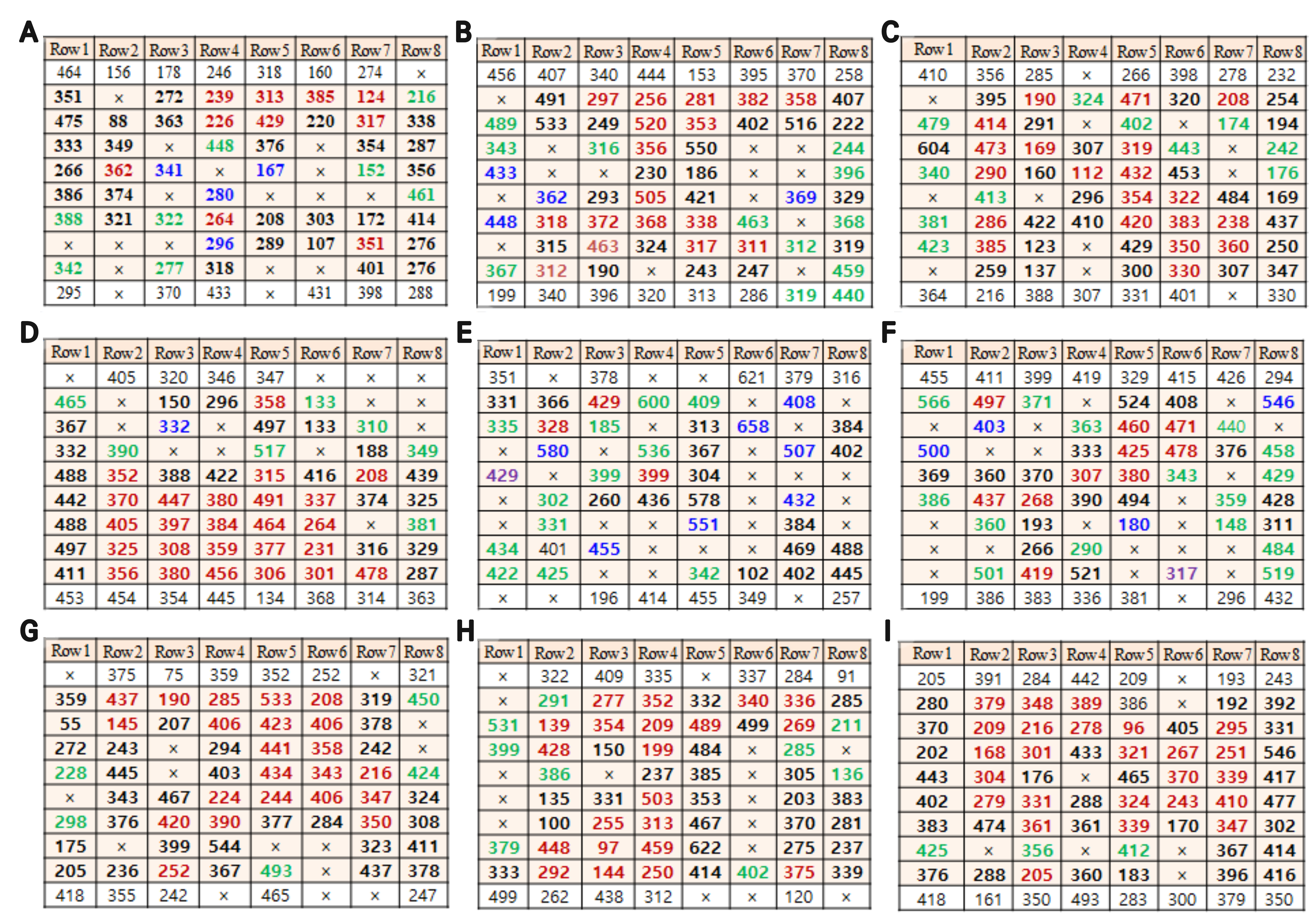
Fig. 1.
Onion bulb weight at harvest as affected by missing plant patterns under mechanical transplanting. Red, no missing plants among four adjacent positions; black, one missing plant; green, two missing plants; blue, three missing plants; purple, four missing plants. Plot I represents the replanted control treatment, in which missing plants were refilled; however, a small number of non-established plants remained.
Table 1.
Onion bulb weight at harvest as affected by the number of missing plants in four adjacent positions under mechanical transplanting
| Investigated plot | NMP 0z | NMP 1 | NMP 2 | NMP 3 | NMP 4 | Stand reduction (%) |
| A | 301.0 | 302.9 | 341.4 | 262.7 | - | 23.4 |
| B | 359.2 | 367.1 | 372.4 | 403.0 | - | 21.9 |
| C | 325.3 | 319.5 | 345.2 | - | - | 15.6 |
| D | 366.0 | 356.8 | 363.6 | 332.0 | - | 15.6 |
| E | 389.3 | 379.1 | 394.0 | 513.0 | 429.0 | 34.4 |
| F | 414.2 | 381.6 | 401.1 | 407.3 | 317.0 | 31.3 |
| G | 339.0 | 327.5 | 378.6 | - | - | 14.1 |
| H | 320.0 | 318.5 | 335.6 | - | - | 17.2 |
| I | 298.3 | 355.5 | 397.7 | - | - | 9.4 |
| Mean | 345.8 ay | 345.7 a | 368.2 a | 383.6 a | 373.0 a | 20.3 |
| Indexx | 100.0 | 100.0 | 106.5 | 110.9 | 107.9 | - |
The absence of statistical significance despite a clear increasing trend suggests that spatial variability and heterogeneous plant interactions under field conditions limited the consistency of the response. This variability is expected in mechanically transplanted systems in which plant spacing is inherently non-uniform. Although bulb weight did not differ significantly among the missing plant pattern treatments, the observed numerical variation was generally consistent with previously reported responses of onion to reduced plant competition. Shock et al. (2015) demonstrated that reduced plant population leads to increased bulb sizes due to decreased inter-plant competition for light, nutrients, and water. Similarly, Brewster (2008) reported that onion exhibits strong phenotypic plasticity in bulb enlargement under low-density conditions.
From a crop ecology perspective, this response reflects classical competition theory, where reduced stand density levels enhance resource availability per plant, resulting in increases in individual plant productivity (Donald 1963). The greater bulb weights observed particularly in treatments with multiple adjacent missing plants suggest localized compensatory growth, which is a well-documented response in partially thinned crop stands.
Bulb size distribution under different stand reduction levels
Stand reduction significantly affected the bulb size distribution, particularly in the medium size category (p ≤ 0.05), while large and small bulb yields were not significantly different among the treatments (p > 0.05) (Table 2). The yield of large bulbs (≥ 80 mm) ranged from 76.3 to 82.5 Mg·ha-1 and remained statistically unchanged across all stand reduction levels. In contrast, the medium-sized bulb yield (60–80 mm) decreased significantly from 13.7 Mg·ha-1 in the replanted control to 1.9 Mg·ha-1 at 35–38% stand reduction, with clear separation among the treatment groups based on LSD (p ≤ 0.05). The small bulb yield (< 60 mm) was negligible and showed no statistical difference.
This shift in the size distribution indicates that stand reduction promoted the transition of bulbs from medium to large size classes rather than increasing size variability. Similar trends have been reported in onion density studies, where reduced plant population were found to increase the proportion of large bulbs while decreasing intermediate sizes (Boyhan et al. 2009; Shock et al. 2015).
Physiologically, this response can be explained by the increased assimilate availability per plant, which enhances cell expansion and storage tissue accumulation in the bulb. Brewster (2008) emphasized that bulb enlargement in onion is highly responsive to assimilate supply during the bulbing stage, making it particularly sensitive to plant density and competition.
Marketable bulb yield response to stand reduction
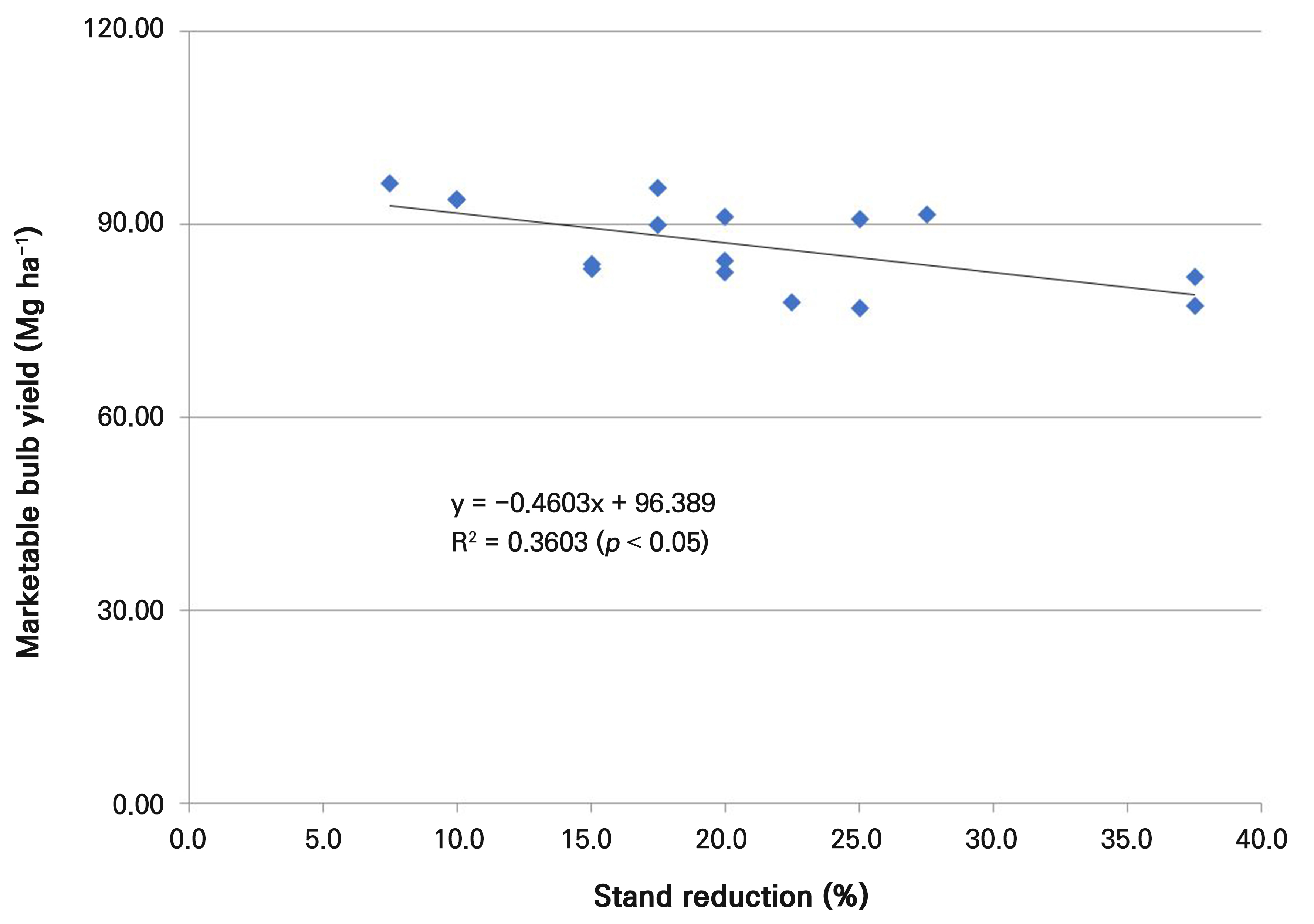
The marketable yield was significantly affected by stand reduction (p ≤ 0.05), showing a decreasing trend as stand reduction increased (Table 2 and Fig. 2). The highest yield (94.6 Mg·ha-1) was recorded in the replanted control, whereas yields under the stand reduction treatments ranged from 88.2 to 79.5 Mg·ha-1.
Table 2.
Comparison of bulb yield characteristics of onion as affected by stand reduction under mechanical transplanting
| Treatments | Marketable yield (Mg·ha-1) | Stand reduction (%) | ||||
| Largez (%)y | Medium (%) | Small (%) | Total | Index | ||
| Replanting | 80.7 ax (85.3) | 13.7 a (14.4) | 0.2 a (0.3) | 94.6 a | 100.0 | 9.2 |
| Stand reduction 15-18% | 76.3 a (86.6) | 11.2 ab (12.7) | 0.7 a (0.7) | 88.2 ab | 93.2 | 16.3 |
| Stand reduction 20-23% | 76.9 a (91.5) | 6.8 bc (8.0) | 0.4 a (0.5) | 84.1 ab | 88.9 | 20.6 |
| Stand reduction 25-28% | 82.5 a (95.3) | 3.8 c (4.4) | 0.2 a (0.3) | 86.5 ab | 91.5 | 25.8 |
| Stand reduction 35-38% | 77.6 a (97.6) | 1.9 c (2.4) | 0.0 a (0.0) | 79.5 b | 84.1 | 37.5 |
At moderate stand reduction levels (15–28%), the marketable bulb yield did not differ significantly from the control (p > 0.05), remaining at 88.9–93.2% of the control yield. However, at higher stand reduction levels (35–38%), the yield was significantly reduced (p ≤ 0.05), reaching 79.5 Mg·ha-1 (84.1% of control). The proportion of large bulbs increased progressively with stand reduction, reaching 97.6% at 35–38% stand reduction, whereas the proportion of medium-sized bulbs decreased markedly.
The linear regression analysis (Fig. 2) revealed a significant negative relationship between stand reduction and the marketable yield (p ≤ 0.05), indicating that yield losses increased proportionally with increasing plant losses. This response reflects the classical trade-off between plant density and individual plant productivity. While a reduced density level enhances the bulb size, it decreases the number of plants per unit area, ultimately reducing the bulb yield beyond a certain threshold. This relationship has been consistently reported in onion production systems (Willey and Heath 1969; Shock et al. 2015).
Importantly, the present study demonstrates that mechanical transplanting errors (i.e., missing plants) produce responses analogous to controlled density reduction, confirming that stand reduction can be interpreted as a functional decrease in effective plant population.
Spatial effect of missing plant configuration on yield compensation
Although the primary factor analyzed was the number of missing plants, the variation in the bulb weight among plots suggests that spatial configuration played a significant role in determining the magnitude of compensatory growth. Plots with similar stand reduction percentages exhibited different bulb weight responses (Table 1), indicating that plant response was not solely determined by plant density but also by the spatial distribution of missing plants. Clustered missing plants likely created localized zones of reduced competition, allowing neighboring plants to access disproportionately greater resources.
This interpretation is supported by spatial competition theory, which states that plant performance is strongly influenced by the spatial arrangement of neighbors (Weiner 1985). In contrast, randomly distributed missing plants may result in more uniform but less pronounced compensatory responses. Therefore, stand reduction in mechanized systems should not be evaluated solely in terms of percentage loss but also in terms of the spatial configuration, as this directly influences resource distribution and plant growth dynamics.
Agronomic implications for mechanical transplanting systems
From a practical standpoint, the results indicate that onion production systems can tolerate moderate stand reduction without significant yield losses. Stand reduction up to approximately 20–28% did not result in statistically significant decreases in marketable yields (p > 0.05), suggesting that compensatory growth can partially offset plant losses. However, stand reduction exceeding this threshold resulted in significant yield reductions (p ≤ 0.05), highlighting the importance of maintaining transplanting accuracy within acceptable limits.
In conclusion, the increased bulb size under moderate stand reduction may have positive economic implications in markets that favor larger bulbs. The present study suggests that efforts to improve mechanical transplanting performance capabilities should prioritize minimizing excessive stand reduction (>30%) while recognizing that limited plant loss may not critically affect productivity due to the ability of onion plants to maintain yield levels under moderate stand reduction conditions.
This study was conducted at a single location and within a single growing season; therefore, caution should be exercised when extrapolating the results to other environments. Further multi-location and multi-year studies are required to validate the robustness of these findings.
